Unit I
INSTRUMENTATION - INTRODUCTION
GENERAL CONCEPTS
 Instrumentation is a branch of engineering science which deals with the techniquesused for
measurement, the measuring devices used and the problems that are associated with the
technique used for measurement.
 “In other words it can be said that instrumentation is a branch that deals with the Technology
of making instruments and basic principles used in construction of instruments”.
Hence, using an instrument, some measurement is being done. Generally, measurement is a word
used to tell us about physical quantities such as length, weight, temperature, pressure, Force, etc.,
this physical quantity which is the object of measurement of an instrument is called as measured or
the measured variable. Standardization organizations.
 NBS -National Bureau of Standardization.
 ISO -International organization for standardization.
 ANSI -American National Standardization Institute.
Measurements:
 For measurement an instrument is necessary. In general, measurement means getting to know
about physical quantity such as length, weight, temperature, pressure force and so on.
 This physical quantity is called as Measurand or measured variable.
 Measurement is the outcome of an opinion formed by observers about some physical
quantity. The observer forms this opinion by comparing the object with a quantity of similar
kind is called standard.
Measurement
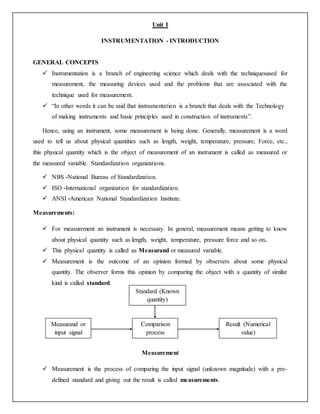
 Measurement is the process of comparing the input signal (unknown magnitude) with a pre-
defined standard and giving out the result is called measurements.
Measurand or
input signal
Comparison
process
Result (Numerical
value)
Standard (Known
quantity)
 The result of measurement is a numerical value representing the ratio of the unknown
quantity to the standard used. This number becomes the value of the measured quantity.
Requirements of Measurement
For the measurements results to be accurate, two conditions should be met.
 Firstly, the standard which is used for comparison must be defined accurately and it should
be universally accepted.
 The second important condition to be met for measurements is that the procedure applied for
the measurements should be provable and there should be provable instruments for
measurements.
MEASUREMENT METHODS:
The methods of measurement are classified under two heads namely:
(a) Direct .comparison method.
(b) Indirect comparison method.
(a) DIRECT COMPARISION METHOD:
 In this method, the measured (unknown quantity) is directly compared with the standard.
 The result of measurement is a number and a unit. The direct comparison method is used for
measuring physical quantities such as time, mass, length etc,.
 Ex: Measuring the length of a wire. The unit of length is meter. The wire is so many times
long because that many units on the standard have the same length of the wire.
When the unknown quantity (measured) is very small, the human being cannot make direct
comparison with accuracy and precision. Moreover, human beings cannot distinguish wide margins
of the measured and hence it becomes a constraint in direct comparison methods.
(b) INDIRECT COMPARISION METHOD:
 In many applications, the indirect comparison method is used which intern means the use of a
measurement system.
 These measurement systems have a transducer element which converts the quantity to be
measured from one form to another form (analogous signal) without changing the
information content.
 The analogous signal is then processed and is sent to the end devices which present the result
of measurement.
 “In short, in indirect comparison method, the input signal is converted to some other form
and then it is compared with the standard”.
Methods of measurement can also be classified as
a. Primary measurement
b. Secondary measurement
c. Tertiary measurement
Primary Measurement
 Only subjective information is provided in this method.
Example:
 One vessel is cooler than the other.
 One rod is longer than the other.
 These measurements are made by direct observation. They do not involve any
translation of information.
Secondary Measurement
 In this method, the output result is obtained by one translation.
Example:
Convertion of Measurand into length which is shown below. Bellows, bourdon’s pressure
gauge.
Pressure length
Primary signal secondary signal
Tertiary Measurement:
In this method, the output result is obtained by two translations.
Example:
Electric tachometer. The input is converted to voltage then this voltage is converted to length.
Speed voltage length
Primary signalsecondary signal Tertiary signal
Measurand or
input
Translation Measured value or
output
Voltmeter
[second
translation]
Output or
measured
value
Tachometer
(translation)
Input or
measurand
APPLICATION OF MEASURING INSTRUMENTS:
Measuring instruments are used in the following three areas namely:
(a) Monitoring of processes and operations
(b) Control of processes and operations
(C) Experimental engineering analysis.
(a) MONITORING OF PROCESSES AND OPERATIONS:
Some of the measuring in performs the function of monitoring. EXAMPLES (1): Thermometers,
pressure gauges, etc.
 These instruments simply indicate the condition of the environment. Their reading does not
serve any control function.
EXAMPLE (1): Water, gas and electric meters:
 These meters indicate the quantity of commodity used. Using this quantity, the cost to the
user can be calculated.
(b) CONTROL OF PROCESSES AND OPERATIONS:
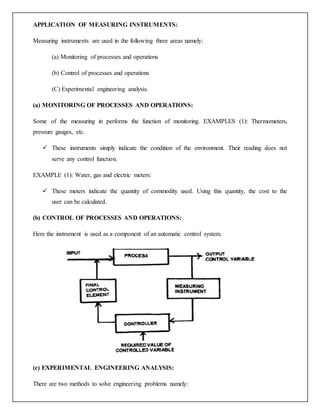
Here the instrument is used as a component of an automatic control system.
(c) EXPERIMENTAL ENGINEERING ANALYSIS:
There are two methods to solve engineering problems namely:
 Theoretical methods
 Experimental methods.
In many cases, application of both the methods is required. Following are characteristics of
experimental methods.
 These methods give results that apply only to specific problems.
 The real true behavior of the system is revealed.
 The features of the measuring instrument must be understood properly.
 A scale model or the actual system itself is required.
GENERALISED MEASUREMENT SYSTEM AND ITS ELEMENTS
MEASUREMENT SYSTEM
INPUT SIGNAL (Measurand) OUTPUT SIGNAL (Measurement)
The main functions of an instrument is
 Get information,
 Process the information and
 Present the information to a human observer.
For the purpose of study, the instrument is considered as a system. A system is an assembly of
components which are interconnected to perform a specific function. Each component is called as an
element: Each element does a particular act during measurement.
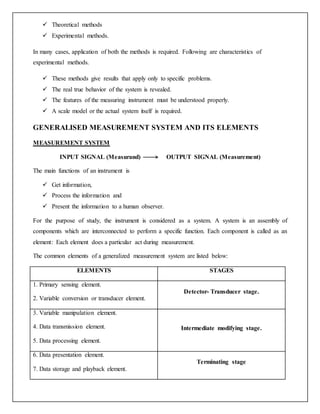
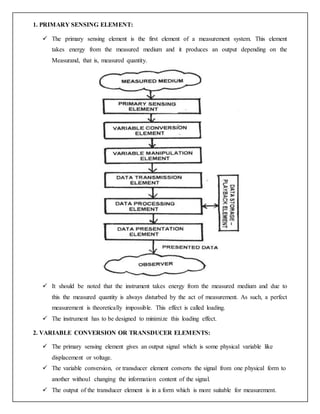
The common elements of a generalized measurement system are listed below:
ELEMENTS STAGES
1. Primary sensing element.
2. Variable conversion or transducer element.
Detector- Transducer stage.
3. Variable manipulation element.
4. Data transmission element.
5. Data processing element.
Intermediate modifying stage.
6. Data presentation element.
7. Data storage and playback element.
Terminating stage
1. PRIMARY SENSING ELEMENT:
 The primary sensing element is the first element of a measurement system. This element
takes energy from the measured medium and it produces an output depending on the
Measurand, that is, measured quantity.
 It should be noted that the instrument takes energy from the measured medium and due to
this the measured quantity is always disturbed by the act of measurement. As such, a perfect
measurement is theoretically impossible. This effect is called loading.
 The instrument has to be designed to minimize this loading effect.
2. VARIABLE CONVERSION OR TRANSDUCER ELEMENTS:
 The primary sensing element gives an output signal which is some physical variable like
displacement or voltage.
 The variable conversion, or transducer element converts the signal from one physical form to
another withou1 changing the information content of the signal.
 The output of the transducer element is in a form which is more suitable for measurement.
3. VARIABLE MANIPULATION ELEMENT:
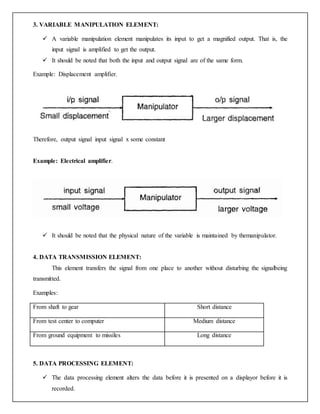
 A variable manipulation element manipulates its input to get a magnified output. That is, the
input signal is amplified to get the output.
 It should be noted that both the input and output signal are of the same form.
Example: Displacement amplifier.
Therefore, output signal input signal x some constant
Example: Electrical amplifier.
 It should be noted that the physical nature of the variable is maintained by themanipulator.
4. DATA TRANSMISSION ELEMENT:
This element transfers the signal from one place to another without disturbing the signalbeing
transmitted.
Examples:
From shaft to gear Short distance
From test center to computer Medium distance
From ground equipment to missiles Long distance
5. DATA PROCESSING ELEMENT:
 The data processing element alters the data before it is presented on a displayor before it is
recorded.
 The main work of this element is to convert the date to an understandable anduseful form.
Example:
 It removes unwanted disturbances such as noises which come with the signal
 It can provide compensation for change in temperature etc.,
6. DATA PRESENTATION ELEMENT:
 The information about the measured quantity is to be presented to a human being for
monitoring, control or analysis purpose.
 Hence the information about the measured quantity has to be put in a form that is
understandable to the human being. An element that performs this translation function is
called as “Data presentation element”.
Examples:
 Pointer moving over a scale.
7. DATA STORAGE AND PLAYBACK ELEMENT:
This element stores the data/information and presents the same when commanded.
Example:
 Pen-ink recording
 Magnetic tape recorder - reproducer
 Computer.
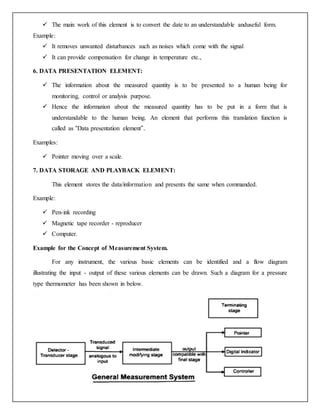
Example for the Concept of Measurement System.
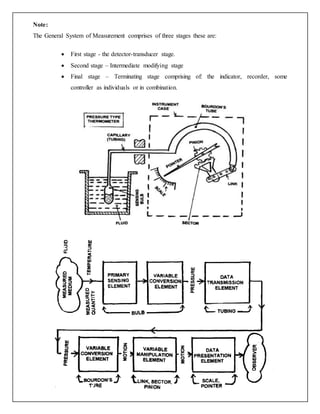
For any instrument, the various basic elements can be identified and a flow diagram
illustrating the input - output of these various elements can be drawn. Such a diagram for a pressure
type thermometer has been shown in below.
Note:
The General System of Measurement comprises of three stages these are:
 First stage - the detector-transducer stage.
 Second stage – Intermediate modifying stage
 Final stage – Terminating stage comprising of: the indicator, recorder, some
controller as individuals or in combination.
First Stage: The Detector-Transducer Stage
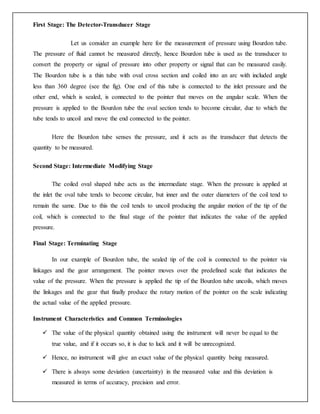
Let us consider an example here for the measurement of pressure using Bourdon tube.
The pressure of fluid cannot be measured directly, hence Bourdon tube is used as the transducer to
convert the property or signal of pressure into other property or signal that can be measured easily.
The Bourdon tube is a thin tube with oval cross section and coiled into an arc with included angle
less than 360 degree (see the fig). One end of this tube is connected to the inlet pressure and the
other end, which is sealed, is connected to the pointer that moves on the angular scale. When the
pressure is applied to the Bourdon tube the oval section tends to become circular, due to which the
tube tends to uncoil and move the end connected to the pointer.
Here the Bourdon tube senses the pressure, and it acts as the transducer that detects the
quantity to be measured.
Second Stage: Intermediate Modifying Stage
The coiled oval shaped tube acts as the intermediate stage. When the pressure is applied at
the inlet the oval tube tends to become circular, but inner and the outer diameters of the coil tend to
remain the same. Due to this the coil tends to uncoil producing the angular motion of the tip of the
coil, which is connected to the final stage of the pointer that indicates the value of the applied
pressure.
Final Stage: Terminating Stage
In our example of Bourdon tube, the sealed tip of the coil is connected to the pointer via
linkages and the gear arrangement. The pointer moves over the predefined scale that indicates the
value of the pressure. When the pressure is applied the tip of the Bourdon tube uncoils, which moves
the linkages and the gear that finally produce the rotary motion of the pointer on the scale indicating
the actual value of the applied pressure.
Instrument Characteristics and Common Terminologies
 The value of the physical quantity obtained using the instrument will never be equal to the
true value, and if it occurs so, it is due to luck and it will be unrecognized.
 Hence, no instrument will give an exact value of the physical quantity being measured.
 There is always some deviation (uncertainty) in the measured value and this deviation is
measured in terms of accuracy, precision and error.
Accuracy:
 When a physical quantity is being measured, a numerical value is obtained. A concern arises
regarding how close this value is to the true value (Theoretically correct value).
 As the physical quantity cannot be defined perfectly, the true value of the physical quantity is
unknown and unknowable. In practice, true value refers to a value obtained by an
“EXAMPLAR-METHOD.”
 This method has been agreed by experts to be sufficiently accurate. The closeness of the
measured value with respect to the true value is called as accuracy.
Example:
 Let us say a micrometer is used to measure a wire whose diameter is 10 mm (Determined by
an exemplar method).
 If the micrometer reads 9.99 mm or 10.01 mm, these values are close to the true value and
hence the micrometer is said to be accurate.
 If the micrometer reads 9.5 mm or 10.3 mm, these values are far from the true value and
hence the micrometer is said to be inaccurate.
The accuracy of the physical quantity being measured depends on the following:
 Accuracy of the instrument being used to measure the physical quantity.
 Variation of the physical quantity being measured.
 The extent to which the true value is impressed on the instrument.
 The accuracy with which the observation is made by the observer.
Precision (Repeatability or reproducibility):
 The terms accuracy and precision are used interchangeably in many situations. But in
instrumentation, accuracy and precision mean different.
 The term precision refers to the ability of an instrument to reproduce its readings again and
again in the same manner for a constant input signal.
 That is, if a number of measurements are made on the same true value, the degree of
closeness of these measurements is called as precision.
 Now let us differentiate between accuracy and precision.
 Accuracy represents to the closeness of the measured value with respect the true
value.
 But precision refers to the ability of the instrument to reproduce its readings again and
again in the same manner for a constant input signal.
Example:
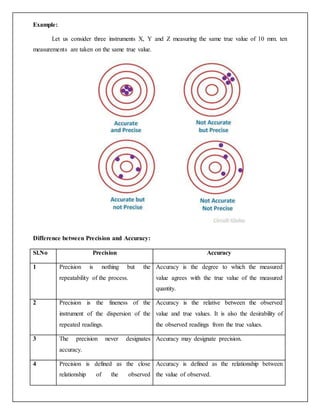
Let us consider three instruments X, Y and Z measuring the same true value of 10 mm. ten
measurements are taken on the same true value.
Difference between Precision and Accuracy:
Sl.No Precision Accuracy
1 Precision is nothing but the
repeatability of the process.
Accuracy is the degree to which the measured
value agrees with the true value of the measured
quantity.
2 Precision is the fineness of the
instrument of the dispersion of the
repeated readings.
Accuracy is the relative between the observed
value and true values. It is also the desirability of
the observed readings from the true values.
3 The precision never designates
accuracy.
Accuracy may designate precision.
4 Precision is defined as the close
relationship of the observed
Accuracy is defined as the relationship between
the value of observed.
readings with the average value.
5 Standard deviation is the index of
precision for the less value of σ,
more precise is the instrument.
The difference between the measured value and
the true value is the error of the measurement.
If the error is less, then the accuracy is more.
ERROR:
 Error is the difference between the measured value (Vm) and the true value (Vt) of a physical
quantity. The accuracy of a measurement system is measured in terms of error.
Static error E = Vm - Vt
 Error may be positive or negative. If the instrument reads higher than the true value, it is
called as positive error and if the instrument reads lower than the true value, it is called as
negative error.
 A study of error helps in reducing them and helps in finding the reliability of the results.
TYPES OF ERRORS:
Important errors have been listed below.
a. Systematic errors or fixed errors
 Errors due to calibration.
 Human errors (observation errors and operational errors).
 Loading error (system interaction error).
 Error of technique.
 Instruments Errors
b. Illegitimate errors
 Chaotic errors.
c. Random errors
 Environmental error
Errors Due To Calibration:
 Any instrument has to be calibrated before it is put to use. Calibration is a process of giving a
known input to the measurement system and taking necessary actions to see that the output of
the measurement system matches with its input.
 If the instrument is not calibrated properly, it will show reading with a higher degree of
error. This is called as calibration error.
 Calibration errors are fixed errors as they have been introduced into the measurement system
because of improper calibration.
Human Errors:
 There are two human errors namely the observation errors and the operational errors.
 There is a saying that “Instruments are better than the people who use them”. Even if a good
instrument is available, errors are introduced due to the user.
 Observation errors are due to improper observation made by the user of the instrument.
Example (1): If the graduations on the scale are very close, the observer may read
incorrectly.
Example (2): Not observing continuously when it is necessary to do so.
Loading Errors (System Interaction Errors):
 The measuring instrument always takes energy from the signal source (measured medium)
and due to this the signal source is always altered by the act of measurement. This effect is
called as loading.
 As the measured quantity loses energy due to the act of measurement, error is introduced.
This is called as loading error.
Example (1): When a thermometer is introduced, it alters the thermal capacity of the
system and heat leakage takes place. Due to this error occurs.
Example (2): Reading of a hand tachometer will vary depending on the pressure with
which it is pressed on the shaft.
Error of technique
Improper use of the exact technique for executing an operation leads to this type of error.
Instruments Errors:
 The accuracy of an instrument is affected due to limitations in its design and construction.
Example (1): The components of an instrument may be assembled incorrectly and due to this
an error may occur. This error does not vary with time and can be corrected.
Example (2): An improper material may be selected for the instrument causing it to wear
quickly or creating friction, thus introducing an error.
b. Illegitimate errors
Chaotic Errors:
 Errors induced by random disturbances such as vibrations, noises, shocks etc., of sufficient
magnitude tend to affect the test information. Such errors are called as chaotic errors.
 Due to such random disturbances, the instrument cannot measure the physical quantity
properly and more over there will be information lose during signal transmission, this is
called as transmission error.
Uncertainty and Random Error
 Uncertainty and random errors are indicated when repeated measurements of the same
quantity result in differing values. The magnitude and direction of these errors are not known
and as such are considered indeterminate.
 They are caused by such effects as friction, spring hysteresis, noise, and other phenomena.
The contributing factors are any random changes in input signal, combined with noise and
drift in the signal conditioner.
 Such errors occur more in dynamic data analysis. The uncertainty is expressed as the average
deviation, probable error, or statistical deviation. The error value is estimated as the amount
by which the observed or calculated value departs from the true value.
Environmental Error:
 Any instrument is manufactured and calibrated at one place and is put in use at some other
place where the environmental conditions such as pressure, temperature, humidity etc., are
different.
 This change in environment influences the readings of the instrument. This change in reading
of the instrument due to environmental changes is called as environmental error.
Example (1): If a mercury - in glass thermometer is located at a place where the air pressure is high,
the air pressure acts on the walls of the thermometer causing the mercury to rise even without a
change in temperature.
Example (2): A bourdon-tube pressure gauge has a link-sector-pinion arrangement. The link may
expand if the environmental temperature increases, causing an error.
The following points are noted to eliminate environmental errors.
 The measuring instrument is calibrated at that place of use.
 Atmospheric temperature changes are monitored.
 The instrument is used in conditions as told by the manufacturer of the instrument.
Some automatic devices are used to compensate the effects due to change in environment
Comparison between Systematic Error and Random Error
Sl.No Systematic Error Random Error
1
These errors repetitive in nature and are
constant and similar form. The value of error
can change according to a constant law.
These errors are not repetitive and they
occur randomly.
2
The systematic errors are controllable in
magnitude and sense.
It cannot be determined and it cannot be
reduced.
3 Systematic error can be analyzed properly It cannot be analyzed properly.
4
This occurs due to experimental mistake. This occurs due to small variation in
positioning of work piece & instrument.
5
They cannot be identified by repeated
observations.
They can be identified by the repeated
fluctuations of the readings.
Classification of instrument as indicator, recorder and integrator:
INDICATOR
 In various manufacturing contexts an indicator is one of the instruments used to accurately
measure small distances, and amplify them to make them more obvious.
 The name comes from the concept of indicating to the user that which their naked eye cannot
discern; such as the presence, or exact quantity, of some small distance (for example, a small
height difference between two flat surfaces, a slight lack of concentricity between two
cylinders, or other small physical deviations).
 Many indicators have a dial display, in which a needle points to graduations in a circular
array around the dial. Such indicators, of which there are several types, therefore are often
called dial indicators.
 Non-dial types of indicators include mechanical devices with cantilevered pointers and
electronic devices with digital displays.
 Indicators may be used to check the variation in tolerance during the inspection process of a
machined part.
 Dial indicators typically measure ranges from 0.25mm to 300mm (0.015in to 12.0in), with
graduations of 0.001mm to 0.01mm (metric) or 0.00005in to 0.001in (imperial).
Alternate names are associated with indicators of various types,
 Plunger indicator
 Dial gauge,
 Probe indicator,
 Pointer,
 Test indicator,
 Dial test indicator, and others.
Dial Indicator:
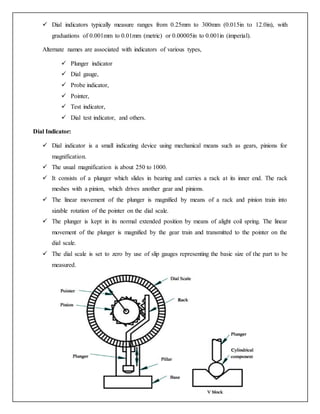
 Dial indicator is a small indicating device using mechanical means such as gears, pinions for
magnification.
 The usual magnification is about 250 to 1000.
 It consists of a plunger which slides in bearing and carries a rack at its inner end. The rack
meshes with a pinion, which drives another gear and pinions.
 The linear movement of the plunger is magnified by means of a rack and pinion train into
sizable rotation of the pointer on the dial scale.
 The plunger is kept in its normal extended position by means of alight coil spring. The linear
movement of the plunger is magnified by the gear train and transmitted to the pointer on the
dial scale.
 The dial scale is set to zero by use of slip gauges representing the basic size of the part to be
measured.
 Dial indicators are compact and robust in construction.
 They are portable, easy to handle and can be set very quickly.
 This type of comparator can be used with various attachments so that it may be used for
larger number of works.
 They are used for inspection of small precision machined parts testing alignment, roundness,
parallelism of work pieces, etc.
Application
 To check for run out when fitting a new disc to an automotive disc brake. Runout can rapidly
ruin the disc if it exceeds the specified tolerance (typically 0.05mm or less).
 In a quality environment to check for consistency and accuracy in the manufacturing process.
 On the workshop floor to initially set up or calibrate a machine, prior to a production run.
 By toolmakers (mold makers) in the process of manufacturing precision tooling.
 The ultimate aim of reducing it to a suitably small range using small chuck jaw adjustments.
RECORDER
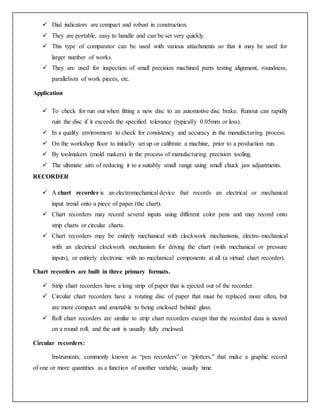
 A chart recorder is an electromechanical device that records an electrical or mechanical
input trend onto a piece of paper (the chart).
 Chart recorders may record several inputs using different color pens and may record onto
strip charts or circular charts.
 Chart recorders may be entirely mechanical with clockwork mechanisms, electro-mechanical
with an electrical clockwork mechanism for driving the chart (with mechanical or pressure
inputs), or entirely electronic with no mechanical components at all (a virtual chart recorder).
Chart recorders are built in three primary formats.
 Strip chart recorders have a long strip of paper that is ejected out of the recorder.
 Circular chart recorders have a rotating disc of paper that must be replaced more often, but
are more compact and amenable to being enclosed behind glass.
 Roll chart recorders are similar to strip chart recorders except that the recorded data is stored
on a round roll, and the unit is usually fully enclosed.
Circular recorders:
Instruments, commonly known as “pen recorders” or “plotters,” that make a graphic record
of one or more quantities as a function of another variable, usually time.
The complete instrument is often named a “-graph,” for example, a barograph for recording
barometric pressure data, a tachograph for recording the time and velocity that a vehicle is in motion,
or a seismograph for recording seismic waves.
INTEGRATOR
 An integrator is a device to perform the mathematical operation known as integration, a
fundamental operation in calculus.
 Mechanical integrators are used in such applications as metering of water flow or electric
power. Electronic analog integrators were the basis of analog computers.
Disk and wheel mechanical integrator
 The earliest integrator was a mechanical instrument called the planimeter.
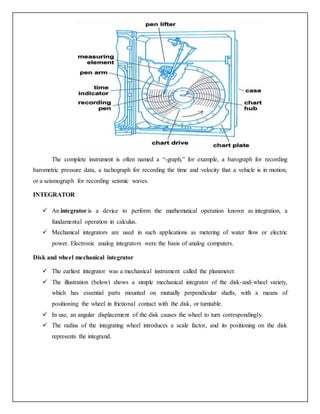
 The illustration (below) shows a simple mechanical integrator of the disk-and-wheel variety,
which has essential parts mounted on mutually perpendicular shafts, with a means of
positioning the wheel in frictional contact with the disk, or turntable.
 In use, an angular displacement of the disk causes the wheel to turn correspondingly.
 The radius of the integrating wheel introduces a scale factor, and its positioning on the disk
represents the integrand.
 Thus the rotations of the disk and the wheel are related through multiplicative factors and the
number of turns made by the integrating wheel (for any number of turns of the disk) will be
expressed as a definite integral of the function represented by the variable position of the
wheel on the disk.
Electronic integrator
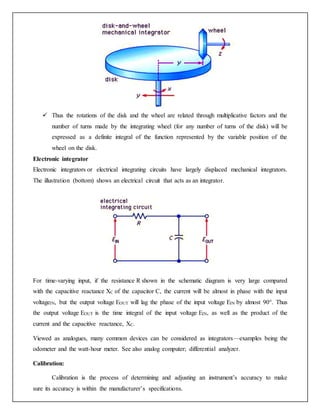
Electronic integrators or electrical integrating circuits have largely displaced mechanical integrators.
The illustration (bottom) shows an electrical circuit that acts as an integrator.
For time-varying input, if the resistance R shown in the schematic diagram is very large compared
with the capacitive reactance XC of the capacitor C, the current will be almost in phase with the input
voltageIN, but the output voltage EOUT will lag the phase of the input voltage EIN by almost 90°. Thus
the output voltage EOUT is the time integral of the input voltage EIN, as well as the product of the
current and the capacitive reactance, XC.
Viewed as analogues, many common devices can be considered as integrators—examples being the
odometer and the watt-hour meter. See also analog computer; differential analyzer.
Calibration:
Calibration is the process of determining and adjusting an instrument’s accuracy to make
sure its accuracy is within the manufacturer’s specifications.
 Calibration is an essential part of industrial measurement and control. It can be defined as the
comparison of specific values of the input and output of an instrument with a corresponding
reference standard.
 It offers a guarantee to the device or instrument that it operates with the required accuracy
and the range specifications under the stipulated environmental conditions. Calibrated
devices permit a manufacturer or processor to produce a quality product with desirable or
required specifications. By this process, the errors and corrections are revealed.
 Calibration must be performed periodically to test the validity of the performance of the
device or the system and requires the use of a standard for comparison of values. These
comparisons require operator skill, availability of good reference standards, and standard
environments.
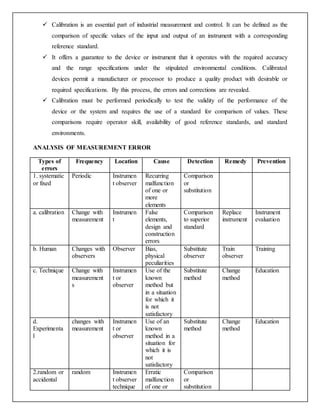
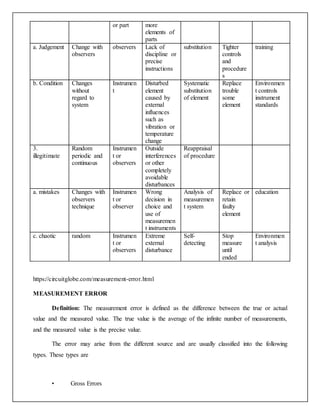
ANALYSIS OF MEASUREMENT ERROR
Types of
errors
Frequency Location Cause Detection Remedy Prevention
1. systematic
or fixed
Periodic Instrumen
t observer
Recurring
malfunction
of one or
more
elements
Comparison
or
substitution
a. calibration Change with
measurement
Instrumen
t
False
elements,
design and
construction
errors
Comparison
to superior
standard
Replace
instrument
Instrument
evaluation
b. Human Changes with
observers
Observer Bias,
physical
peculiarities
Substitute
observer
Train
observer
Training
c. Technique Change with
measurement
s
Instrumen
t or
observer
Use of the
known
method but
in a situation
for which it
is not
satisfactory
Substitute
method
Change
method
Education
d.
Experimenta
l
changes with
measurement
Instrumen
t or
observer
Use of an
known
method in a
situation for
which it is
not
satisfactory
Substitute
method
Change
method
Education
2.random or
accidental
random Instrumen
t observer
technique
Erratic
malfunction
of one or
Comparison
or
substitution
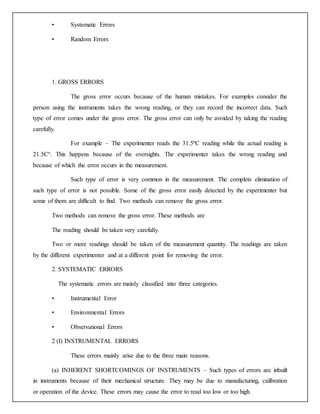
or part more
elements of
parts
a. Judgement Change with
observers
observers Lack of
discipline or
precise
instructions
substitution Tighter
controls
and
procedure
s
training
b. Condition Changes
without
regard to
system
Instrumen
t
Disturbed
element
caused by
external
influences
such as
vibration or
temperature
change
Systematic
substitution
of element
Replace
trouble
some
element
Environmen
t controls
instrument
standards
3.
illegitimate
Random
periodic and
continuous
Instrumen
t or
observers
Outside
interferences
or other
completely
avoidable
disturbances
Reappraisal
of procedure
a. mistakes Changes with
observers
technique
Instrumen
t or
observer
Wrong
decision in
choice and
use of
measuremen
t instruments
Analysis of
measuremen
t system
Replace or
retain
faulty
element
education
c. chaotic random Instrumen
t or
observers
Extreme
external
disturbance
Self-
detecting
Stop
measure
until
ended
Environmen
t analysis
https://circuitglobe.com/measurement-error.html
MEASUREMENT ERROR
Definition: The measurement error is defined as the difference between the true or actual
value and the measured value. The true value is the average of the infinite number of measurements,
and the measured value is the precise value.
The error may arise from the different source and are usually classified into the following
types. These types are
• Gross Errors
• Systematic Errors
• Random Errors
1. GROSS ERRORS
The gross error occurs because of the human mistakes. For examples consider the
person using the instruments takes the wrong reading, or they can record the incorrect data. Such
type of error comes under the gross error. The gross error can only be avoided by taking the reading
carefully.
For example – The experimenter reads the 31.5ºC reading while the actual reading is
21.5Cº. This happens because of the oversights. The experimenter takes the wrong reading and
because of which the error occurs in the measurement.
Such type of error is very common in the measurement. The complete elimination of
such type of error is not possible. Some of the gross error easily detected by the experimenter but
some of them are difficult to find. Two methods can remove the gross error.
Two methods can remove the gross error. These methods are
The reading should be taken very carefully.
Two or more readings should be taken of the measurement quantity. The readings are taken
by the different experimenter and at a different point for removing the error.
2. SYSTEMATIC ERRORS
The systematic errors are mainly classified into three categories.
• Instrumental Error
• Environmental Errors
• Observational Errors
2 (I) INSTRUMENTAL ERRORS
These errors mainly arise due to the three main reasons.
(a) INHERENT SHORTCOMINGS OF INSTRUMENTS – Such types of errors are inbuilt
in instruments because of their mechanical structure. They may be due to manufacturing, calibration
or operation of the device. These errors may cause the error to read too low or too high.
For example – If the instrument uses the weak spring then it gives the high value of
measuring quantity. The error occurs in the instrument because of the friction or hysteresis loss.
(b) MISUSE OF INSTRUMENT – The error occurs in the instrument because of the fault of
the operator. A good instrument used in an unintelligent way may give an enormous result.
For example – the misuse of the instrument may cause the failure to adjust the zero of
instruments, poor initial adjustment, using lead to too high resistance. These improper practices may
not cause permanent damage to the instrument, but all the same, they cause errors.
(c) LOADING EFFECT – It is the most common type of error which is caused by the
instrument in measurement work. For example, when the voltmeter is connected to the high
resistance circuit it gives a misleading reading, and when it is connected to the low resistance circuit,
it gives the dependable reading. This means the voltmeter has a loading effect on the circuit.
The error caused by the loading effect can be overcome by using the meters
intelligently. For example, when measuring a low resistance by the ammeter-voltmeter method, a
voltmeter having a very high value of resistance should be used.
2 (ii) Environmental Errors
These errors are due to the external condition of the measuring devices. Such types of
errors mainly occur due to the effect of temperature, pressure, humidity, dust, vibration or because of
the magnetic or electrostatic field. The corrective measures employed to eliminate or to reduce these
undesirable effects are
The arrangement should be made to keep the conditions as constant as possible.
Using the equipment which is free from these effects.
By using the techniques which eliminate the effect of these disturbances.
By applying the computed corrections.
2 (iii) Observational Errors
Such types of errors are due to the wrong observation of the reading. There are many sources
of observational error. For example, the pointer of a voltmeter resets slightly above the surface of the
scale. Thus an error occurs (because of parallax) unless the line of vision of the observer is exactly
above the pointer. To minimise the parallax error highly accurate meters are provided with mirrored
scales.
3. Random Errors
The error which is caused by the sudden change in the atmospheric condition, such type of
error is called random error. These types of error remain even after the removal of the systematic
error. Hence such type of error is also called residual error.

Unit i

  • 1.
    Unit I INSTRUMENTATION -INTRODUCTION GENERAL CONCEPTS  Instrumentation is a branch of engineering science which deals with the techniquesused for measurement, the measuring devices used and the problems that are associated with the technique used for measurement.  “In other words it can be said that instrumentation is a branch that deals with the Technology of making instruments and basic principles used in construction of instruments”. Hence, using an instrument, some measurement is being done. Generally, measurement is a word used to tell us about physical quantities such as length, weight, temperature, pressure, Force, etc., this physical quantity which is the object of measurement of an instrument is called as measured or the measured variable. Standardization organizations.  NBS -National Bureau of Standardization.  ISO -International organization for standardization.  ANSI -American National Standardization Institute. Measurements:  For measurement an instrument is necessary. In general, measurement means getting to know about physical quantity such as length, weight, temperature, pressure force and so on.  This physical quantity is called as Measurand or measured variable.  Measurement is the outcome of an opinion formed by observers about some physical quantity. The observer forms this opinion by comparing the object with a quantity of similar kind is called standard. Measurement  Measurement is the process of comparing the input signal (unknown magnitude) with a pre- defined standard and giving out the result is called measurements. Measurand or input signal Comparison process Result (Numerical value) Standard (Known quantity)
  • 2.
     The resultof measurement is a numerical value representing the ratio of the unknown quantity to the standard used. This number becomes the value of the measured quantity. Requirements of Measurement For the measurements results to be accurate, two conditions should be met.  Firstly, the standard which is used for comparison must be defined accurately and it should be universally accepted.  The second important condition to be met for measurements is that the procedure applied for the measurements should be provable and there should be provable instruments for measurements. MEASUREMENT METHODS: The methods of measurement are classified under two heads namely: (a) Direct .comparison method. (b) Indirect comparison method. (a) DIRECT COMPARISION METHOD:  In this method, the measured (unknown quantity) is directly compared with the standard.  The result of measurement is a number and a unit. The direct comparison method is used for measuring physical quantities such as time, mass, length etc,.  Ex: Measuring the length of a wire. The unit of length is meter. The wire is so many times long because that many units on the standard have the same length of the wire. When the unknown quantity (measured) is very small, the human being cannot make direct comparison with accuracy and precision. Moreover, human beings cannot distinguish wide margins of the measured and hence it becomes a constraint in direct comparison methods. (b) INDIRECT COMPARISION METHOD:  In many applications, the indirect comparison method is used which intern means the use of a measurement system.  These measurement systems have a transducer element which converts the quantity to be measured from one form to another form (analogous signal) without changing the information content.
  • 3.
     The analogoussignal is then processed and is sent to the end devices which present the result of measurement.  “In short, in indirect comparison method, the input signal is converted to some other form and then it is compared with the standard”. Methods of measurement can also be classified as a. Primary measurement b. Secondary measurement c. Tertiary measurement Primary Measurement  Only subjective information is provided in this method. Example:  One vessel is cooler than the other.  One rod is longer than the other.  These measurements are made by direct observation. They do not involve any translation of information. Secondary Measurement  In this method, the output result is obtained by one translation. Example: Convertion of Measurand into length which is shown below. Bellows, bourdon’s pressure gauge. Pressure length Primary signal secondary signal Tertiary Measurement: In this method, the output result is obtained by two translations. Example: Electric tachometer. The input is converted to voltage then this voltage is converted to length. Speed voltage length Primary signalsecondary signal Tertiary signal Measurand or input Translation Measured value or output Voltmeter [second translation] Output or measured value Tachometer (translation) Input or measurand
  • 4.
    APPLICATION OF MEASURINGINSTRUMENTS: Measuring instruments are used in the following three areas namely: (a) Monitoring of processes and operations (b) Control of processes and operations (C) Experimental engineering analysis. (a) MONITORING OF PROCESSES AND OPERATIONS: Some of the measuring in performs the function of monitoring. EXAMPLES (1): Thermometers, pressure gauges, etc.  These instruments simply indicate the condition of the environment. Their reading does not serve any control function. EXAMPLE (1): Water, gas and electric meters:  These meters indicate the quantity of commodity used. Using this quantity, the cost to the user can be calculated. (b) CONTROL OF PROCESSES AND OPERATIONS: Here the instrument is used as a component of an automatic control system. (c) EXPERIMENTAL ENGINEERING ANALYSIS: There are two methods to solve engineering problems namely:
  • 5.
     Theoretical methods Experimental methods. In many cases, application of both the methods is required. Following are characteristics of experimental methods.  These methods give results that apply only to specific problems.  The real true behavior of the system is revealed.  The features of the measuring instrument must be understood properly.  A scale model or the actual system itself is required. GENERALISED MEASUREMENT SYSTEM AND ITS ELEMENTS MEASUREMENT SYSTEM INPUT SIGNAL (Measurand) OUTPUT SIGNAL (Measurement) The main functions of an instrument is  Get information,  Process the information and  Present the information to a human observer. For the purpose of study, the instrument is considered as a system. A system is an assembly of components which are interconnected to perform a specific function. Each component is called as an element: Each element does a particular act during measurement. The common elements of a generalized measurement system are listed below: ELEMENTS STAGES 1. Primary sensing element. 2. Variable conversion or transducer element. Detector- Transducer stage. 3. Variable manipulation element. 4. Data transmission element. 5. Data processing element. Intermediate modifying stage. 6. Data presentation element. 7. Data storage and playback element. Terminating stage
  • 6.
    1. PRIMARY SENSINGELEMENT:  The primary sensing element is the first element of a measurement system. This element takes energy from the measured medium and it produces an output depending on the Measurand, that is, measured quantity.  It should be noted that the instrument takes energy from the measured medium and due to this the measured quantity is always disturbed by the act of measurement. As such, a perfect measurement is theoretically impossible. This effect is called loading.  The instrument has to be designed to minimize this loading effect. 2. VARIABLE CONVERSION OR TRANSDUCER ELEMENTS:  The primary sensing element gives an output signal which is some physical variable like displacement or voltage.  The variable conversion, or transducer element converts the signal from one physical form to another withou1 changing the information content of the signal.  The output of the transducer element is in a form which is more suitable for measurement.
  • 7.
    3. VARIABLE MANIPULATIONELEMENT:  A variable manipulation element manipulates its input to get a magnified output. That is, the input signal is amplified to get the output.  It should be noted that both the input and output signal are of the same form. Example: Displacement amplifier. Therefore, output signal input signal x some constant Example: Electrical amplifier.  It should be noted that the physical nature of the variable is maintained by themanipulator. 4. DATA TRANSMISSION ELEMENT: This element transfers the signal from one place to another without disturbing the signalbeing transmitted. Examples: From shaft to gear Short distance From test center to computer Medium distance From ground equipment to missiles Long distance 5. DATA PROCESSING ELEMENT:  The data processing element alters the data before it is presented on a displayor before it is recorded.
  • 8.
     The mainwork of this element is to convert the date to an understandable anduseful form. Example:  It removes unwanted disturbances such as noises which come with the signal  It can provide compensation for change in temperature etc., 6. DATA PRESENTATION ELEMENT:  The information about the measured quantity is to be presented to a human being for monitoring, control or analysis purpose.  Hence the information about the measured quantity has to be put in a form that is understandable to the human being. An element that performs this translation function is called as “Data presentation element”. Examples:  Pointer moving over a scale. 7. DATA STORAGE AND PLAYBACK ELEMENT: This element stores the data/information and presents the same when commanded. Example:  Pen-ink recording  Magnetic tape recorder - reproducer  Computer. Example for the Concept of Measurement System. For any instrument, the various basic elements can be identified and a flow diagram illustrating the input - output of these various elements can be drawn. Such a diagram for a pressure type thermometer has been shown in below.
  • 9.
    Note: The General Systemof Measurement comprises of three stages these are:  First stage - the detector-transducer stage.  Second stage – Intermediate modifying stage  Final stage – Terminating stage comprising of: the indicator, recorder, some controller as individuals or in combination.
  • 10.
    First Stage: TheDetector-Transducer Stage Let us consider an example here for the measurement of pressure using Bourdon tube. The pressure of fluid cannot be measured directly, hence Bourdon tube is used as the transducer to convert the property or signal of pressure into other property or signal that can be measured easily. The Bourdon tube is a thin tube with oval cross section and coiled into an arc with included angle less than 360 degree (see the fig). One end of this tube is connected to the inlet pressure and the other end, which is sealed, is connected to the pointer that moves on the angular scale. When the pressure is applied to the Bourdon tube the oval section tends to become circular, due to which the tube tends to uncoil and move the end connected to the pointer. Here the Bourdon tube senses the pressure, and it acts as the transducer that detects the quantity to be measured. Second Stage: Intermediate Modifying Stage The coiled oval shaped tube acts as the intermediate stage. When the pressure is applied at the inlet the oval tube tends to become circular, but inner and the outer diameters of the coil tend to remain the same. Due to this the coil tends to uncoil producing the angular motion of the tip of the coil, which is connected to the final stage of the pointer that indicates the value of the applied pressure. Final Stage: Terminating Stage In our example of Bourdon tube, the sealed tip of the coil is connected to the pointer via linkages and the gear arrangement. The pointer moves over the predefined scale that indicates the value of the pressure. When the pressure is applied the tip of the Bourdon tube uncoils, which moves the linkages and the gear that finally produce the rotary motion of the pointer on the scale indicating the actual value of the applied pressure. Instrument Characteristics and Common Terminologies  The value of the physical quantity obtained using the instrument will never be equal to the true value, and if it occurs so, it is due to luck and it will be unrecognized.  Hence, no instrument will give an exact value of the physical quantity being measured.  There is always some deviation (uncertainty) in the measured value and this deviation is measured in terms of accuracy, precision and error.
  • 11.
    Accuracy:  When aphysical quantity is being measured, a numerical value is obtained. A concern arises regarding how close this value is to the true value (Theoretically correct value).  As the physical quantity cannot be defined perfectly, the true value of the physical quantity is unknown and unknowable. In practice, true value refers to a value obtained by an “EXAMPLAR-METHOD.”  This method has been agreed by experts to be sufficiently accurate. The closeness of the measured value with respect to the true value is called as accuracy. Example:  Let us say a micrometer is used to measure a wire whose diameter is 10 mm (Determined by an exemplar method).  If the micrometer reads 9.99 mm or 10.01 mm, these values are close to the true value and hence the micrometer is said to be accurate.  If the micrometer reads 9.5 mm or 10.3 mm, these values are far from the true value and hence the micrometer is said to be inaccurate. The accuracy of the physical quantity being measured depends on the following:  Accuracy of the instrument being used to measure the physical quantity.  Variation of the physical quantity being measured.  The extent to which the true value is impressed on the instrument.  The accuracy with which the observation is made by the observer. Precision (Repeatability or reproducibility):  The terms accuracy and precision are used interchangeably in many situations. But in instrumentation, accuracy and precision mean different.  The term precision refers to the ability of an instrument to reproduce its readings again and again in the same manner for a constant input signal.  That is, if a number of measurements are made on the same true value, the degree of closeness of these measurements is called as precision.  Now let us differentiate between accuracy and precision.  Accuracy represents to the closeness of the measured value with respect the true value.  But precision refers to the ability of the instrument to reproduce its readings again and again in the same manner for a constant input signal.
  • 12.
    Example: Let us considerthree instruments X, Y and Z measuring the same true value of 10 mm. ten measurements are taken on the same true value. Difference between Precision and Accuracy: Sl.No Precision Accuracy 1 Precision is nothing but the repeatability of the process. Accuracy is the degree to which the measured value agrees with the true value of the measured quantity. 2 Precision is the fineness of the instrument of the dispersion of the repeated readings. Accuracy is the relative between the observed value and true values. It is also the desirability of the observed readings from the true values. 3 The precision never designates accuracy. Accuracy may designate precision. 4 Precision is defined as the close relationship of the observed Accuracy is defined as the relationship between the value of observed.
  • 13.
    readings with theaverage value. 5 Standard deviation is the index of precision for the less value of σ, more precise is the instrument. The difference between the measured value and the true value is the error of the measurement. If the error is less, then the accuracy is more. ERROR:  Error is the difference between the measured value (Vm) and the true value (Vt) of a physical quantity. The accuracy of a measurement system is measured in terms of error. Static error E = Vm - Vt  Error may be positive or negative. If the instrument reads higher than the true value, it is called as positive error and if the instrument reads lower than the true value, it is called as negative error.  A study of error helps in reducing them and helps in finding the reliability of the results. TYPES OF ERRORS: Important errors have been listed below. a. Systematic errors or fixed errors  Errors due to calibration.  Human errors (observation errors and operational errors).  Loading error (system interaction error).  Error of technique.  Instruments Errors b. Illegitimate errors  Chaotic errors. c. Random errors  Environmental error Errors Due To Calibration:  Any instrument has to be calibrated before it is put to use. Calibration is a process of giving a known input to the measurement system and taking necessary actions to see that the output of the measurement system matches with its input.  If the instrument is not calibrated properly, it will show reading with a higher degree of error. This is called as calibration error.
  • 14.
     Calibration errorsare fixed errors as they have been introduced into the measurement system because of improper calibration. Human Errors:  There are two human errors namely the observation errors and the operational errors.  There is a saying that “Instruments are better than the people who use them”. Even if a good instrument is available, errors are introduced due to the user.  Observation errors are due to improper observation made by the user of the instrument. Example (1): If the graduations on the scale are very close, the observer may read incorrectly. Example (2): Not observing continuously when it is necessary to do so. Loading Errors (System Interaction Errors):  The measuring instrument always takes energy from the signal source (measured medium) and due to this the signal source is always altered by the act of measurement. This effect is called as loading.  As the measured quantity loses energy due to the act of measurement, error is introduced. This is called as loading error. Example (1): When a thermometer is introduced, it alters the thermal capacity of the system and heat leakage takes place. Due to this error occurs. Example (2): Reading of a hand tachometer will vary depending on the pressure with which it is pressed on the shaft. Error of technique Improper use of the exact technique for executing an operation leads to this type of error. Instruments Errors:  The accuracy of an instrument is affected due to limitations in its design and construction. Example (1): The components of an instrument may be assembled incorrectly and due to this an error may occur. This error does not vary with time and can be corrected. Example (2): An improper material may be selected for the instrument causing it to wear quickly or creating friction, thus introducing an error. b. Illegitimate errors Chaotic Errors:
  • 15.
     Errors inducedby random disturbances such as vibrations, noises, shocks etc., of sufficient magnitude tend to affect the test information. Such errors are called as chaotic errors.  Due to such random disturbances, the instrument cannot measure the physical quantity properly and more over there will be information lose during signal transmission, this is called as transmission error. Uncertainty and Random Error  Uncertainty and random errors are indicated when repeated measurements of the same quantity result in differing values. The magnitude and direction of these errors are not known and as such are considered indeterminate.  They are caused by such effects as friction, spring hysteresis, noise, and other phenomena. The contributing factors are any random changes in input signal, combined with noise and drift in the signal conditioner.  Such errors occur more in dynamic data analysis. The uncertainty is expressed as the average deviation, probable error, or statistical deviation. The error value is estimated as the amount by which the observed or calculated value departs from the true value. Environmental Error:  Any instrument is manufactured and calibrated at one place and is put in use at some other place where the environmental conditions such as pressure, temperature, humidity etc., are different.  This change in environment influences the readings of the instrument. This change in reading of the instrument due to environmental changes is called as environmental error. Example (1): If a mercury - in glass thermometer is located at a place where the air pressure is high, the air pressure acts on the walls of the thermometer causing the mercury to rise even without a change in temperature. Example (2): A bourdon-tube pressure gauge has a link-sector-pinion arrangement. The link may expand if the environmental temperature increases, causing an error. The following points are noted to eliminate environmental errors.  The measuring instrument is calibrated at that place of use.  Atmospheric temperature changes are monitored.  The instrument is used in conditions as told by the manufacturer of the instrument. Some automatic devices are used to compensate the effects due to change in environment
  • 16.
    Comparison between SystematicError and Random Error Sl.No Systematic Error Random Error 1 These errors repetitive in nature and are constant and similar form. The value of error can change according to a constant law. These errors are not repetitive and they occur randomly. 2 The systematic errors are controllable in magnitude and sense. It cannot be determined and it cannot be reduced. 3 Systematic error can be analyzed properly It cannot be analyzed properly. 4 This occurs due to experimental mistake. This occurs due to small variation in positioning of work piece & instrument. 5 They cannot be identified by repeated observations. They can be identified by the repeated fluctuations of the readings. Classification of instrument as indicator, recorder and integrator: INDICATOR  In various manufacturing contexts an indicator is one of the instruments used to accurately measure small distances, and amplify them to make them more obvious.  The name comes from the concept of indicating to the user that which their naked eye cannot discern; such as the presence, or exact quantity, of some small distance (for example, a small height difference between two flat surfaces, a slight lack of concentricity between two cylinders, or other small physical deviations).  Many indicators have a dial display, in which a needle points to graduations in a circular array around the dial. Such indicators, of which there are several types, therefore are often called dial indicators.  Non-dial types of indicators include mechanical devices with cantilevered pointers and electronic devices with digital displays.  Indicators may be used to check the variation in tolerance during the inspection process of a machined part.
  • 17.
     Dial indicatorstypically measure ranges from 0.25mm to 300mm (0.015in to 12.0in), with graduations of 0.001mm to 0.01mm (metric) or 0.00005in to 0.001in (imperial). Alternate names are associated with indicators of various types,  Plunger indicator  Dial gauge,  Probe indicator,  Pointer,  Test indicator,  Dial test indicator, and others. Dial Indicator:  Dial indicator is a small indicating device using mechanical means such as gears, pinions for magnification.  The usual magnification is about 250 to 1000.  It consists of a plunger which slides in bearing and carries a rack at its inner end. The rack meshes with a pinion, which drives another gear and pinions.  The linear movement of the plunger is magnified by means of a rack and pinion train into sizable rotation of the pointer on the dial scale.  The plunger is kept in its normal extended position by means of alight coil spring. The linear movement of the plunger is magnified by the gear train and transmitted to the pointer on the dial scale.  The dial scale is set to zero by use of slip gauges representing the basic size of the part to be measured.
  • 18.
     Dial indicatorsare compact and robust in construction.  They are portable, easy to handle and can be set very quickly.  This type of comparator can be used with various attachments so that it may be used for larger number of works.  They are used for inspection of small precision machined parts testing alignment, roundness, parallelism of work pieces, etc. Application  To check for run out when fitting a new disc to an automotive disc brake. Runout can rapidly ruin the disc if it exceeds the specified tolerance (typically 0.05mm or less).  In a quality environment to check for consistency and accuracy in the manufacturing process.  On the workshop floor to initially set up or calibrate a machine, prior to a production run.  By toolmakers (mold makers) in the process of manufacturing precision tooling.  The ultimate aim of reducing it to a suitably small range using small chuck jaw adjustments. RECORDER  A chart recorder is an electromechanical device that records an electrical or mechanical input trend onto a piece of paper (the chart).  Chart recorders may record several inputs using different color pens and may record onto strip charts or circular charts.  Chart recorders may be entirely mechanical with clockwork mechanisms, electro-mechanical with an electrical clockwork mechanism for driving the chart (with mechanical or pressure inputs), or entirely electronic with no mechanical components at all (a virtual chart recorder). Chart recorders are built in three primary formats.  Strip chart recorders have a long strip of paper that is ejected out of the recorder.  Circular chart recorders have a rotating disc of paper that must be replaced more often, but are more compact and amenable to being enclosed behind glass.  Roll chart recorders are similar to strip chart recorders except that the recorded data is stored on a round roll, and the unit is usually fully enclosed. Circular recorders: Instruments, commonly known as “pen recorders” or “plotters,” that make a graphic record of one or more quantities as a function of another variable, usually time.
  • 19.
    The complete instrumentis often named a “-graph,” for example, a barograph for recording barometric pressure data, a tachograph for recording the time and velocity that a vehicle is in motion, or a seismograph for recording seismic waves. INTEGRATOR  An integrator is a device to perform the mathematical operation known as integration, a fundamental operation in calculus.  Mechanical integrators are used in such applications as metering of water flow or electric power. Electronic analog integrators were the basis of analog computers. Disk and wheel mechanical integrator  The earliest integrator was a mechanical instrument called the planimeter.  The illustration (below) shows a simple mechanical integrator of the disk-and-wheel variety, which has essential parts mounted on mutually perpendicular shafts, with a means of positioning the wheel in frictional contact with the disk, or turntable.  In use, an angular displacement of the disk causes the wheel to turn correspondingly.  The radius of the integrating wheel introduces a scale factor, and its positioning on the disk represents the integrand.
  • 20.
     Thus therotations of the disk and the wheel are related through multiplicative factors and the number of turns made by the integrating wheel (for any number of turns of the disk) will be expressed as a definite integral of the function represented by the variable position of the wheel on the disk. Electronic integrator Electronic integrators or electrical integrating circuits have largely displaced mechanical integrators. The illustration (bottom) shows an electrical circuit that acts as an integrator. For time-varying input, if the resistance R shown in the schematic diagram is very large compared with the capacitive reactance XC of the capacitor C, the current will be almost in phase with the input voltageIN, but the output voltage EOUT will lag the phase of the input voltage EIN by almost 90°. Thus the output voltage EOUT is the time integral of the input voltage EIN, as well as the product of the current and the capacitive reactance, XC. Viewed as analogues, many common devices can be considered as integrators—examples being the odometer and the watt-hour meter. See also analog computer; differential analyzer. Calibration: Calibration is the process of determining and adjusting an instrument’s accuracy to make sure its accuracy is within the manufacturer’s specifications.
  • 21.
     Calibration isan essential part of industrial measurement and control. It can be defined as the comparison of specific values of the input and output of an instrument with a corresponding reference standard.  It offers a guarantee to the device or instrument that it operates with the required accuracy and the range specifications under the stipulated environmental conditions. Calibrated devices permit a manufacturer or processor to produce a quality product with desirable or required specifications. By this process, the errors and corrections are revealed.  Calibration must be performed periodically to test the validity of the performance of the device or the system and requires the use of a standard for comparison of values. These comparisons require operator skill, availability of good reference standards, and standard environments. ANALYSIS OF MEASUREMENT ERROR Types of errors Frequency Location Cause Detection Remedy Prevention 1. systematic or fixed Periodic Instrumen t observer Recurring malfunction of one or more elements Comparison or substitution a. calibration Change with measurement Instrumen t False elements, design and construction errors Comparison to superior standard Replace instrument Instrument evaluation b. Human Changes with observers Observer Bias, physical peculiarities Substitute observer Train observer Training c. Technique Change with measurement s Instrumen t or observer Use of the known method but in a situation for which it is not satisfactory Substitute method Change method Education d. Experimenta l changes with measurement Instrumen t or observer Use of an known method in a situation for which it is not satisfactory Substitute method Change method Education 2.random or accidental random Instrumen t observer technique Erratic malfunction of one or Comparison or substitution
  • 22.
    or part more elementsof parts a. Judgement Change with observers observers Lack of discipline or precise instructions substitution Tighter controls and procedure s training b. Condition Changes without regard to system Instrumen t Disturbed element caused by external influences such as vibration or temperature change Systematic substitution of element Replace trouble some element Environmen t controls instrument standards 3. illegitimate Random periodic and continuous Instrumen t or observers Outside interferences or other completely avoidable disturbances Reappraisal of procedure a. mistakes Changes with observers technique Instrumen t or observer Wrong decision in choice and use of measuremen t instruments Analysis of measuremen t system Replace or retain faulty element education c. chaotic random Instrumen t or observers Extreme external disturbance Self- detecting Stop measure until ended Environmen t analysis https://circuitglobe.com/measurement-error.html MEASUREMENT ERROR Definition: The measurement error is defined as the difference between the true or actual value and the measured value. The true value is the average of the infinite number of measurements, and the measured value is the precise value. The error may arise from the different source and are usually classified into the following types. These types are • Gross Errors
  • 23.
    • Systematic Errors •Random Errors 1. GROSS ERRORS The gross error occurs because of the human mistakes. For examples consider the person using the instruments takes the wrong reading, or they can record the incorrect data. Such type of error comes under the gross error. The gross error can only be avoided by taking the reading carefully. For example – The experimenter reads the 31.5ºC reading while the actual reading is 21.5Cº. This happens because of the oversights. The experimenter takes the wrong reading and because of which the error occurs in the measurement. Such type of error is very common in the measurement. The complete elimination of such type of error is not possible. Some of the gross error easily detected by the experimenter but some of them are difficult to find. Two methods can remove the gross error. Two methods can remove the gross error. These methods are The reading should be taken very carefully. Two or more readings should be taken of the measurement quantity. The readings are taken by the different experimenter and at a different point for removing the error. 2. SYSTEMATIC ERRORS The systematic errors are mainly classified into three categories. • Instrumental Error • Environmental Errors • Observational Errors 2 (I) INSTRUMENTAL ERRORS These errors mainly arise due to the three main reasons. (a) INHERENT SHORTCOMINGS OF INSTRUMENTS – Such types of errors are inbuilt in instruments because of their mechanical structure. They may be due to manufacturing, calibration or operation of the device. These errors may cause the error to read too low or too high.
  • 24.
    For example –If the instrument uses the weak spring then it gives the high value of measuring quantity. The error occurs in the instrument because of the friction or hysteresis loss. (b) MISUSE OF INSTRUMENT – The error occurs in the instrument because of the fault of the operator. A good instrument used in an unintelligent way may give an enormous result. For example – the misuse of the instrument may cause the failure to adjust the zero of instruments, poor initial adjustment, using lead to too high resistance. These improper practices may not cause permanent damage to the instrument, but all the same, they cause errors. (c) LOADING EFFECT – It is the most common type of error which is caused by the instrument in measurement work. For example, when the voltmeter is connected to the high resistance circuit it gives a misleading reading, and when it is connected to the low resistance circuit, it gives the dependable reading. This means the voltmeter has a loading effect on the circuit. The error caused by the loading effect can be overcome by using the meters intelligently. For example, when measuring a low resistance by the ammeter-voltmeter method, a voltmeter having a very high value of resistance should be used. 2 (ii) Environmental Errors These errors are due to the external condition of the measuring devices. Such types of errors mainly occur due to the effect of temperature, pressure, humidity, dust, vibration or because of the magnetic or electrostatic field. The corrective measures employed to eliminate or to reduce these undesirable effects are The arrangement should be made to keep the conditions as constant as possible. Using the equipment which is free from these effects. By using the techniques which eliminate the effect of these disturbances. By applying the computed corrections.
  • 25.
    2 (iii) ObservationalErrors Such types of errors are due to the wrong observation of the reading. There are many sources of observational error. For example, the pointer of a voltmeter resets slightly above the surface of the scale. Thus an error occurs (because of parallax) unless the line of vision of the observer is exactly above the pointer. To minimise the parallax error highly accurate meters are provided with mirrored scales. 3. Random Errors The error which is caused by the sudden change in the atmospheric condition, such type of error is called random error. These types of error remain even after the removal of the systematic error. Hence such type of error is also called residual error.