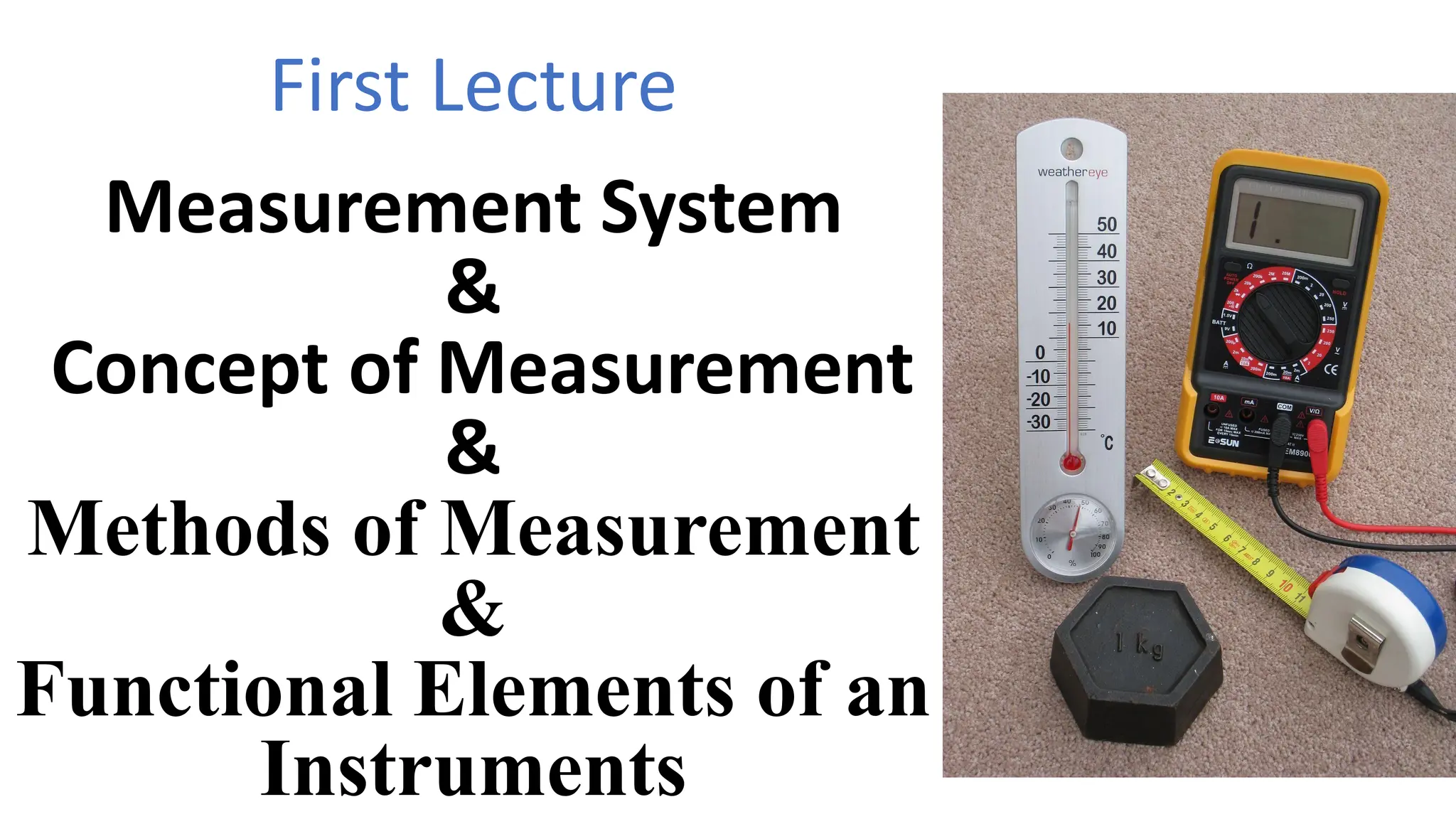
Measurement System
&
Concept of Measurement
&
Methods of Measurement
&
Functional Elements of an
Instruments
First Lecture
Units andstandards
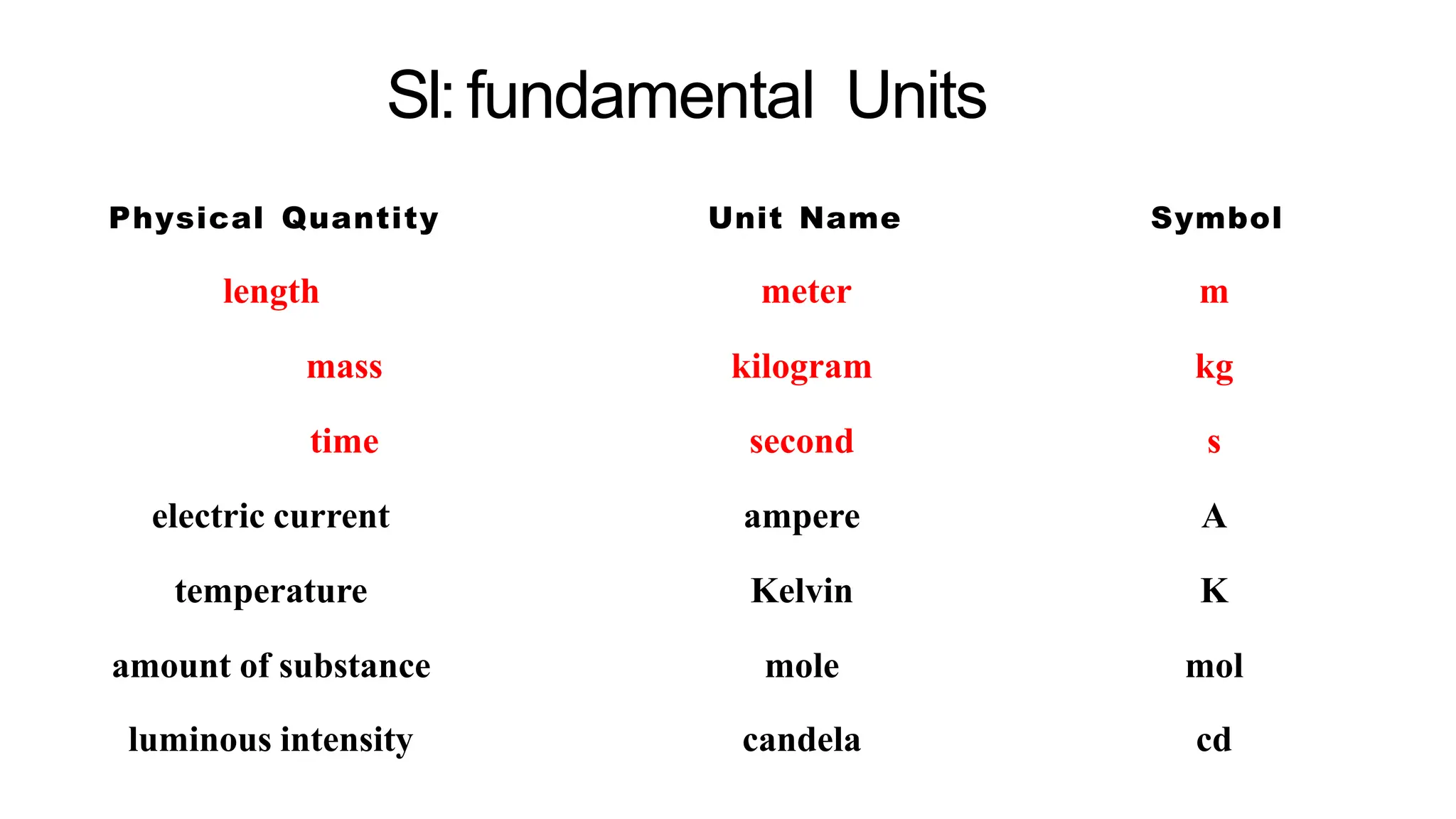
SI:fundamental Units
Physical Quantity Unit Name Symbol
length meter m
mass kilogram kg
time second s
electric current ampere A
temperature Kelvin K
amount of substance mole mol
luminous intensity candela cd
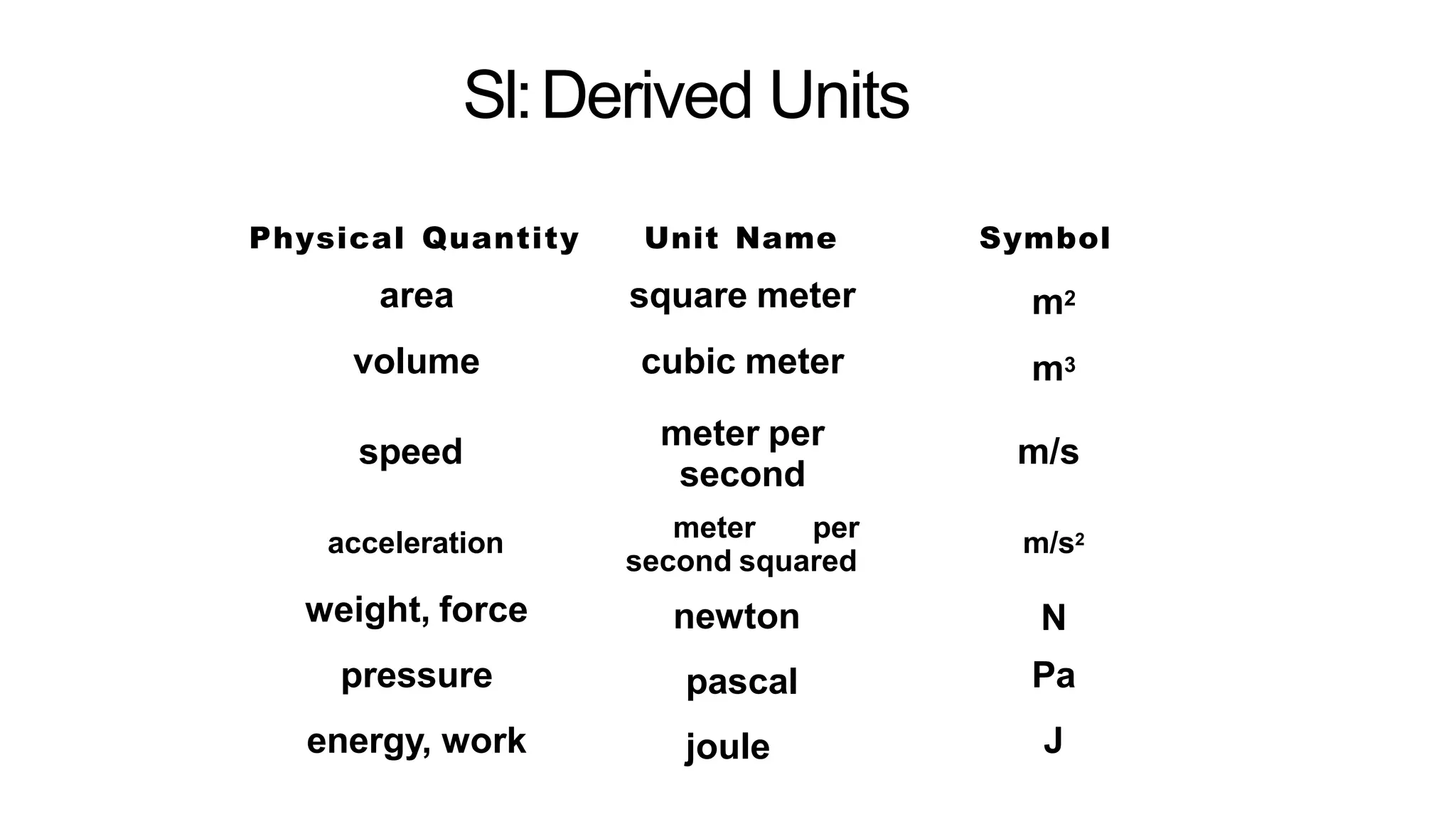
SI:Derived Units
Physical Quantity
area
volume
Unit Name
square meter
cubic meter
meter per
second
meter per
second squared
newton
pascal
joule
Symbol
m2
m3
speed m/s
acceleration m/s2
weight, force
pressure
energy, work
N
Pa
J
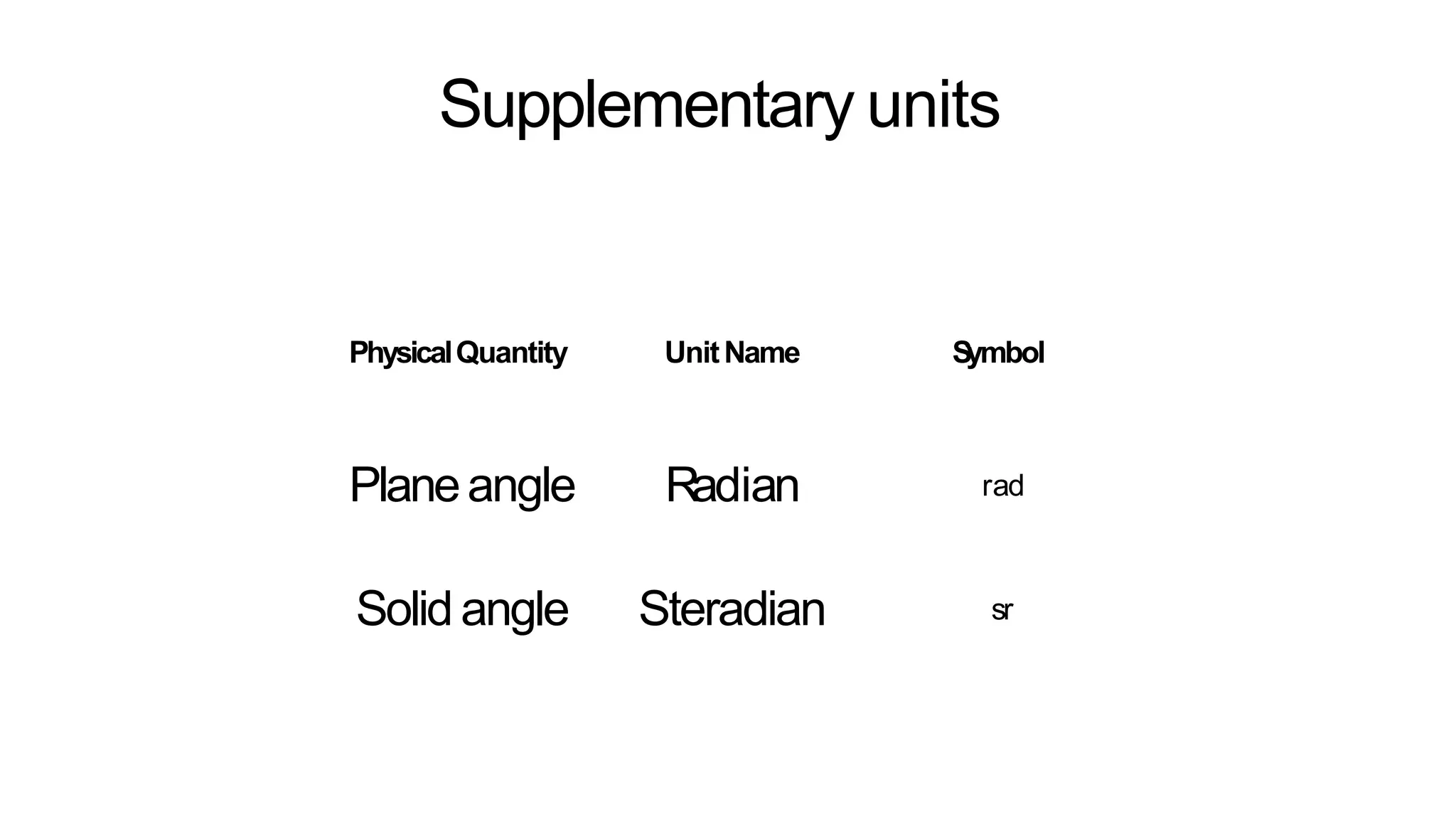
Supplementary units
PhysicalQuantity UnitName Symbol
Planeangle Radian rad
Solid angle Steradian sr
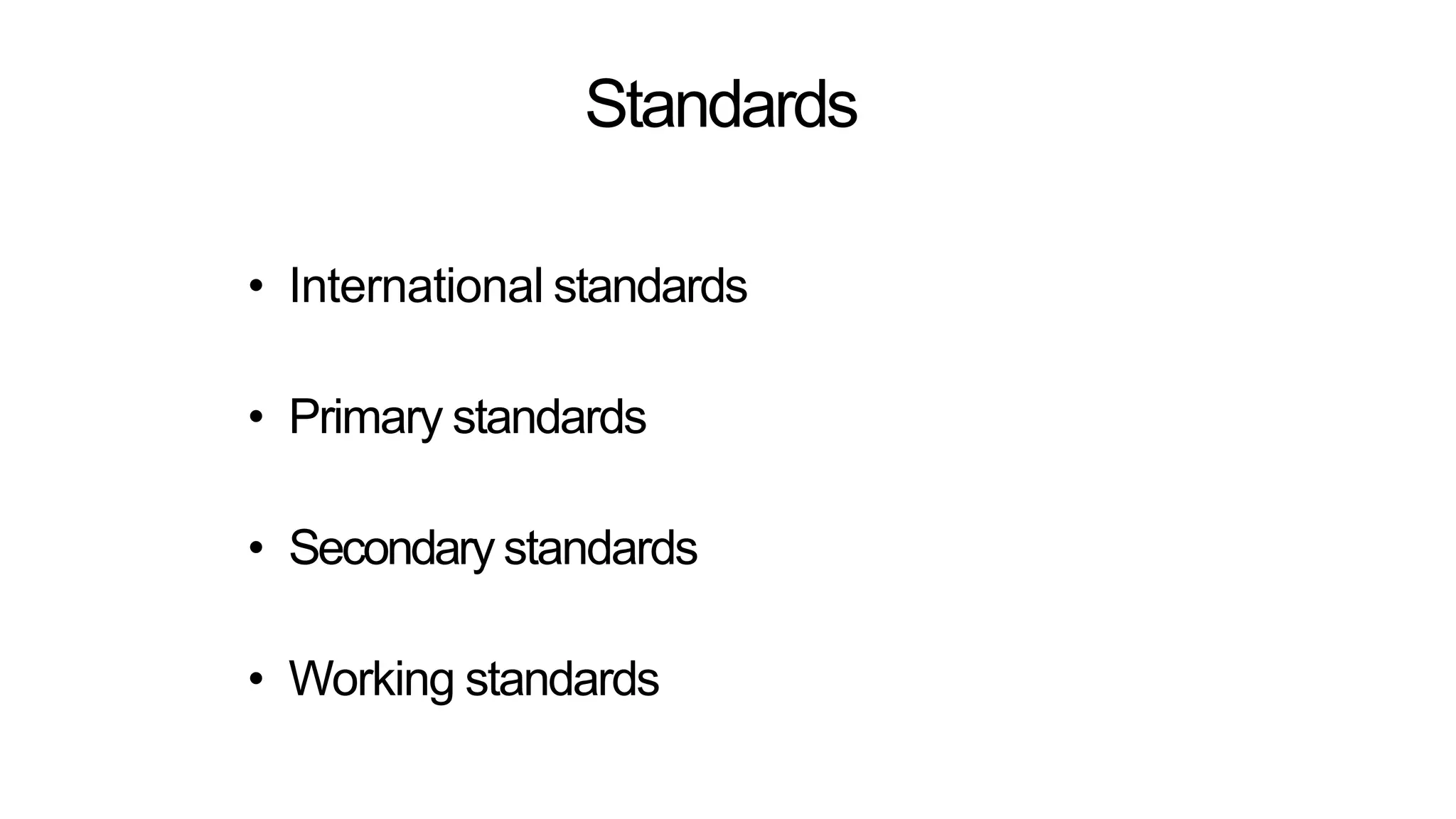
Standards
• International standards
• Primary standards
• Secondary standards
• Working standards
Scientists use many skills as they investigate the world around them.
They make observations by gathering information with their senses.
Some observations are simple. For example, a simple observation
would be figuring out the color or texture of an object. However, if
scientists want to know more about a substance, they may need to
take measurements. Measurement is perhaps one of the most
fundamental concepts in science. Without the ability to measure, it
would be difficult for scientists to conduct experiments or form
theories. It is also essential in farming, engineering, construction,
manufacturing, commerce, and numerous
other occupations and activities.
15
Measurements and measurement systems:
• Definition, significance of measurement, generalized
measurement system.
• Definitions and concept of accuracy, precision, calibration,
threshold, sensitivity, hysteresis, repeatability, linearity, loading
effect, system response-times delay.
• Errors in measurement, classification of errors.
• Transducers, transfer efficiency, primary and secondary
transducers, electrical, mechanical, electronic transducers,
advantages of each typetransducers.
MEASUREMENT SYSTEM:
• Measurement means determination of anything that exists in some amount.
• If those things that exist are related to mechanical engineering, then the determination
of such amounts are referred to as mechanical measurements.
• An engineer is not only interested in the measurement of physical variables but
also concerned with their control.
• These two functions are closely related because one must be able to measure a variable
such as temperature, or flow in order to control it.
• The accuracy of control is essentially dependent on the accuracy of measurement. Hence, a
good knowledge of measurement techniques is necessary for the design of control systems.
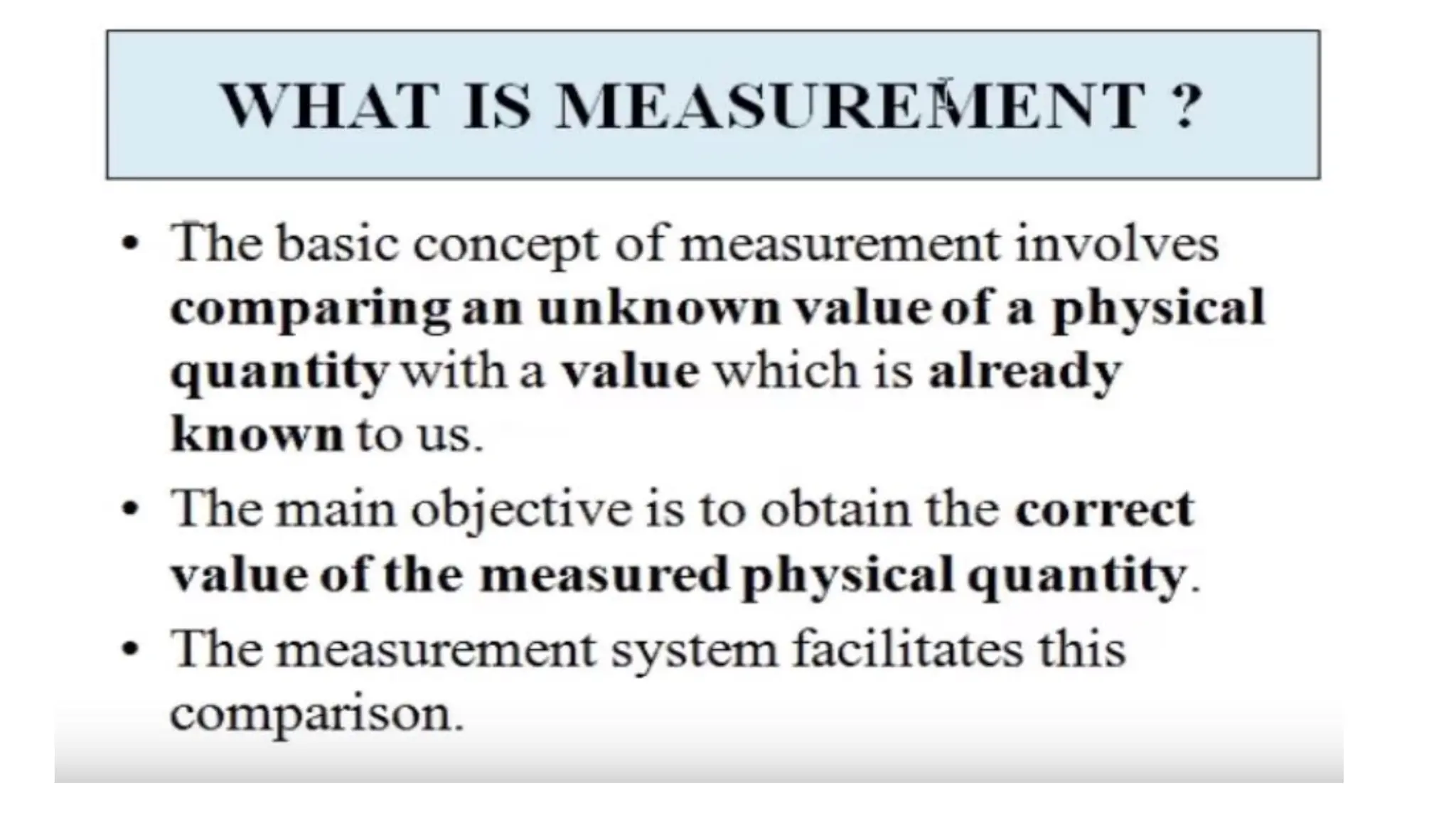
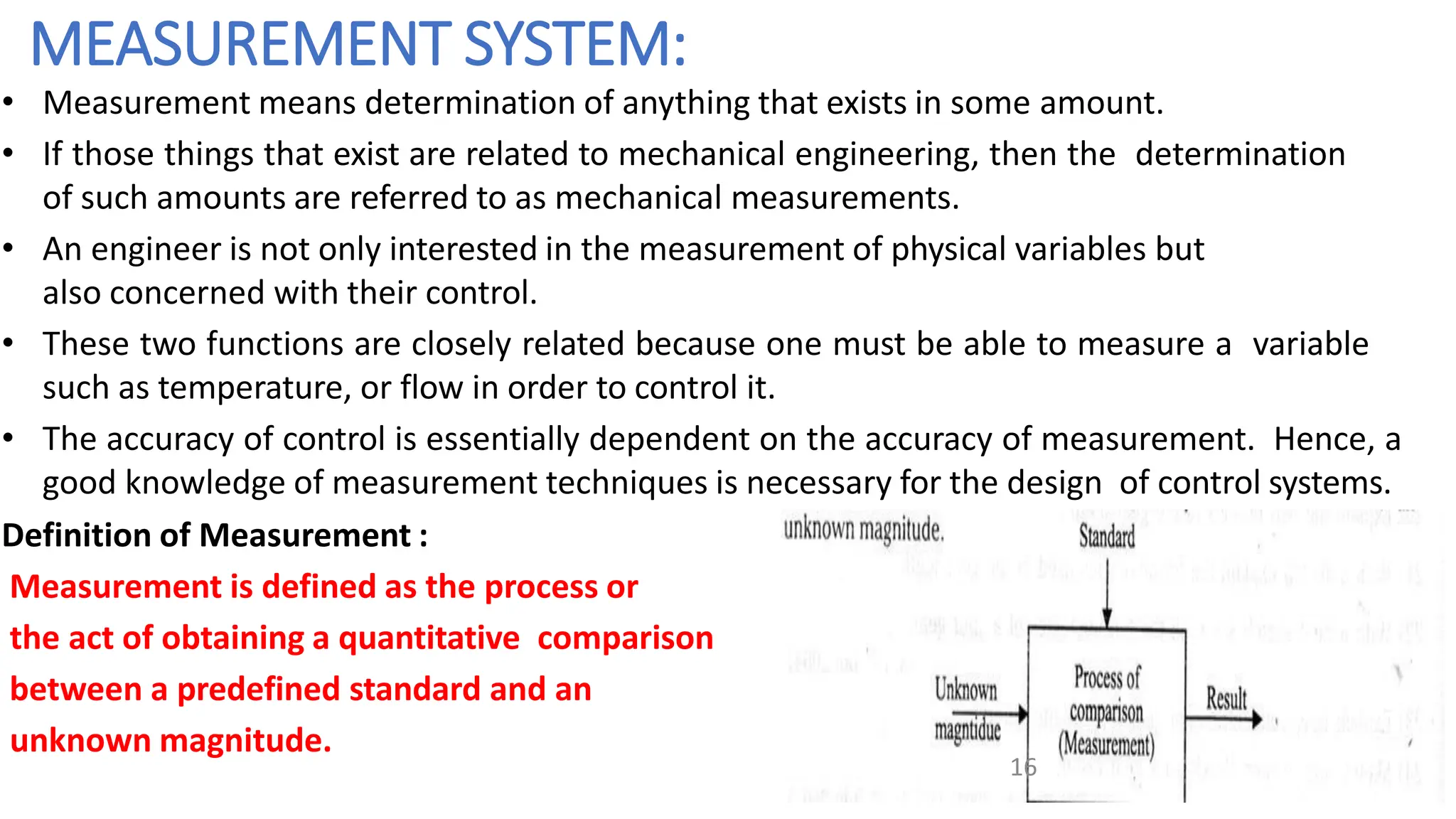
Definition of Measurement :
Measurement is defined as the process or
the act of obtaining a quantitative comparison
between a predefined standard and an
unknown magnitude.
16
17
18
SIGNIFICANCE OF MEASUREMENT SYSTEM
• Measurement provides the fundamental basis for research and development.
Development is the final stage of the design procedure involving the measurement of
various quantities pertaining to operation and performance of the device being
developed.
• Measurement is also a fundamental element of any control process, which requires the
measured discrepancy between the actual and the desired performances.
• Many operations require measurement for proper performance. For example : In
modern central power stations, temperatures, pressures, vibrational amplitudes etc., are
monitored by measurement to ensure proper performance.
• Measurement is also a bias of commerce, because the cost of the products are
established on the basis of amounts of materials, power, expenditure of time and labour,
and other constraints.
Contd..
12
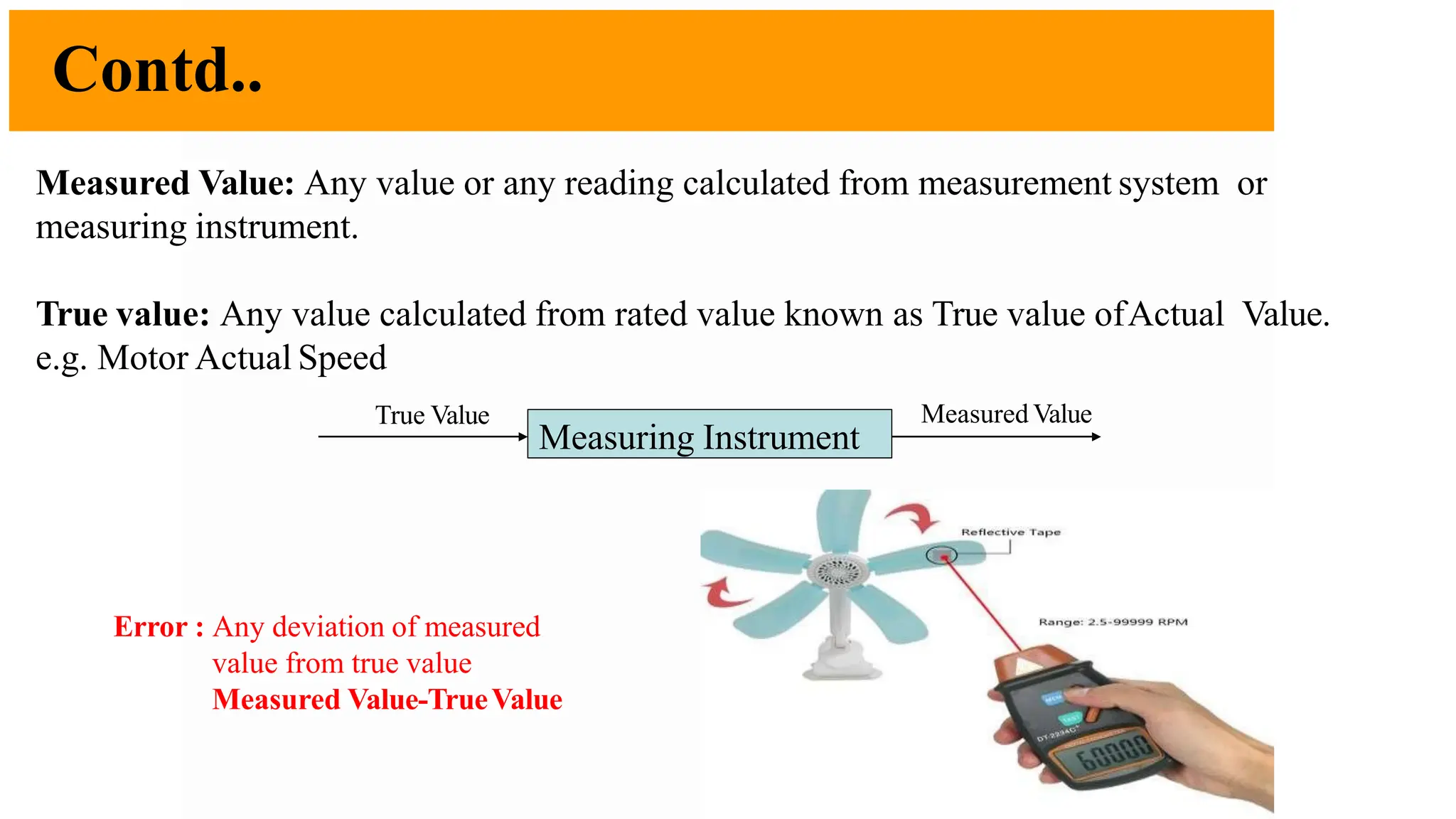
Measured Value: Any value or any reading calculated from measurement system or
measuring instrument.
True value: Any value calculated from rated value known as True value ofActual Value.
e.g. Motor Actual Speed
Error : Any deviation of measured
value from true value
Measured Value-TrueValue
Measuring Instrument
True Value Measured Value
Why measure things?
• Checkquality?
• Checktolerances?
Measurements require tools and provide scientists with a quantity. A quantity
describes how much of something there is or how many there are. A good
example of measurement is using a ruler to find the length of an object. The
object is whatever you are measuring, the property you are trying to determine
is the object’s length, and the standard you are
comparing the object’s length to is the ruler.
Need of Measurement
• Establish standard
• Interchangeability
• Customer Satisfaction
• Validate the design
• Physicalparameter into meaningfulnumber
• True dimension
• Evaluate the Performance
Methods of Measurement
• Direct method
• Indirect method
• Comparative method
• Coincidence method
• Contact method
• Deflection method
• Complementary method
Methods of Measurement
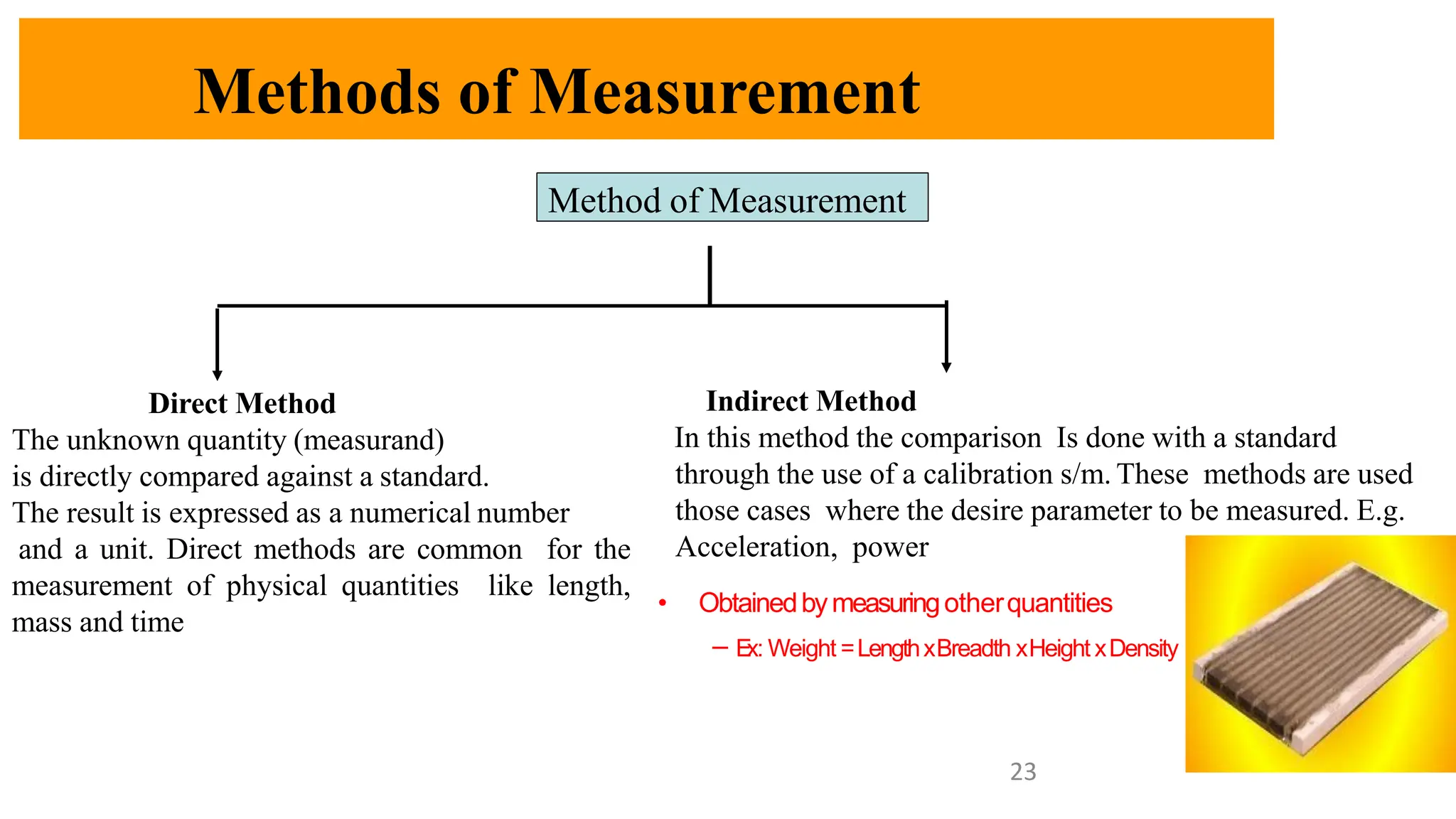
Direct Method
The unknown quantity (measurand)
is directly compared against a standard.
The result is expressed as a numerical number
and a unit. Direct methods are common for the
measurement of physical quantities like length,
mass and time
Indirect Method
In this method the comparison Is done with a standard
through the use of a calibration s/m. These methods are used
those cases where the desire parameter to be measured. E.g.
Acceleration, power
Method of Measurement
23
• Obtainedbymeasuringotherquantities
– E
x: Weight =LengthxBreadth xHeight xDensity
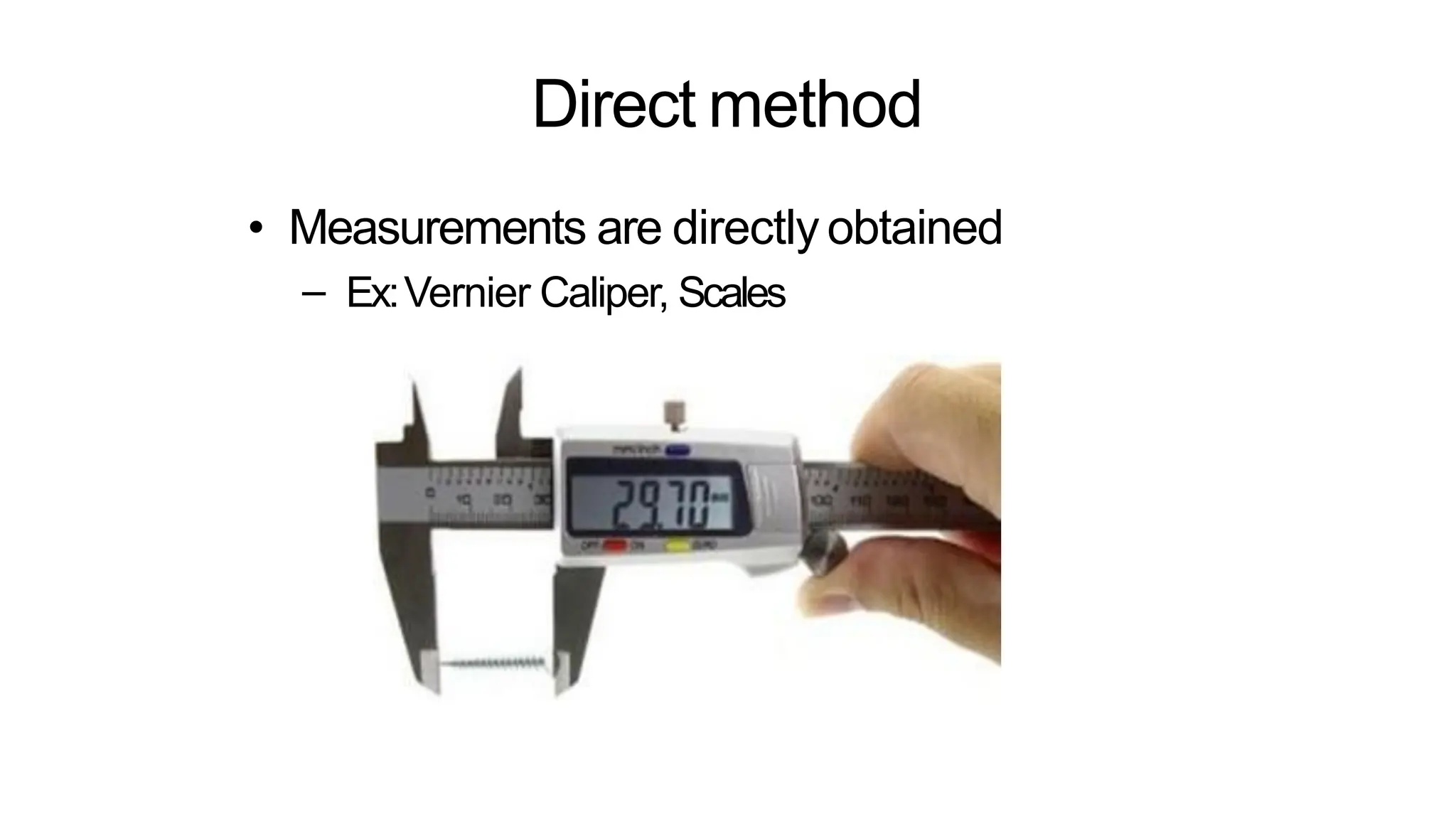
Direct method
• Measurements are directly obtained
– Ex:Vernier Caliper, Scales
Direct Methods Clasified as:
❑Deflection methods
Deflection method” includes the deflection of pointer on a scale
due to the quantity to be measured. Example: Wattmeter, ammeter
voltmeter
❑Comparison methods
“Comparison method” include the comparison of the quantity
under measurement with a pre-defined standard quantity which
gives measurement. Example: potentiometer
25
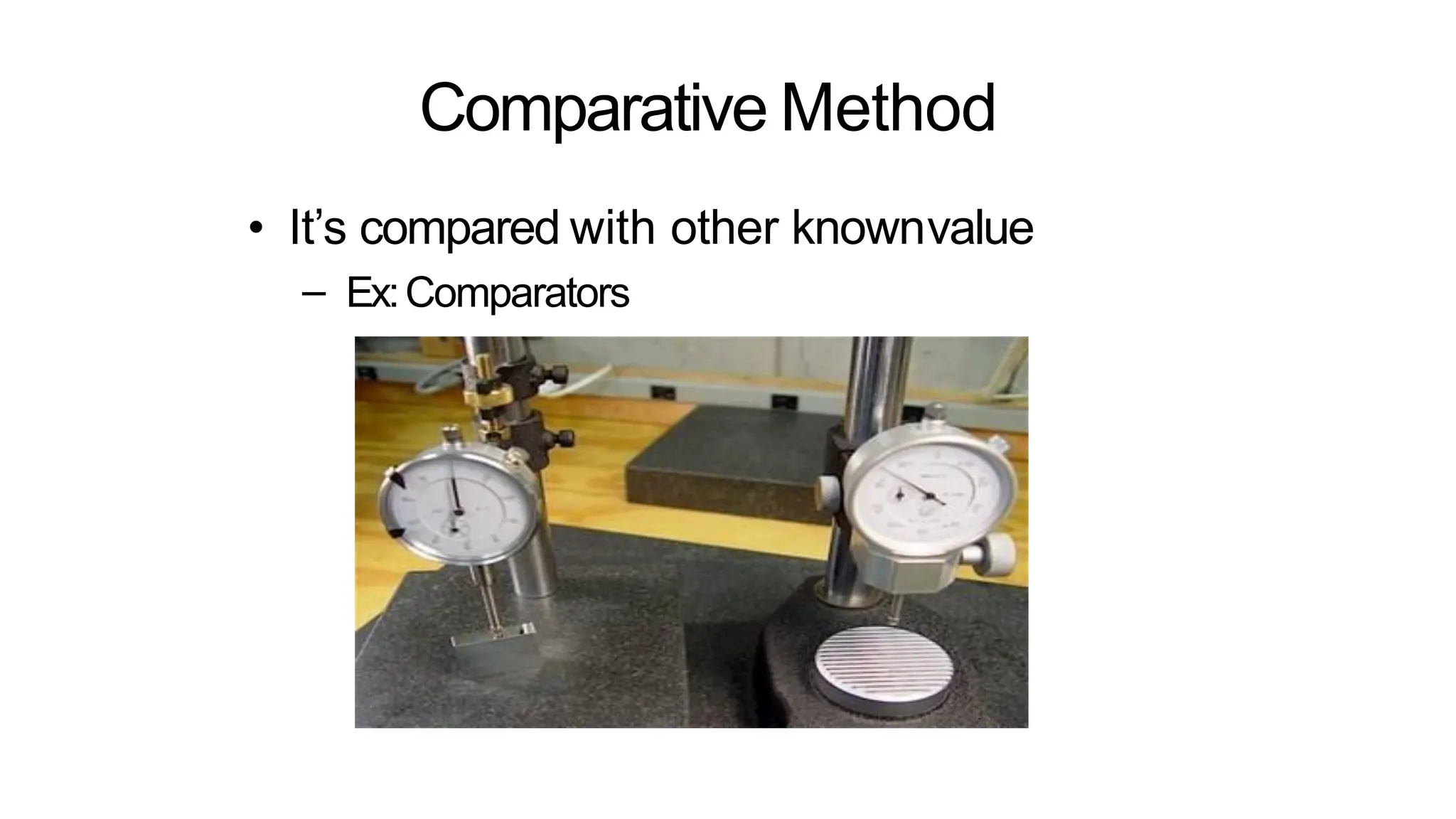
Comparative Method
• It’s compared with other knownvalue
– Ex:Comparators
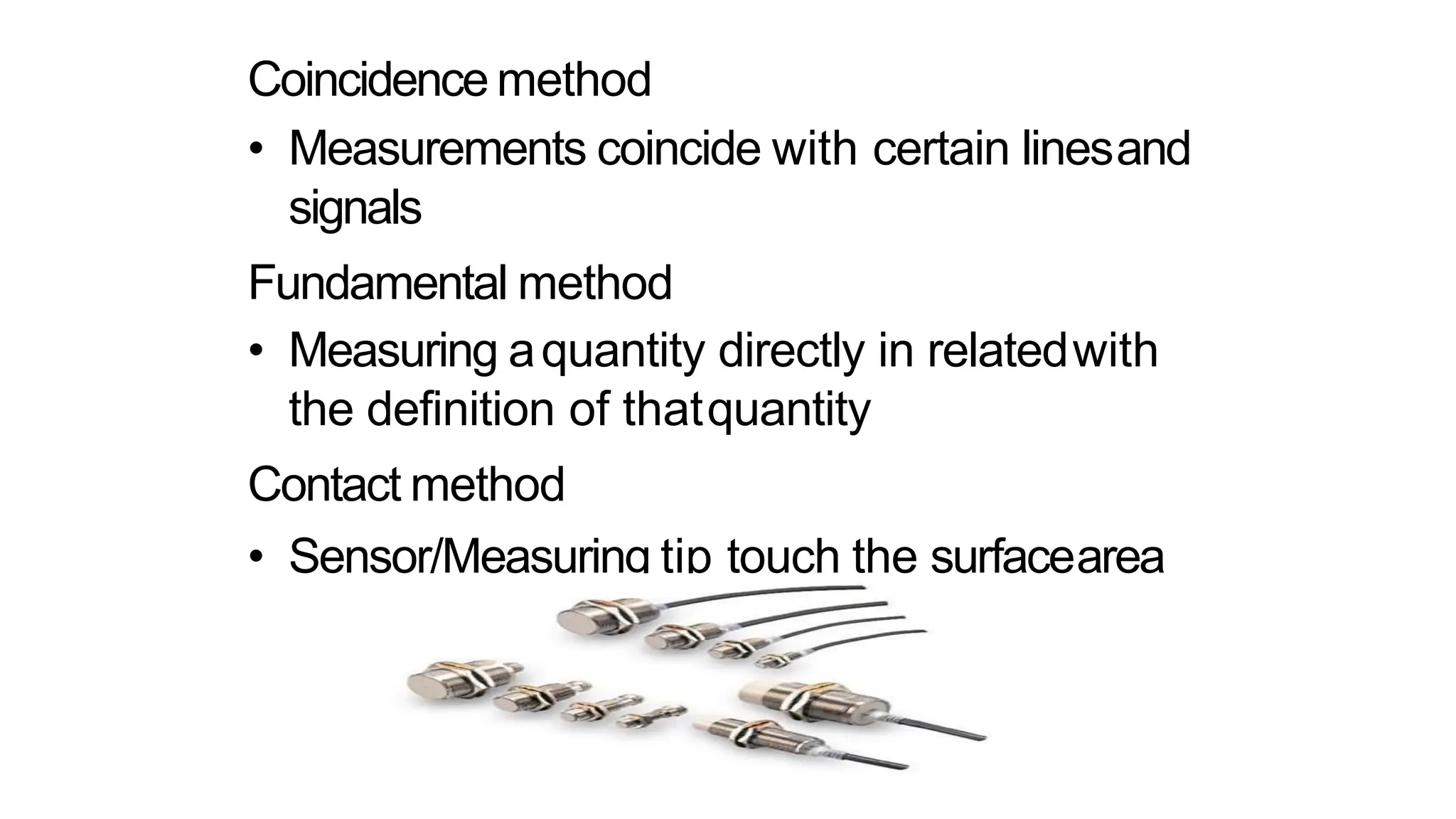
Coincidence method
• Measurements coincide with certain linesand
signals
Fundamental method
• Measuring aquantity directly in relatedwith
the definition of thatquantity
Contact method
• Sensor/Measuring tip touch the surfacearea
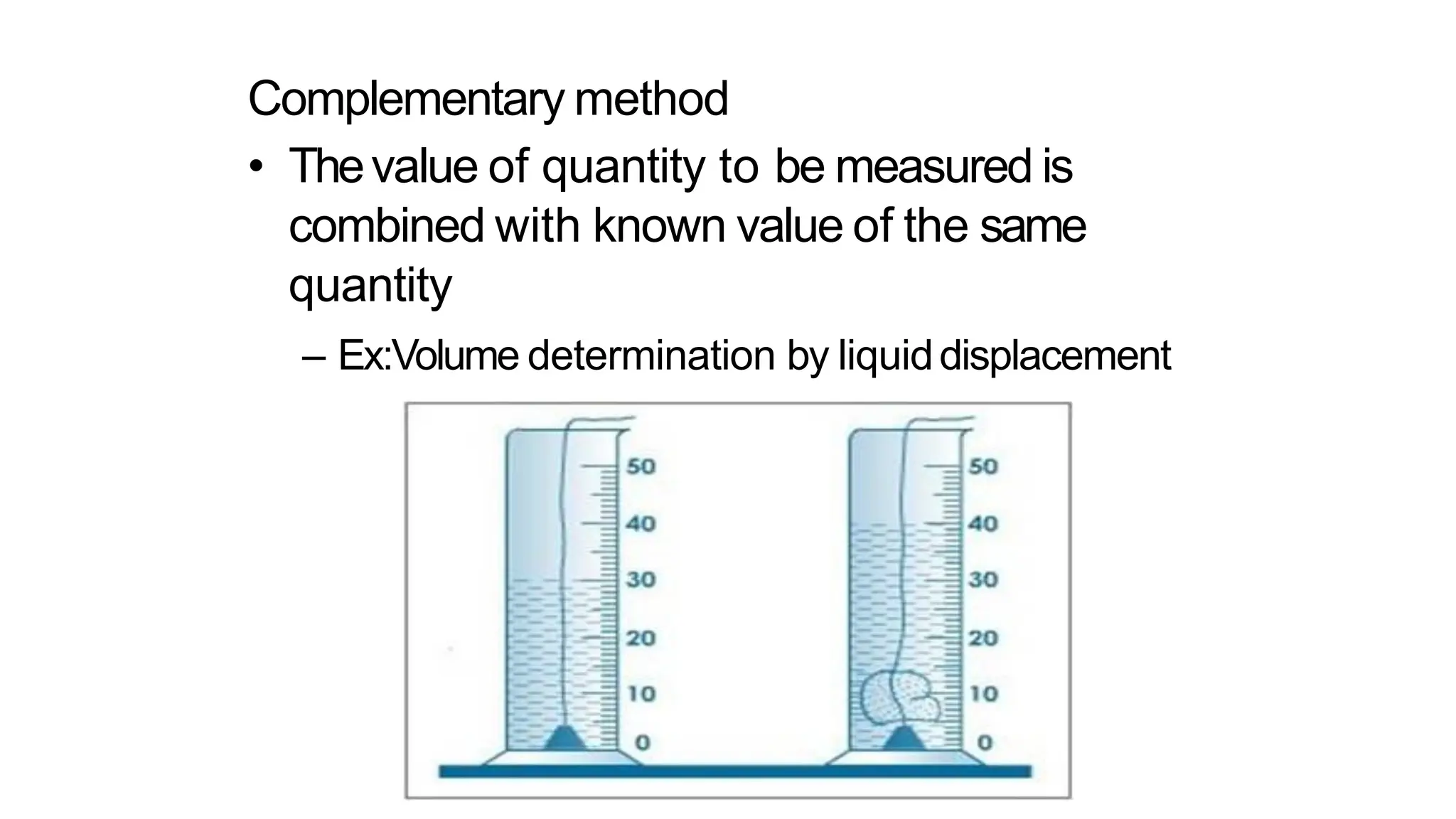
Complementary method
• Thevalue of quantity to be measured is
combined with known value of the same
quantity
– Ex:Volume determination by liquiddisplacement
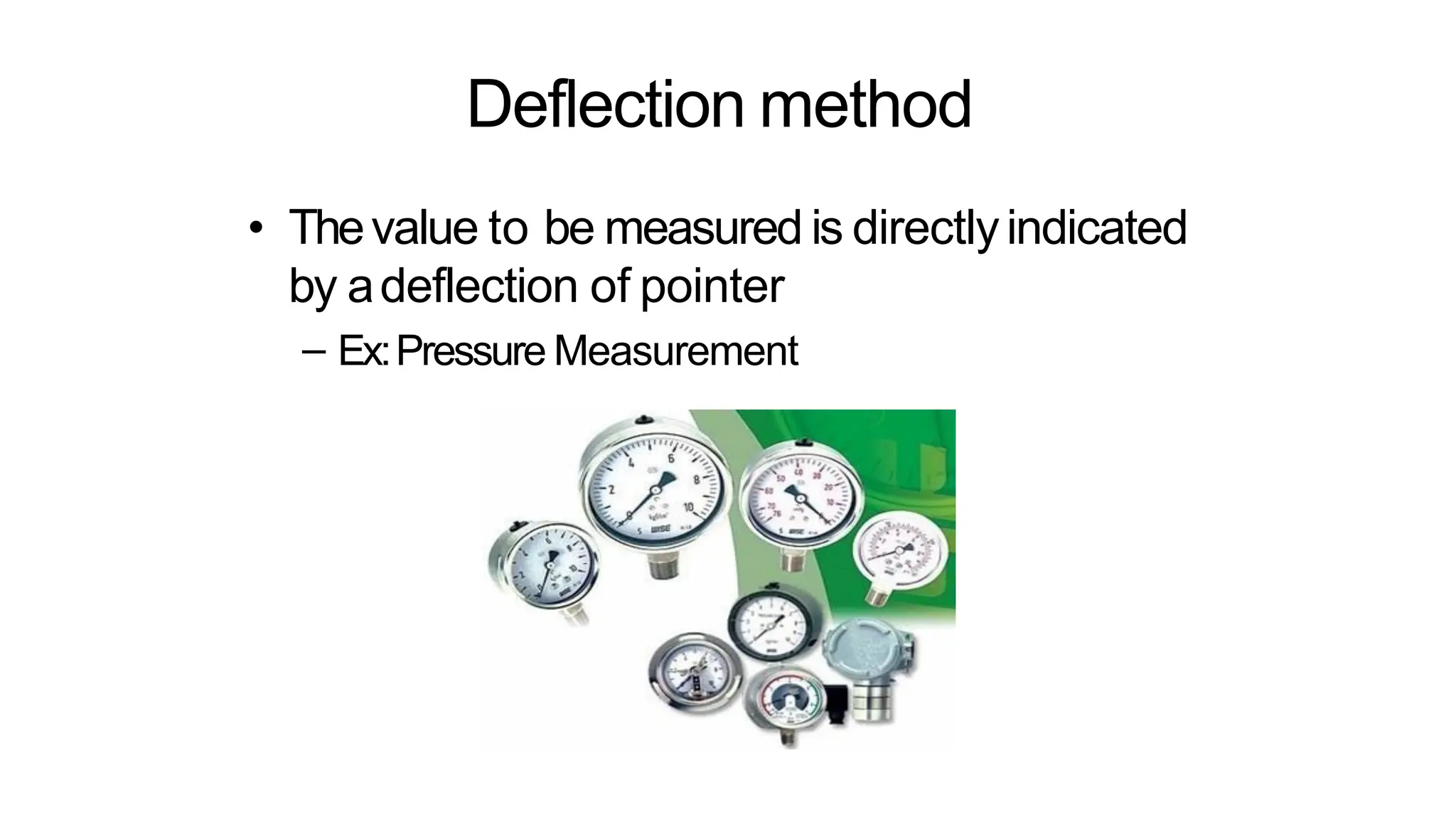
Deflection method
• Thevalue to be measured is directlyindicated
by adeflection of pointer
– Ex:Pressure Measurement
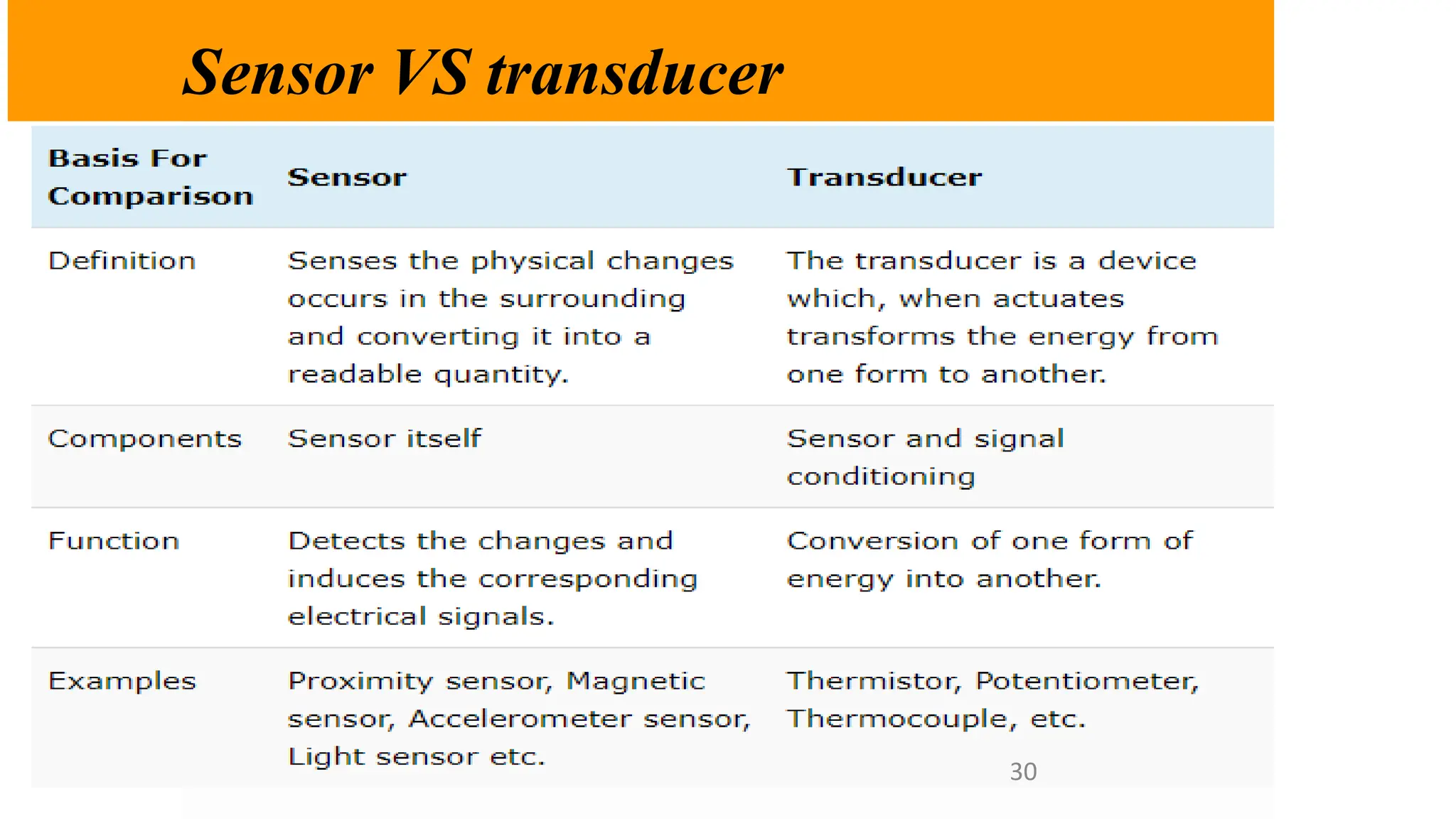
Sensor VS transducer
30
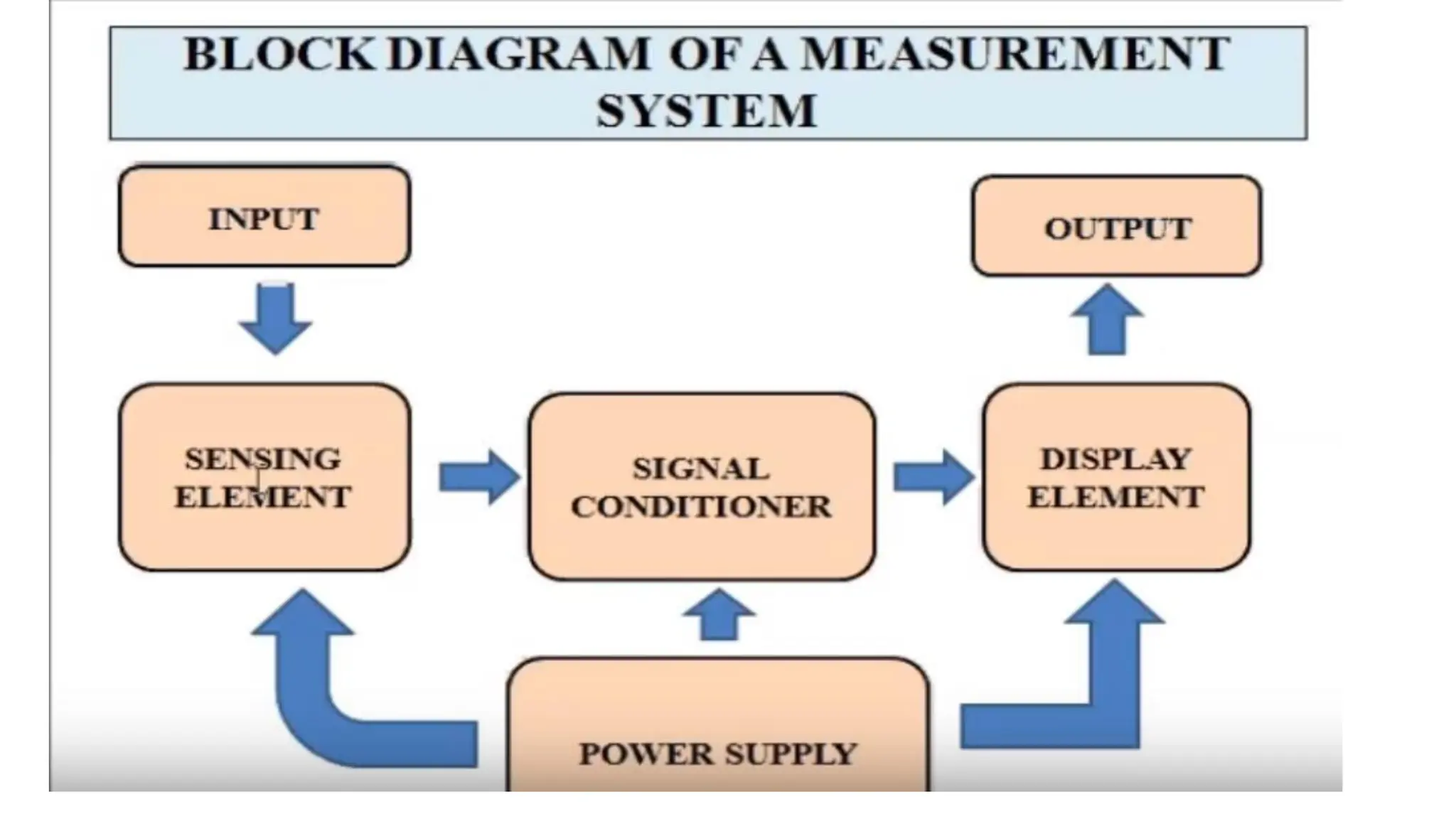
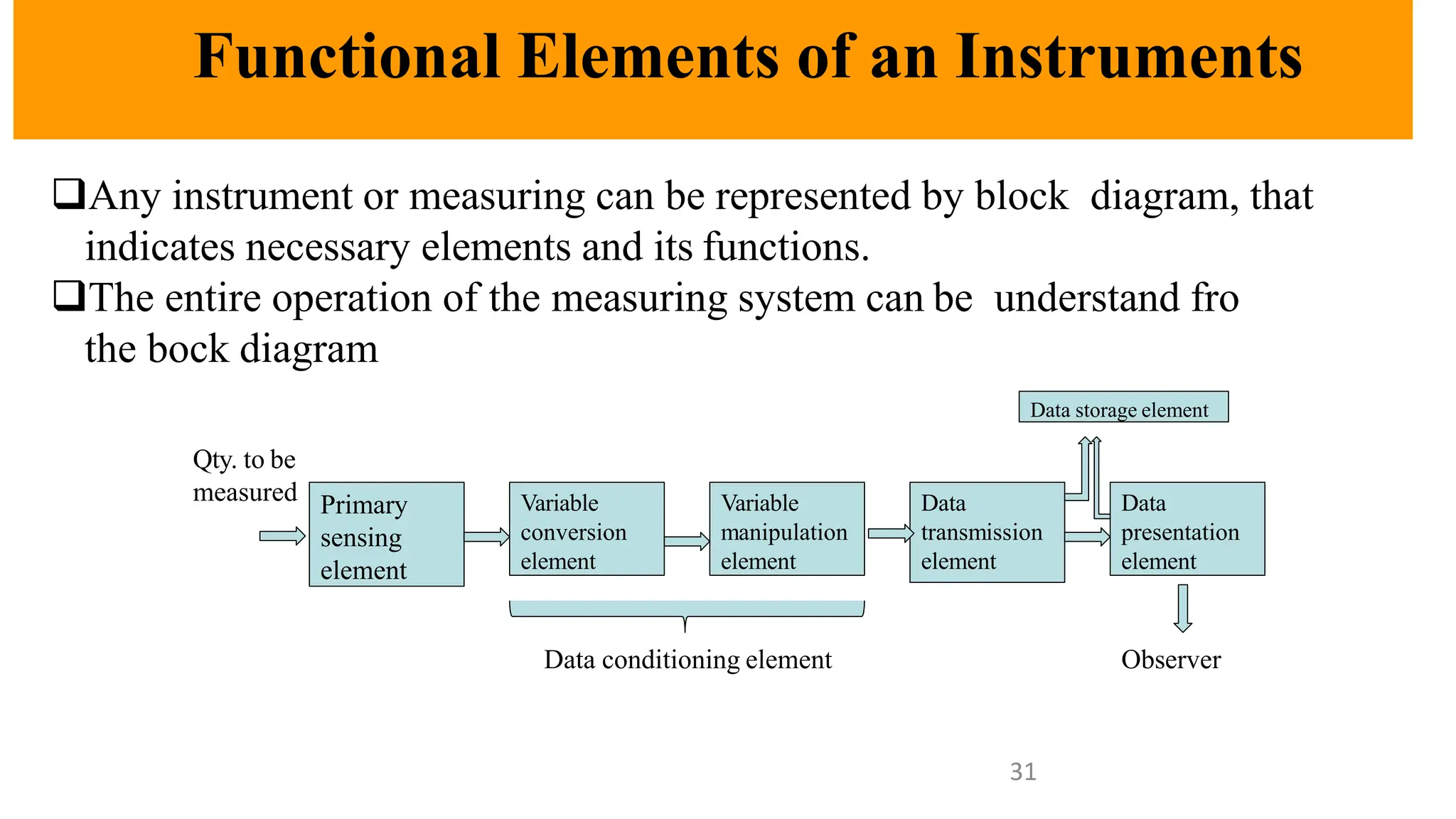
Functional Elements of an Instruments
❑Any instrument or measuring can be represented by block diagram, that
indicates necessary elements and its functions.
❑The entire operation of the measuring system can be understand fro
the bock diagram
Primary
sensing
element
Variable
conversion
element
Variable
manipulation
element
Data
transmission
element
Data
presentation
element
Qty. to be
measured
Data conditioning element Observer
Data storage element
31
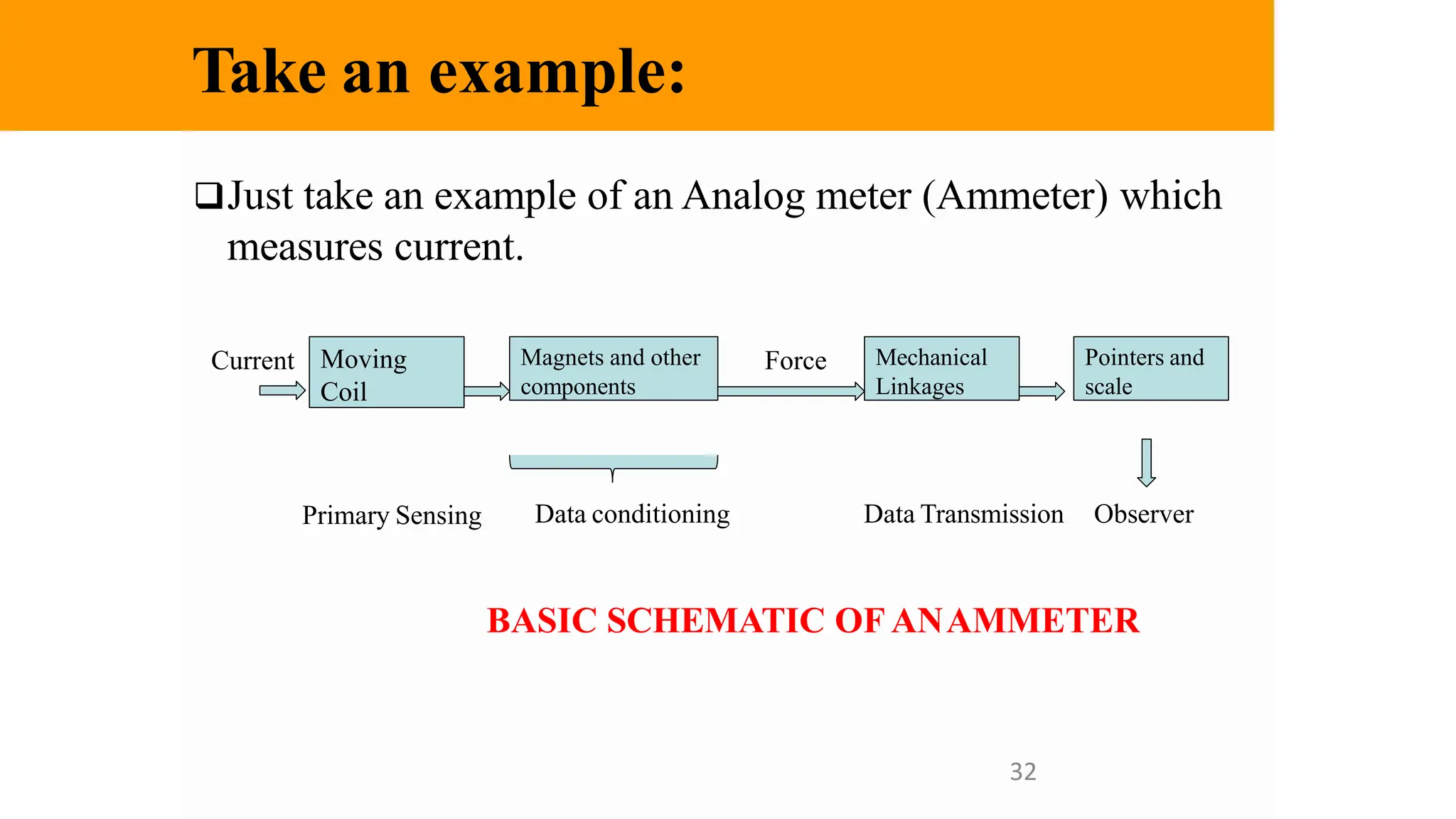
Take an example:
❑Just take an example of an Analog meter (Ammeter) which
measures current.
Moving
Coil
Magnets and other
components
Mechanical
Linkages
Pointers and
scale
Current
Data conditioning Observer
Primary Sensing Data Transmission
Force
BASIC SCHEMATIC OF ANAMMETER
32
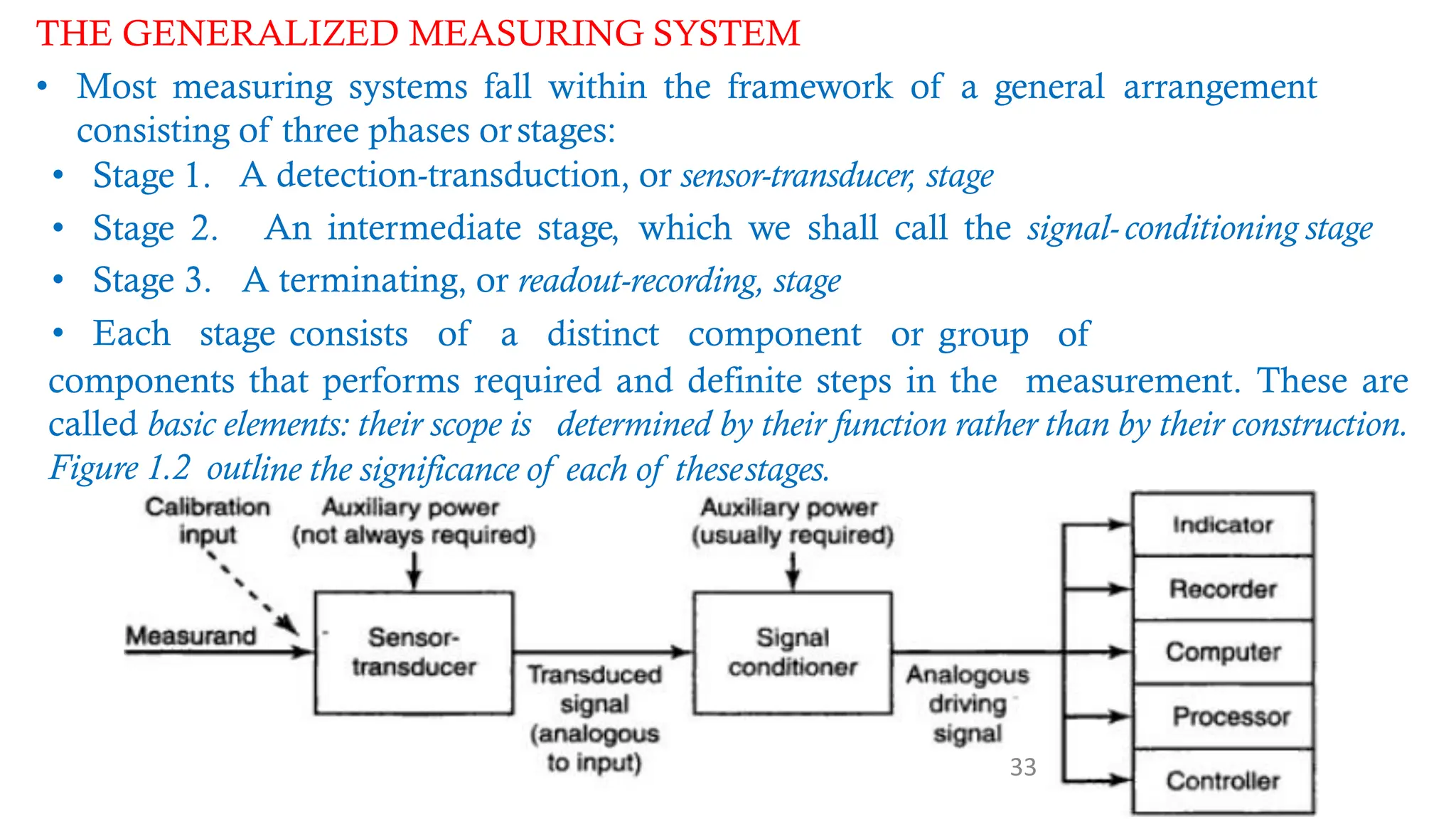
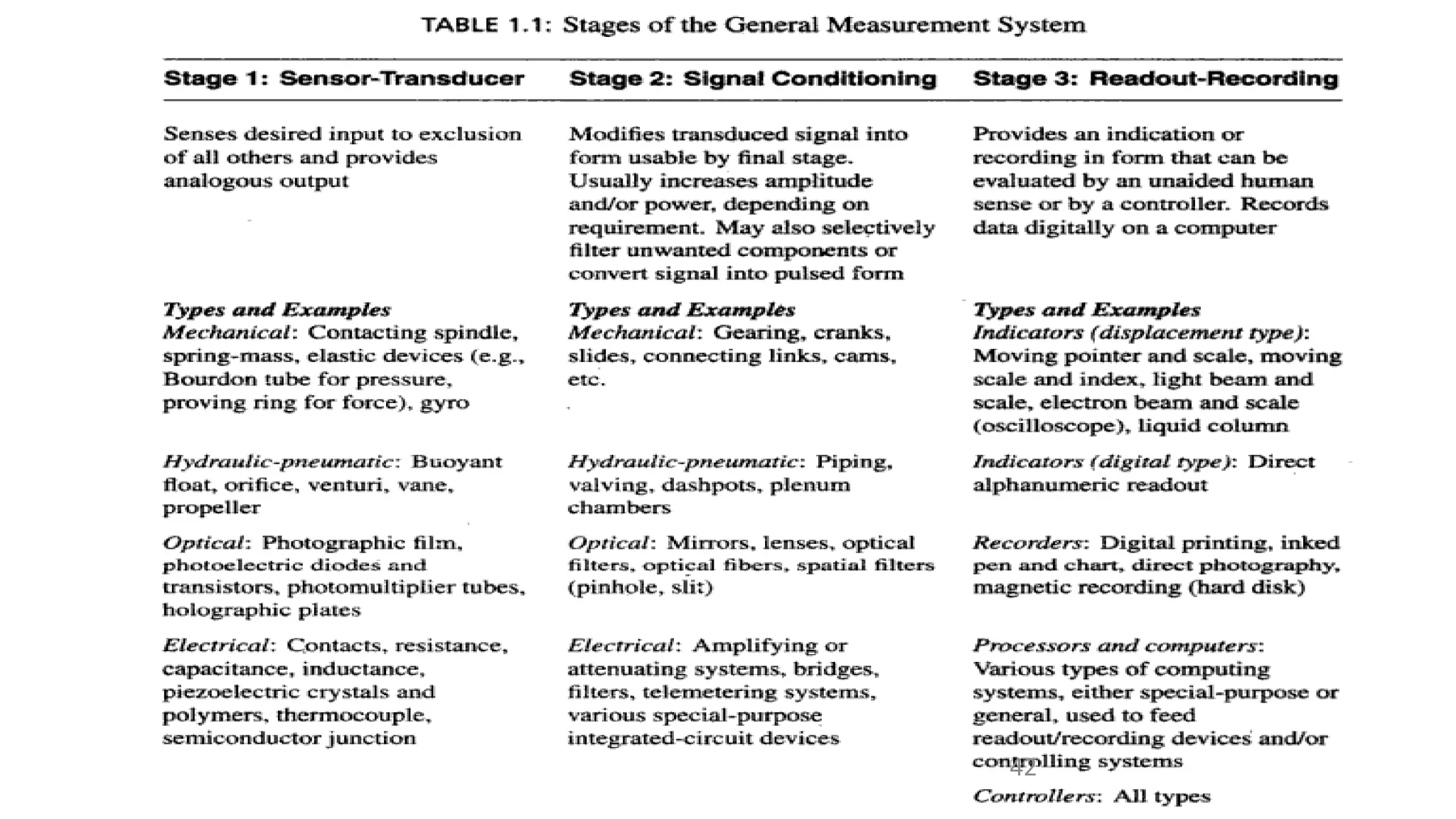
THE GENERALIZED MEASURING SYSTEM
• Most measuring systems fall within the framework of a general arrangement
consisting of three phases orstages:
• Stage 1.
• Stage 2.
A detection-transduction, or sensor-transducer, stage
An intermediate stage, which we shall call the signal- conditioning stage
• Stage 3. A terminating, or readout-recording, stage
• Each stage consists of a distinct component or group of
components that performs required and definite steps in the measurement. These are
called basic elements: their scope is determined by their function rather than by their construction.
Figure 1.2 outline the significance of each of thesestages.
33
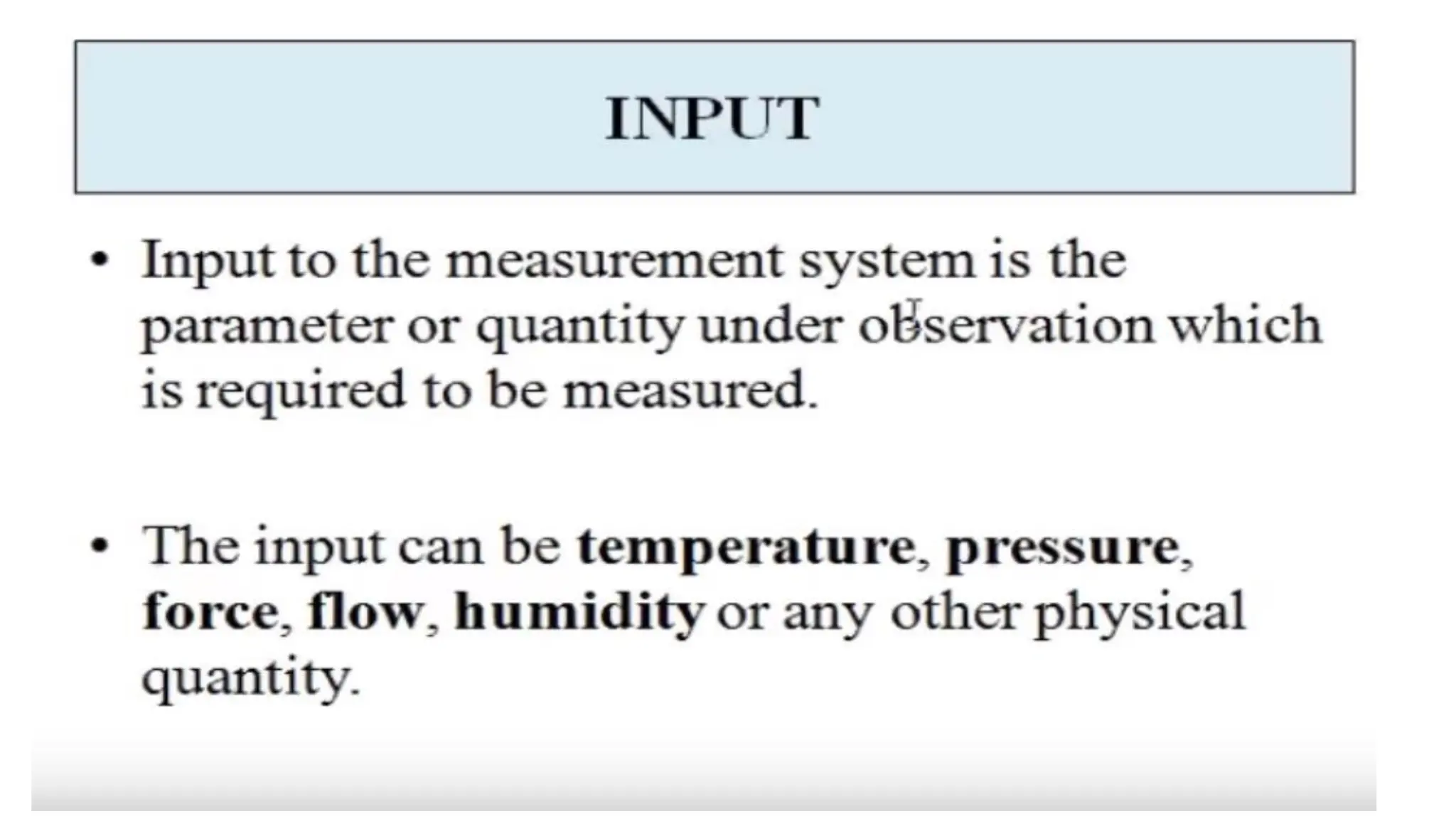
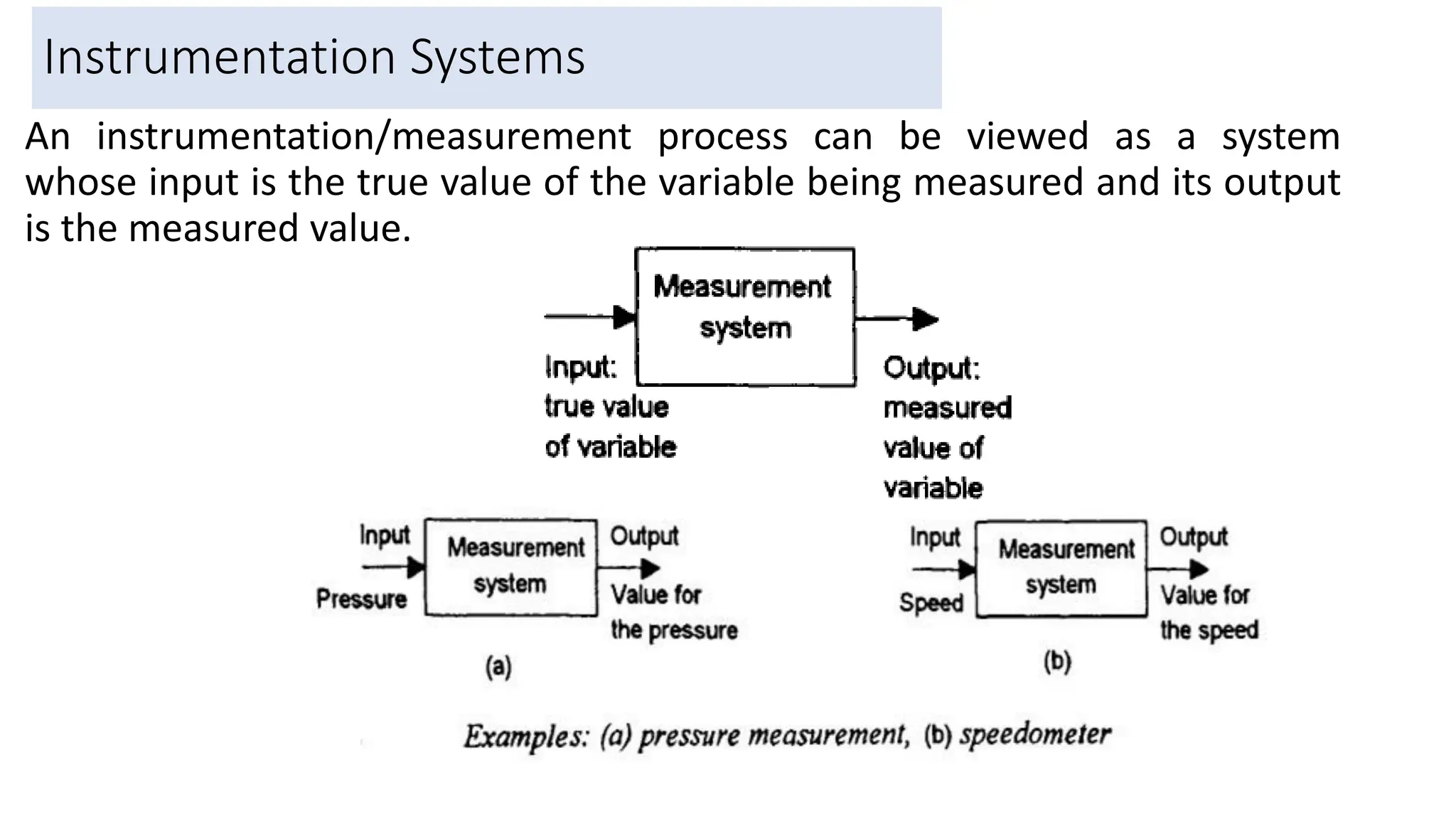
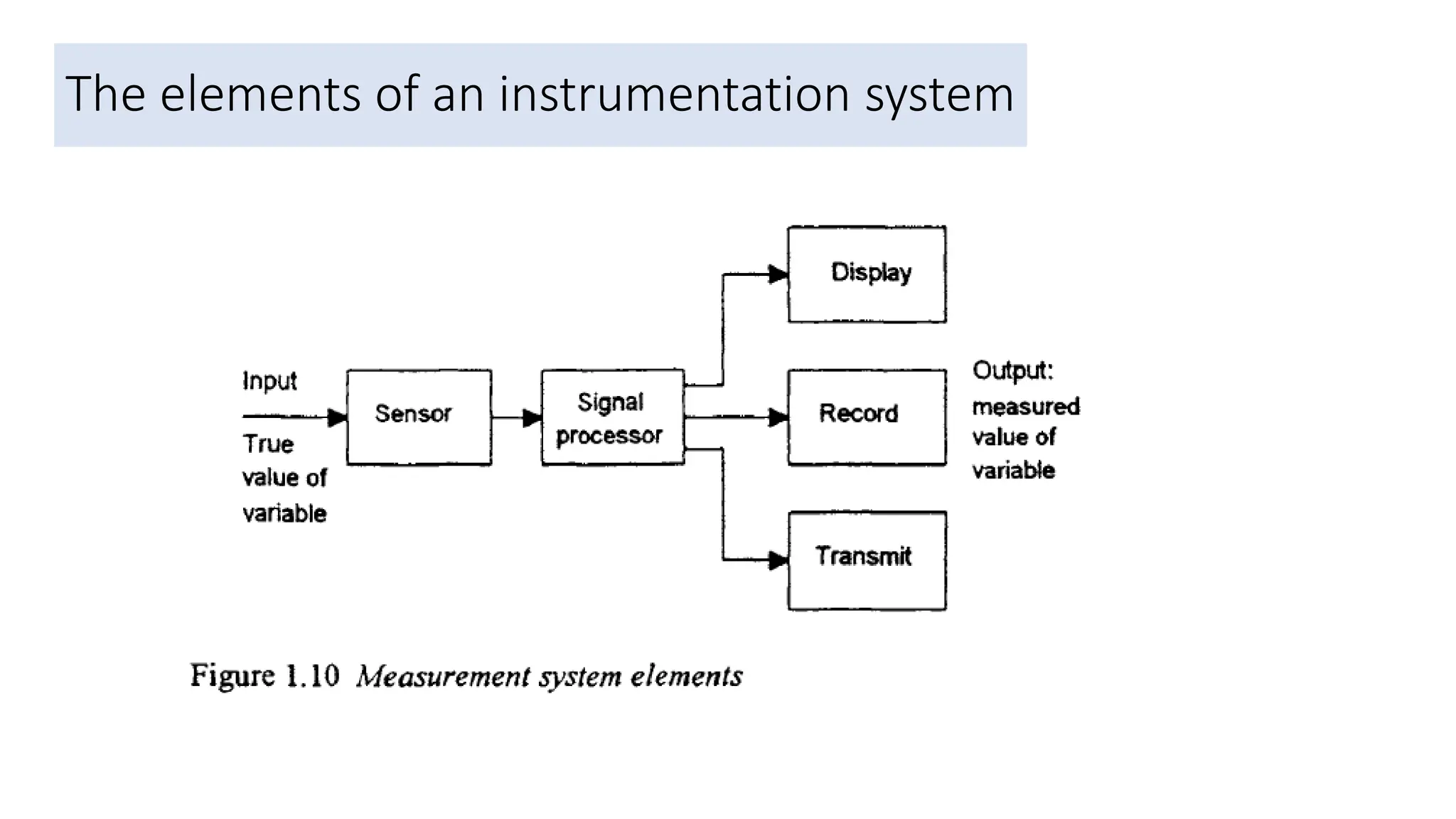
Instrumentation Systems
An instrumentation/measurement process can be viewed as a system
whose input is the true value of the variable being measured and its output
is the measured value.
34
The elements of an instrumentation system
35
36
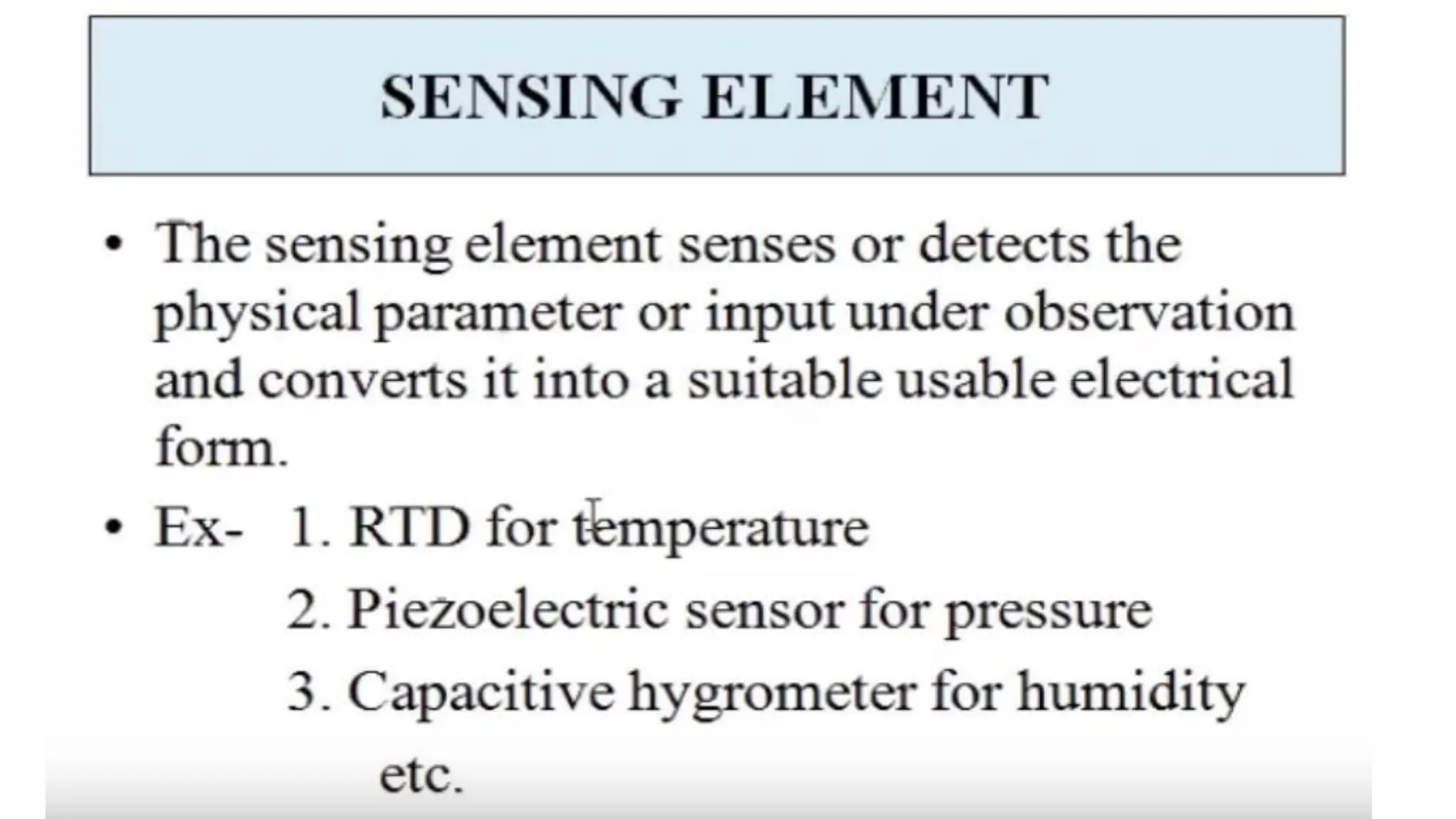
First, or Sensor-Transducer, Stage
• The primary function of the first stage is to detect or to sense themeasurand.
• At the same time, ideally, this stage should be insensitive to every other possible input.
• For instance, if it is a pressure pickup, it should be insensitive to say,
acceleration;
• if it is a strain gage, it should be insensitive totemperature;
• if a linear accelerometer, it should be insensitive to angular acceleration; and so on.
• Unfortunately, it is rare indeed to find a detecting device that is completely selective.
• Unwanted sensitivity is a measuring error, called noise.
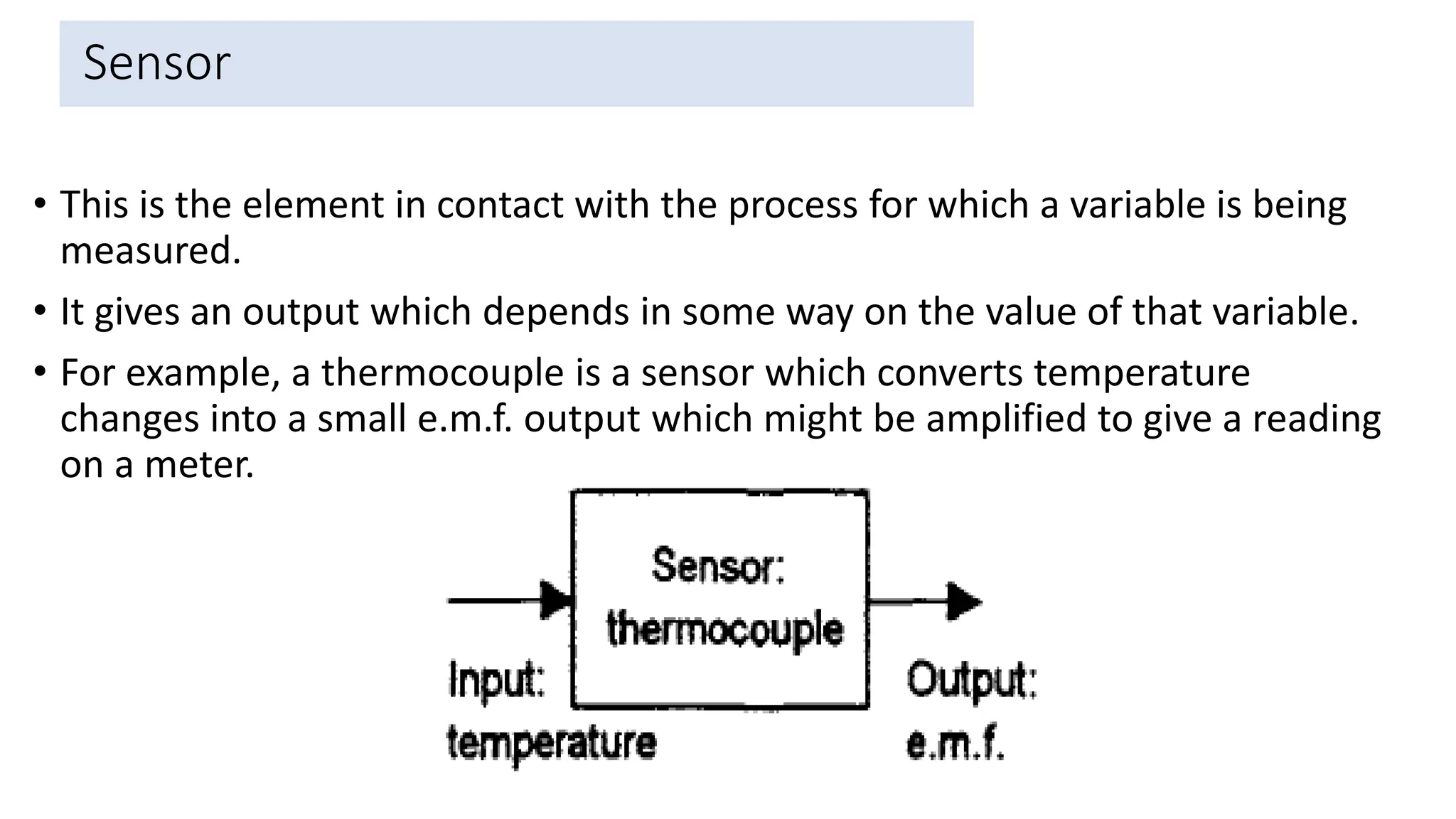
Sensor
• This is the element in contact with the process for which a variable is being
measured.
• It gives an output which depends in some way on the value of that variable.
• For example, a thermocouple is a sensor which converts temperature
changes into a small e.m.f. output which might be amplified to give a reading
on a meter.
37
38
Second, or Signal-Conditioning, Stage
• The purpose of the second stage of the general system is to modify the
transduced information so that it is acceptable to the third, or terminating
stage.
• In addition, it may perform one or more basic operations, such as selective
filtering to remove noise, integration, differentiation, as may be required.
• Probably the most common function of the second stage is to increase
either amplitude or power of the signal, or both, to the level required to
drive the final terminating device.
Signal Conditioner
• As we have seen in previous lectures, this element converts the sensor
output into a form which is suitable for further processing such as display or
onward transmission in some control system.
• For example, in the case of the resistance thermistor there might be a signal
conditioner, a Wheatstone bridge, which transforms the resistance change
into a voltage change, then an amplifier to make the voltage big enough for
display.
39
40
Third, or Readout-Recording, Stage
• The third stage provides the information sought in a form
comprehensible to one of the human senses or to a controller.
• If the output is intended for immediate human recognition, it is,
with rare exception, presented in one of the following forms:
– As a relative displacement, such as movement of an indicating hand or
displacement of oscilloscope trace
– In digital form, as presented by a counter such as an automobile odometer, or by
a liquid crystal display (LCD) or light-emitting diode (LED) display as on a
digital voltmeter
Data presentation
• This presents or displays the measured value in a suitable form for the
operator.
• This may be done using a pointer moving across the scale of a meter or by
presenting information on a visual display.
• Alternatively, the signal may be recorded, e.g. on the paper of a chart
recorder or transmitted to some other system such as a control system.
41
42
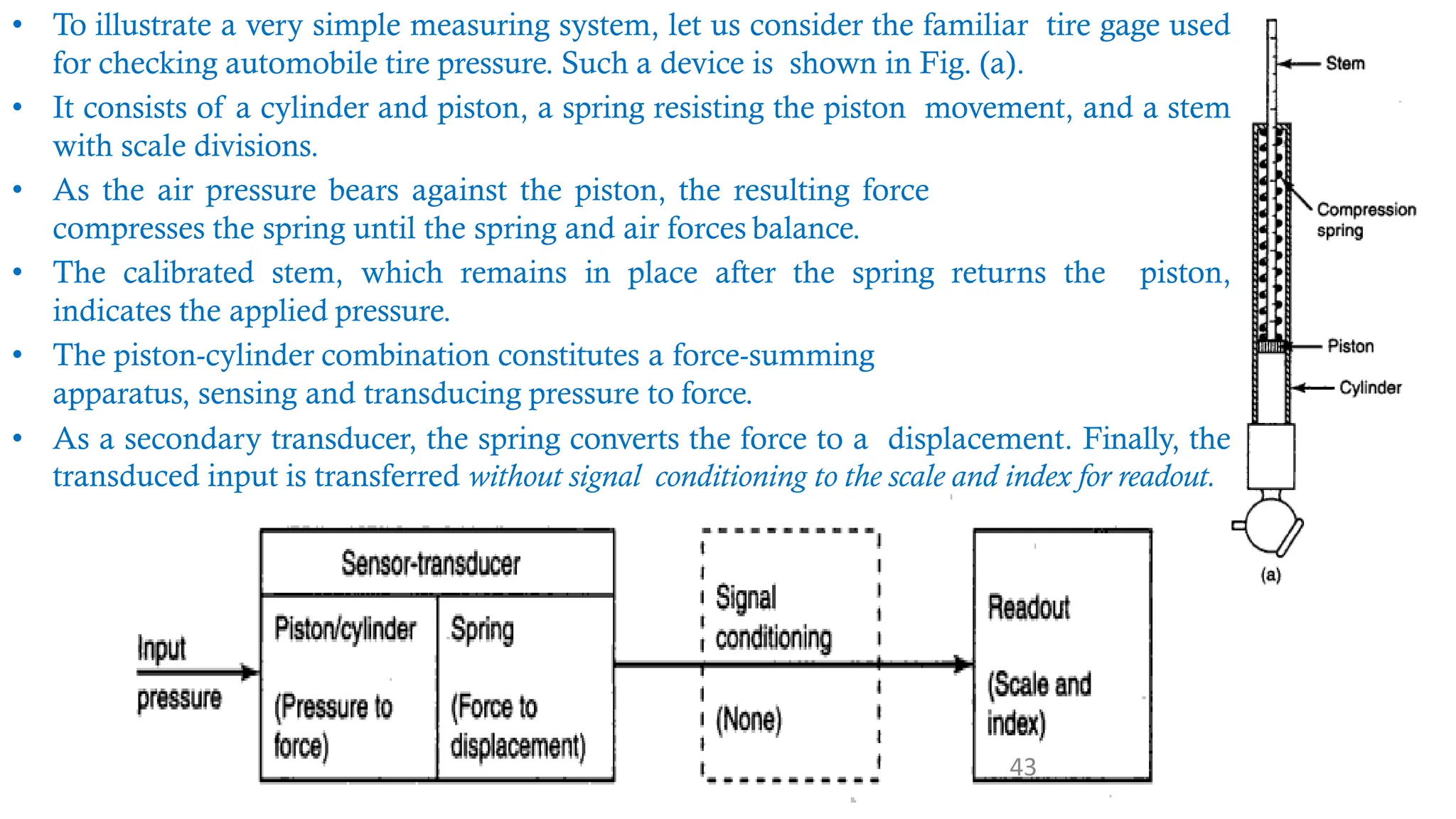
• To illustrate a very simple measuring system, let us consider the familiar tire gage used
for checking automobile tire pressure. Such a device is shown in Fig. (a).
• It consists of a cylinder and piston, a spring resisting the piston movement, and a stem
with scale divisions.
• As the air pressure bears against the piston, the resulting force
compresses the spring until the spring and air forces balance.
• The calibrated stem, which remains in place after the spring returns the piston,
indicates the applied pressure.
• The piston-cylinder combination constitutes a force-summing
apparatus, sensing and transducing pressure to force.
• As a secondary transducer, the spring converts the force to a displacement. Finally, the
transduced input is transferred without signal conditioning to the scale and index for readout.
43
Thank you

Measurement System and concept of measuring.pptx.pdf

  • 1.
    Measurement System & Concept ofMeasurement & Methods of Measurement & Functional Elements of an Instruments First Lecture
  • 2.
  • 3.
    SI:fundamental Units Physical QuantityUnit Name Symbol length meter m mass kilogram kg time second s electric current ampere A temperature Kelvin K amount of substance mole mol luminous intensity candela cd
  • 4.
    SI:Derived Units Physical Quantity area volume UnitName square meter cubic meter meter per second meter per second squared newton pascal joule Symbol m2 m3 speed m/s acceleration m/s2 weight, force pressure energy, work N Pa J
  • 5.
    Supplementary units PhysicalQuantity UnitNameSymbol Planeangle Radian rad Solid angle Steradian sr
  • 6.
    Standards • International standards •Primary standards • Secondary standards • Working standards
  • 14.
    Scientists use manyskills as they investigate the world around them. They make observations by gathering information with their senses. Some observations are simple. For example, a simple observation would be figuring out the color or texture of an object. However, if scientists want to know more about a substance, they may need to take measurements. Measurement is perhaps one of the most fundamental concepts in science. Without the ability to measure, it would be difficult for scientists to conduct experiments or form theories. It is also essential in farming, engineering, construction, manufacturing, commerce, and numerous other occupations and activities.
  • 15.
    15 Measurements and measurementsystems: • Definition, significance of measurement, generalized measurement system. • Definitions and concept of accuracy, precision, calibration, threshold, sensitivity, hysteresis, repeatability, linearity, loading effect, system response-times delay. • Errors in measurement, classification of errors. • Transducers, transfer efficiency, primary and secondary transducers, electrical, mechanical, electronic transducers, advantages of each typetransducers.
  • 16.
    MEASUREMENT SYSTEM: • Measurementmeans determination of anything that exists in some amount. • If those things that exist are related to mechanical engineering, then the determination of such amounts are referred to as mechanical measurements. • An engineer is not only interested in the measurement of physical variables but also concerned with their control. • These two functions are closely related because one must be able to measure a variable such as temperature, or flow in order to control it. • The accuracy of control is essentially dependent on the accuracy of measurement. Hence, a good knowledge of measurement techniques is necessary for the design of control systems. Definition of Measurement : Measurement is defined as the process or the act of obtaining a quantitative comparison between a predefined standard and an unknown magnitude. 16
  • 17.
  • 18.
    18 SIGNIFICANCE OF MEASUREMENTSYSTEM • Measurement provides the fundamental basis for research and development. Development is the final stage of the design procedure involving the measurement of various quantities pertaining to operation and performance of the device being developed. • Measurement is also a fundamental element of any control process, which requires the measured discrepancy between the actual and the desired performances. • Many operations require measurement for proper performance. For example : In modern central power stations, temperatures, pressures, vibrational amplitudes etc., are monitored by measurement to ensure proper performance. • Measurement is also a bias of commerce, because the cost of the products are established on the basis of amounts of materials, power, expenditure of time and labour, and other constraints.
  • 19.
    Contd.. 12 Measured Value: Anyvalue or any reading calculated from measurement system or measuring instrument. True value: Any value calculated from rated value known as True value ofActual Value. e.g. Motor Actual Speed Error : Any deviation of measured value from true value Measured Value-TrueValue Measuring Instrument True Value Measured Value
  • 20.
    Why measure things? •Checkquality? • Checktolerances? Measurements require tools and provide scientists with a quantity. A quantity describes how much of something there is or how many there are. A good example of measurement is using a ruler to find the length of an object. The object is whatever you are measuring, the property you are trying to determine is the object’s length, and the standard you are comparing the object’s length to is the ruler.
  • 21.
    Need of Measurement •Establish standard • Interchangeability • Customer Satisfaction • Validate the design • Physicalparameter into meaningfulnumber • True dimension • Evaluate the Performance
  • 22.
    Methods of Measurement •Direct method • Indirect method • Comparative method • Coincidence method • Contact method • Deflection method • Complementary method
  • 23.
    Methods of Measurement DirectMethod The unknown quantity (measurand) is directly compared against a standard. The result is expressed as a numerical number and a unit. Direct methods are common for the measurement of physical quantities like length, mass and time Indirect Method In this method the comparison Is done with a standard through the use of a calibration s/m. These methods are used those cases where the desire parameter to be measured. E.g. Acceleration, power Method of Measurement 23 • Obtainedbymeasuringotherquantities – E x: Weight =LengthxBreadth xHeight xDensity
  • 24.
    Direct method • Measurementsare directly obtained – Ex:Vernier Caliper, Scales
  • 25.
    Direct Methods Clasifiedas: ❑Deflection methods Deflection method” includes the deflection of pointer on a scale due to the quantity to be measured. Example: Wattmeter, ammeter voltmeter ❑Comparison methods “Comparison method” include the comparison of the quantity under measurement with a pre-defined standard quantity which gives measurement. Example: potentiometer 25
  • 26.
    Comparative Method • It’scompared with other knownvalue – Ex:Comparators
  • 27.
    Coincidence method • Measurementscoincide with certain linesand signals Fundamental method • Measuring aquantity directly in relatedwith the definition of thatquantity Contact method • Sensor/Measuring tip touch the surfacearea
  • 28.
    Complementary method • Thevalueof quantity to be measured is combined with known value of the same quantity – Ex:Volume determination by liquiddisplacement
  • 29.
    Deflection method • Thevalueto be measured is directlyindicated by adeflection of pointer – Ex:Pressure Measurement
  • 30.
  • 31.
    Functional Elements ofan Instruments ❑Any instrument or measuring can be represented by block diagram, that indicates necessary elements and its functions. ❑The entire operation of the measuring system can be understand fro the bock diagram Primary sensing element Variable conversion element Variable manipulation element Data transmission element Data presentation element Qty. to be measured Data conditioning element Observer Data storage element 31
  • 32.
    Take an example: ❑Justtake an example of an Analog meter (Ammeter) which measures current. Moving Coil Magnets and other components Mechanical Linkages Pointers and scale Current Data conditioning Observer Primary Sensing Data Transmission Force BASIC SCHEMATIC OF ANAMMETER 32
  • 33.
    THE GENERALIZED MEASURINGSYSTEM • Most measuring systems fall within the framework of a general arrangement consisting of three phases orstages: • Stage 1. • Stage 2. A detection-transduction, or sensor-transducer, stage An intermediate stage, which we shall call the signal- conditioning stage • Stage 3. A terminating, or readout-recording, stage • Each stage consists of a distinct component or group of components that performs required and definite steps in the measurement. These are called basic elements: their scope is determined by their function rather than by their construction. Figure 1.2 outline the significance of each of thesestages. 33
  • 34.
    Instrumentation Systems An instrumentation/measurementprocess can be viewed as a system whose input is the true value of the variable being measured and its output is the measured value. 34
  • 35.
    The elements ofan instrumentation system 35
  • 36.
    36 First, or Sensor-Transducer,Stage • The primary function of the first stage is to detect or to sense themeasurand. • At the same time, ideally, this stage should be insensitive to every other possible input. • For instance, if it is a pressure pickup, it should be insensitive to say, acceleration; • if it is a strain gage, it should be insensitive totemperature; • if a linear accelerometer, it should be insensitive to angular acceleration; and so on. • Unfortunately, it is rare indeed to find a detecting device that is completely selective. • Unwanted sensitivity is a measuring error, called noise.
  • 37.
    Sensor • This isthe element in contact with the process for which a variable is being measured. • It gives an output which depends in some way on the value of that variable. • For example, a thermocouple is a sensor which converts temperature changes into a small e.m.f. output which might be amplified to give a reading on a meter. 37
  • 38.
    38 Second, or Signal-Conditioning,Stage • The purpose of the second stage of the general system is to modify the transduced information so that it is acceptable to the third, or terminating stage. • In addition, it may perform one or more basic operations, such as selective filtering to remove noise, integration, differentiation, as may be required. • Probably the most common function of the second stage is to increase either amplitude or power of the signal, or both, to the level required to drive the final terminating device.
  • 39.
    Signal Conditioner • Aswe have seen in previous lectures, this element converts the sensor output into a form which is suitable for further processing such as display or onward transmission in some control system. • For example, in the case of the resistance thermistor there might be a signal conditioner, a Wheatstone bridge, which transforms the resistance change into a voltage change, then an amplifier to make the voltage big enough for display. 39
  • 40.
    40 Third, or Readout-Recording,Stage • The third stage provides the information sought in a form comprehensible to one of the human senses or to a controller. • If the output is intended for immediate human recognition, it is, with rare exception, presented in one of the following forms: – As a relative displacement, such as movement of an indicating hand or displacement of oscilloscope trace – In digital form, as presented by a counter such as an automobile odometer, or by a liquid crystal display (LCD) or light-emitting diode (LED) display as on a digital voltmeter
  • 41.
    Data presentation • Thispresents or displays the measured value in a suitable form for the operator. • This may be done using a pointer moving across the scale of a meter or by presenting information on a visual display. • Alternatively, the signal may be recorded, e.g. on the paper of a chart recorder or transmitted to some other system such as a control system. 41
  • 42.
  • 43.
    • To illustratea very simple measuring system, let us consider the familiar tire gage used for checking automobile tire pressure. Such a device is shown in Fig. (a). • It consists of a cylinder and piston, a spring resisting the piston movement, and a stem with scale divisions. • As the air pressure bears against the piston, the resulting force compresses the spring until the spring and air forces balance. • The calibrated stem, which remains in place after the spring returns the piston, indicates the applied pressure. • The piston-cylinder combination constitutes a force-summing apparatus, sensing and transducing pressure to force. • As a secondary transducer, the spring converts the force to a displacement. Finally, the transduced input is transferred without signal conditioning to the scale and index for readout. 43

  • 44.