PLC M10
S.S.Paheerathan 1
PLC COUNTER
 A PLC counter is a function block that counts up or down until it
reaches a limit. When the limit is reached the output is set.
 An example of this could be to keep track of how many times a
process has been completed. Or how many products has been
produced.
COUNTERS IN PLC PROGRAMMING:
TYPES of Counter Function Blocks
1. UP COUNTER (CTU)
2. DOWN COUNTER (CTD)
3. UPDOWN COUNTER (CTUD)
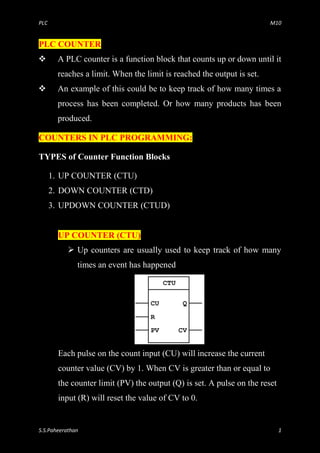
UP COUNTER (CTU)
 Up counters are usually used to keep track of how many
times an event has happened
Each pulse on the count input (CU) will increase the current
counter value (CV) by 1. When CV is greater than or equal to
the counter limit (PV) the output (Q) is set. A pulse on the reset
input (R) will reset the value of CV to 0.
PLC M10
S.S.Paheerathan 2
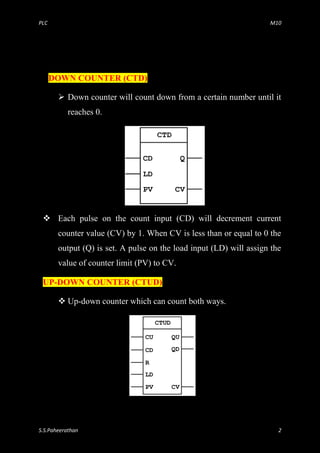
DOWN COUNTER (CTD)
 Down counter will count down from a certain number until it
reaches 0.
 Each pulse on the count input (CD) will decrement current
counter value (CV) by 1. When CV is less than or equal to 0 the
output (Q) is set. A pulse on the load input (LD) will assign the
value of counter limit (PV) to CV.
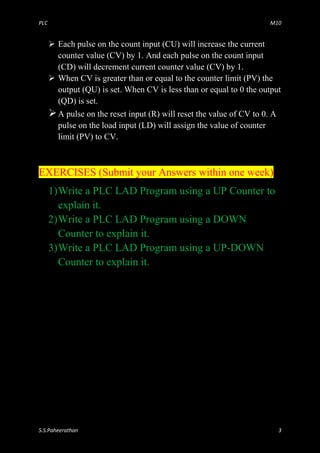
UP-DOWN COUNTER (CTUD)
 Up-down counter which can count both ways.
PLC M10
S.S.Paheerathan 3
 Each pulse on the count input (CU) will increase the current
counter value (CV) by 1. And each pulse on the count input
(CD) will decrement current counter value (CV) by 1.
 When CV is greater than or equal to the counter limit (PV) the
output (QU) is set. When CV is less than or equal to 0 the output
(QD) is set.
A pulse on the reset input (R) will reset the value of CV to 0. A
pulse on the load input (LD) will assign the value of counter
limit (PV) to CV.
EXERCISES (Submit your Answers within one week)
1)Write a PLC LAD Program using a UP Counter to
explain it.
2)Write a PLC LAD Program using a DOWN
Counter to explain it.
3)Write a PLC LAD Program using a UP-DOWN
Counter to explain it.

PLC PROGRAMMING- COUNTER INSTRUCTION

  • 1.
    PLC M10 S.S.Paheerathan 1 PLCCOUNTER  A PLC counter is a function block that counts up or down until it reaches a limit. When the limit is reached the output is set.  An example of this could be to keep track of how many times a process has been completed. Or how many products has been produced. COUNTERS IN PLC PROGRAMMING: TYPES of Counter Function Blocks 1. UP COUNTER (CTU) 2. DOWN COUNTER (CTD) 3. UPDOWN COUNTER (CTUD) UP COUNTER (CTU)  Up counters are usually used to keep track of how many times an event has happened Each pulse on the count input (CU) will increase the current counter value (CV) by 1. When CV is greater than or equal to the counter limit (PV) the output (Q) is set. A pulse on the reset input (R) will reset the value of CV to 0.
  • 2.
    PLC M10 S.S.Paheerathan 2 DOWNCOUNTER (CTD)  Down counter will count down from a certain number until it reaches 0.  Each pulse on the count input (CD) will decrement current counter value (CV) by 1. When CV is less than or equal to 0 the output (Q) is set. A pulse on the load input (LD) will assign the value of counter limit (PV) to CV. UP-DOWN COUNTER (CTUD)  Up-down counter which can count both ways.
  • 3.
    PLC M10 S.S.Paheerathan 3 Each pulse on the count input (CU) will increase the current counter value (CV) by 1. And each pulse on the count input (CD) will decrement current counter value (CV) by 1.  When CV is greater than or equal to the counter limit (PV) the output (QU) is set. When CV is less than or equal to 0 the output (QD) is set. A pulse on the reset input (R) will reset the value of CV to 0. A pulse on the load input (LD) will assign the value of counter limit (PV) to CV. EXERCISES (Submit your Answers within one week) 1)Write a PLC LAD Program using a UP Counter to explain it. 2)Write a PLC LAD Program using a DOWN Counter to explain it. 3)Write a PLC LAD Program using a UP-DOWN Counter to explain it.