ELECTRICAL INSTRUMENTS
- Roshan K. Aalshi
R.R.C. Mumbai-19
What is a Multimeter?
• An electronic instrument mainly used to measure the three basic electrical
characteristics of voltage, current, and resistance.
• It can also be used to test continuity between two points in an electrical circuit.
• The multimeter has multi functionalities like, acts like ammeter, voltmeter, and
ohmmeter.
• It is a handheld device with positive and negative indicator needles over a
numeric LCD digital display.
• Multimeters can be used for testing batteries, household wiring, electric motors,
and power supplies.
• The essential parts of the multimeter mainly include a display, power source,
probes, and controls.
Types of Multimeter
•Analog Multimeter.
•Digital Multimeter.
•Fluke Multimeter.
•Clamp Type.
•Autoranging Type.
D’ Arsonval Movement (PMMC) as a Galvanometer
• For measuring a small electrical current or a function of the current by
deflection of a moving coil.
• The deflection is a mechanical rotation derived from forces resulting from the
current.
• The indicating system consists of a light coil of wire suspended from a
metallic ribbon between the poles of a permanent magnet.
• The magnetic field produced by a current passing through the coil reacts with
the magnetic field of the permanent magnet, producing a torque, or twisting
force.
• The coil, to which an indicating needle or mirror is attached, rotates under
the action of the torque; the angle through which it rotates to balance the
torsion of the suspension provides a measure of the current flowing in the
coil.
• The angle is measured by the movement of the needle or by the deflection of
a beam of light reflected from the mirror.
A PMMC meter (or D’Arsonval meters) is
constructed of 5 main components:
•Stationary Part or Magnet System
•Moving Coil
•Control System
•Damping System
•Meter
• Advantages of Permanent Magnet Moving Coil Instruments:
1.The scale is uniformly divided as the current is directly proportional
to deflection of the pointer. Hence it is very easy to measure
quantities from these instruments.
2.Power consumption is also very low in these types of instruments.
3.A high torque to weight ratio.
4.These are having multiple advantages, a single instrument can be
used for measuring various quantities by using different values of
shunts and multipliers.
• Disadvantages of Permanent Magnet Moving Coil Instruments:
1.These instruments cannot measure AC quantities.
2.The cost of these instruments is high as compared to moving iron
instrument.
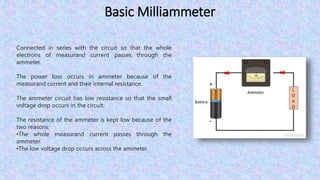
Basic Milliammeter
Connected in series with the circuit so that the whole
electrons of measurand current passes through the
ammeter.
The power loss occurs in ammeter because of the
measurand current and their internal resistance.
The ammeter circuit has low resistance so that the small
voltage drop occurs in the circuit.
The resistance of the ammeter is kept low because of the
two reasons:
•The whole measurand current passes through the
ammeter.
•The low voltage drop occurs across the ammeter.
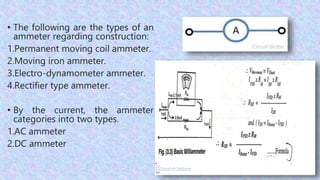
• The following are the types of an
ammeter regarding construction:
1.Permanent moving coil ammeter.
2.Moving iron ammeter.
3.Electro-dynamometer ammeter.
4.Rectifier type ammeter.
• By the current, the ammeter
categories into two types.
1.AC ammeter
2.DC ammeter
Multirange Ammeters
The following precautions should be observed when using an
ammeter for measurement:
1. Never connect an ammeter across a source of emf. Because of its
low resistance it would draw a high current and destroy the
movement. Always connect an ammeter in series with a load
capable of limiting the current.
2. Observe the correct polarity. Reverse polarity causes the meter to
deflect against the mechanical stopper, which may damage the
pointer.
3. When using a multirange meter, first use the highest current
range, then decrease the current range until substantial deflection is
obtained. To increase the accuracy use the range that will give a
reading as near full scale as possible.
The Ayrton Shunt or Universal Shunt
Requirements of a Shunt:
1) The temperature coefficient of shunt and the meter should be low and should be as equal as
possible.
2) The shunt resistances should be stable and constant with time.
3) The shunt resistances should not carry currents which will cause excessive temperature rise.
4) The type of material used to join the shunts should have low thermo dielectric voltage drop i.e
the soldering of joints should not cause a voltage drop.
5) Due to the soldering, the values of resistance should not be change.
6) The resistances should have low thermal electromotive force with copper. The manganin is
usually used for the shunts of d.c. instruments while the constantan is useful for the shunts of a.c
instruments.
Basic DC Voltmeter
Multi Range DC Voltmeter
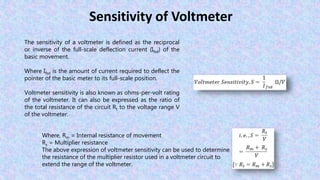
Sensitivity of Voltmeter
The sensitivity of a voltmeter is defined as the reciprocal
or inverse of the full-scale deflection current (Ifsd) of the
basic movement.
Where Ifsd is the amount of current required to deflect the
pointer of the basic meter to its full-scale position.
Voltmeter sensitivity is also known as ohms-per-volt rating
of the voltmeter. It can also be expressed as the ratio of
the total resistance of the circuit Rt to the voltage range V
of the voltmeter.
Where, Rm = Internal resistance of movement
Rs = Multiplier resistance
The above expression of voltmeter sensitivity can be used to determine
the resistance of the multiplier resistor used in a voltmeter circuit to
extend the range of the voltmeter.
Loading Effect
• It is the difference between actual voltage that exists in the circuit without
connecting the voltmeter and the voltage that appears after connecting
voltmeter.
• A voltmeter is placed across a resistor to measure its voltage. When a
voltmeter connects across any resistance its internal resistance impacts the
overall resistance of the circuit.
• This effect of change in overall resistance is known as the loading effect of the
voltmeter.
Multirange AC Voltmeter
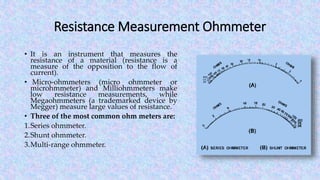
Resistance Measurement Ohmmeter
• It is an instrument that measures the
resistance of a material (resistance is a
measure of the opposition to the flow of
current).
• Micro-ohmmeters (micro ohmmeter or
microhmmeter) and Milliohmmeters make
low resistance measurements, while
Megaohmmeters (a trademarked device by
Megger) measure large values of resistance.
• Three of the most common ohm meters are:
1.Series ohmmeter.
2.Shunt ohmmeter.
3.Multi-range ohmmeter.
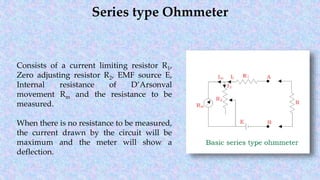
Series type Ohmmeter
Consists of a current limiting resistor R1,
Zero adjusting resistor R2, EMF source E,
Internal resistance of D’Arsonval
movement Rm and the resistance to be
measured.
When there is no resistance to be measured,
the current drawn by the circuit will be
maximum and the meter will show a
deflection.
Shunt Type Ohmmeter
PROBLEMS
TRY THIS
ELECTRICAL INSTRUMENTS 3.pptx

ELECTRICAL INSTRUMENTS 3.pptx

  • 1.
    ELECTRICAL INSTRUMENTS - RoshanK. Aalshi R.R.C. Mumbai-19
  • 2.
    What is aMultimeter? • An electronic instrument mainly used to measure the three basic electrical characteristics of voltage, current, and resistance. • It can also be used to test continuity between two points in an electrical circuit. • The multimeter has multi functionalities like, acts like ammeter, voltmeter, and ohmmeter. • It is a handheld device with positive and negative indicator needles over a numeric LCD digital display. • Multimeters can be used for testing batteries, household wiring, electric motors, and power supplies. • The essential parts of the multimeter mainly include a display, power source, probes, and controls. Types of Multimeter •Analog Multimeter. •Digital Multimeter. •Fluke Multimeter. •Clamp Type. •Autoranging Type.
  • 3.
    D’ Arsonval Movement(PMMC) as a Galvanometer • For measuring a small electrical current or a function of the current by deflection of a moving coil. • The deflection is a mechanical rotation derived from forces resulting from the current. • The indicating system consists of a light coil of wire suspended from a metallic ribbon between the poles of a permanent magnet. • The magnetic field produced by a current passing through the coil reacts with the magnetic field of the permanent magnet, producing a torque, or twisting force. • The coil, to which an indicating needle or mirror is attached, rotates under the action of the torque; the angle through which it rotates to balance the torsion of the suspension provides a measure of the current flowing in the coil. • The angle is measured by the movement of the needle or by the deflection of a beam of light reflected from the mirror.
  • 4.
    A PMMC meter(or D’Arsonval meters) is constructed of 5 main components: •Stationary Part or Magnet System •Moving Coil •Control System •Damping System •Meter
  • 5.
    • Advantages ofPermanent Magnet Moving Coil Instruments: 1.The scale is uniformly divided as the current is directly proportional to deflection of the pointer. Hence it is very easy to measure quantities from these instruments. 2.Power consumption is also very low in these types of instruments. 3.A high torque to weight ratio. 4.These are having multiple advantages, a single instrument can be used for measuring various quantities by using different values of shunts and multipliers. • Disadvantages of Permanent Magnet Moving Coil Instruments: 1.These instruments cannot measure AC quantities. 2.The cost of these instruments is high as compared to moving iron instrument.
  • 6.
    Basic Milliammeter Connected inseries with the circuit so that the whole electrons of measurand current passes through the ammeter. The power loss occurs in ammeter because of the measurand current and their internal resistance. The ammeter circuit has low resistance so that the small voltage drop occurs in the circuit. The resistance of the ammeter is kept low because of the two reasons: •The whole measurand current passes through the ammeter. •The low voltage drop occurs across the ammeter.
  • 7.
    • The followingare the types of an ammeter regarding construction: 1.Permanent moving coil ammeter. 2.Moving iron ammeter. 3.Electro-dynamometer ammeter. 4.Rectifier type ammeter. • By the current, the ammeter categories into two types. 1.AC ammeter 2.DC ammeter
  • 8.
  • 9.
    The following precautionsshould be observed when using an ammeter for measurement: 1. Never connect an ammeter across a source of emf. Because of its low resistance it would draw a high current and destroy the movement. Always connect an ammeter in series with a load capable of limiting the current. 2. Observe the correct polarity. Reverse polarity causes the meter to deflect against the mechanical stopper, which may damage the pointer. 3. When using a multirange meter, first use the highest current range, then decrease the current range until substantial deflection is obtained. To increase the accuracy use the range that will give a reading as near full scale as possible.
  • 10.
    The Ayrton Shuntor Universal Shunt Requirements of a Shunt: 1) The temperature coefficient of shunt and the meter should be low and should be as equal as possible. 2) The shunt resistances should be stable and constant with time. 3) The shunt resistances should not carry currents which will cause excessive temperature rise. 4) The type of material used to join the shunts should have low thermo dielectric voltage drop i.e the soldering of joints should not cause a voltage drop. 5) Due to the soldering, the values of resistance should not be change. 6) The resistances should have low thermal electromotive force with copper. The manganin is usually used for the shunts of d.c. instruments while the constantan is useful for the shunts of a.c instruments.
  • 12.
  • 13.
    Multi Range DCVoltmeter
  • 14.
    Sensitivity of Voltmeter Thesensitivity of a voltmeter is defined as the reciprocal or inverse of the full-scale deflection current (Ifsd) of the basic movement. Where Ifsd is the amount of current required to deflect the pointer of the basic meter to its full-scale position. Voltmeter sensitivity is also known as ohms-per-volt rating of the voltmeter. It can also be expressed as the ratio of the total resistance of the circuit Rt to the voltage range V of the voltmeter. Where, Rm = Internal resistance of movement Rs = Multiplier resistance The above expression of voltmeter sensitivity can be used to determine the resistance of the multiplier resistor used in a voltmeter circuit to extend the range of the voltmeter.
  • 15.
    Loading Effect • Itis the difference between actual voltage that exists in the circuit without connecting the voltmeter and the voltage that appears after connecting voltmeter. • A voltmeter is placed across a resistor to measure its voltage. When a voltmeter connects across any resistance its internal resistance impacts the overall resistance of the circuit. • This effect of change in overall resistance is known as the loading effect of the voltmeter.
  • 17.
  • 18.
    Resistance Measurement Ohmmeter •It is an instrument that measures the resistance of a material (resistance is a measure of the opposition to the flow of current). • Micro-ohmmeters (micro ohmmeter or microhmmeter) and Milliohmmeters make low resistance measurements, while Megaohmmeters (a trademarked device by Megger) measure large values of resistance. • Three of the most common ohm meters are: 1.Series ohmmeter. 2.Shunt ohmmeter. 3.Multi-range ohmmeter.
  • 19.
    Series type Ohmmeter Consistsof a current limiting resistor R1, Zero adjusting resistor R2, EMF source E, Internal resistance of D’Arsonval movement Rm and the resistance to be measured. When there is no resistance to be measured, the current drawn by the circuit will be maximum and the meter will show a deflection.
  • 20.
  • 21.
  • 25.