Measurement, Evaluation and Assessment
By
Dr.Shazia Zamir
NUML

© 2011 Pearson Education, Inc.
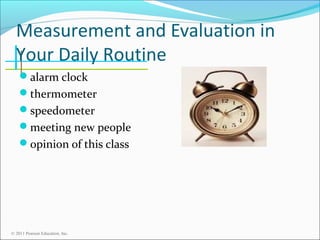
Measurement and Evaluation in
Your Daily Routine
alarm clock
thermometer
speedometer
meeting new people
opinion of this class

© 2011 Pearson Education, Inc.
Current Trends
public health initiatives
promotion of physical activity
problems with obesity
evaluation standards for school

programs

© 2011 Pearson Education, Inc.
Test and Data
Test: An instrument or activity used to accumulate

data on a person’s ability to perform a specified task.

Data: The translation of behavior into a numerical

or verbal descriptor which is then recorded in
written form.

© 2011 Pearson Education, Inc.
Why Administer Tests?
To measure individual differences on a specific trait

(behavior).

Discussion: Is a test “good” if everyone/anyone scores

100%? Or, is a test “good” if everyone/anyone scores
0%?

© 2011 Pearson Education, Inc.
Use of Tests
Motivation
Achievement
Improvement
Diagnosis
Prescription
Grading
Classification
Prediction

© 2011 Pearson Education, Inc.
Administrative Concerns in Test Selection
Relevance
Education value
Economic value
Time
Norms
Bias
Safety

© 2011 Pearson Education, Inc.
Measurement
A measurement takes place when a “test” is given and a

“score” is obtained.
If the test collects quantitative data, the score is a
number.
If the test collects qualitative data, the score may be a
phrase or word such as “excellent.”

© 2011 Pearson Education, Inc.
Assessment
Assessment-The goal of assessment is to make

improvements, as opposed to simply being judged.
In an educational context, assessment is the
process
of
describing,
collecting,
recording, scoring, and interpreting information
about learning.

© 2011 Pearson Education, Inc.
Types of Assessment
Quantitative
time in one mile run
score on basketball spot shooting test
grade on weight training exam
Qualitative
“excellent” ranking
checklist on golf swing

© 2011 Pearson Education, Inc.
Measurement Process Involves Four Steps
Define the characteristics that you want to
measure.
2. Select the appropriate test. This may also mean
to select the appropriate testing instrument.
3. Administer the test. If an instrument is involved
in the testing, this also means to use the
instrument correctly.
4. Collect and record the measurement from the
test.
1.

© 2011 Pearson Education, Inc.
Considerations When Taking Measurements
Remember that you are measuring a characteristic of

the person—you are not measuring the person
themselves; thus, make no judgments about the person.
Make no comical remarks regarding the collected data.
Have a high ethical standards when collecting the data.
Be professional.

© 2011 Pearson Education, Inc.
Subjective vs. Objective Measurement
A subjective measurement is one that can possibly be

interpreted differently.

An objective measurement is one that cannot be

interpreted differently because of numerical values.

© 2011 Pearson Education, Inc.
Evaluation
Definition 1: Evaluation is the systematic process of

collecting and analyzing data in order to determine
whether and to what degree objectives have been or are
being, achieved.

Definition 2: The process of obtaining information (data)

and using it to form judgments, which in turn are used in
decision making.

© 2011 Pearson Education, Inc.
Steps Involved in Making an Evaluation
1.
2.
3.
4.
5.

Define the objective or the purpose of the test.
Measure the performance or administer the test.
Find or develop a standard.
Compare a person’s performance on the test to a
standard.
Make the evaluation then discuss and distribute the
results in the most appropriate manner.

© 2011 Pearson Education, Inc.
Formative & Summative Evaluation
Formative evaluation: A formative evaluation is a method for

judging the worth of a program while the program activities
are forming (in progress). This part of the evaluation focuses
on the process

Summative evaluation: A summative evaluation (sometimes

referred to as external) is a method of judging the worth of a
program at the end of the program activities (summation).
The focus is on the outcome.

© 2011 Pearson Education, Inc.
Types of Evaluation
Student Evaluation
Curriculum Evaluation
School Evaluation
Program/Project Evaluation
Staff Evaluation

© 2011 Pearson Education, Inc.
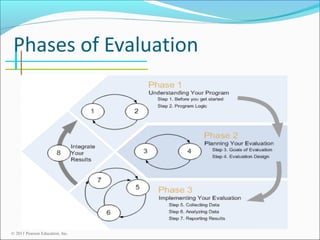
Phases of Evaluation

© 2011 Pearson Education, Inc.
Goals and Objectives
Goals are general statements of purpose or desired

outcomes and are not as such directly measurable;
each goal must be translated into one or more specific
objectives.
Objectives are specific statements of what is to be
accomplished and how well and are expressed in
terms of quantifiable, measurable outcomes.
objectives give direction to all subsequent activities.

© 2011 Pearson Education, Inc.
Norms
Evaluations are often based on norms:
Something that is usual, typical, or standard.
A standard or pattern, esp. of social behavior, that is

typical or expected of a group: "the norms of good behavior
in the civil service".

© 2011 Pearson Education, Inc.
Reliability
Reliability defined as the consistency of an

individual when repeatedly performing the same
test.
Example: If a group of people take the same test on
two different days, the scores obtained should be
approximately the same.
A reliable test will yield data that are stable,
repeatable, and precise.

© 2011 Pearson Education, Inc.
Validity
The most important characteristic to a test or

measuring instrument.
The validity of each test can only be evaluated in
terms of a particular purpose and for a particular
group.

© 2011 Pearson Education, Inc.
Quick Summary:
Test, Measurement, Evaluation and Assessment
Test – instrument or technique that measures someone's

knowledge of something to determine what he /she has
learned
Measurement-A measurement takes place when a “test” is
given and a “score” is obtained.
Evaluation–process
of
interpreting
the
collected
measurement to make professional judgment of value or
worth

© 2011 Pearson Education, Inc.
Quick Summary:
Test, Measurement, Evaluation and Assessment
Assessment-The goal of assessment is to make

improvements, as opposed to simply being judged.
In an educational context, assessment is the
process
of
describing,
collecting,
recording, scoring, and interpreting information
about learning.

© 2011 Pearson Education, Inc.

Measurement,evaluation,assessment(upload)

  • 1.
    Measurement, Evaluation andAssessment By Dr.Shazia Zamir NUML © 2011 Pearson Education, Inc.
  • 2.
    Measurement and Evaluationin Your Daily Routine alarm clock thermometer speedometer meeting new people opinion of this class © 2011 Pearson Education, Inc.
  • 3.
    Current Trends public healthinitiatives promotion of physical activity problems with obesity evaluation standards for school programs © 2011 Pearson Education, Inc.
  • 4.
    Test and Data Test:An instrument or activity used to accumulate data on a person’s ability to perform a specified task. Data: The translation of behavior into a numerical or verbal descriptor which is then recorded in written form. © 2011 Pearson Education, Inc.
  • 5.
    Why Administer Tests? Tomeasure individual differences on a specific trait (behavior). Discussion: Is a test “good” if everyone/anyone scores 100%? Or, is a test “good” if everyone/anyone scores 0%? © 2011 Pearson Education, Inc.
  • 6.
  • 7.
    Administrative Concerns inTest Selection Relevance Education value Economic value Time Norms Bias Safety © 2011 Pearson Education, Inc.
  • 8.
    Measurement A measurement takesplace when a “test” is given and a “score” is obtained. If the test collects quantitative data, the score is a number. If the test collects qualitative data, the score may be a phrase or word such as “excellent.” © 2011 Pearson Education, Inc.
  • 9.
    Assessment Assessment-The goal ofassessment is to make improvements, as opposed to simply being judged. In an educational context, assessment is the process of describing, collecting, recording, scoring, and interpreting information about learning. © 2011 Pearson Education, Inc.
  • 10.
    Types of Assessment Quantitative timein one mile run score on basketball spot shooting test grade on weight training exam Qualitative “excellent” ranking checklist on golf swing © 2011 Pearson Education, Inc.
  • 11.
    Measurement Process InvolvesFour Steps Define the characteristics that you want to measure. 2. Select the appropriate test. This may also mean to select the appropriate testing instrument. 3. Administer the test. If an instrument is involved in the testing, this also means to use the instrument correctly. 4. Collect and record the measurement from the test. 1. © 2011 Pearson Education, Inc.
  • 12.
    Considerations When TakingMeasurements Remember that you are measuring a characteristic of the person—you are not measuring the person themselves; thus, make no judgments about the person. Make no comical remarks regarding the collected data. Have a high ethical standards when collecting the data. Be professional. © 2011 Pearson Education, Inc.
  • 13.
    Subjective vs. ObjectiveMeasurement A subjective measurement is one that can possibly be interpreted differently. An objective measurement is one that cannot be interpreted differently because of numerical values. © 2011 Pearson Education, Inc.
  • 14.
    Evaluation Definition 1: Evaluationis the systematic process of collecting and analyzing data in order to determine whether and to what degree objectives have been or are being, achieved. Definition 2: The process of obtaining information (data) and using it to form judgments, which in turn are used in decision making. © 2011 Pearson Education, Inc.
  • 15.
    Steps Involved inMaking an Evaluation 1. 2. 3. 4. 5. Define the objective or the purpose of the test. Measure the performance or administer the test. Find or develop a standard. Compare a person’s performance on the test to a standard. Make the evaluation then discuss and distribute the results in the most appropriate manner. © 2011 Pearson Education, Inc.
  • 16.
    Formative & SummativeEvaluation Formative evaluation: A formative evaluation is a method for judging the worth of a program while the program activities are forming (in progress). This part of the evaluation focuses on the process Summative evaluation: A summative evaluation (sometimes referred to as external) is a method of judging the worth of a program at the end of the program activities (summation). The focus is on the outcome. © 2011 Pearson Education, Inc.
  • 17.
    Types of Evaluation StudentEvaluation Curriculum Evaluation School Evaluation Program/Project Evaluation Staff Evaluation © 2011 Pearson Education, Inc.
  • 18.
    Phases of Evaluation ©2011 Pearson Education, Inc.
  • 19.
    Goals and Objectives Goalsare general statements of purpose or desired outcomes and are not as such directly measurable; each goal must be translated into one or more specific objectives. Objectives are specific statements of what is to be accomplished and how well and are expressed in terms of quantifiable, measurable outcomes. objectives give direction to all subsequent activities. © 2011 Pearson Education, Inc.
  • 20.
    Norms Evaluations are oftenbased on norms: Something that is usual, typical, or standard. A standard or pattern, esp. of social behavior, that is typical or expected of a group: "the norms of good behavior in the civil service". © 2011 Pearson Education, Inc.
  • 21.
    Reliability Reliability defined asthe consistency of an individual when repeatedly performing the same test. Example: If a group of people take the same test on two different days, the scores obtained should be approximately the same. A reliable test will yield data that are stable, repeatable, and precise. © 2011 Pearson Education, Inc.
  • 22.
    Validity The most importantcharacteristic to a test or measuring instrument. The validity of each test can only be evaluated in terms of a particular purpose and for a particular group. © 2011 Pearson Education, Inc.
  • 23.
    Quick Summary: Test, Measurement,Evaluation and Assessment Test – instrument or technique that measures someone's knowledge of something to determine what he /she has learned Measurement-A measurement takes place when a “test” is given and a “score” is obtained. Evaluation–process of interpreting the collected measurement to make professional judgment of value or worth © 2011 Pearson Education, Inc.
  • 24.
    Quick Summary: Test, Measurement,Evaluation and Assessment Assessment-The goal of assessment is to make improvements, as opposed to simply being judged. In an educational context, assessment is the process of describing, collecting, recording, scoring, and interpreting information about learning. © 2011 Pearson Education, Inc.