Chabahar Maritime University
Faculty of Humanities
By:
Z. Dehghan
Professor:
Dr. khoshsima
May 2014
Click to add title
•Click to add text
Introduction
Assessment and testing
• Testing is formal and often standardized
• Assessment is based on a collection of information about what
students know and what they are able to do.
Assessment and testing
Assessment :“any method used to
better understand the current
knowledge that a student possesses”
Testing : “single-occasion, one-
dimensional, timed exercise, usually in
multiple choice or short-answer form”
Traditional assessment tools
The most widely used traditional assessment
tools are:
Multiple-choice tests
True/false tests
Short answers
Essays.
Alternative assessment tools
Portfolios
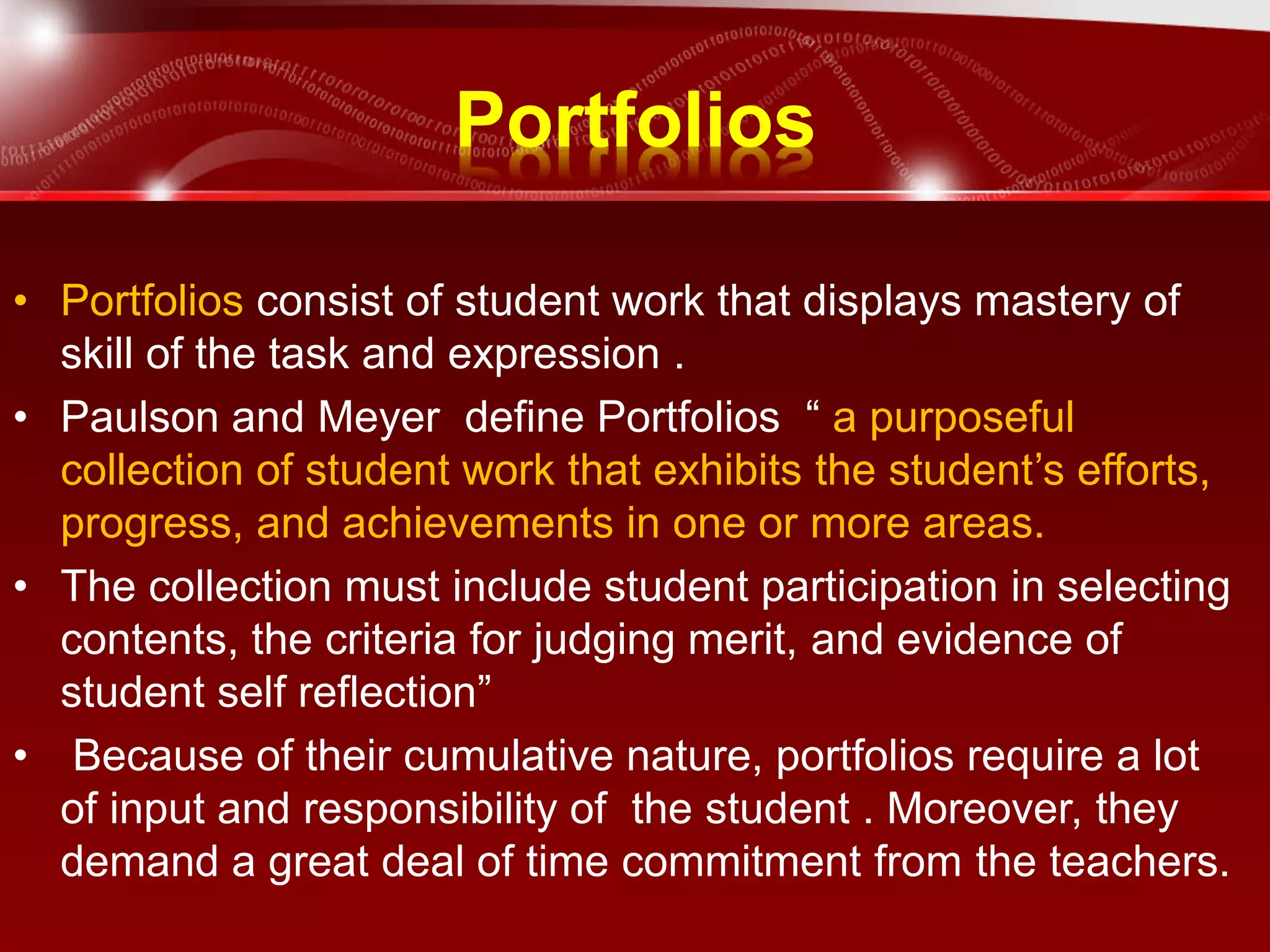
• Portfolios consist of student work that displays mastery of
skill of the task and expression .
• Paulson and Meyer define Portfolios “ a purposeful
collection of student work that exhibits the student’s efforts,
progress, and achievements in one or more areas.
• The collection must include student participation in selecting
contents, the criteria for judging merit, and evidence of
student self reflection”
• Because of their cumulative nature, portfolios require a lot
of input and responsibility of the student . Moreover, they
demand a great deal of time commitment from the teachers.
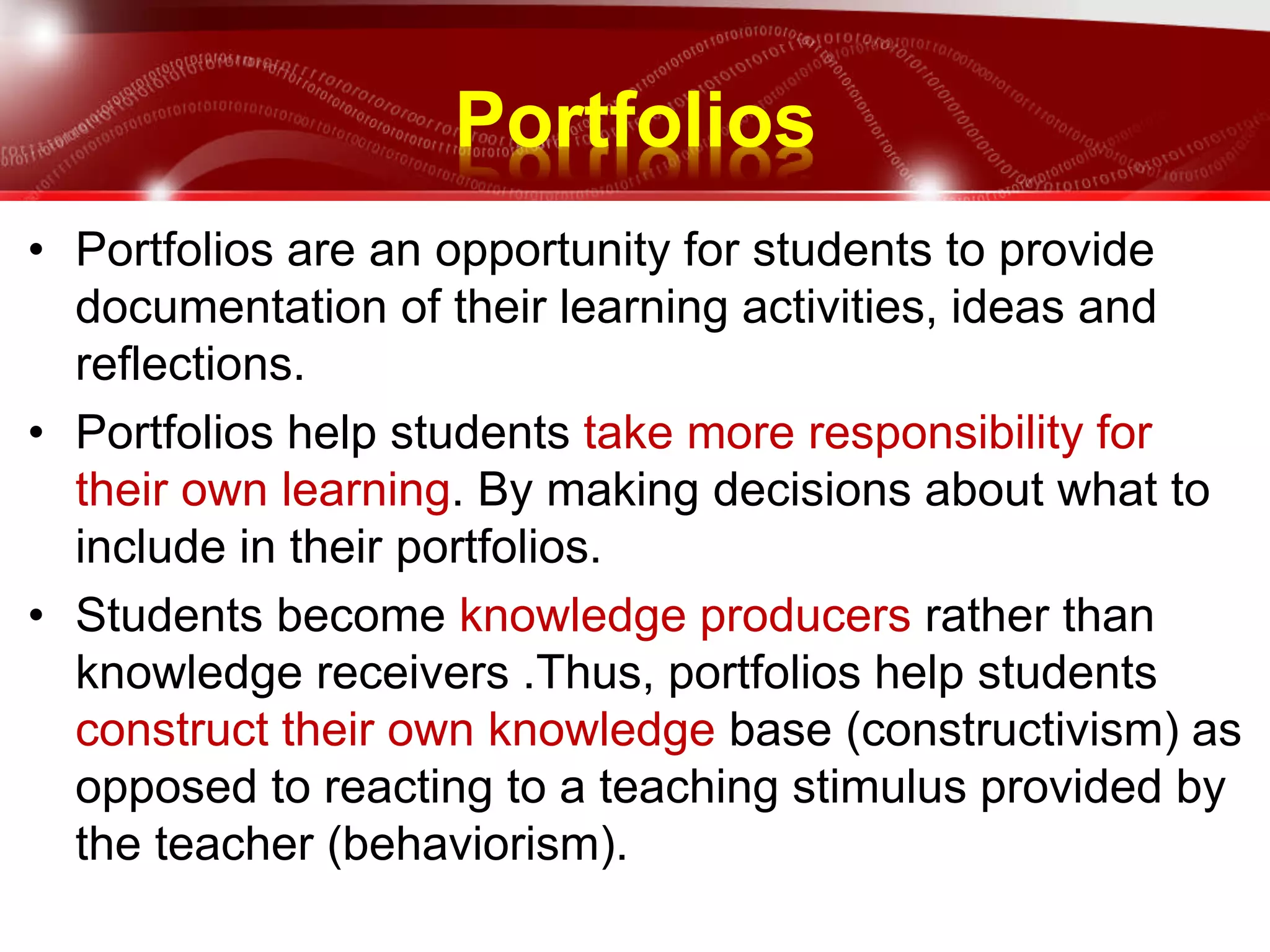
Portfolios
• Portfolios are an opportunity for students to provide
documentation of their learning activities, ideas and
reflections.
• Portfolios help students take more responsibility for
their own learning. By making decisions about what to
include in their portfolios.
• Students become knowledge producers rather than
knowledge receivers .Thus, portfolios help students
construct their own knowledge base (constructivism) as
opposed to reacting to a teaching stimulus provided by
the teacher (behaviorism).
Portfolios
• The portfolio is not supposed to be an easy
alternative to substitute for testing.
• If the portfolio is taken seriously, applied with
skill and intelligence, it can become a
teacher’s valuable tool.
Anecdotal Records
 An anecdotal record is a collection of
written observations of students related to
their progress in learning.
 This written account of observations may be
kept in a separate notebook or included in a
student’s portfolio. Teacher notes to students,
weather offering criticism or encouragement.
 Using this technique allows teachers the
opportunity to modify their instruction to
better meet the needs of their students.
Diaries and Writing Folders
• Students should be encouraged to write across
the curriculum. Student writings may take several
forms.
• Students may be encouraged to make daily
entries summarizing their progress in a
particular study in a diary.
• Writing folders show the different styles of
writing that students accomplish such as first
drafts, current writing, finished drafts, new
writing ideas, and student reflections on material
being studied.
Peer
conference
Teacher-
student
conference
Conferences
1) * Focusing on a body of work vs. a one off performance*
 The portfolio process reviews a comparatively large body of a
learner’s work, rather than a one off performance, to evaluate
performance over a course of study.
2) * Being a truly authentic assessment*
 Portfolios rely on direct observation ,therefore, can be
thought of as authentic assessment.
3) * Increasing the involvement of learners*
 Portfolios necessitate the active participation of learners in
the evaluation process.
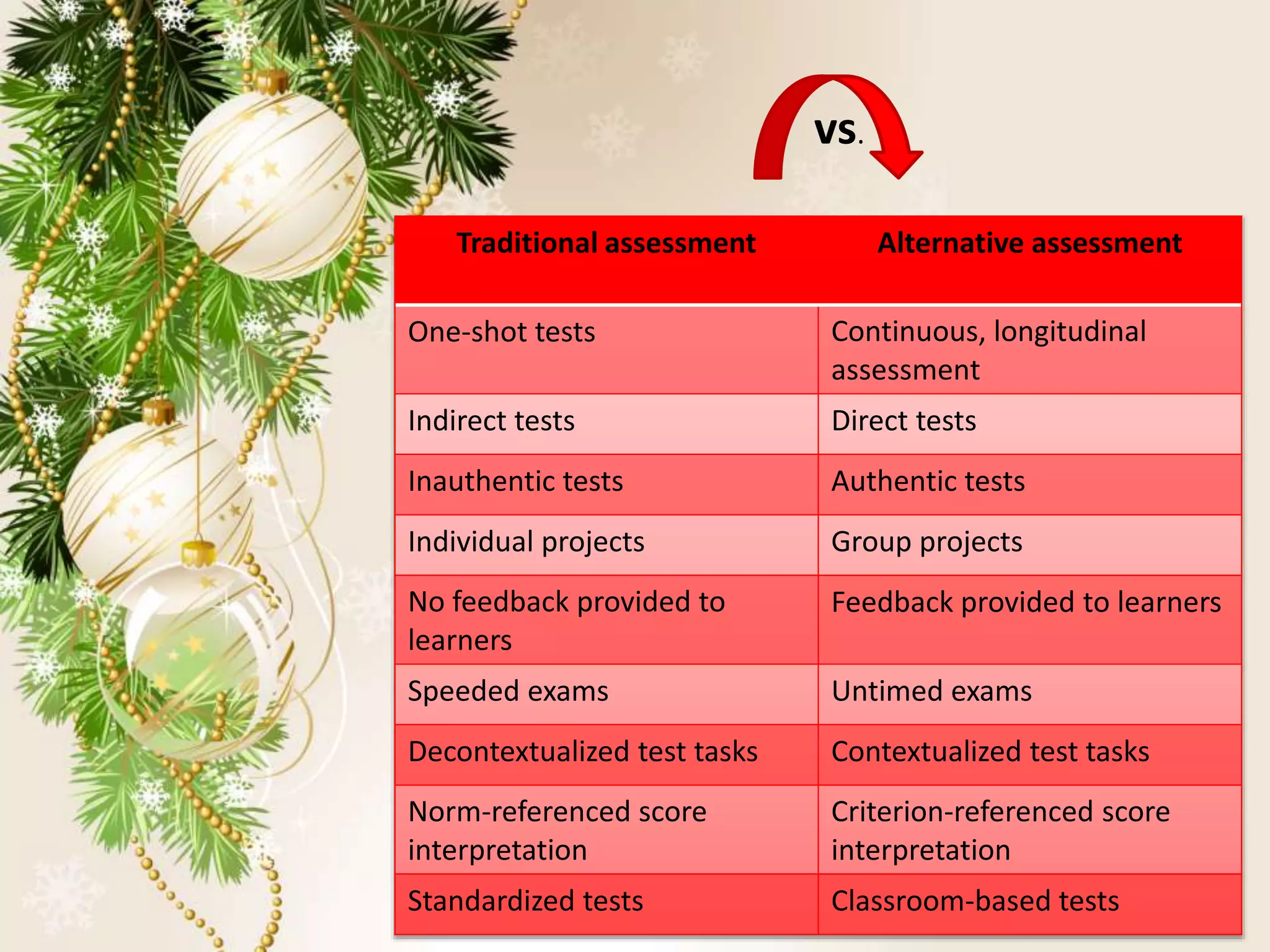
Alternative assessmentTraditional assessment
Continuous, longitudinal
assessment
One-shot tests
Direct testsIndirect tests
Authentic testsInauthentic tests
Group projectsIndividual projects
Feedback provided to learnersNo feedback provided to
learners
Untimed examsSpeeded exams
Contextualized test tasksDecontextualized test tasks
Criterion-referenced score
interpretation
Norm-referenced score
interpretation
Classroom-based testsStandardized tests
vs.
First,
they tend to
simulate real-
life contexts
Second,
Collaborative
working is
encouraged.
Third,
Assist
instructors to
have a better
understanding
of student
learning
Advantages of alternative assessment
“A person who never made a mistake
never tried anything”
-Albert Einstein

Traditional assessment v.s Alternative assessment

  • 2.
    Chabahar Maritime University Facultyof Humanities By: Z. Dehghan Professor: Dr. khoshsima May 2014
  • 3.
    Click to addtitle •Click to add text
  • 4.
  • 5.
    Assessment and testing •Testing is formal and often standardized • Assessment is based on a collection of information about what students know and what they are able to do.
  • 6.
    Assessment and testing Assessment:“any method used to better understand the current knowledge that a student possesses” Testing : “single-occasion, one- dimensional, timed exercise, usually in multiple choice or short-answer form”
  • 7.
    Traditional assessment tools Themost widely used traditional assessment tools are: Multiple-choice tests True/false tests Short answers Essays.
  • 8.
  • 9.
    Portfolios • Portfolios consistof student work that displays mastery of skill of the task and expression . • Paulson and Meyer define Portfolios “ a purposeful collection of student work that exhibits the student’s efforts, progress, and achievements in one or more areas. • The collection must include student participation in selecting contents, the criteria for judging merit, and evidence of student self reflection” • Because of their cumulative nature, portfolios require a lot of input and responsibility of the student . Moreover, they demand a great deal of time commitment from the teachers.
  • 10.
    Portfolios • Portfolios arean opportunity for students to provide documentation of their learning activities, ideas and reflections. • Portfolios help students take more responsibility for their own learning. By making decisions about what to include in their portfolios. • Students become knowledge producers rather than knowledge receivers .Thus, portfolios help students construct their own knowledge base (constructivism) as opposed to reacting to a teaching stimulus provided by the teacher (behaviorism).
  • 11.
    Portfolios • The portfoliois not supposed to be an easy alternative to substitute for testing. • If the portfolio is taken seriously, applied with skill and intelligence, it can become a teacher’s valuable tool.
  • 12.
    Anecdotal Records  Ananecdotal record is a collection of written observations of students related to their progress in learning.  This written account of observations may be kept in a separate notebook or included in a student’s portfolio. Teacher notes to students, weather offering criticism or encouragement.  Using this technique allows teachers the opportunity to modify their instruction to better meet the needs of their students.
  • 13.
    Diaries and WritingFolders • Students should be encouraged to write across the curriculum. Student writings may take several forms. • Students may be encouraged to make daily entries summarizing their progress in a particular study in a diary. • Writing folders show the different styles of writing that students accomplish such as first drafts, current writing, finished drafts, new writing ideas, and student reflections on material being studied.
  • 14.
  • 15.
    1) * Focusingon a body of work vs. a one off performance*  The portfolio process reviews a comparatively large body of a learner’s work, rather than a one off performance, to evaluate performance over a course of study. 2) * Being a truly authentic assessment*  Portfolios rely on direct observation ,therefore, can be thought of as authentic assessment. 3) * Increasing the involvement of learners*  Portfolios necessitate the active participation of learners in the evaluation process.
  • 16.
    Alternative assessmentTraditional assessment Continuous,longitudinal assessment One-shot tests Direct testsIndirect tests Authentic testsInauthentic tests Group projectsIndividual projects Feedback provided to learnersNo feedback provided to learners Untimed examsSpeeded exams Contextualized test tasksDecontextualized test tasks Criterion-referenced score interpretation Norm-referenced score interpretation Classroom-based testsStandardized tests vs.
  • 17.
    First, they tend to simulatereal- life contexts Second, Collaborative working is encouraged. Third, Assist instructors to have a better understanding of student learning Advantages of alternative assessment
  • 18.
    “A person whonever made a mistake never tried anything” -Albert Einstein