EDUCATIONAL
MEASUREMENT,
ASSESSMENT and
EVALUATION
Dr. Tanveer iqbal
Basic Concepts and Principles
TEST
MEASUREMENTS
ASSESSMENT
EVALUATION-
Test
-- most commonly used method of making measurements in
education. It is also an instrument or systematic procedures
for measuring sample of behavior by posing a set of
questions in a uniform manner. Designed to measure any
quality, ability, skill or knowledge. There is right or wrong
answer.
Tests
• We define psychological testing as the process of measuring
psychology-related variables by means of devices or procedures
designed to obtain a sample of behavior.
Measurement
-- assignment of numbers (quantity), uses variety of
instrument: test, rating scale. It is the process of
obtaining numerical description of the degree of
individual possesses. Quantifying of how much does
learner learned.
Measurement
• The word measurement, as it applies to education, is not substantially
different from when it is used in any other field. It simply means
determining the attributes or dimensions of an object, skill or
knowledge. We use common objects in the physical world to
measure, such as tape measures, scales and meters. These
measurement tools are held to standards and can be used to obtain
reliable results. When used properly, they accurately gather data for
educators and administrators.
Assessment
--- process by which evidence of student
achievement is obtained and evaluated.
Information is obtained relative to objective it
include testing, interpreting and placing
information in context. It is the process of
gathering and organizing data—the basis for
decision making (evaluation). Methods of
measuring and evaluating the nature of the
learner/(what he learned, how he learned)
Assessment
• One of the primary measurement tools in education is
the assessment. Teachers gather information by giving tests,
conducting interviews and monitoring behavior. The assessment
should be carefully prepared and administered to ensure its reliability
and validity. In other words, an assessment must provide consistent
results and it must measure what it claims to measure.
• We define psychological assessment as the gathering and integration
of psychology related data for the purpose of making a psychological
evaluation that is accomplished through the use of tools such as tests,
interviews, case studies, behavioral observation, and specially
designed apparatuses and measurement procedures.
Evaluation
• Creating valid and reliable assessments is critical to accurately
measuring educational data. Evaluating the information gathered,
however, is equally important to the effective use of the information
for instruction.
In education, evaluation is the process of using the measurements
gathered in the assessments. Teachers use this information to judge
the relationship between what was intended by the instruction and
what was learned. They evaluate the information gathered to
determine what students know and understand, how far they have
progressed and how fast, and how their scores and progress compare
to those of other studen
Evaluation
--it is a process because it includes a series of steps
(*establishing objective, *classifying objective, *defining
objective, *selecting indicators, *and comparing data with
objectives). It is concerned with making judgments on the
worth or value of a performance, answer the question “how
good, adequate, or desirable”. It is also the process of
obtaining, analyzing and interpreting information to
determent the extent to which students achieve
instructional objective.
Purpose of educational testing and
measurement
• Instructional---test is given to assess students’ progress
in a subject
• Curricular---given when decision are to be made about
school curricula.
• Selection---test is given to determine students
ability/suitability to enter school.(college entrance test)
• Placement--- test is given to group students (below
average, geniuses, morons or homogeneous or
heterogeneous)
• Personal--- asisst individual to make wise decision for
themselves (personality inventory test, aptitude test and
its all standardize.)
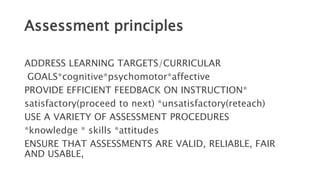
Assessment principles
ADDRESS LEARNING TARGETS/CURRICULAR
GOALS*cognitive*psychomotor*affective
PROVIDE EFFICIENT FEEDBACK ON INSTRUCTION*
satisfactory(proceed to next) *unsatisfactory(reteach)
USE A VARIETY OF ASSESSMENT PROCEDURES
*knowledge * skills *attitudes
ENSURE THAT ASSESSMENTS ARE VALID, RELIABLE, FAIR
AND USABLE,
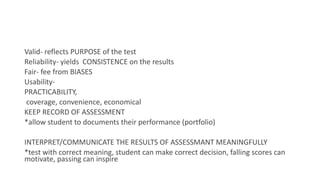
Valid- reflects PURPOSE of the test
Reliability- yields CONSISTENCE on the results
Fair- fee from BIASES
Usability-
PRACTICABILITY,
coverage, convenience, economical
KEEP RECORD OF ASSESSMENT
*allow student to documents their performance (portfolio)
INTERPRET/COMMUNICATE THE RESULTS OF ASSESSMANT MEANINGFULLY
*test with correct meaning, student can make correct decision, falling scores can
motivate, passing can inspire
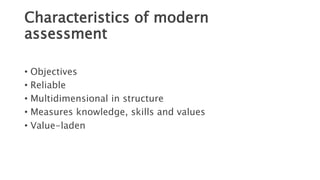
Characteristics of modern
assessment
• Objectives
• Reliable
• Multidimensional in structure
• Measures knowledge, skills and values
• Value-laden
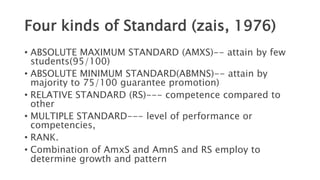
Four kinds of Standard (zais, 1976)
• ABSOLUTE MAXIMUM STANDARD (AMXS)-- attain by few
students(95/100)
• ABSOLUTE MINIMUM STANDARD(ABMNS)-- attain by
majority to 75/100 guarantee promotion)
• RELATIVE STANDARD (RS)--- competence compared to
other
• MULTIPLE STANDARD--- level of performance or
competencies,
• RANK.
• Combination of AmxS and AmnS and RS employ to
determine growth and pattern

Assessment, Mearurements, Evaluation.pptx

  • 1.
  • 2.
    Basic Concepts andPrinciples TEST MEASUREMENTS ASSESSMENT EVALUATION-
  • 3.
    Test -- most commonlyused method of making measurements in education. It is also an instrument or systematic procedures for measuring sample of behavior by posing a set of questions in a uniform manner. Designed to measure any quality, ability, skill or knowledge. There is right or wrong answer.
  • 4.
    Tests • We definepsychological testing as the process of measuring psychology-related variables by means of devices or procedures designed to obtain a sample of behavior.
  • 5.
    Measurement -- assignment ofnumbers (quantity), uses variety of instrument: test, rating scale. It is the process of obtaining numerical description of the degree of individual possesses. Quantifying of how much does learner learned.
  • 6.
    Measurement • The wordmeasurement, as it applies to education, is not substantially different from when it is used in any other field. It simply means determining the attributes or dimensions of an object, skill or knowledge. We use common objects in the physical world to measure, such as tape measures, scales and meters. These measurement tools are held to standards and can be used to obtain reliable results. When used properly, they accurately gather data for educators and administrators.
  • 7.
    Assessment --- process bywhich evidence of student achievement is obtained and evaluated. Information is obtained relative to objective it include testing, interpreting and placing information in context. It is the process of gathering and organizing data—the basis for decision making (evaluation). Methods of measuring and evaluating the nature of the learner/(what he learned, how he learned)
  • 8.
    Assessment • One ofthe primary measurement tools in education is the assessment. Teachers gather information by giving tests, conducting interviews and monitoring behavior. The assessment should be carefully prepared and administered to ensure its reliability and validity. In other words, an assessment must provide consistent results and it must measure what it claims to measure. • We define psychological assessment as the gathering and integration of psychology related data for the purpose of making a psychological evaluation that is accomplished through the use of tools such as tests, interviews, case studies, behavioral observation, and specially designed apparatuses and measurement procedures.
  • 9.
    Evaluation • Creating validand reliable assessments is critical to accurately measuring educational data. Evaluating the information gathered, however, is equally important to the effective use of the information for instruction. In education, evaluation is the process of using the measurements gathered in the assessments. Teachers use this information to judge the relationship between what was intended by the instruction and what was learned. They evaluate the information gathered to determine what students know and understand, how far they have progressed and how fast, and how their scores and progress compare to those of other studen
  • 10.
    Evaluation --it is aprocess because it includes a series of steps (*establishing objective, *classifying objective, *defining objective, *selecting indicators, *and comparing data with objectives). It is concerned with making judgments on the worth or value of a performance, answer the question “how good, adequate, or desirable”. It is also the process of obtaining, analyzing and interpreting information to determent the extent to which students achieve instructional objective.
  • 11.
    Purpose of educationaltesting and measurement • Instructional---test is given to assess students’ progress in a subject • Curricular---given when decision are to be made about school curricula. • Selection---test is given to determine students ability/suitability to enter school.(college entrance test) • Placement--- test is given to group students (below average, geniuses, morons or homogeneous or heterogeneous) • Personal--- asisst individual to make wise decision for themselves (personality inventory test, aptitude test and its all standardize.)
  • 12.
    Assessment principles ADDRESS LEARNINGTARGETS/CURRICULAR GOALS*cognitive*psychomotor*affective PROVIDE EFFICIENT FEEDBACK ON INSTRUCTION* satisfactory(proceed to next) *unsatisfactory(reteach) USE A VARIETY OF ASSESSMENT PROCEDURES *knowledge * skills *attitudes ENSURE THAT ASSESSMENTS ARE VALID, RELIABLE, FAIR AND USABLE,
  • 13.
    Valid- reflects PURPOSEof the test Reliability- yields CONSISTENCE on the results Fair- fee from BIASES Usability- PRACTICABILITY, coverage, convenience, economical KEEP RECORD OF ASSESSMENT *allow student to documents their performance (portfolio) INTERPRET/COMMUNICATE THE RESULTS OF ASSESSMANT MEANINGFULLY *test with correct meaning, student can make correct decision, falling scores can motivate, passing can inspire
  • 14.
    Characteristics of modern assessment •Objectives • Reliable • Multidimensional in structure • Measures knowledge, skills and values • Value-laden
  • 15.
    Four kinds ofStandard (zais, 1976) • ABSOLUTE MAXIMUM STANDARD (AMXS)-- attain by few students(95/100) • ABSOLUTE MINIMUM STANDARD(ABMNS)-- attain by majority to 75/100 guarantee promotion) • RELATIVE STANDARD (RS)--- competence compared to other • MULTIPLE STANDARD--- level of performance or competencies, • RANK. • Combination of AmxS and AmnS and RS employ to determine growth and pattern