
DISASTER
NURSING
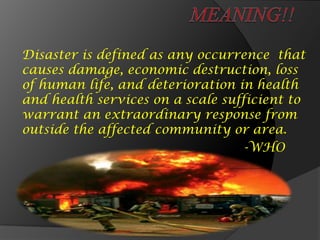
Disaster is defined as any occurrence that
causes damage, economic destruction, loss
of human life, and deterioration in health
and health services on a scale sufficient to
warrant an extraordinary response from
outside the affected community or area.
-WHO
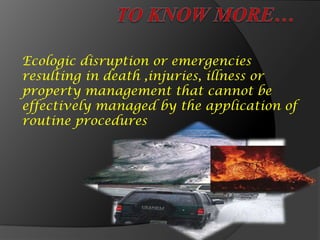
Ecologic disruption or emergencies
resulting in death ,injuries, illness or
property management that cannot be
effectively managed by the application of
routine procedures
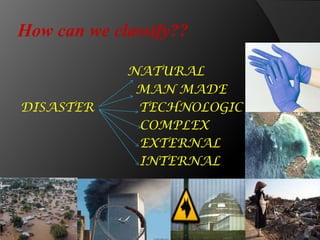
How can we classify??
NATURAL
MAN MADE
DISASTER TECHNOLOGIC
COMPLEX
EXTERNAL
INTERNAL
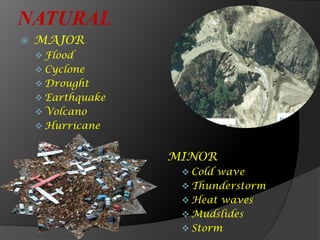
NATURAL
 MAJOR
 Flood
 Cyclone
 Drought
 Earthquake
 Volcano
 Hurricane
MINOR
 Cold wave
 Thunderstorm
 Heat waves
 Mudslides
 Storm
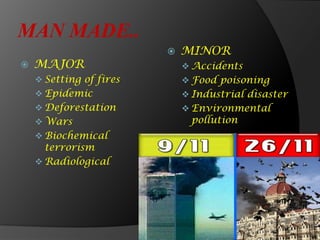
MAN MADE..
 MAJOR
 Setting of fires
 Epidemic
 Deforestation
 Wars
 Biochemical
terrorism
 Radiological
 MINOR
 Accidents
 Food poisoning
 Industrial disaster
 Environmental
pollution
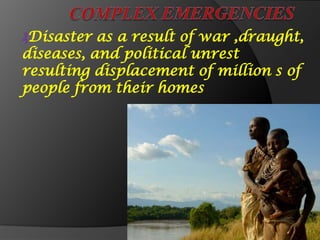
₰Disaster as a result of war ,draught,
diseases, and political unrest
resulting displacement of million s of
people from their homes
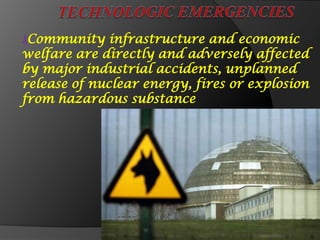
₰Community infrastructure and economic
welfare are directly and adversely affected
by major industrial accidents, unplanned
release of nuclear energy, fires or explosion
from hazardous substance
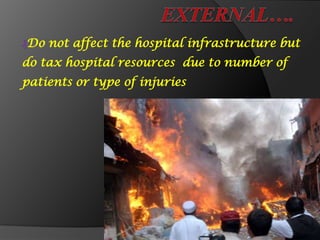
₰Do not affect the hospital infrastructure but
do tax hospital resources due to number of
patients or type of injuries
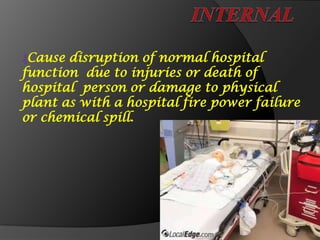
₰Cause disruption of normal hospital
function due to injuries or death of
hospital person or damage to physical
plant as with a hospital fire power failure
or chemical spill.
₰Nature of the event
₰Time of the year or day
₰Health and age characteristics of population
effected
₰Availability of the resources
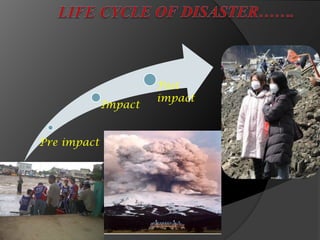
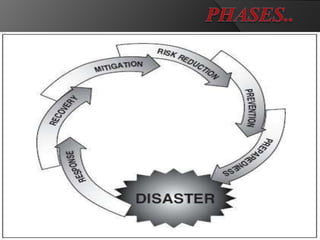
Pre impact
Impact
Post
impact
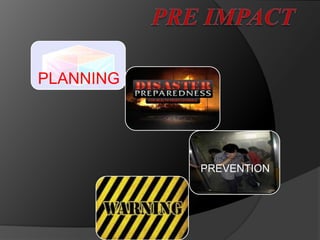
PLANNING
PREVENTION
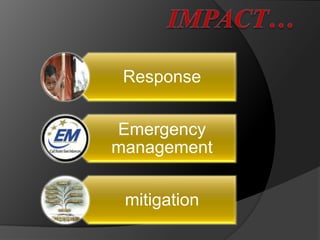
Response
Emergency
management
mitigation
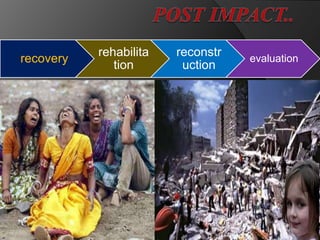
recovery
rehabilita
tion
reconstr
uction
evaluation
₰Earthquake and tornadoes: rapid onset &
sudden impact on the community
₰Hurricane & volcanic eruption: sudden
impact on the community but there is some
advance warning
₰Bioterrorism : sudden and unanticipated ,
sudden and prolonged impact on the
community
₰Drought & famine: gradual onset or chronic
genesis (so called “creeping "disaster) and
prolonged impact
₰Proactive planning efforts designed to structure
the disaster response prior to its occurrence
₰Communication plans
₰Multiagency coordination
₰Emergency services- emergency shelters with
evacuation plans
₰Supplies and equipments
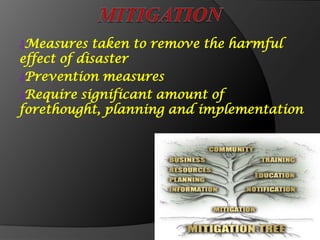
₰Measures taken to remove the harmful
effect of disaster
₰Prevention measures
₰Require significant amount of
forethought, planning and implementation
₰Emergency relief such as saving lives,
providing first aid, minimizing and restoring
damaged systems such as communications and
transportation , providing care and basic life
requirement to victim
₰Organized its activities in sectors- fire, police
hazardous material management and
emergency medical services
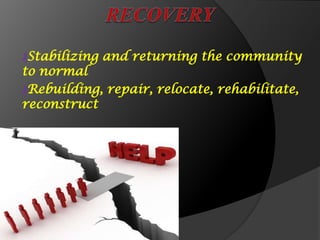
₰Stabilizing and returning the community
to normal
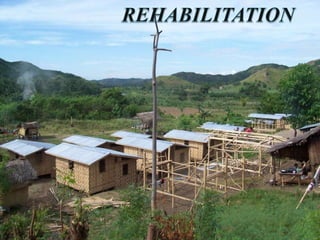
₰Rebuilding, repair, relocate, rehabilitate,
reconstruct
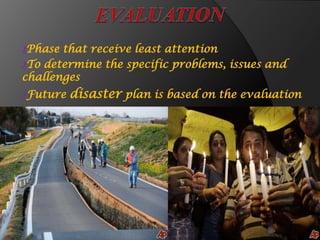
₰Phase that receive least attention
₰To determine the specific problems, issues and
challenges
₰Future disaster plan is based on the evaluation
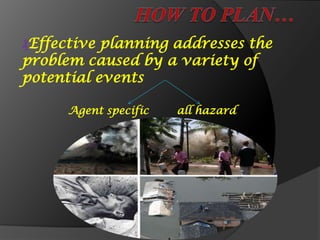
₰Effective planning addresses the
problem caused by a variety of
potential events
Agent specific all hazard
Challenges…
₰ Communication problem
₰ Triage, transportation & evacuation
₰ Leadership issues
₰ Distribution of resources
₰ Coordination of search & rescue efforts
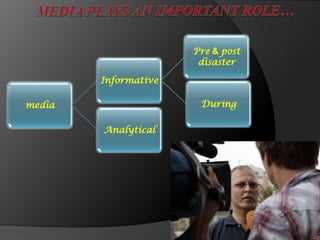
₰ Media issues
₰ Distribution of patients in an equitable
fashion
₰ destruction of health care infrastructure
₰ Management of volunteers, donations
&large no. of resources
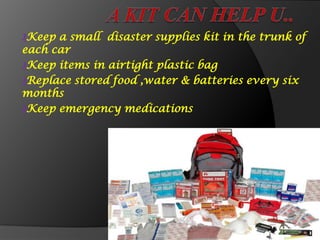
₰Keep a small disaster supplies kit in the trunk of
each car
₰Keep items in airtight plastic bag
₰Replace stored food ,water & batteries every six
months
₰Keep emergency medications
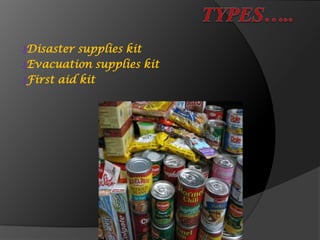
₰Disaster supplies kit
₰Evacuation supplies kit
₰First aid kit
₰Will, insurance policies, contracts
₰Passports, social security cards, immunization
records
₰Credit cards, account numbers
₰Important phone numbers
₰Family records
media
Informative
Pre & post
disaster
During
Analytical
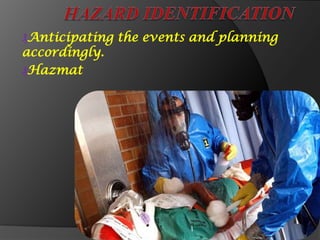
₰Anticipating the events and planning
accordingly.
₰Hazmat
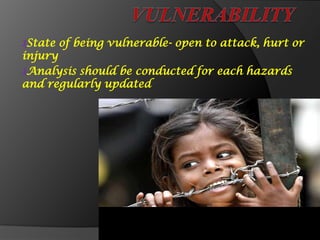
₰State of being vulnerable- open to attack, hurt or
injury
₰Analysis should be conducted for each hazards
and regularly updated
₰Use the element of hazard analysis and
vulnerability analysis
₰Necessitate cooperation of corporate and
community group
₰Prevention or removal of hazards
₰Removal of at risk population
₰Provision of public information and education
₰Establishment of early warning system
₰Mitigation of vulnerabilities
₰Risk reduction
₰Enhancing community to respond
₰Theoretical foundations for disaster
planning
₰As effective as the assumption upon
which is based
₰Must go beyond routine
₰Need assessment
₰Leadership
₰Design for local response
₰Vulnerable population
₰Assistance
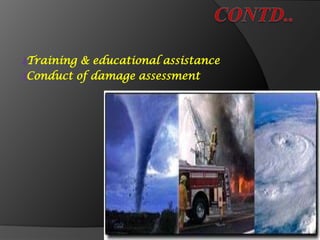
₰Training & educational assistance
₰Conduct of damage assessment
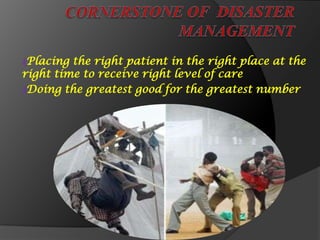
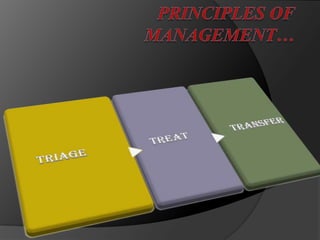
₰Placing the right patient in the right place at the
right time to receive right level of care
₰Doing the greatest good for the greatest number
₰Clinically experienced
₰Good judgment and leadership
₰Calm and cool under stress
₰Decisive
₰Knowledgeable of available resources
₰Sense of humor
₰Creative problem solver
₰Available
₰Experienced and knowledgeable regarding
anticipated casualties
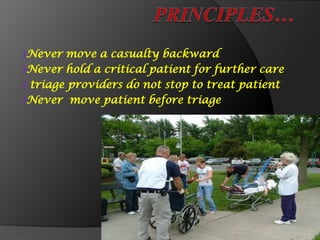
₰Never move a casualty backward
₰Never hold a critical patient for further care
₰ triage providers do not stop to treat patient
₰Never move patient before triage
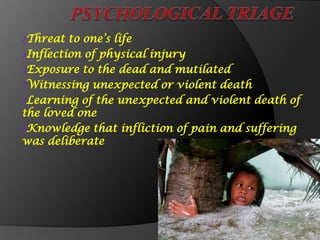
₰Threat to one’s life
₰Inflection of physical injury
₰Exposure to the dead and mutilated
₰Witnessing unexpected or violent death
₰Learning of the unexpected and violent death of
the loved one
₰Knowledge that infliction of pain and suffering
was deliberate
₰Review of all hazardous topics including
natural and accidental man made events
,chemical, traumatic, explosive and
nuclear events
₰Role in public health, incident
management system & special needs
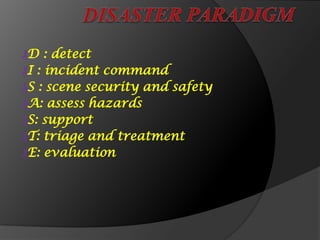
₰D : detect
₰I : incident command
₰S : scene security and safety
₰A: assess hazards
₰S: support
₰T: triage and treatment
₰E: evaluation
₰Performed by the BDLS provider
₰Demonstrate competencies in casualty decontamination,
specified essential skills and MCI information system
₰4 skills
₰MASS triage
₰Personal protective equipment and
decontamination
₰Disaster skills
₰Human patient simulator
₰Mortality
₰Injury
₰Infectious diseases
₰Chronic diseases
₰Malnutrition
₰Health risk and chemical contamination
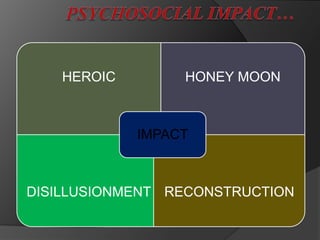
HEROIC HONEY MOON
DISILLUSIONMENT RECONSTRUCTION
IMPACT
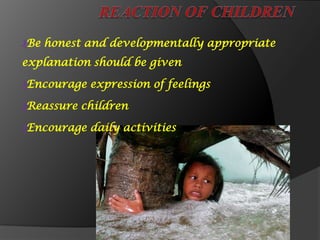
₰Be honest and developmentally appropriate
explanation should be given
₰Encourage expression of feelings
₰Reassure children
₰Encourage daily activities
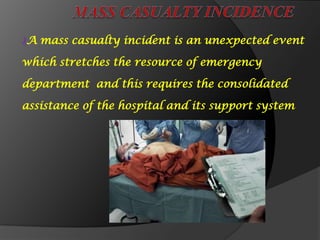
₰A mass casualty incident is an unexpected event
which stretches the resource of emergency
department and this requires the consolidated
assistance of the hospital and its support system
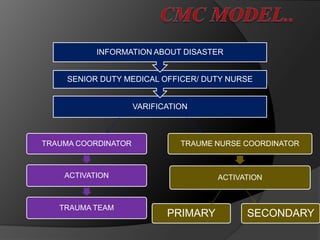
VARIFICATION
SENIOR DUTY MEDICAL OFFICER/ DUTY NURSE
INFORMATION ABOUT DISASTER
TRAUMA COORDINATOR
ACTIVATION
TRAUMA TEAM
TRAUME NURSE COORDINATOR
ACTIVATION
PRIMARY SECONDARY
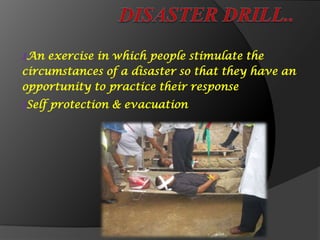
₰An exercise in which people stimulate the
circumstances of a disaster so that they have an
opportunity to practice their response
₰Self protection & evacuation
₰Leadership
₰Identify the roles and functions
₰Policy development
₰Government organizations
₰Public health
₰Health promotion
₰Disease prevention
₰Quality care
₰Evidence based practice
₰Education
₰Critical thinking
₰Collaboration
₰IN NURSING EDUCATION
development and validation of core competencies
provision of continuous education program and material
for practicing nurses
inclusion of content and clinical experience in nursing
curriculum
development of teaching resources and material
IN RESEARCH AND DEVELOPMENT
related to mass casualty incidence
preparedness , response and recovery
₰Focused on poorer countries
₰According to the culture-
₰Communication and transport difficulties
₰Knowledge and skill
₰Apex body for disaster management in India
EVOLUTION OF NDMA:
₰High powered committee in 1999
₰Nation committee in 2001 after Gujarat earth
quake
₰Tenth five year plan- attached a chapter on
disaster management
₰12th finance commission- financial
arrangement
₰Creation of NDMA on 23rd December 2005.
₰Lay down policies on disaster management
₰Approve national plan
₰Approves plan prepared by ministers or departments
₰Coordinate the implementation
₰Recommend provision of funds
₰Provide support to other countries
₰Multidisciplinary , multiskilled high-tech force of NDMA
capable of dealing with all types of natural and man made
disasters.
₰Specialized response to natural and manmade disaster.
₰Total 8 battalion and has 45 personnel including
engineer, technicians, medical and paramedical and dog
squads.
Thank you…

Disaster nursing

  • 1.
  • 3.
    Disaster is definedas any occurrence that causes damage, economic destruction, loss of human life, and deterioration in health and health services on a scale sufficient to warrant an extraordinary response from outside the affected community or area. -WHO
  • 4.
    Ecologic disruption oremergencies resulting in death ,injuries, illness or property management that cannot be effectively managed by the application of routine procedures
  • 5.
    How can weclassify?? NATURAL MAN MADE DISASTER TECHNOLOGIC COMPLEX EXTERNAL INTERNAL
  • 6.
    NATURAL  MAJOR  Flood Cyclone  Drought  Earthquake  Volcano  Hurricane MINOR  Cold wave  Thunderstorm  Heat waves  Mudslides  Storm
  • 7.
    MAN MADE..  MAJOR Setting of fires  Epidemic  Deforestation  Wars  Biochemical terrorism  Radiological  MINOR  Accidents  Food poisoning  Industrial disaster  Environmental pollution
  • 8.
    ₰Disaster as aresult of war ,draught, diseases, and political unrest resulting displacement of million s of people from their homes
  • 9.
    ₰Community infrastructure andeconomic welfare are directly and adversely affected by major industrial accidents, unplanned release of nuclear energy, fires or explosion from hazardous substance
  • 10.
    ₰Do not affectthe hospital infrastructure but do tax hospital resources due to number of patients or type of injuries
  • 11.
    ₰Cause disruption ofnormal hospital function due to injuries or death of hospital person or damage to physical plant as with a hospital fire power failure or chemical spill.
  • 12.
    ₰Nature of theevent ₰Time of the year or day ₰Health and age characteristics of population effected ₰Availability of the resources
  • 13.
  • 14.
  • 15.
  • 16.
  • 17.
    ₰Earthquake and tornadoes:rapid onset & sudden impact on the community ₰Hurricane & volcanic eruption: sudden impact on the community but there is some advance warning ₰Bioterrorism : sudden and unanticipated , sudden and prolonged impact on the community ₰Drought & famine: gradual onset or chronic genesis (so called “creeping "disaster) and prolonged impact
  • 19.
    ₰Proactive planning effortsdesigned to structure the disaster response prior to its occurrence ₰Communication plans ₰Multiagency coordination ₰Emergency services- emergency shelters with evacuation plans ₰Supplies and equipments
  • 20.
    ₰Measures taken toremove the harmful effect of disaster ₰Prevention measures ₰Require significant amount of forethought, planning and implementation
  • 21.
    ₰Emergency relief suchas saving lives, providing first aid, minimizing and restoring damaged systems such as communications and transportation , providing care and basic life requirement to victim ₰Organized its activities in sectors- fire, police hazardous material management and emergency medical services
  • 22.
    ₰Stabilizing and returningthe community to normal ₰Rebuilding, repair, relocate, rehabilitate, reconstruct
  • 23.
    ₰Phase that receiveleast attention ₰To determine the specific problems, issues and challenges ₰Future disaster plan is based on the evaluation
  • 24.
    ₰Effective planning addressesthe problem caused by a variety of potential events Agent specific all hazard
  • 25.
    Challenges… ₰ Communication problem ₰Triage, transportation & evacuation ₰ Leadership issues ₰ Distribution of resources ₰ Coordination of search & rescue efforts ₰ Media issues ₰ Distribution of patients in an equitable fashion ₰ destruction of health care infrastructure ₰ Management of volunteers, donations &large no. of resources
  • 26.
    ₰Keep a smalldisaster supplies kit in the trunk of each car ₰Keep items in airtight plastic bag ₰Replace stored food ,water & batteries every six months ₰Keep emergency medications
  • 27.
    ₰Disaster supplies kit ₰Evacuationsupplies kit ₰First aid kit
  • 28.
    ₰Will, insurance policies,contracts ₰Passports, social security cards, immunization records ₰Credit cards, account numbers ₰Important phone numbers ₰Family records
  • 29.
  • 30.
    ₰Anticipating the eventsand planning accordingly. ₰Hazmat
  • 31.
    ₰State of beingvulnerable- open to attack, hurt or injury ₰Analysis should be conducted for each hazards and regularly updated
  • 32.
    ₰Use the elementof hazard analysis and vulnerability analysis ₰Necessitate cooperation of corporate and community group
  • 33.
    ₰Prevention or removalof hazards ₰Removal of at risk population ₰Provision of public information and education ₰Establishment of early warning system ₰Mitigation of vulnerabilities ₰Risk reduction ₰Enhancing community to respond
  • 34.
    ₰Theoretical foundations fordisaster planning ₰As effective as the assumption upon which is based ₰Must go beyond routine ₰Need assessment ₰Leadership ₰Design for local response ₰Vulnerable population ₰Assistance
  • 35.
    ₰Training & educationalassistance ₰Conduct of damage assessment
  • 37.
    ₰Placing the rightpatient in the right place at the right time to receive right level of care ₰Doing the greatest good for the greatest number
  • 38.
    ₰Clinically experienced ₰Good judgmentand leadership ₰Calm and cool under stress ₰Decisive ₰Knowledgeable of available resources ₰Sense of humor ₰Creative problem solver ₰Available ₰Experienced and knowledgeable regarding anticipated casualties
  • 39.
    ₰Never move acasualty backward ₰Never hold a critical patient for further care ₰ triage providers do not stop to treat patient ₰Never move patient before triage
  • 40.
    ₰Threat to one’slife ₰Inflection of physical injury ₰Exposure to the dead and mutilated ₰Witnessing unexpected or violent death ₰Learning of the unexpected and violent death of the loved one ₰Knowledge that infliction of pain and suffering was deliberate
  • 42.
    ₰Review of allhazardous topics including natural and accidental man made events ,chemical, traumatic, explosive and nuclear events ₰Role in public health, incident management system & special needs
  • 43.
    ₰D : detect ₰I: incident command ₰S : scene security and safety ₰A: assess hazards ₰S: support ₰T: triage and treatment ₰E: evaluation
  • 44.
    ₰Performed by theBDLS provider ₰Demonstrate competencies in casualty decontamination, specified essential skills and MCI information system ₰4 skills ₰MASS triage ₰Personal protective equipment and decontamination ₰Disaster skills ₰Human patient simulator
  • 46.
  • 47.
    HEROIC HONEY MOON DISILLUSIONMENTRECONSTRUCTION IMPACT
  • 48.
    ₰Be honest anddevelopmentally appropriate explanation should be given ₰Encourage expression of feelings ₰Reassure children ₰Encourage daily activities
  • 49.
    ₰A mass casualtyincident is an unexpected event which stretches the resource of emergency department and this requires the consolidated assistance of the hospital and its support system
  • 51.
    VARIFICATION SENIOR DUTY MEDICALOFFICER/ DUTY NURSE INFORMATION ABOUT DISASTER TRAUMA COORDINATOR ACTIVATION TRAUMA TEAM TRAUME NURSE COORDINATOR ACTIVATION PRIMARY SECONDARY
  • 52.
    ₰An exercise inwhich people stimulate the circumstances of a disaster so that they have an opportunity to practice their response ₰Self protection & evacuation
  • 53.
    ₰Leadership ₰Identify the rolesand functions ₰Policy development ₰Government organizations ₰Public health ₰Health promotion ₰Disease prevention ₰Quality care ₰Evidence based practice ₰Education ₰Critical thinking ₰Collaboration
  • 54.
    ₰IN NURSING EDUCATION developmentand validation of core competencies provision of continuous education program and material for practicing nurses inclusion of content and clinical experience in nursing curriculum development of teaching resources and material IN RESEARCH AND DEVELOPMENT related to mass casualty incidence preparedness , response and recovery
  • 55.
    ₰Focused on poorercountries ₰According to the culture- ₰Communication and transport difficulties ₰Knowledge and skill
  • 56.
    ₰Apex body fordisaster management in India EVOLUTION OF NDMA: ₰High powered committee in 1999 ₰Nation committee in 2001 after Gujarat earth quake ₰Tenth five year plan- attached a chapter on disaster management ₰12th finance commission- financial arrangement ₰Creation of NDMA on 23rd December 2005.
  • 57.
    ₰Lay down policieson disaster management ₰Approve national plan ₰Approves plan prepared by ministers or departments ₰Coordinate the implementation ₰Recommend provision of funds ₰Provide support to other countries
  • 58.
    ₰Multidisciplinary , multiskilledhigh-tech force of NDMA capable of dealing with all types of natural and man made disasters. ₰Specialized response to natural and manmade disaster. ₰Total 8 battalion and has 45 personnel including engineer, technicians, medical and paramedical and dog squads.
  • 59.