INTRODUCTION
With the changeof focus in instruction from
content to learning outcomes came the need to
redefine and clarify the terms used to determine
the progress of students towards attainment of
the desired learning outcomes. These are
measurement, evaluation and assessment.
3.
MEASUREMENT
Measurement is theprocess of determining or
describing the attributes or characteristics of physical
object generally in terms of quantity.
* When we measure, we use some standard
instrument to find out how
long,heavy,hot,voluminous,cold,fast or straight some
things are.
Instruments: Ruler, Scale, Thermometer, Pressure
Gauge
4.
We can measurephysical quantities by combining
directly measurable quantities to form derived
quantities.
For example: to find the area of a square piece of
paper we simply multiply the length of one the
side of the paper by 4.
Knowledge of the subject matter is often
measured standardized test results. In this case
the measurements procedure is "testing".
5.
The same conceptcan be measured in another way. We
can ask a group of experts to rate a student's (or a
teacher's) knowledge of the subject matter in a scale of 1
to 5 with 1being the lowest and 5 the highest. In this
procedure, knowledge of the subject matter is measured
through perceptions.
6.
TYPES OF MEASUREMENT
Objective(as in testing)
Objective measurements are the measurements that do
not depend on the person or individual taking the
measurements.
Subjective (as in perception)
Subjective measurements often differ from one assessor
to the next even if the same quantity or quality is
measured.
7.
In the examplecited, testing produces objective measurements while experts
ratings provide subjective measurements.
Objective measurements are more stable than subjective measurements in the
sense that repeated measurements of the same quantity or quality of interest will
produce more or less the same outcome.
There are certain facets that cannot be successfully captured by objective
procedure but which can be done by subjective methods. For example: aesthetic
appeal of the product or project of a student performance.
8.
Whether one usesan objective or subjective
assessment procedure, the underlying principle in
educational measurement is summarized by the
following formula.
Formula:
Measurement of quantity or quality of interest= True
Value plus random error.
Measuring Indicators,
Variables andFactors
Variables:
Directly Measurable
X=Age of a Student
X=Height of a Student
Cannot be Directly Measured
-Class Participation
11.
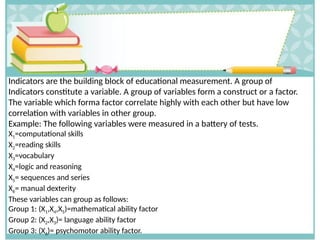
Indicators are thebuilding block of educational measurement. A group of
Indicators constitute a variable. A group of variables form a construct or a factor.
The variable which forma factor correlate highly with each other but have low
correlation with variables in other group.
Example: The following variables were measured in a battery of tests.
X1=computational skills
X2=reading skills
X3=vocabulary
X4=logic and reasoning
X5= sequences and series
X6= manual dexterity
These variables can group as follows:
Group 1: (X1,X4,X5)=mathematical ability factor
Group 2: (X2,X3)= language ability factor
Group 3: (X6)= psychomotor ability factor.
12.
ASSESTMENT
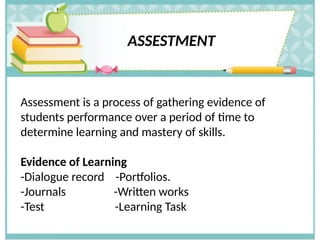
Assessment is aprocess of gathering evidence of
students performance over a period of time to
determine learning and mastery of skills.
Evidence of Learning
-Dialogue record -Portfolios.
-Journals -Written works
-Test -Learning Task
13.
Goal of Assessment
•to improve student learning and provide students,
parents and teachers with reliable information
regarding student progress and extent of attainment of
the expected learning outcomes. Assessment uses, as
basis. The levels of achievement and standards
required for the curricular goals appropriate for the
grade or year level. Assessment results show the more
permanent learning and clearer picture of the
student's ability.
14.
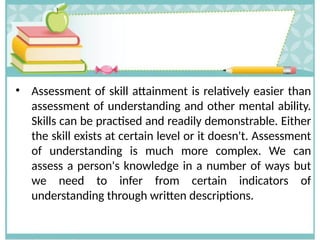
• Assessment ofskill attainment is relatively easier than
assessment of understanding and other mental ability.
Skills can be practised and readily demonstrable. Either
the skill exists at certain level or it doesn't. Assessment
of understanding is much more complex. We can
assess a person's knowledge in a number of ways but
we need to infer from certain indicators of
understanding through written descriptions.
15.
EVALUATION
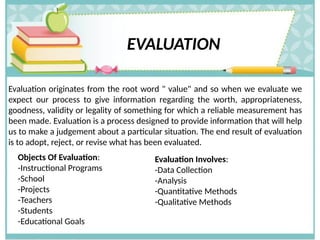
Evaluation originates fromthe root word " value" and so when we evaluate we
expect our process to give information regarding the worth, appropriateness,
goodness, validity or legality of something for which a reliable measurement has
been made. Evaluation is a process designed to provide information that will help
us to make a judgement about a particular situation. The end result of evaluation
is to adopt, reject, or revise what has been evaluated.
Objects Of Evaluation:
-Instructional Programs
-School
-Projects
-Teachers
-Students
-Educational Goals
Evaluation Involves:
-Data Collection
-Analysis
-Quantitative Methods
-Qualitative Methods
16.
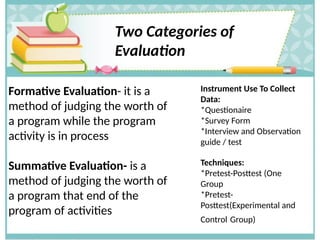
Two Categories of
Evaluation
FormativeEvaluation- it is a
method of judging the worth of
a program while the program
activity is in process
Summative Evaluation- is a
method of judging the worth of
a program that end of the
program of activities
Instrument Use To Collect
Data:
*Questionaire
*Survey Form
*Interview and Observation
guide / test
Techniques:
*Pretest-Posttest (One
Group
*Pretest-
Posttest(Experimental and
Control Group)
17.
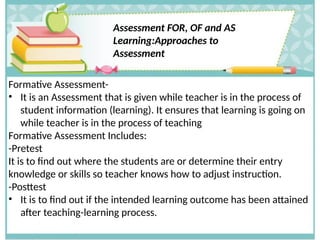
Assessment FOR, OFand AS
Learning:Approaches to
Assessment
Formative Assessment-
• It is an Assessment that is given while teacher is in the process of
student information (learning). It ensures that learning is going on
while teacher is in the process of teaching
Formative Assessment Includes:
-Pretest
It is to find out where the students are or determine their entry
knowledge or skills so teacher knows how to adjust instruction.
-Posttest
• It is to find out if the intended learning outcome has been attained
after teaching-learning process.
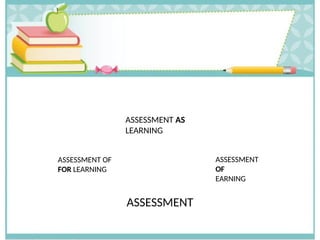
FOR Learning: Teachersusing student knowledge,
understanding and skills to inform their students.
OF Learning: Is usually given at the end of a unit,graging
period term like a semester.
AS Learning: It is associated with self-assessment. As the
term implies,assessment by itself is already a form of
learning for the students.


 Most read
 Most read
 Most read