Measurement  and Error
In small groups... Each group must  invent  a new unit of measurement  Use the new unit to determine the area of the classroom Compare your group’s unit to another  What is the conversion factor between the two different units? How would other students in another place be able to use your unit?
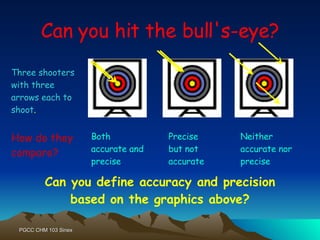
Three shooters with three arrows each to shoot . Can you hit the bull's-eye? Both accurate and precise Precise but not accurate Neither accurate nor precise How do they compare? Can you define accuracy and precision based on the graphics above?
Some terminology True value  – standard or reference of known value or a theoretical value Accuracy  – closeness to the true value Precision  – reproducibility or agreement with each other for multiple trials
A group measurement task… Using a metric stick, determine the diameter of the ball provided. Compare your results with another group. Any problems with your measurement?
Can all errors be controlled?  What are some possible things that can be done to minimize errors?
Types of Errors Determinate (or Systematic) Sometimes called  bias  due to error in one direction- high or low Known cause Operator Calibration of glassware, sensor, or instrument When determined can be corrected May be of a constant or proportional nature
constant or proportional error… Constant error influences the  intercept . Proportional error influences the  slope .
Types of Errors continued Indeterminate (or Random) Cannot be determined (no control over) Random nature causes both high and low values which will average out Multiple trials  help to minimize
sampling preparation analysis Sources of Error Representative sample homogeneous vs.  heterogeneous Loss  Contamination (unwanted addition) Measurement  of Analyte Calibration of  Instrument or Standard solutions How about sampling a chocolate chip cookie?
How do you assess the total error? One way to assess total error is to treat a reference standard as a sample. The reference standard would be carried through the entire process to see how close the results are to the reference value.
Expressing accuracy and precision Mean (average) Percent error Range Deviation Standard deviation Percent coefficient of variation precision accuracy
Accuracy and Precision The center of the target is the true value. Can’t hit the broad side of a barn! Gun barrel must be bent! Great shooting! Target shooters comments Neither accurate nor precise Precise only Both accurate and precise Nature of accuracy and precision
Both a & p P only Neither a nor p The shot-gun effect Get a new measurement system or operator Clustered multiple measurements but consistently off from true value Calibration of probe or other measuring device is off or unknown systematic error  Very small error in measurement All cluster the true value Remember a standard or true value is needed Scientific comments
Both a & p P only Neither a nor p Unacceptable Acceptable, the best that can be done without a true value Highly desired Status/rank Large standard deviation or %CV Large %error Small standard deviation or %CV Large %error Small standard deviation or %CV Small %error Mathematical comments
How would practice in target shooting or making a measurement influence the results? To judge the accuracy of an analysis, what is required?
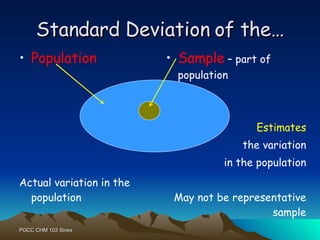
Standard Deviation of the… Population   Actual variation in the population Sample  – part of  population Estimates the variation in the population May not be representative sample
A sampling activity From the bag of poker chips ( THE POPULATION ), containing two colors, pull out FIVE chips ( THE SAMPLE ).  Record your results and calculate the %white. Place your five chips back into the bag. Repeat the five chip sample four times.
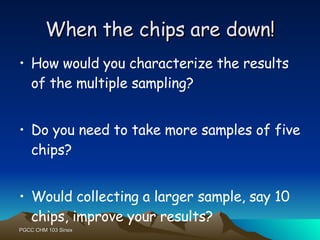
When the chips are down! How would you characterize the results of the multiple sampling? Do you need to take more samples of five chips? Would collecting a larger sample, say 10 chips, improve your results?
THE SAMPLE STANDARD DEVIATION allows for more variation in the sample compared to the population, since sample is only part of population.  Dividing by  n-1  increases the estimate of the population variation.  This attempts to  eliminate the possibility of bias . On the TI-83, the sample standard deviation is given as  Sx   when you do 1-Var Stats under  [STAT]  CALC. Population Sample In Excel, use STDEV under insert function, f x
Graphical methods Scatter plots Most accurate and precise Worst precision Systematic error? CHM 103 webpage
Box and whisker plot on TI-83 median range Large variation  Small variation
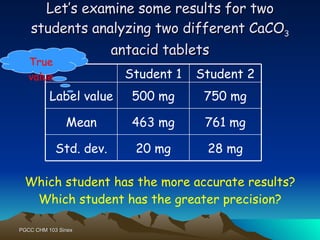
Let’s examine some results for two students analyzing two different CaCO 3  antacid tablets Which student has the more accurate results? Which student has the greater precision? True value 28 mg 20 mg Std. dev. 761 mg 463 mg Mean 750 mg 500 mg Label value Student 2 Student 1
%CV %Error How are we going to address these questions? What does the sign of the percent error tell you about the error? Student 2 Student 1 quantity
and always remember to… Make all measurements  carefully  and check your results or readings a second time. Read all devices to as many places as possible (significant figures):  calibration marks + one more place   A buret,  which is calibrated to 0.1 mL, can be read to 0.01 mL. A thermometer marked every degree can be read to 0.1 degree

Measurement

  • 1.
  • 2.
    In small groups...Each group must invent a new unit of measurement Use the new unit to determine the area of the classroom Compare your group’s unit to another What is the conversion factor between the two different units? How would other students in another place be able to use your unit?
  • 3.
    Three shooters withthree arrows each to shoot . Can you hit the bull's-eye? Both accurate and precise Precise but not accurate Neither accurate nor precise How do they compare? Can you define accuracy and precision based on the graphics above?
  • 4.
    Some terminology Truevalue – standard or reference of known value or a theoretical value Accuracy – closeness to the true value Precision – reproducibility or agreement with each other for multiple trials
  • 5.
    A group measurementtask… Using a metric stick, determine the diameter of the ball provided. Compare your results with another group. Any problems with your measurement?
  • 6.
    Can all errorsbe controlled? What are some possible things that can be done to minimize errors?
  • 7.
    Types of ErrorsDeterminate (or Systematic) Sometimes called bias due to error in one direction- high or low Known cause Operator Calibration of glassware, sensor, or instrument When determined can be corrected May be of a constant or proportional nature
  • 8.
    constant or proportionalerror… Constant error influences the intercept . Proportional error influences the slope .
  • 9.
    Types of Errorscontinued Indeterminate (or Random) Cannot be determined (no control over) Random nature causes both high and low values which will average out Multiple trials help to minimize
  • 10.
    sampling preparation analysisSources of Error Representative sample homogeneous vs. heterogeneous Loss Contamination (unwanted addition) Measurement of Analyte Calibration of Instrument or Standard solutions How about sampling a chocolate chip cookie?
  • 11.
    How do youassess the total error? One way to assess total error is to treat a reference standard as a sample. The reference standard would be carried through the entire process to see how close the results are to the reference value.
  • 12.
    Expressing accuracy andprecision Mean (average) Percent error Range Deviation Standard deviation Percent coefficient of variation precision accuracy
  • 13.
    Accuracy and PrecisionThe center of the target is the true value. Can’t hit the broad side of a barn! Gun barrel must be bent! Great shooting! Target shooters comments Neither accurate nor precise Precise only Both accurate and precise Nature of accuracy and precision
  • 14.
    Both a &p P only Neither a nor p The shot-gun effect Get a new measurement system or operator Clustered multiple measurements but consistently off from true value Calibration of probe or other measuring device is off or unknown systematic error Very small error in measurement All cluster the true value Remember a standard or true value is needed Scientific comments
  • 15.
    Both a &p P only Neither a nor p Unacceptable Acceptable, the best that can be done without a true value Highly desired Status/rank Large standard deviation or %CV Large %error Small standard deviation or %CV Large %error Small standard deviation or %CV Small %error Mathematical comments
  • 16.
    How would practicein target shooting or making a measurement influence the results? To judge the accuracy of an analysis, what is required?
  • 17.
    Standard Deviation ofthe… Population Actual variation in the population Sample – part of population Estimates the variation in the population May not be representative sample
  • 18.
    A sampling activityFrom the bag of poker chips ( THE POPULATION ), containing two colors, pull out FIVE chips ( THE SAMPLE ). Record your results and calculate the %white. Place your five chips back into the bag. Repeat the five chip sample four times.
  • 19.
    When the chipsare down! How would you characterize the results of the multiple sampling? Do you need to take more samples of five chips? Would collecting a larger sample, say 10 chips, improve your results?
  • 20.
    THE SAMPLE STANDARDDEVIATION allows for more variation in the sample compared to the population, since sample is only part of population. Dividing by n-1 increases the estimate of the population variation. This attempts to eliminate the possibility of bias . On the TI-83, the sample standard deviation is given as Sx when you do 1-Var Stats under [STAT] CALC. Population Sample In Excel, use STDEV under insert function, f x
  • 21.
    Graphical methods Scatterplots Most accurate and precise Worst precision Systematic error? CHM 103 webpage
  • 22.
    Box and whiskerplot on TI-83 median range Large variation Small variation
  • 23.
    Let’s examine someresults for two students analyzing two different CaCO 3 antacid tablets Which student has the more accurate results? Which student has the greater precision? True value 28 mg 20 mg Std. dev. 761 mg 463 mg Mean 750 mg 500 mg Label value Student 2 Student 1
  • 24.
    %CV %Error Howare we going to address these questions? What does the sign of the percent error tell you about the error? Student 2 Student 1 quantity
  • 25.
    and always rememberto… Make all measurements carefully and check your results or readings a second time. Read all devices to as many places as possible (significant figures): calibration marks + one more place A buret, which is calibrated to 0.1 mL, can be read to 0.01 mL. A thermometer marked every degree can be read to 0.1 degree