A2 Edexcel Physics Unit 6
       Revision
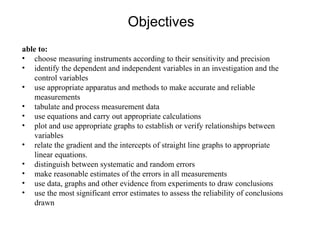
Objectives
able to:
• choose measuring instruments according to their sensitivity and precision
• identify the dependent and independent variables in an investigation and the
   control variables
• use appropriate apparatus and methods to make accurate and reliable
   measurements
• tabulate and process measurement data
• use equations and carry out appropriate calculations
• plot and use appropriate graphs to establish or verify relationships between
   variables
• relate the gradient and the intercepts of straight line graphs to appropriate
   linear equations.
• distinguish between systematic and random errors
• make reasonable estimates of the errors in all measurements
• use data, graphs and other evidence from experiments to draw conclusions
• use the most significant error estimates to assess the reliability of conclusions
   drawn
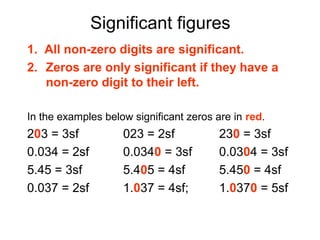
Significant figures
1. All non-zero digits are significant.
2. Zeros are only significant if they have a
   non-zero digit to their left.

In the examples below significant zeros are in red.
203 = 3sf           023 = 2sf            230 = 3sf
0.034 = 2sf         0.0340 = 3sf         0.0304 = 3sf
5.45 = 3sf          5.405 = 4sf          5.450 = 4sf
0.037 = 2sf         1.037 = 4sf;         1.0370 = 5sf
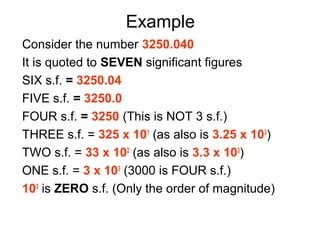
Example
Consider the number 3250.040
It is quoted to SEVEN significant figures
SIX s.f. = 3250.04
FIVE s.f. = 3250.0
FOUR s.f. = 3250 (This is NOT 3 s.f.)
THREE s.f. = 325 x 101 (as also is 3.25 x 10³)
TWO s.f. = 33 x 102 (as also is 3.3 x 10³)
ONE s.f. = 3 x 10³ (3000 is FOUR s.f.)
103 is ZERO s.f. (Only the order of magnitude)
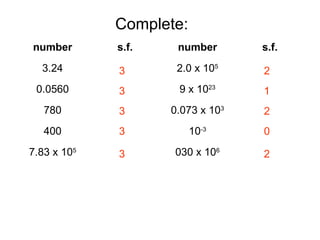
Complete:
             Answers:
number       s.f.    number       s.f.
  3.24       3       2.0 x 10⁵    2
 0.0560      3       9 x 10²³     1
   780       3      0.073 x 10³   2
   400       3           10-3     0
7.83 x 10⁵   3      030 x 106     2
Significant figures in calculations
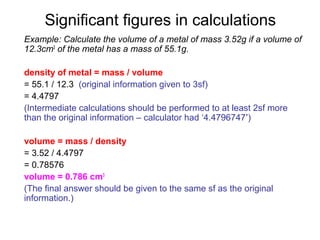
Example: Calculate the volume of a metal of mass 3.52g if a volume of
12.3cm3 of the metal has a mass of 55.1g.

density of metal = mass / volume
= 55.1 / 12.3 (original information given to 3sf)
= 4.4797
(Intermediate calculations should be performed to at least 2sf more
than the original information – calculator had ‘4.4796747’)

volume = mass / density
= 3.52 / 4.4797
= 0.78576
volume = 0.786 cm3
(The final answer should be given to the same sf as the original
information.)
Results tables


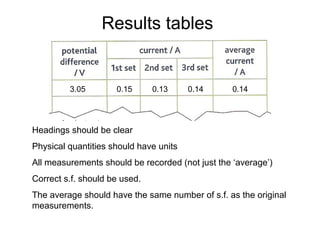
         3.05        0.15      0.13     0.14      0.14


Headings should be clear
Physical quantities should have units
All measurements should be recorded (not just the ‘average’)
Correct s.f. should be used.
The average should have the same number of s.f. as the original
measurements.
Sensitivity
The sensitivity of a measuring instrument
is equal to the output reading per unit input
quantity.

For example an multimeter set to measure
currents up to 20mA will be ten times more
sensitive than one set to read up to 200mA
when both are trying to measure the same
‘unit’ current of 1mA.
Precision
A precise measurement is one that has the maximum
possible significant figures. It is as exact as possible.
Precise measurements are obtained from sensitive
measuring instruments.

The precision of a measuring instrument is equal to the
smallest non-zero reading that can be obtained.

Examples:
A metre ruler with a millimetre scale has a precision of ± 1mm.
A multimeter set on its 20mA scale has a precision of ± 0.01mA.
A less sensitive setting (200mA) only has a precision of ± 0.1mA.
Accuracy
An accurate measurement will be close to the
correct value of the quantity being measured.

Accurate measurements are obtained by a good
technique with correctly calibrated instruments.

Example: If the temperature is known to be 20ºC a
measurement of 19ºC is more accurate than one of
23ºC.
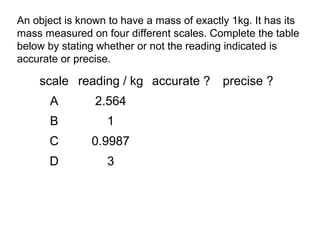
An object is known to have a mass of exactly 1kg. It has its
mass measured on four different scales. Complete the table
below by stating whether or not the reading indicated is
accurate or precise.

    scale reading / kg accurate ?          precise ?
       A        2.564           NO            YES
       B           1            YES            NO
      C        0.9987           YES           YES
      D            3            NO             NO
Reliability
Measurements are reliable if consistent
values are obtained each time the same
measurement is repeated.

Reliable: 45g; 44g; 44g; 47g; 46g
Unreliable: 45g; 44g; 67g; 47g; 12g; 45g
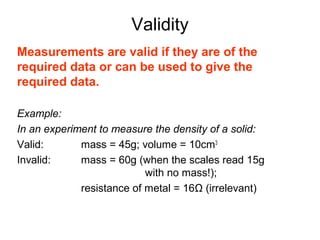
Validity
Measurements are valid if they are of the
required data or can be used to give the
required data.

Example:
In an experiment to measure the density of a solid:
Valid:       mass = 45g; volume = 10cm3
Invalid:     mass = 60g (when the scales read 15g
                           with no mass!);
             resistance of metal = 16Ω (irrelevant)
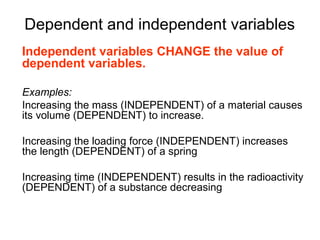
Dependent and independent variables
Independent variables CHANGE the value of
dependent variables.

Examples:
Increasing the mass (INDEPENDENT) of a material causes
its volume (DEPENDENT) to increase.

Increasing the loading force (INDEPENDENT) increases
the length (DEPENDENT) of a spring

Increasing time (INDEPENDENT) results in the radioactivity
(DEPENDENT) of a substance decreasing
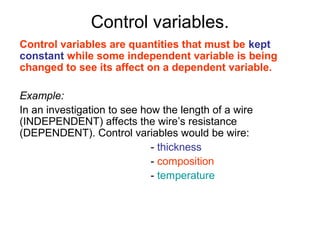
Control variables.
Control variables are quantities that must be kept
constant while some independent variable is being
changed to see its affect on a dependent variable.

Example:
In an investigation to see how the length of a wire
(INDEPENDENT) affects the wire’s resistance
(DEPENDENT). Control variables would be wire:
                             - thickness
                             - composition
                             - temperature
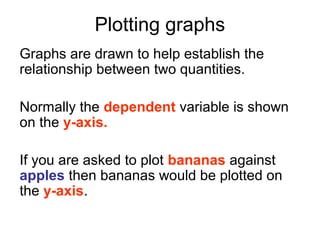
Plotting graphs
Graphs are drawn to help establish the
relationship between two quantities.

Normally the dependent variable is shown
on the y-axis.

If you are asked to plot bananas against
apples then bananas would be plotted on
the y-axis.
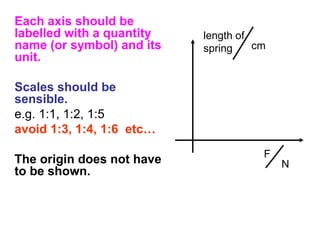
Each axis should be
labelled with a quantity   length of
name (or symbol) and its   spring    cm
unit.

Scales should be
sensible.
e.g. 1:1, 1:2, 1:5
avoid 1:3, 1:4, 1:6 etc…
                                      F
The origin does not have                  N
to be shown.
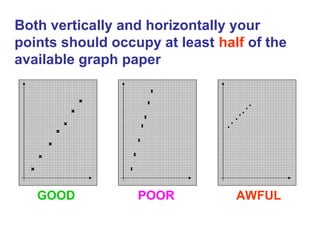
Both vertically and horizontally your
points should occupy at least half of the
available graph paper


   GOOD           POOR           AWFUL
Best fit lines
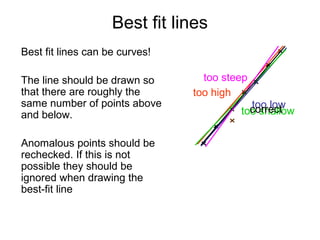
Best fit lines can be curves!

The line should be drawn so       too steep
that there are roughly the      too high
same number of points above                too low
                                           correct
                                         too shallow
and below.

Anomalous points should be
rechecked. If this is not
possible they should be
ignored when drawing the
best-fit line
Measuring gradients
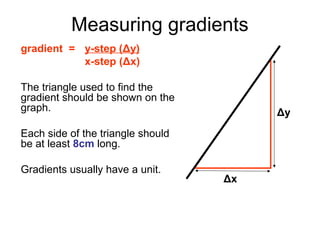
gradient = y-step (Δy)
           x-step (Δx)

The triangle used to find the
gradient should be shown on the
graph.                                  Δy
Each side of the triangle should
be at least 8cm long.

Gradients usually have a unit.
                                   Δx
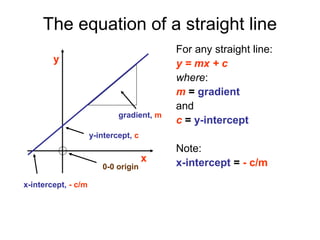
The equation of a straight line
                                           For any straight line:
        y                                  y = mx + c
                                           where:
                                           m = gradient
                                           and
                             gradient, m
                                           c = y-intercept
                     y-intercept, c
                                           Note:
                                      x    x-intercept = - c/m
                        0-0 origin

x-intercept, - c/m
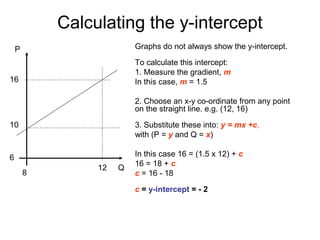
Calculating the y-intercept
    P                     Graphs do not always show the y-intercept.

                          To calculate this intercept:
                          1. Measure the gradient, m
16                        In this case, m = 1.5

                          2. Choose an x-y co-ordinate from any point
                          on the straight line. e.g. (12, 16)

10                        3. Substitute these into: y = mx +c,
                          with (P = y and Q = x)

6                         In this case 16 = (1.5 x 12) + c
                          16 = 18 + c
                 12   Q
        8                 c = 16 - 18

                          c = y-intercept = - 2
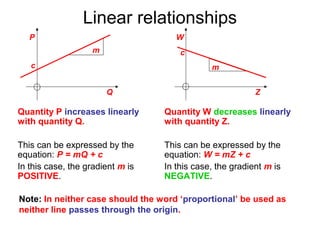
Linear relationships
   P                                 W
                   m                  c
   c                                          m


                       Q                                  Z

Quantity P increases linearly     Quantity W decreases linearly
with quantity Q.                  with quantity Z.

This can be expressed by the      This can be expressed by the
equation: P = mQ + c              equation: W = mZ + c
In this case, the gradient m is   In this case, the gradient m is
POSITIVE.                         NEGATIVE.

Note: In neither case should the word ‘proportional’ be used as
neither line passes through the origin.
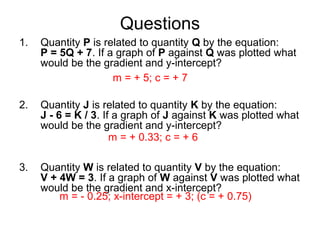
Questions
1.   Quantity P is related to quantity Q by the equation:
     P = 5Q + 7. If a graph of P against Q was plotted what
     would be the gradient and y-intercept?
                     m = + 5; c = + 7

2.   Quantity J is related to quantity K by the equation:
     J - 6 = K / 3. If a graph of J against K was plotted what
     would be the gradient and y-intercept?
                      m = + 0.33; c = + 6

3.   Quantity W is related to quantity V by the equation:
     V + 4W = 3. If a graph of W against V was plotted what
     would be the gradient and x-intercept?
         m = - 0.25; x-intercept = + 3; (c = + 0.75)
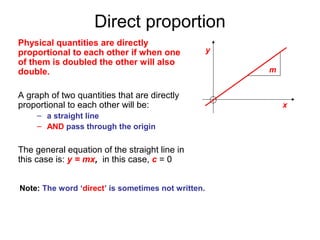
Direct proportion
Physical quantities are directly
proportional to each other if when one              y
of them is doubled the other will also
double.                                                 m


A graph of two quantities that are directly
proportional to each other will be:                         x
     – a straight line
     – AND pass through the origin

The general equation of the straight line in
this case is: y = mx, in this case, c = 0


Note: The word ‘direct’ is sometimes not written.
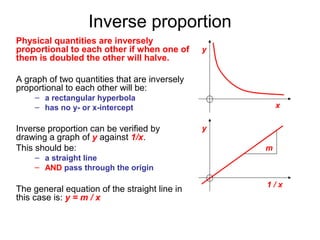
Inverse proportion
Physical quantities are inversely
proportional to each other if when one of      y
them is doubled the other will halve.

A graph of two quantities that are inversely
proportional to each other will be:
    – a rectangular hyperbola
    – has no y- or x-intercept                         x

Inverse proportion can be verified by          y
drawing a graph of y against 1/x.
This should be:                                    m
    – a straight line
    – AND pass through the origin

                                                   1/x
The general equation of the straight line in
this case is: y = m / x
Systematic error
Systematic error is error of measurement due to readings that
systematically differ from the true reading and follow a pattern or
trend or bias.

Example: Suppose a measurement should be 567cm
Readings showing systematic error: 585cm; 584cm; 583cm; 584cm

Systematic error is often caused by poor measurement technique
or by using incorrectly calibrated instruments.

Calculating a mean value (584cm) does not eliminate systematic error.

Zero error is a common cause of systematic error. This occurs when
an instrument does not read zero when it should do so. The
measurement examples above may have been caused by a zero error
of about + 17 cm.
Random error
Random error is error of measurement due to readings
that vary randomly with no recognisable pattern or
trend or bias.

Example: Suppose a measurement should be 567cm
Readings showing random error only: 569cm; 568cm; 564cm; 566cm

Random error is unavoidable but can be minimalised by using a
consistent measurement technique and the best possible
measuring instruments.

Calculating a mean value (567cm) will reduce the effect of random
error.
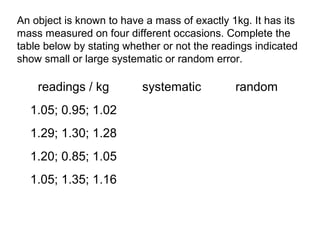
An object is known to have a mass of exactly 1kg. It has its
mass measured on four different occasions. Complete the
table below by stating whether or not the readings indicated
show small or large systematic or random error.

    readings / kg         systematic          random
  1.05; 0.95; 1.02           small             small
  1.29; 1.30; 1.28           large             small
  1.20; 0.85; 1.05           small              large
  1.05; 1.35; 1.16           large              large
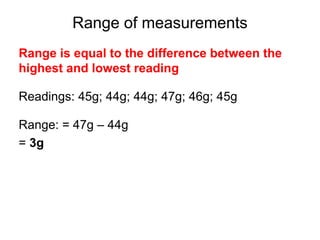
Range of measurements
Range is equal to the difference between the
highest and lowest reading

Readings: 45g; 44g; 44g; 47g; 46g; 45g

Range: = 47g – 44g
= 3g
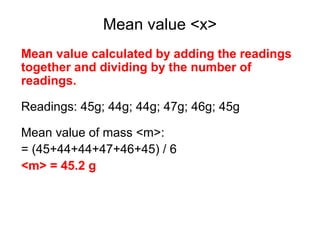
Mean value <x>
Mean value calculated by adding the readings
together and dividing by the number of
readings.

Readings: 45g; 44g; 44g; 47g; 46g; 45g

Mean value of mass <m>:
= (45+44+44+47+46+45) / 6
<m> = 45.2 g
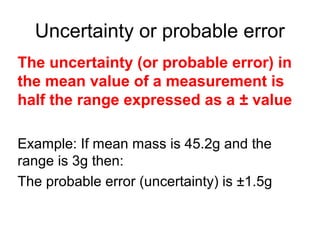
Uncertainty or probable error
The uncertainty (or probable error) in
the mean value of a measurement is
half the range expressed as a ± value

Example: If mean mass is 45.2g and the
range is 3g then:
The probable error (uncertainty) is ±1.5g
Uncertainty in a single reading
OR when measurements do not vary

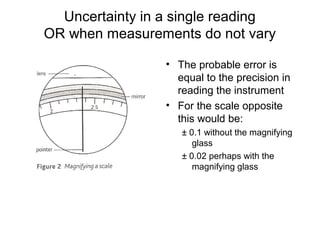
                 • The probable error is
                   equal to the precision in
                   reading the instrument
                 • For the scale opposite
                   this would be:
                    ± 0.1 without the magnifying
                       glass
                    ± 0.02 perhaps with the
                       magnifying glass
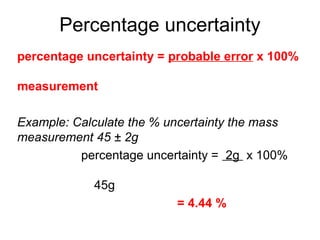
Percentage uncertainty
percentage uncertainty = probable error x 100%

measurement

Example: Calculate the % uncertainty the mass
measurement 45 ± 2g
          percentage uncertainty = 2g x 100%

            45g
                          = 4.44 %
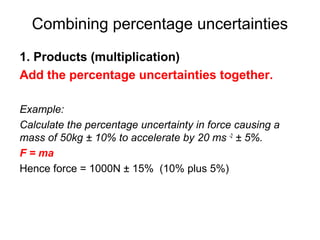
Combining percentage uncertainties
1. Products (multiplication)
Add the percentage uncertainties together.

Example:
Calculate the percentage uncertainty in force causing a
mass of 50kg ± 10% to accelerate by 20 ms -2 ± 5%.
F = ma
Hence force = 1000N ± 15% (10% plus 5%)
2. Quotients (division)
Add the percentage uncertainties together.
Example:
Calculate the percentage uncertainty in the density of a
material of mass 300g ± 5% and volume 60cm3 ± 2%.
D=M/V
Hence density = 5.0 gcm-3 ± 7% (5% plus 2%)
3. Powers
Multiply the percentage uncertainty by the
number of the power.

Example:
Calculate the percentage uncertainty in the volume of a
cube of side, L = 4.0cm ± 2%.
Volume = L3
Volume = 64cm3 ± 6% (2% x 3)
Significant figures and uncertainty
The percentage uncertainty in a measurement or calculation
determines the number of significant figures to be used.

Example:
mass = 4.52g ± 10%
±10% of 4.52g is ± 0.452g
The uncertainty should be quoted to 1sf only. i.e. ± 0.5g
The quantity value (4.52) should be quoted to the same
decimal places as the 1sf uncertainty value. i.e. ‘4.5’
The mass value will now be quoted to only 2sf.
mass = 4.5 ± 0.5g
Conclusion reliability and uncertainty
The smaller the percentage uncertainty the
more reliable is a conclusion.

Example: The average speed of a car is measured
using two different methods:
(a) manually with a stop-watch
– distance 100 ± 0.5m; time 12.2 ± 0.5s
(b) automatically using a set of light gates
– distance 10 ± 0.5cm; time 1.31 ± 0.01s
Which method gives the more reliable answer?
Percentage uncertainties:
(a) stop-watch – distance ± 0.5%; time ± 4%
(b) light gates – distance ± 5%; time ± 0.8%

Total percentage uncertainties:
(a) stop-watch: ± 4.5%
(b) light gates: ± 5.8%

Evaluation:
The stop-watch method has the lower overall percentage
uncertainty and so is the more reliable method.
The light gate method would be much better if a larger
distance was used.
Planning procedures
Usually the final part of a written ISA paper is a question
involving the planning of a procedure, usually related to an
ISA experiment, to test a hypothesis.

Example:
In an ISA experiment a marble was rolled down a slope.
With the slope angle kept constant the time taken by the
marble was measured for different distances down the
slope. The average speed of the marble was then measured
using the equation, speed = distance ÷ time.

Question:
Describe a procedure for measuring how the average speed
varies with slope angle. [5 marks]
Answer:
Any five of:
• measure the angle of a slope using a protractor
• release the marble from the same distance up the slope
• start the stop-watch on marble release stop the stop-
  watch once the marble reaches the end of the slope
• repeat timing
• calculate the average time
• measure the distance the marble rolls using a metre
  ruler
• calculate average speed using: speed = distance ÷ time
• repeat the above for different slope angles
Internet Links
• Equation Grapher - PhET - Learn about graphing polynomials. The
  shape of the curve changes as the constants are adjusted. View the
  curves for the individual terms (e.g. y=bx ) to see how they add to
  generate the polynomial curve.
Notes from Breithaupt pages 219 to 220, 223 to 225 & 233
1.   Define in the context of recording measurements, and give
     examples of, what is meant by: (a) reliable; (b) valid;
     (c) range; (d) mean value; (e) systematic error; (f) random
     error; (g) zero error; (h) uncertainty; (i) accuracy;
     (j) precision and (k) linearity
2.   What determines the precision in (a) a single reading and
     (b) multiple readings?
3.   Define percentage uncertainty.
4.   Two measurements P = 2.0 ± 0.1 and Q = 4.0 ± 0.4 are
     obtained. Determine the uncertainty (probable error) in:
     (a) P x Q; (b) Q / P; (c) P3; (d) √Q.
5.   Measure the area of a piece of A4 paper and state the
     probable error (or uncertainty) in your answer.
6.   State the number 1230.0456 to (a) 6 sf, (b) 3 sf and (c) 0 sf.
Notes from Breithaupt pages 238 & 239
1. Copy figure 2 on page 238 and define the
   terms of the equation of a straight line graph.
2. Copy figure 1 on page 238 and explain how it
   shows the direct proportionality relationship
   between the two quantities.
3. Draw figures 3, 4 & 5 and explain how these
   graphs relate to the equation y = mx + c.
4. How can straight line graphs be used to solve
   simultaneous equations?
5. Try the summary questions on page 239

A2 edexcel physics unit 6 revision

  • 1.
    A2 Edexcel PhysicsUnit 6 Revision
  • 2.
    Objectives able to: • choosemeasuring instruments according to their sensitivity and precision • identify the dependent and independent variables in an investigation and the control variables • use appropriate apparatus and methods to make accurate and reliable measurements • tabulate and process measurement data • use equations and carry out appropriate calculations • plot and use appropriate graphs to establish or verify relationships between variables • relate the gradient and the intercepts of straight line graphs to appropriate linear equations. • distinguish between systematic and random errors • make reasonable estimates of the errors in all measurements • use data, graphs and other evidence from experiments to draw conclusions • use the most significant error estimates to assess the reliability of conclusions drawn
  • 3.
    Significant figures 1. Allnon-zero digits are significant. 2. Zeros are only significant if they have a non-zero digit to their left. In the examples below significant zeros are in red. 203 = 3sf 023 = 2sf 230 = 3sf 0.034 = 2sf 0.0340 = 3sf 0.0304 = 3sf 5.45 = 3sf 5.405 = 4sf 5.450 = 4sf 0.037 = 2sf 1.037 = 4sf; 1.0370 = 5sf
  • 4.
    Example Consider the number3250.040 It is quoted to SEVEN significant figures SIX s.f. = 3250.04 FIVE s.f. = 3250.0 FOUR s.f. = 3250 (This is NOT 3 s.f.) THREE s.f. = 325 x 101 (as also is 3.25 x 10³) TWO s.f. = 33 x 102 (as also is 3.3 x 10³) ONE s.f. = 3 x 10³ (3000 is FOUR s.f.) 103 is ZERO s.f. (Only the order of magnitude)
  • 5.
    Complete: Answers: number s.f. number s.f. 3.24 3 2.0 x 10⁵ 2 0.0560 3 9 x 10²³ 1 780 3 0.073 x 10³ 2 400 3 10-3 0 7.83 x 10⁵ 3 030 x 106 2
  • 6.
    Significant figures incalculations Example: Calculate the volume of a metal of mass 3.52g if a volume of 12.3cm3 of the metal has a mass of 55.1g. density of metal = mass / volume = 55.1 / 12.3 (original information given to 3sf) = 4.4797 (Intermediate calculations should be performed to at least 2sf more than the original information – calculator had ‘4.4796747’) volume = mass / density = 3.52 / 4.4797 = 0.78576 volume = 0.786 cm3 (The final answer should be given to the same sf as the original information.)
  • 7.
    Results tables 3.05 0.15 0.13 0.14 0.14 Headings should be clear Physical quantities should have units All measurements should be recorded (not just the ‘average’) Correct s.f. should be used. The average should have the same number of s.f. as the original measurements.
  • 8.
    Sensitivity The sensitivity ofa measuring instrument is equal to the output reading per unit input quantity. For example an multimeter set to measure currents up to 20mA will be ten times more sensitive than one set to read up to 200mA when both are trying to measure the same ‘unit’ current of 1mA.
  • 9.
    Precision A precise measurementis one that has the maximum possible significant figures. It is as exact as possible. Precise measurements are obtained from sensitive measuring instruments. The precision of a measuring instrument is equal to the smallest non-zero reading that can be obtained. Examples: A metre ruler with a millimetre scale has a precision of ± 1mm. A multimeter set on its 20mA scale has a precision of ± 0.01mA. A less sensitive setting (200mA) only has a precision of ± 0.1mA.
  • 10.
    Accuracy An accurate measurementwill be close to the correct value of the quantity being measured. Accurate measurements are obtained by a good technique with correctly calibrated instruments. Example: If the temperature is known to be 20ºC a measurement of 19ºC is more accurate than one of 23ºC.
  • 11.
    An object isknown to have a mass of exactly 1kg. It has its mass measured on four different scales. Complete the table below by stating whether or not the reading indicated is accurate or precise. scale reading / kg accurate ? precise ? A 2.564 NO YES B 1 YES NO C 0.9987 YES YES D 3 NO NO
  • 12.
    Reliability Measurements are reliableif consistent values are obtained each time the same measurement is repeated. Reliable: 45g; 44g; 44g; 47g; 46g Unreliable: 45g; 44g; 67g; 47g; 12g; 45g
  • 13.
    Validity Measurements are validif they are of the required data or can be used to give the required data. Example: In an experiment to measure the density of a solid: Valid: mass = 45g; volume = 10cm3 Invalid: mass = 60g (when the scales read 15g with no mass!); resistance of metal = 16Ω (irrelevant)
  • 14.
    Dependent and independentvariables Independent variables CHANGE the value of dependent variables. Examples: Increasing the mass (INDEPENDENT) of a material causes its volume (DEPENDENT) to increase. Increasing the loading force (INDEPENDENT) increases the length (DEPENDENT) of a spring Increasing time (INDEPENDENT) results in the radioactivity (DEPENDENT) of a substance decreasing
  • 15.
    Control variables. Control variablesare quantities that must be kept constant while some independent variable is being changed to see its affect on a dependent variable. Example: In an investigation to see how the length of a wire (INDEPENDENT) affects the wire’s resistance (DEPENDENT). Control variables would be wire: - thickness - composition - temperature
  • 16.
    Plotting graphs Graphs aredrawn to help establish the relationship between two quantities. Normally the dependent variable is shown on the y-axis. If you are asked to plot bananas against apples then bananas would be plotted on the y-axis.
  • 17.
    Each axis shouldbe labelled with a quantity length of name (or symbol) and its spring cm unit. Scales should be sensible. e.g. 1:1, 1:2, 1:5 avoid 1:3, 1:4, 1:6 etc… F The origin does not have N to be shown.
  • 18.
    Both vertically andhorizontally your points should occupy at least half of the available graph paper GOOD POOR AWFUL
  • 19.
    Best fit lines Bestfit lines can be curves! The line should be drawn so too steep that there are roughly the too high same number of points above too low correct too shallow and below. Anomalous points should be rechecked. If this is not possible they should be ignored when drawing the best-fit line
  • 20.
    Measuring gradients gradient =y-step (Δy) x-step (Δx) The triangle used to find the gradient should be shown on the graph. Δy Each side of the triangle should be at least 8cm long. Gradients usually have a unit. Δx
  • 21.
    The equation ofa straight line For any straight line: y y = mx + c where: m = gradient and gradient, m c = y-intercept y-intercept, c Note: x x-intercept = - c/m 0-0 origin x-intercept, - c/m
  • 22.
    Calculating the y-intercept P Graphs do not always show the y-intercept. To calculate this intercept: 1. Measure the gradient, m 16 In this case, m = 1.5 2. Choose an x-y co-ordinate from any point on the straight line. e.g. (12, 16) 10 3. Substitute these into: y = mx +c, with (P = y and Q = x) 6 In this case 16 = (1.5 x 12) + c 16 = 18 + c 12 Q 8 c = 16 - 18 c = y-intercept = - 2
  • 23.
    Linear relationships P W m c c m Q Z Quantity P increases linearly Quantity W decreases linearly with quantity Q. with quantity Z. This can be expressed by the This can be expressed by the equation: P = mQ + c equation: W = mZ + c In this case, the gradient m is In this case, the gradient m is POSITIVE. NEGATIVE. Note: In neither case should the word ‘proportional’ be used as neither line passes through the origin.
  • 24.
    Questions 1. Quantity P is related to quantity Q by the equation: P = 5Q + 7. If a graph of P against Q was plotted what would be the gradient and y-intercept? m = + 5; c = + 7 2. Quantity J is related to quantity K by the equation: J - 6 = K / 3. If a graph of J against K was plotted what would be the gradient and y-intercept? m = + 0.33; c = + 6 3. Quantity W is related to quantity V by the equation: V + 4W = 3. If a graph of W against V was plotted what would be the gradient and x-intercept? m = - 0.25; x-intercept = + 3; (c = + 0.75)
  • 25.
    Direct proportion Physical quantitiesare directly proportional to each other if when one y of them is doubled the other will also double. m A graph of two quantities that are directly proportional to each other will be: x – a straight line – AND pass through the origin The general equation of the straight line in this case is: y = mx, in this case, c = 0 Note: The word ‘direct’ is sometimes not written.
  • 26.
    Inverse proportion Physical quantitiesare inversely proportional to each other if when one of y them is doubled the other will halve. A graph of two quantities that are inversely proportional to each other will be: – a rectangular hyperbola – has no y- or x-intercept x Inverse proportion can be verified by y drawing a graph of y against 1/x. This should be: m – a straight line – AND pass through the origin 1/x The general equation of the straight line in this case is: y = m / x
  • 27.
    Systematic error Systematic erroris error of measurement due to readings that systematically differ from the true reading and follow a pattern or trend or bias. Example: Suppose a measurement should be 567cm Readings showing systematic error: 585cm; 584cm; 583cm; 584cm Systematic error is often caused by poor measurement technique or by using incorrectly calibrated instruments. Calculating a mean value (584cm) does not eliminate systematic error. Zero error is a common cause of systematic error. This occurs when an instrument does not read zero when it should do so. The measurement examples above may have been caused by a zero error of about + 17 cm.
  • 28.
    Random error Random erroris error of measurement due to readings that vary randomly with no recognisable pattern or trend or bias. Example: Suppose a measurement should be 567cm Readings showing random error only: 569cm; 568cm; 564cm; 566cm Random error is unavoidable but can be minimalised by using a consistent measurement technique and the best possible measuring instruments. Calculating a mean value (567cm) will reduce the effect of random error.
  • 29.
    An object isknown to have a mass of exactly 1kg. It has its mass measured on four different occasions. Complete the table below by stating whether or not the readings indicated show small or large systematic or random error. readings / kg systematic random 1.05; 0.95; 1.02 small small 1.29; 1.30; 1.28 large small 1.20; 0.85; 1.05 small large 1.05; 1.35; 1.16 large large
  • 30.
    Range of measurements Rangeis equal to the difference between the highest and lowest reading Readings: 45g; 44g; 44g; 47g; 46g; 45g Range: = 47g – 44g = 3g
  • 31.
    Mean value <x> Meanvalue calculated by adding the readings together and dividing by the number of readings. Readings: 45g; 44g; 44g; 47g; 46g; 45g Mean value of mass <m>: = (45+44+44+47+46+45) / 6 <m> = 45.2 g
  • 32.
    Uncertainty or probableerror The uncertainty (or probable error) in the mean value of a measurement is half the range expressed as a ± value Example: If mean mass is 45.2g and the range is 3g then: The probable error (uncertainty) is ±1.5g
  • 33.
    Uncertainty in asingle reading OR when measurements do not vary • The probable error is equal to the precision in reading the instrument • For the scale opposite this would be: ± 0.1 without the magnifying glass ± 0.02 perhaps with the magnifying glass
  • 34.
    Percentage uncertainty percentage uncertainty= probable error x 100% measurement Example: Calculate the % uncertainty the mass measurement 45 ± 2g percentage uncertainty = 2g x 100% 45g = 4.44 %
  • 35.
    Combining percentage uncertainties 1.Products (multiplication) Add the percentage uncertainties together. Example: Calculate the percentage uncertainty in force causing a mass of 50kg ± 10% to accelerate by 20 ms -2 ± 5%. F = ma Hence force = 1000N ± 15% (10% plus 5%)
  • 36.
    2. Quotients (division) Addthe percentage uncertainties together. Example: Calculate the percentage uncertainty in the density of a material of mass 300g ± 5% and volume 60cm3 ± 2%. D=M/V Hence density = 5.0 gcm-3 ± 7% (5% plus 2%)
  • 37.
    3. Powers Multiply thepercentage uncertainty by the number of the power. Example: Calculate the percentage uncertainty in the volume of a cube of side, L = 4.0cm ± 2%. Volume = L3 Volume = 64cm3 ± 6% (2% x 3)
  • 38.
    Significant figures anduncertainty The percentage uncertainty in a measurement or calculation determines the number of significant figures to be used. Example: mass = 4.52g ± 10% ±10% of 4.52g is ± 0.452g The uncertainty should be quoted to 1sf only. i.e. ± 0.5g The quantity value (4.52) should be quoted to the same decimal places as the 1sf uncertainty value. i.e. ‘4.5’ The mass value will now be quoted to only 2sf. mass = 4.5 ± 0.5g
  • 39.
    Conclusion reliability anduncertainty The smaller the percentage uncertainty the more reliable is a conclusion. Example: The average speed of a car is measured using two different methods: (a) manually with a stop-watch – distance 100 ± 0.5m; time 12.2 ± 0.5s (b) automatically using a set of light gates – distance 10 ± 0.5cm; time 1.31 ± 0.01s Which method gives the more reliable answer?
  • 40.
    Percentage uncertainties: (a) stop-watch– distance ± 0.5%; time ± 4% (b) light gates – distance ± 5%; time ± 0.8% Total percentage uncertainties: (a) stop-watch: ± 4.5% (b) light gates: ± 5.8% Evaluation: The stop-watch method has the lower overall percentage uncertainty and so is the more reliable method. The light gate method would be much better if a larger distance was used.
  • 41.
    Planning procedures Usually thefinal part of a written ISA paper is a question involving the planning of a procedure, usually related to an ISA experiment, to test a hypothesis. Example: In an ISA experiment a marble was rolled down a slope. With the slope angle kept constant the time taken by the marble was measured for different distances down the slope. The average speed of the marble was then measured using the equation, speed = distance ÷ time. Question: Describe a procedure for measuring how the average speed varies with slope angle. [5 marks]
  • 42.
    Answer: Any five of: •measure the angle of a slope using a protractor • release the marble from the same distance up the slope • start the stop-watch on marble release stop the stop- watch once the marble reaches the end of the slope • repeat timing • calculate the average time • measure the distance the marble rolls using a metre ruler • calculate average speed using: speed = distance ÷ time • repeat the above for different slope angles
  • 43.
    Internet Links • EquationGrapher - PhET - Learn about graphing polynomials. The shape of the curve changes as the constants are adjusted. View the curves for the individual terms (e.g. y=bx ) to see how they add to generate the polynomial curve.
  • 44.
    Notes from Breithauptpages 219 to 220, 223 to 225 & 233 1. Define in the context of recording measurements, and give examples of, what is meant by: (a) reliable; (b) valid; (c) range; (d) mean value; (e) systematic error; (f) random error; (g) zero error; (h) uncertainty; (i) accuracy; (j) precision and (k) linearity 2. What determines the precision in (a) a single reading and (b) multiple readings? 3. Define percentage uncertainty. 4. Two measurements P = 2.0 ± 0.1 and Q = 4.0 ± 0.4 are obtained. Determine the uncertainty (probable error) in: (a) P x Q; (b) Q / P; (c) P3; (d) √Q. 5. Measure the area of a piece of A4 paper and state the probable error (or uncertainty) in your answer. 6. State the number 1230.0456 to (a) 6 sf, (b) 3 sf and (c) 0 sf.
  • 45.
    Notes from Breithauptpages 238 & 239 1. Copy figure 2 on page 238 and define the terms of the equation of a straight line graph. 2. Copy figure 1 on page 238 and explain how it shows the direct proportionality relationship between the two quantities. 3. Draw figures 3, 4 & 5 and explain how these graphs relate to the equation y = mx + c. 4. How can straight line graphs be used to solve simultaneous equations? 5. Try the summary questions on page 239