Introduction to Measurements
• Typically, we are accustomed to counting but not
measuring.
• Engineers are concerned with distances,
elevations, volumes, direction, and weights.
• Fundamental principle of measuring:
No measurement is exact
and the true value is never known
Introduction to Measurements
Accuracy and Precision
 Accuracy - degree of perfection obtained in a
measurement
 Precision - the closeness of one measurement to
another
Introduction to Measurements
Accuracy and Precision
This target grouping is precise
Target #1
Introduction to Measurements
Accuracy and Precision
This target grouping is accurate
Target #2
Introduction to Measurements
Accuracy and Precision
This target grouping is accurate and precise
Target #3
Introduction to Measurements
Accuracy and Precision
Here are a couple of other web sites for additional
information in accuracy and precision:
http://www.colorado.edu/geography/gcraft/notes/error/error_f.html
http://en.wikipedia.org/wiki/Accuracy
CIVL 1101 Surveying - Precision and Significant Figures 1/8
Introduction to Measurements
Accuracy and Precision
 Better precision does not necessarily mean better
accuracy
 In measuring distance, precision is defined as:
error of measurement
=
distance measured
precision
Introduction to Measurements
Accuracy and Precision
 For example, if a distance of 4,200 ft. is measured and
the error is estimated a 0.7 ft., then the precision is:

0.7 ft.
4,200 ft.
precision 
1
6,000
 The objective of surveying is to make measurements that
are both precise and accurate
Introduction to Measurements
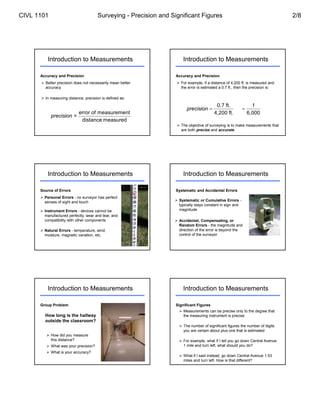
Source of Errors
 Personal Errors - no surveyor has perfect
senses of sight and touch
 Instrument Errors - devices cannot be
manufactured perfectly, wear and tear, and
compatibility with other components
 Natural Errors - temperature, wind,
moisture, magnetic variation, etc.
Introduction to Measurements
Systematic and Accidental Errors
 Systematic or Cumulative Errors -
typically stays constant in sign and
magnitude
 Accidental, Compensating, or
Random Errors - the magnitude and
direction of the error is beyond the
control of the surveyor
Introduction to Measurements
Group Problem
How long is the hallway
outside the classroom?
 How did you measure
this distance?
 What was your precision?
 What is your accuracy?
I measured it as: 171.60 ft.
Introduction to Measurements
Significant Figures
 Measurements can be precise only to the degree that
the measuring instrument is precise.
 The number of significant figures the number of digits
you are certain about plus one that is estimated
 For example, what if I tell you go down Central Avenue
1 mile and turn left, what should you do?
 What if I said instead, go down Central Avenue 1.53
miles and turn left. How is that different?
CIVL 1101 Surveying - Precision and Significant Figures 2/8
Introduction to Measurements
Significant Figures
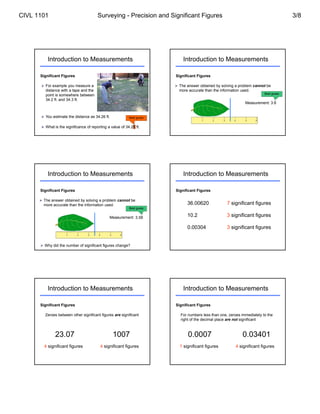
 For example you measure a
distance with a tape and the
point is somewhere between
34.2 ft. and 34.3 ft.
Best guess You estimate the distance as 34.26 ft.
 What is the significance of reporting a value of 34.26 ft.
Introduction to Measurements
Significant Figures
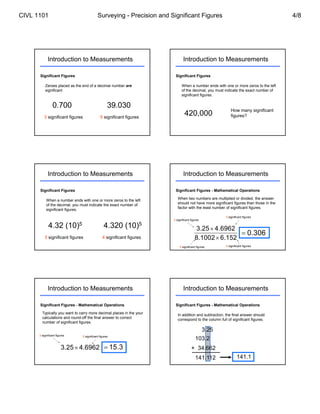
 The answer obtained by solving a problem cannot be
more accurate than the information used.
3.6Measurement:
Best guess
Introduction to Measurements
Significant Figures
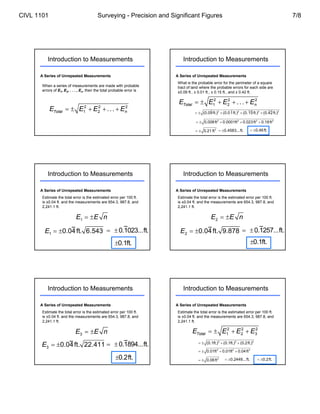
 The answer obtained by solving a problem cannot be
more accurate than the information used.
Measurement: 3.6Measurement: 3.58
Best guess
 Why did the number of significant figures change?
Introduction to Measurements
Significant Figures
36.00620 7 significant figures
10.2
0.00304
3 significant figures
Introduction to Measurements
Significant Figures
Zeroes between other significant figures are significant
23.07 1007
4 significant figures 4 significant figures
Introduction to Measurements
Significant Figures
For numbers less than one, zeroes immediately to the
right of the decimal place are not significant
0.0007 0.03401
1 significant figures 4 significant figures
CIVL 1101 Surveying - Precision and Significant Figures 3/8
Introduction to Measurements
Significant Figures
Zeroes placed as the end of a decimal number are
significant
0.700 39.030
3 significant figures 5 significant figures
Introduction to Measurements
Significant Figures
When a number ends with one or more zeros to the left
of the decimal, you must indicate the exact number of
significant figures.
420,000 How many significant
figures?
Introduction to Measurements
Significant Figures
4.32 (10)5 4.320 (10)5
3 significant figures 4 significant figures
When a number ends with one or more zeros to the left
of the decimal, you must indicate the exact number of
significant figures.
Introduction to Measurements
Significant Figures - Mathematical Operations
When two numbers are multiplied or divided, the answer
should not have more significant figures than those in the
factor with the least number of significant figures.


3.25 4.6962
8.1002 6.152
3 significant figures
5 significant figures
4 significant figures5 significant figures
 0.306279463... 0.306
Introduction to Measurements
Significant Figures - Mathematical Operations
Typically you want to carry more decimal places in the your
calculations and round-off the final answer to correct
number of significant figures.
3.25 4.6962
3 significant figures 5 significant figures
 15.2626650 15.3
Introduction to Measurements
Significant Figures - Mathematical Operations
In addition and subtraction, the final answer should
correspond to the column full of significant figures.
3.25
103.2
+ 34.662
141.112 141.1
CIVL 1101 Surveying - Precision and Significant Figures 4/8
Introduction to Measurements
Significant Figures - Mathematical Operations
 When the answer to a calculation contains too many
significant figures, it must be rounded off.
 One way of rounding off involves underestimating the
answer for five of these digits (0, 1, 2, 3, and 4) and
overestimating the answer for the other five (5, 6, 7, 8,
and 9).
Introduction to Measurements
Significant Figures - Mathematical Operations
This approach to rounding off is summarized as follows:
If the digit is smaller than 5, drop this digit and leave the
remaining number unchanged.
Report the following to three significant figures:
1.68497  1.68
Introduction to Measurements
Significant Figures - Mathematical Operations
This approach to rounding off is summarized as follows:
If the digit is 5 or larger, drop this digit and add 1 to the
preceding digit.
Report the following to three significant figures:
1.24712  1.25
Introduction to Measurements
Significant Figures - Mathematical Operations
In addition and subtraction, the final answer should
correspond to the column full of significant figures
3.200
0.4968
+ 24
27.6968 28
Introduction to Measurements
Significant Figures - Mathematical Operations
When measurements are converted into another set of
units, the number of significant figures is preserved.
39,456 ft2 0.90578512... acres0.90579 acres
Introduction to Measurements
Significant Figures - Mathematical Operations
http://en.wikipedia.org/wiki/Significant_figures
http://www.chem.tamu.edu/class/fyp/mathrev/mr-sigfg.html
 There is a nice interactive practice on significant figures
on the web at:
http://www.mrwiggersci.com/chem/Tutorials/Ch2-Interact-Pract-Sig-Figs-Blacksburg.htm
 Some other sites you might want to check out:
CIVL 1101 Surveying - Precision and Significant Figures 5/8
Introduction to Measurements
TopHat Problems
Introduction to Measurements
Repeated Measurements of a Single Quantity
 When a single quantity is measured several times or
when a series of quantities is measured, random errors
tend to accumulate in proportion to the square root of the
number of measurements.
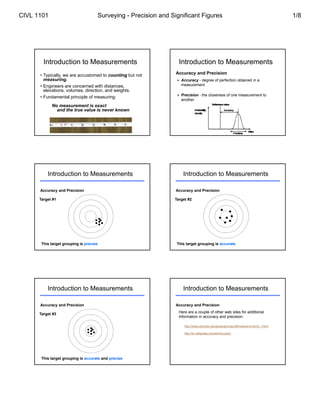
 This is called the law of compensation:
 TotalE E n   TotalE
E
n
Introduction to Measurements
Repeated Measurements of a Single Quantity
If a distance is measured 9 time and the estimated error in
each measurement is ±0.05 ft., what is the estimate of the
total error?
 TotalE E n
 0.05 9TotalE ft  0.15 ft.
0.2 ft. 
 0.0979.. ft
Introduction to Measurements
Repeated Measurements of a Single Quantity
A surveying crew or party is capable of taping distances with
an estimated error of ±0.02 ft. for each 100-ft. distance.
Estimate total error if a distance of 2,400 ft. is measured?
 TotalE E n
 0.02 24TotalE ft
 0.1ft.
Introduction to Measurements
Repeated Measurements of a Single Quantity
Surveyors typically measure a series of quantities:
distance, angles, elevations, etc.
A circle is made up of 360 degrees or 360°
A degree is made up of 60 minutes => 1° = 60 ’
A minute is made up of 60 seconds => 1’ = 60’’
 1' 35''
Introduction to Measurements
Repeated Measurements of a Single Quantity
If an angle is measured ten time and the estimated error in
each measurement is ±30 seconds, what is the estimate of
the total error?
 30'' 10TotalE  94.8683...''
 95''
CIVL 1101 Surveying - Precision and Significant Figures 6/8
Introduction to Measurements
A Series of Unrepeated Measurements
When a series of measurements are made with probable
errors of E1, E2, . . . , En, then the total probable error is
    2 2 2
1 2 ...Total nE E E E
Introduction to Measurements
A Series of Unrepeated Measurements
What is the probable error for the perimeter of a square
tract of land where the probable errors for each side are
±0.09 ft., ± 0.01 ft., ± 0.15 ft., and ± 0.42 ft.
    2 2 2
1 2 ...Total nE E E E
2 2 2 2
(0.09ft.) (0.01ft.) (0.15ft.) (0.42ft.)    
    2 2 2 2
0.008ft 0.0001ft 0.023ft 0.18ft
2
0.21 ft   0.46ft.0.4583...ft. 
Introduction to Measurements
A Series of Unrepeated Measurements
Estimate the total error is the estimated error per 100 ft.
is ±0.04 ft. and the measurements are 654.3, 987.8, and
2,241.1 ft.
 1E E n
 1 0.04ft. 6.543E
0.1ft.
 0.1023...ft.
Introduction to Measurements
A Series of Unrepeated Measurements
 2E E n
 2 0.04ft. 9.878E
0.1ft.
Estimate the total error is the estimated error per 100 ft.
is ±0.04 ft. and the measurements are 654.3, 987.8, and
2,241.1 ft.
 0.1257...ft.
Introduction to Measurements
A Series of Unrepeated Measurements
 3E E n
 3 0.04ft. 22.411E
Estimate the total error is the estimated error per 100 ft.
is ±0.04 ft. and the measurements are 654.3, 987.8, and
2,241.1 ft.
0.2ft.
 0.1894...ft.
Introduction to Measurements
A Series of Unrepeated Measurements
   2 2 2
1 2 3TotalE E E E
   2 2 2
(0.1ft.) (0.1ft.) (0.2ft.)
   2 2 2
0.01ft 0.01ft 0.04ft
  2
0.06ft  0.2ft.
Estimate the total error is the estimated error per 100 ft.
is ±0.04 ft. and the measurements are 654.3, 987.8, and
2,241.1 ft.
 0.2449...ft.
CIVL 1101 Surveying - Precision and Significant Figures 7/8
Introduction to Measurements
TopHat Problems
Introduction to Measurements
Any Questions?
CIVL 1101 Surveying - Precision and Significant Figures 8/8

Surveying 3 precision

  • 1.
    Introduction to Measurements •Typically, we are accustomed to counting but not measuring. • Engineers are concerned with distances, elevations, volumes, direction, and weights. • Fundamental principle of measuring: No measurement is exact and the true value is never known Introduction to Measurements Accuracy and Precision  Accuracy - degree of perfection obtained in a measurement  Precision - the closeness of one measurement to another Introduction to Measurements Accuracy and Precision This target grouping is precise Target #1 Introduction to Measurements Accuracy and Precision This target grouping is accurate Target #2 Introduction to Measurements Accuracy and Precision This target grouping is accurate and precise Target #3 Introduction to Measurements Accuracy and Precision Here are a couple of other web sites for additional information in accuracy and precision: http://www.colorado.edu/geography/gcraft/notes/error/error_f.html http://en.wikipedia.org/wiki/Accuracy CIVL 1101 Surveying - Precision and Significant Figures 1/8
  • 2.
    Introduction to Measurements Accuracyand Precision  Better precision does not necessarily mean better accuracy  In measuring distance, precision is defined as: error of measurement = distance measured precision Introduction to Measurements Accuracy and Precision  For example, if a distance of 4,200 ft. is measured and the error is estimated a 0.7 ft., then the precision is:  0.7 ft. 4,200 ft. precision  1 6,000  The objective of surveying is to make measurements that are both precise and accurate Introduction to Measurements Source of Errors  Personal Errors - no surveyor has perfect senses of sight and touch  Instrument Errors - devices cannot be manufactured perfectly, wear and tear, and compatibility with other components  Natural Errors - temperature, wind, moisture, magnetic variation, etc. Introduction to Measurements Systematic and Accidental Errors  Systematic or Cumulative Errors - typically stays constant in sign and magnitude  Accidental, Compensating, or Random Errors - the magnitude and direction of the error is beyond the control of the surveyor Introduction to Measurements Group Problem How long is the hallway outside the classroom?  How did you measure this distance?  What was your precision?  What is your accuracy? I measured it as: 171.60 ft. Introduction to Measurements Significant Figures  Measurements can be precise only to the degree that the measuring instrument is precise.  The number of significant figures the number of digits you are certain about plus one that is estimated  For example, what if I tell you go down Central Avenue 1 mile and turn left, what should you do?  What if I said instead, go down Central Avenue 1.53 miles and turn left. How is that different? CIVL 1101 Surveying - Precision and Significant Figures 2/8
  • 3.
    Introduction to Measurements SignificantFigures  For example you measure a distance with a tape and the point is somewhere between 34.2 ft. and 34.3 ft. Best guess You estimate the distance as 34.26 ft.  What is the significance of reporting a value of 34.26 ft. Introduction to Measurements Significant Figures  The answer obtained by solving a problem cannot be more accurate than the information used. 3.6Measurement: Best guess Introduction to Measurements Significant Figures  The answer obtained by solving a problem cannot be more accurate than the information used. Measurement: 3.6Measurement: 3.58 Best guess  Why did the number of significant figures change? Introduction to Measurements Significant Figures 36.00620 7 significant figures 10.2 0.00304 3 significant figures 3 significant figures Introduction to Measurements Significant Figures Zeroes between other significant figures are significant 23.07 1007 4 significant figures 4 significant figures Introduction to Measurements Significant Figures For numbers less than one, zeroes immediately to the right of the decimal place are not significant 0.0007 0.03401 1 significant figures 4 significant figures CIVL 1101 Surveying - Precision and Significant Figures 3/8
  • 4.
    Introduction to Measurements SignificantFigures Zeroes placed as the end of a decimal number are significant 0.700 39.030 3 significant figures 5 significant figures Introduction to Measurements Significant Figures When a number ends with one or more zeros to the left of the decimal, you must indicate the exact number of significant figures. 420,000 How many significant figures? Introduction to Measurements Significant Figures 4.32 (10)5 4.320 (10)5 3 significant figures 4 significant figures When a number ends with one or more zeros to the left of the decimal, you must indicate the exact number of significant figures. Introduction to Measurements Significant Figures - Mathematical Operations When two numbers are multiplied or divided, the answer should not have more significant figures than those in the factor with the least number of significant figures.   3.25 4.6962 8.1002 6.152 3 significant figures 5 significant figures 4 significant figures5 significant figures  0.306279463... 0.306 Introduction to Measurements Significant Figures - Mathematical Operations Typically you want to carry more decimal places in the your calculations and round-off the final answer to correct number of significant figures. 3.25 4.6962 3 significant figures 5 significant figures  15.2626650 15.3 Introduction to Measurements Significant Figures - Mathematical Operations In addition and subtraction, the final answer should correspond to the column full of significant figures. 3.25 103.2 + 34.662 141.112 141.1 CIVL 1101 Surveying - Precision and Significant Figures 4/8
  • 5.
    Introduction to Measurements SignificantFigures - Mathematical Operations  When the answer to a calculation contains too many significant figures, it must be rounded off.  One way of rounding off involves underestimating the answer for five of these digits (0, 1, 2, 3, and 4) and overestimating the answer for the other five (5, 6, 7, 8, and 9). Introduction to Measurements Significant Figures - Mathematical Operations This approach to rounding off is summarized as follows: If the digit is smaller than 5, drop this digit and leave the remaining number unchanged. Report the following to three significant figures: 1.68497  1.68 Introduction to Measurements Significant Figures - Mathematical Operations This approach to rounding off is summarized as follows: If the digit is 5 or larger, drop this digit and add 1 to the preceding digit. Report the following to three significant figures: 1.24712  1.25 Introduction to Measurements Significant Figures - Mathematical Operations In addition and subtraction, the final answer should correspond to the column full of significant figures 3.200 0.4968 + 24 27.6968 28 Introduction to Measurements Significant Figures - Mathematical Operations When measurements are converted into another set of units, the number of significant figures is preserved. 39,456 ft2 0.90578512... acres0.90579 acres Introduction to Measurements Significant Figures - Mathematical Operations http://en.wikipedia.org/wiki/Significant_figures http://www.chem.tamu.edu/class/fyp/mathrev/mr-sigfg.html  There is a nice interactive practice on significant figures on the web at: http://www.mrwiggersci.com/chem/Tutorials/Ch2-Interact-Pract-Sig-Figs-Blacksburg.htm  Some other sites you might want to check out: CIVL 1101 Surveying - Precision and Significant Figures 5/8
  • 6.
    Introduction to Measurements TopHatProblems Introduction to Measurements Repeated Measurements of a Single Quantity  When a single quantity is measured several times or when a series of quantities is measured, random errors tend to accumulate in proportion to the square root of the number of measurements.  This is called the law of compensation:  TotalE E n   TotalE E n Introduction to Measurements Repeated Measurements of a Single Quantity If a distance is measured 9 time and the estimated error in each measurement is ±0.05 ft., what is the estimate of the total error?  TotalE E n  0.05 9TotalE ft  0.15 ft. 0.2 ft.   0.0979.. ft Introduction to Measurements Repeated Measurements of a Single Quantity A surveying crew or party is capable of taping distances with an estimated error of ±0.02 ft. for each 100-ft. distance. Estimate total error if a distance of 2,400 ft. is measured?  TotalE E n  0.02 24TotalE ft  0.1ft. Introduction to Measurements Repeated Measurements of a Single Quantity Surveyors typically measure a series of quantities: distance, angles, elevations, etc. A circle is made up of 360 degrees or 360° A degree is made up of 60 minutes => 1° = 60 ’ A minute is made up of 60 seconds => 1’ = 60’’  1' 35'' Introduction to Measurements Repeated Measurements of a Single Quantity If an angle is measured ten time and the estimated error in each measurement is ±30 seconds, what is the estimate of the total error?  30'' 10TotalE  94.8683...''  95'' CIVL 1101 Surveying - Precision and Significant Figures 6/8
  • 7.
    Introduction to Measurements ASeries of Unrepeated Measurements When a series of measurements are made with probable errors of E1, E2, . . . , En, then the total probable error is     2 2 2 1 2 ...Total nE E E E Introduction to Measurements A Series of Unrepeated Measurements What is the probable error for the perimeter of a square tract of land where the probable errors for each side are ±0.09 ft., ± 0.01 ft., ± 0.15 ft., and ± 0.42 ft.     2 2 2 1 2 ...Total nE E E E 2 2 2 2 (0.09ft.) (0.01ft.) (0.15ft.) (0.42ft.)         2 2 2 2 0.008ft 0.0001ft 0.023ft 0.18ft 2 0.21 ft   0.46ft.0.4583...ft.  Introduction to Measurements A Series of Unrepeated Measurements Estimate the total error is the estimated error per 100 ft. is ±0.04 ft. and the measurements are 654.3, 987.8, and 2,241.1 ft.  1E E n  1 0.04ft. 6.543E 0.1ft.  0.1023...ft. Introduction to Measurements A Series of Unrepeated Measurements  2E E n  2 0.04ft. 9.878E 0.1ft. Estimate the total error is the estimated error per 100 ft. is ±0.04 ft. and the measurements are 654.3, 987.8, and 2,241.1 ft.  0.1257...ft. Introduction to Measurements A Series of Unrepeated Measurements  3E E n  3 0.04ft. 22.411E Estimate the total error is the estimated error per 100 ft. is ±0.04 ft. and the measurements are 654.3, 987.8, and 2,241.1 ft. 0.2ft.  0.1894...ft. Introduction to Measurements A Series of Unrepeated Measurements    2 2 2 1 2 3TotalE E E E    2 2 2 (0.1ft.) (0.1ft.) (0.2ft.)    2 2 2 0.01ft 0.01ft 0.04ft   2 0.06ft  0.2ft. Estimate the total error is the estimated error per 100 ft. is ±0.04 ft. and the measurements are 654.3, 987.8, and 2,241.1 ft.  0.2449...ft. CIVL 1101 Surveying - Precision and Significant Figures 7/8
  • 8.
    Introduction to Measurements TopHatProblems Introduction to Measurements Any Questions? CIVL 1101 Surveying - Precision and Significant Figures 8/8