Internal
Validity
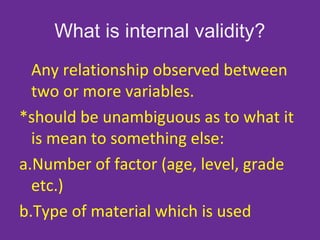
What is internal validity?
Any relationship observed between
two or more variables.
*should be unambiguous as to what it
is mean to something else:
a.Number of factor (age, level, grade
etc.)
b.Type of material which is used
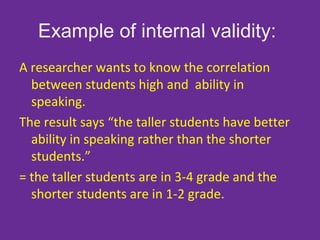
Example of internal validity:
A researcher wants to know the correlation
between students high and ability in
speaking.
The result says “the taller students have better
ability in speaking rather than the shorter
students.”
= the taller students are in 3-4 grade and the
shorter students are in 1-2 grade.
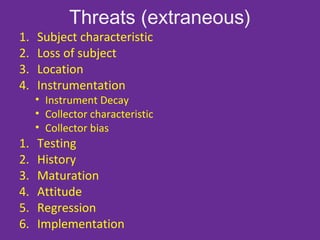
Threats (extraneous)
1. Subject characteristic
2. Loss of subject
3. Location
4. Instrumentation
• Instrument Decay
• Collector characteristic
• Collector bias
1. Testing
2. History
3. Maturation
4. Attitude
5. Regression
6. Implementation
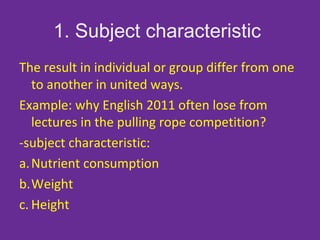
1. Subject characteristic
The result in individual or group differ from one
to another in united ways.
Example: why English 2011 often lose from
lectures in the pulling rope competition?
-subject characteristic:
a.Nutrient consumption
b.Weight
c. Height
2. Loss of subject
Loss of participant.
Example:
Firstly there is 100 participants, a week later
there are only 88, then where 22 students go?
May be they got:
• Illness
• Dying
• Absent etc.
3. Location
The particular place which the data are
collected.
Example: Doing an interview with students in
the classroom and students lounge will give
different result
4. Instrumentation
The way in which the instrument is used.
Instrument decay (is not used properly)
Example: Checking a bunch of questionnaires,
firstly the researcher is firing up to do
checking, later on he gets tired and messily
checking.
5. Collector characteristic
Sometimes data collector is gathered and
inevitable part of instrumentation.
Example: A researcher wants to know how the
society opinion towards police’s duties, in
case the researcher dress up like a police.
Therefore people tend to give a positive
opinion.
6. Collector bias
Collector preference or judgment
Example: what do you think about WIFI?
-since the collector is “sensitive” with Wi-Fi,
sometime he neglect the rubric and tend
interrogating the participant.
7. Testing
Where data are collected over a
period of time, it is common to test subjects at
the beginning of the intervention(s).
Testing using an instrument.
However in some case the researcher use the
same instrument so the students are not
really filling the test instead of memorizing the
answer from the previous test.
• Another case of testing.
A researcher wants to see the effectiveness on
collaborative method. He create an
experiment and applied collaborative method
in group A. However he doesn’t apply it in
group B
8. History
The condition which effecting the participant
(experience).
Example: The participant really nervous during
the interview because the participant
remembered about the previous interview
which gives “complicated questions”.
9. Maturation
Naturally participants will have development
both cognitive and physical.
Example: A researcher doing an experiment
about a grow up supplement to a young child
at 7th
. After a year that child has grow up.
It is bias whether it caused by the supplement or
the child is naturally grow up.
10. Attitude of subject
To provide the control or comparison group(s)
with a special or novel treatment comparable
to that received by the experimental group.
How to treat the participants properly.
A researcher want to know the effectiveness of
suggestopedia.
He played a music in class A but not in class B.
He said to students in class B that music can not
played in the class.
In this case the researcher does not treat the
participants properly.
11. Regression
there is no fix reasons to explains regression in
research.
Example: first test student A get 10 but in the
second test with the same test but different
days he gets 5.
12. Implementation
The possibility that the experimental group may
be treated in ways that are unintended and
not necessarily part of the method.
It is occur because:
• First- assigned to implement different
methods, so the out comes will different
• Second-have a personal bias in favor of one
• method over the other
How to minimize the threat
1. Standardize the condition, procedure and
information
2. More information for the subject /
participant
(avoiding: subject characteristic, mortality,
regression, maturation)
3. More information on the detail of the study
(avoiding: location, instrument, history,
subject attitude, and implementation)
4. Choose proper design

Internal Validity

  • 1.
  • 2.
    What is internalvalidity? Any relationship observed between two or more variables. *should be unambiguous as to what it is mean to something else: a.Number of factor (age, level, grade etc.) b.Type of material which is used
  • 3.
    Example of internalvalidity: A researcher wants to know the correlation between students high and ability in speaking. The result says “the taller students have better ability in speaking rather than the shorter students.” = the taller students are in 3-4 grade and the shorter students are in 1-2 grade.
  • 4.
    Threats (extraneous) 1. Subjectcharacteristic 2. Loss of subject 3. Location 4. Instrumentation • Instrument Decay • Collector characteristic • Collector bias 1. Testing 2. History 3. Maturation 4. Attitude 5. Regression 6. Implementation
  • 5.
    1. Subject characteristic Theresult in individual or group differ from one to another in united ways. Example: why English 2011 often lose from lectures in the pulling rope competition? -subject characteristic: a.Nutrient consumption b.Weight c. Height
  • 6.
    2. Loss ofsubject Loss of participant. Example: Firstly there is 100 participants, a week later there are only 88, then where 22 students go? May be they got: • Illness • Dying • Absent etc.
  • 7.
    3. Location The particularplace which the data are collected. Example: Doing an interview with students in the classroom and students lounge will give different result
  • 8.
    4. Instrumentation The wayin which the instrument is used. Instrument decay (is not used properly) Example: Checking a bunch of questionnaires, firstly the researcher is firing up to do checking, later on he gets tired and messily checking.
  • 9.
    5. Collector characteristic Sometimesdata collector is gathered and inevitable part of instrumentation. Example: A researcher wants to know how the society opinion towards police’s duties, in case the researcher dress up like a police. Therefore people tend to give a positive opinion.
  • 10.
    6. Collector bias Collectorpreference or judgment Example: what do you think about WIFI? -since the collector is “sensitive” with Wi-Fi, sometime he neglect the rubric and tend interrogating the participant.
  • 11.
    7. Testing Where dataare collected over a period of time, it is common to test subjects at the beginning of the intervention(s). Testing using an instrument. However in some case the researcher use the same instrument so the students are not really filling the test instead of memorizing the answer from the previous test.
  • 12.
    • Another caseof testing. A researcher wants to see the effectiveness on collaborative method. He create an experiment and applied collaborative method in group A. However he doesn’t apply it in group B
  • 13.
    8. History The conditionwhich effecting the participant (experience). Example: The participant really nervous during the interview because the participant remembered about the previous interview which gives “complicated questions”.
  • 14.
    9. Maturation Naturally participantswill have development both cognitive and physical. Example: A researcher doing an experiment about a grow up supplement to a young child at 7th . After a year that child has grow up. It is bias whether it caused by the supplement or the child is naturally grow up.
  • 15.
    10. Attitude ofsubject To provide the control or comparison group(s) with a special or novel treatment comparable to that received by the experimental group. How to treat the participants properly.
  • 16.
    A researcher wantto know the effectiveness of suggestopedia. He played a music in class A but not in class B. He said to students in class B that music can not played in the class. In this case the researcher does not treat the participants properly.
  • 17.
    11. Regression there isno fix reasons to explains regression in research. Example: first test student A get 10 but in the second test with the same test but different days he gets 5.
  • 18.
    12. Implementation The possibilitythat the experimental group may be treated in ways that are unintended and not necessarily part of the method. It is occur because: • First- assigned to implement different methods, so the out comes will different • Second-have a personal bias in favor of one • method over the other
  • 19.
    How to minimizethe threat 1. Standardize the condition, procedure and information 2. More information for the subject / participant (avoiding: subject characteristic, mortality, regression, maturation) 3. More information on the detail of the study (avoiding: location, instrument, history, subject attitude, and implementation) 4. Choose proper design