Meaning of work 
In different cultures
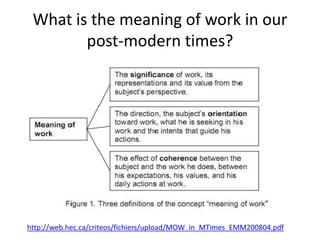
What is the meaning of work in our 
post-modern times? 
http://web.hec.ca/criteos/fichiers/upload/MOW_in_MTimes_EMM200804.pdf
The significance of work 
The concept of “meaning of work” can be 
defined as the significance the subject 
attributes to work, his representations of 
work, and the importance it has in his life. 
This way of defining the meaning of work 
leads to identifying work definition models, as 
Meaning of Working International team 
members proposed it, or the centrality of 
work, as Morse and Weiss stated it. 
http://web.hec.ca/criteos/fichiers/upload/MOW_in_MTimes_EMM200804.pdf
• Work is central in many cultures, although every culture has 
its own values and conceptions about it. However, it seems 
that work is important and significant for a majority of people 
considering the time that individuals devote to work in their 
lives, the numerous functions which it accomplishes for them, 
and the fact that work is closely linked with other important 
aspects of daily life such as family, leisure, religion, and 
community life. 
• Generally, one can find at least three patterns: a job, a career 
and a call. 
http://web.hec.ca/criteos/fichiers/upload/MOW_in_MTimes_EMM200804.pdf
The work values 
• The concept “meaning of work” can also be defined as one’s 
orientation or inclination toward work, what the subject is 
seeking in the work, and the intents that guide his actions. 
Super and Šverko have found 5 major orientations: 
autonomy, social advancement, self-achievement, social 
interactions and risk-taking. 
http://web.hec.ca/criteos/fichiers/upload/MOW_in_MTimes_EMM200804.pdf
The work coherence 
• The concept “meaning of work” can be defined as an effect of coherence 
between the subject and the work he does, the level of harmony or balance 
he achieves in his relationship to work . The thoughts that one has about . 
something else tend to organize themselves into balanced systems and, 
consequently, any incoherence leads to activities (intellectual, emotional, 
behavioral, etc.) to restore that balance. The sense of coherence that the 
subject finds in his relationship to work gives him a sense of psychological 
security and serenity which helps him to cope with the challenges that are 
inevitably involved in performing his duties 
• In our studies on work organization, the meaning of work is defined as an 
effect of coherence between the characteristics sought by a subject in his 
work and those he perceives in the work he does. The characteristics the 
individual seeks in his work should reflect his work values as those mentioned 
previously. 
http://web.hec.ca/criteos/fichiers/upload/MOW_in_MTimes_EMM200804.pdf
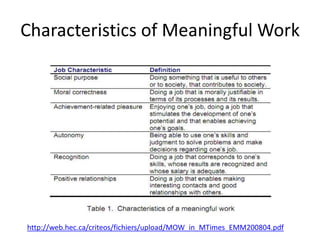
Characteristics of Meaningful Work 
http://web.hec.ca/criteos/fichiers/upload/MOW_in_MTimes_EMM200804.pdf
Today in other cultures 
• Even today, despite an increase in studies of a comparative nature, there is 
still some speculation and not much hard evidence about the concept of a 
work ethic outside the Protestant world. Much of the comparative 
research conducted recently, seems to suggest that a work ethic 
(described as a commitment to asceticism, hard work, thrift, frugality, 
postponement of gratification, etc., considered to be Protestant values; 
Furnham & Muhuideen, 1994), is no longer found only where there is a 
dominant Protestant value system. In fact, much of the cross-cultural 
research by Furnham and his associates (Baguma & Furnham, 1993; 
Furnham, 1991; Furnham & Muhuideen, 1984; Furnham & Rajamanickam, 
1992; Furnham et al., 1993) suggests that paradoxically there seems to be 
a stronger commitment to a "Protestant" work ethic among non- 
Protestant cultures. There is empirical evidence now that seems to 
suggest that a generalized work ethic may be found in diverse cultures and 
is not necessarily linked to Protestant values. 
• Toward a cross-cultural understanding of work-related beliefs 
• F S Niles. Human Relations. New York: Jul 1999. Vol. 52, Iss. 7; pg. 855, 13 
pgs
Issues 
• Thus far, research in non-Western countries has been based on existing 
definitions and instruments and comparative studies have largely 
examined the relative strength of the work ethic in different cultures. Very 
few have attempted to examine how different cultures perceive work-related 
values. Ideally, studies should be undertaken to examine work-related 
beliefs in diverse cultures without any preconceived ideas of what 
they are or ought to be. An impressive number of comparative studies 
have been carried out in many different cultural settings (see Furnham, 
1991, for a listing) but few of them have examined the unique aspects of 
differences in work-related beliefs between cultures or their causes. A 
study undertaken to compare core beliefs in diverse cultures is important 
but it would be an enormous task, therefore this study is limited in design. 
• Toward a cross-cultural understanding of work-related beliefs 
• F S Niles. Human Relations. New York: Jul 1999. Vol. 52, Iss. 7; pg. 855, 13 
pgs
What is the meaning of work in your 
country? 
• Significance 
• Work values 
• Work coherence

Meaning of work

  • 1.
    Meaning of work In different cultures
  • 2.
    What is themeaning of work in our post-modern times? http://web.hec.ca/criteos/fichiers/upload/MOW_in_MTimes_EMM200804.pdf
  • 3.
    The significance ofwork The concept of “meaning of work” can be defined as the significance the subject attributes to work, his representations of work, and the importance it has in his life. This way of defining the meaning of work leads to identifying work definition models, as Meaning of Working International team members proposed it, or the centrality of work, as Morse and Weiss stated it. http://web.hec.ca/criteos/fichiers/upload/MOW_in_MTimes_EMM200804.pdf
  • 4.
    • Work iscentral in many cultures, although every culture has its own values and conceptions about it. However, it seems that work is important and significant for a majority of people considering the time that individuals devote to work in their lives, the numerous functions which it accomplishes for them, and the fact that work is closely linked with other important aspects of daily life such as family, leisure, religion, and community life. • Generally, one can find at least three patterns: a job, a career and a call. http://web.hec.ca/criteos/fichiers/upload/MOW_in_MTimes_EMM200804.pdf
  • 5.
    The work values • The concept “meaning of work” can also be defined as one’s orientation or inclination toward work, what the subject is seeking in the work, and the intents that guide his actions. Super and Šverko have found 5 major orientations: autonomy, social advancement, self-achievement, social interactions and risk-taking. http://web.hec.ca/criteos/fichiers/upload/MOW_in_MTimes_EMM200804.pdf
  • 6.
    The work coherence • The concept “meaning of work” can be defined as an effect of coherence between the subject and the work he does, the level of harmony or balance he achieves in his relationship to work . The thoughts that one has about . something else tend to organize themselves into balanced systems and, consequently, any incoherence leads to activities (intellectual, emotional, behavioral, etc.) to restore that balance. The sense of coherence that the subject finds in his relationship to work gives him a sense of psychological security and serenity which helps him to cope with the challenges that are inevitably involved in performing his duties • In our studies on work organization, the meaning of work is defined as an effect of coherence between the characteristics sought by a subject in his work and those he perceives in the work he does. The characteristics the individual seeks in his work should reflect his work values as those mentioned previously. http://web.hec.ca/criteos/fichiers/upload/MOW_in_MTimes_EMM200804.pdf
  • 7.
    Characteristics of MeaningfulWork http://web.hec.ca/criteos/fichiers/upload/MOW_in_MTimes_EMM200804.pdf
  • 8.
    Today in othercultures • Even today, despite an increase in studies of a comparative nature, there is still some speculation and not much hard evidence about the concept of a work ethic outside the Protestant world. Much of the comparative research conducted recently, seems to suggest that a work ethic (described as a commitment to asceticism, hard work, thrift, frugality, postponement of gratification, etc., considered to be Protestant values; Furnham & Muhuideen, 1994), is no longer found only where there is a dominant Protestant value system. In fact, much of the cross-cultural research by Furnham and his associates (Baguma & Furnham, 1993; Furnham, 1991; Furnham & Muhuideen, 1984; Furnham & Rajamanickam, 1992; Furnham et al., 1993) suggests that paradoxically there seems to be a stronger commitment to a "Protestant" work ethic among non- Protestant cultures. There is empirical evidence now that seems to suggest that a generalized work ethic may be found in diverse cultures and is not necessarily linked to Protestant values. • Toward a cross-cultural understanding of work-related beliefs • F S Niles. Human Relations. New York: Jul 1999. Vol. 52, Iss. 7; pg. 855, 13 pgs
  • 9.
    Issues • Thusfar, research in non-Western countries has been based on existing definitions and instruments and comparative studies have largely examined the relative strength of the work ethic in different cultures. Very few have attempted to examine how different cultures perceive work-related values. Ideally, studies should be undertaken to examine work-related beliefs in diverse cultures without any preconceived ideas of what they are or ought to be. An impressive number of comparative studies have been carried out in many different cultural settings (see Furnham, 1991, for a listing) but few of them have examined the unique aspects of differences in work-related beliefs between cultures or their causes. A study undertaken to compare core beliefs in diverse cultures is important but it would be an enormous task, therefore this study is limited in design. • Toward a cross-cultural understanding of work-related beliefs • F S Niles. Human Relations. New York: Jul 1999. Vol. 52, Iss. 7; pg. 855, 13 pgs
  • 10.
    What is themeaning of work in your country? • Significance • Work values • Work coherence