Prepared by: Rubina Naz
M.Phil.(continuous)
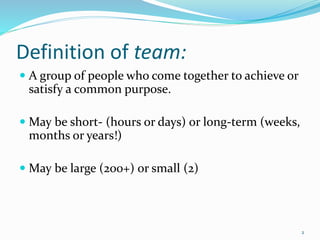
Definition of team:
 A group of people who come together to achieve or
satisfy a common purpose.
 May be short- (hours or days) or long-term (weeks,
months or years!)
 May be large (200+) or small (2)
2
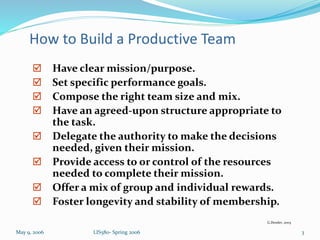
How to Build a Productive Team
 Have clear mission/purpose.
 Set specific performance goals.
 Compose the right team size and mix.
 Have an agreed-upon structure appropriate to
the task.
 Delegate the authority to make the decisions
needed, given their mission.
 Provide access to or control of the resources
needed to complete their mission.
 Offer a mix of group and individual rewards.
 Foster longevity and stability of membership.
May 9, 2006 LIS580- Spring 2006 3
G.Dessler, 2003
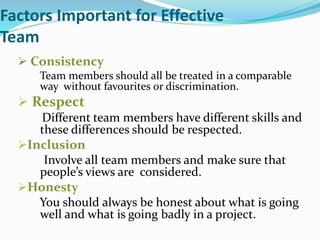
Factors Important for Effective
Team
 Consistency
Team members should all be treated in a comparable
way without favourites or discrimination.
 Respect
Different team members have different skills and
these differences should be respected.
Inclusion
Involve all team members and make sure that
people’s views are considered.
Honesty
You should always be honest about what is going
well and what is going badly in a project.
Definition of virtual team
A virtual team is a group of people that relies primarily
or exclusively on electronic forms of communication to
work together in accomplishing its goals.
Groups of geographically, organizationally and/or time
dispersed workers brought together by information
and telecommunication technologies to accomplish
one or more organizational tasks
5
Virtual teams
 More than 60% of employees in professions are
members of a virtual team
 Information technologies and knowledge-based
work make virtual teams possible and globalization
make them necessary
Similar terms for virtual
Other terms used instead of virtual are:
 Cyberspace
 Dispersed
 Long-distance
 Distributed
 Online
7
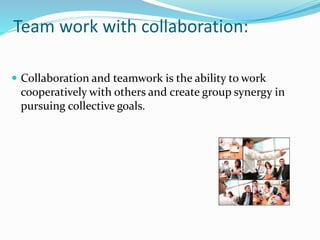
Team work with collaboration:
 Collaboration and teamwork is the ability to work
cooperatively with others and create group synergy in
pursuing collective goals.
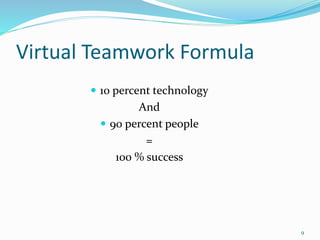
Virtual Teamwork Formula
 10 percent technology
And
 90 percent people
=
100 % success
9
10
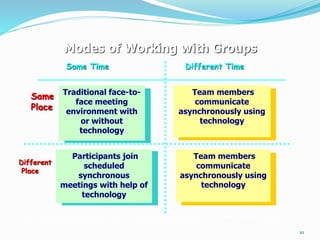
Traditional face-to-
face meeting
environment with
or without
technology
Team members
communicate
asynchronously using
technology
Team members
communicate
asynchronously using
technology
Participants join
scheduled
synchronous
meetings with help of
technology
Modes of Working with Groups
Same Time Different Time
Same
Place
Different
Place
Source: Boundaryless Facilitation: Leveraging the Strengths of Face-to Face and Groupware Tools to Maximize
Group Process, Metasystems Design Group and Catalyst Consulting Team.
11
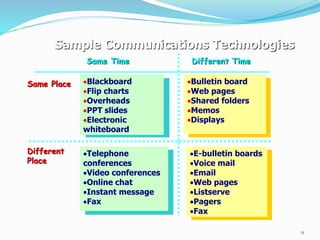
Blackboard
Flip charts
Overheads
PPT slides
Electronic
whiteboard
Bulletin board
Web pages
Shared folders
Memos
Displays
Same Place
Different
Place
Telephone
conferences
Video conferences
Online chat
Instant message
Fax
E-bulletin boards
Voice mail
Email
Web pages
Listserve
Pagers
Fax
Sample Communications Technologies
Same Time Different Time
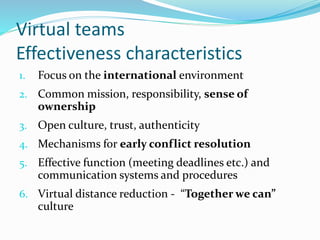
Virtual teams
Effectiveness characteristics
1. Focus on the international environment
2. Common mission, responsibility, sense of
ownership
3. Open culture, trust, authenticity
4. Mechanisms for early conflict resolution
5. Effective function (meeting deadlines etc.) and
communication systems and procedures
6. Virtual distance reduction - “Together we can”
culture
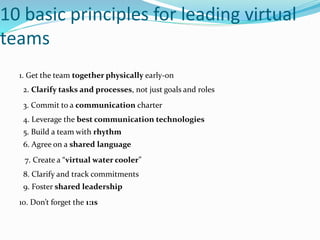
10 basic principles for leading virtual
teams
1. Get the team together physically early-on
2. Clarify tasks and processes, not just goals and roles
3. Commit to a communication charter
4. Leverage the best communication technologies
5. Build a team with rhythm
6. Agree on a shared language
7. Create a “virtual water cooler”
8. Clarify and track commitments
9. Foster shared leadership
10. Don’t forget the 1:1s
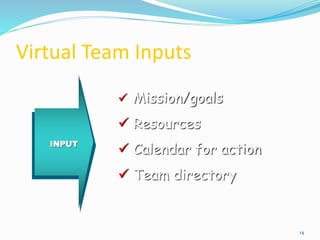
Virtual Team Inputs
14
INPUT
 Mission/goals
 Resources
 Calendar for action
 Team directory
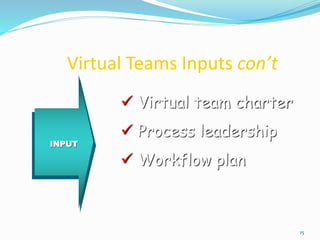
Virtual Teams Inputs con’t
15
INPUT
 Virtual team charter
 Process leadership
 Workflow plan
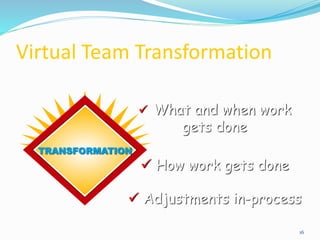
Virtual Team Transformation
16
TRANSFORMATION
 What and when work
gets done
 How work gets done
 Adjustments in-process
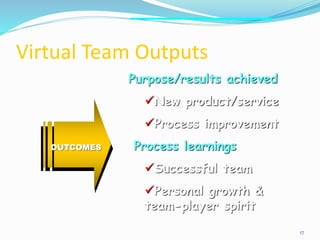
Virtual Team Outputs
17
Purpose/results achieved
New product/service
Process improvement
Process learnings
Successful team
Personal growth &
team-player spirit
OUTCOMES
Virtual Team Tools:
• Face to Face Session
• Audio Conference Calls
• Email
• Internet and desktop computer tools
• Collaboration Software
• Web Based Collaboration applications
Face-to-face sessions
 Preferred means for teams to build trust and
relationships with each other.
 Set up systems for teamwork
 Make decisions
19
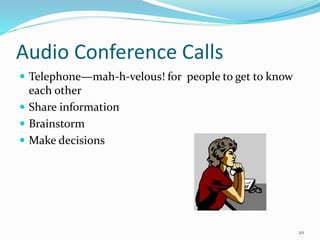
Audio Conference Calls
 Telephone—mah-h-velous! for people to get to know
each other
 Share information
 Brainstorm
 Make decisions
20
Email
 It is the communication tool you love to hate but
cannot live without these days.
 Cost-effective
 Easy to use
 One to many
21
Intranet and Desktop Computer Tools
Intranet websites
Windows
Collaborative calendars
22
Collaborative Software
 Lotus Notes—scheduling, electronic messaging,
document and data sharing
 Easy to use
 Asynchronous/synchronous
23
Web-based Collaboration
Applications
 E groups-Yahoo
 Can set up directory of team member contact/profile
information
 Can set up multiple topics or threads for discussion
 Great for organizing and retrieving past work
 My Place
24
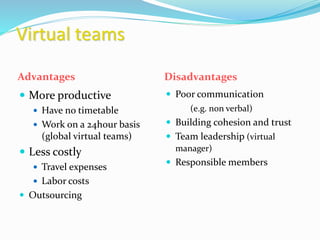
Virtual teams
Advantages Disadvantages
 More productive
 Have no timetable
 Work on a 24hour basis
(global virtual teams)
 Less costly
 Travel expenses
 Labor costs
 Outsourcing
 Poor communication
(e.g. non verbal)
 Building cohesion and trust
 Team leadership (virtual
manager)
 Responsible members
The
End……….

Virtual team work

  • 1.
    Prepared by: RubinaNaz M.Phil.(continuous)
  • 2.
    Definition of team: A group of people who come together to achieve or satisfy a common purpose.  May be short- (hours or days) or long-term (weeks, months or years!)  May be large (200+) or small (2) 2
  • 3.
    How to Builda Productive Team  Have clear mission/purpose.  Set specific performance goals.  Compose the right team size and mix.  Have an agreed-upon structure appropriate to the task.  Delegate the authority to make the decisions needed, given their mission.  Provide access to or control of the resources needed to complete their mission.  Offer a mix of group and individual rewards.  Foster longevity and stability of membership. May 9, 2006 LIS580- Spring 2006 3 G.Dessler, 2003
  • 4.
    Factors Important forEffective Team  Consistency Team members should all be treated in a comparable way without favourites or discrimination.  Respect Different team members have different skills and these differences should be respected. Inclusion Involve all team members and make sure that people’s views are considered. Honesty You should always be honest about what is going well and what is going badly in a project.
  • 5.
    Definition of virtualteam A virtual team is a group of people that relies primarily or exclusively on electronic forms of communication to work together in accomplishing its goals. Groups of geographically, organizationally and/or time dispersed workers brought together by information and telecommunication technologies to accomplish one or more organizational tasks 5
  • 6.
    Virtual teams  Morethan 60% of employees in professions are members of a virtual team  Information technologies and knowledge-based work make virtual teams possible and globalization make them necessary
  • 7.
    Similar terms forvirtual Other terms used instead of virtual are:  Cyberspace  Dispersed  Long-distance  Distributed  Online 7
  • 8.
    Team work withcollaboration:  Collaboration and teamwork is the ability to work cooperatively with others and create group synergy in pursuing collective goals.
  • 9.
    Virtual Teamwork Formula 10 percent technology And  90 percent people = 100 % success 9
  • 10.
    10 Traditional face-to- face meeting environmentwith or without technology Team members communicate asynchronously using technology Team members communicate asynchronously using technology Participants join scheduled synchronous meetings with help of technology Modes of Working with Groups Same Time Different Time Same Place Different Place Source: Boundaryless Facilitation: Leveraging the Strengths of Face-to Face and Groupware Tools to Maximize Group Process, Metasystems Design Group and Catalyst Consulting Team.
  • 11.
    11 Blackboard Flip charts Overheads PPT slides Electronic whiteboard Bulletinboard Web pages Shared folders Memos Displays Same Place Different Place Telephone conferences Video conferences Online chat Instant message Fax E-bulletin boards Voice mail Email Web pages Listserve Pagers Fax Sample Communications Technologies Same Time Different Time
  • 12.
    Virtual teams Effectiveness characteristics 1.Focus on the international environment 2. Common mission, responsibility, sense of ownership 3. Open culture, trust, authenticity 4. Mechanisms for early conflict resolution 5. Effective function (meeting deadlines etc.) and communication systems and procedures 6. Virtual distance reduction - “Together we can” culture
  • 13.
    10 basic principlesfor leading virtual teams 1. Get the team together physically early-on 2. Clarify tasks and processes, not just goals and roles 3. Commit to a communication charter 4. Leverage the best communication technologies 5. Build a team with rhythm 6. Agree on a shared language 7. Create a “virtual water cooler” 8. Clarify and track commitments 9. Foster shared leadership 10. Don’t forget the 1:1s
  • 14.
    Virtual Team Inputs 14 INPUT Mission/goals  Resources  Calendar for action  Team directory
  • 15.
    Virtual Teams Inputscon’t 15 INPUT  Virtual team charter  Process leadership  Workflow plan
  • 16.
    Virtual Team Transformation 16 TRANSFORMATION What and when work gets done  How work gets done  Adjustments in-process
  • 17.
    Virtual Team Outputs 17 Purpose/resultsachieved New product/service Process improvement Process learnings Successful team Personal growth & team-player spirit OUTCOMES
  • 18.
    Virtual Team Tools: •Face to Face Session • Audio Conference Calls • Email • Internet and desktop computer tools • Collaboration Software • Web Based Collaboration applications
  • 19.
    Face-to-face sessions  Preferredmeans for teams to build trust and relationships with each other.  Set up systems for teamwork  Make decisions 19
  • 20.
    Audio Conference Calls Telephone—mah-h-velous! for people to get to know each other  Share information  Brainstorm  Make decisions 20
  • 21.
    Email  It isthe communication tool you love to hate but cannot live without these days.  Cost-effective  Easy to use  One to many 21
  • 22.
    Intranet and DesktopComputer Tools Intranet websites Windows Collaborative calendars 22
  • 23.
    Collaborative Software  LotusNotes—scheduling, electronic messaging, document and data sharing  Easy to use  Asynchronous/synchronous 23
  • 24.
    Web-based Collaboration Applications  Egroups-Yahoo  Can set up directory of team member contact/profile information  Can set up multiple topics or threads for discussion  Great for organizing and retrieving past work  My Place 24
  • 25.
    Virtual teams Advantages Disadvantages More productive  Have no timetable  Work on a 24hour basis (global virtual teams)  Less costly  Travel expenses  Labor costs  Outsourcing  Poor communication (e.g. non verbal)  Building cohesion and trust  Team leadership (virtual manager)  Responsible members
  • 26.