COMMUNITIES OF PRACTICE:
THE ORGANIZATIONAL FRONTIER
PRESENT BY
LU CHEN/ YUAN GAO / ERIC VAUCHEY / YAN GAO /ULRICH ROUSSEAU
-2016-
by Etienne C.Wenger andWilliam M. Snyder
AGENDA
 INTRODUCTION:What is Community of Practice
 BENEFITS of CoP
 TYPE of CoP
 WHERE ISTHE CONCEPT BEING APPLIED
 HOWTO BUILD A CoP
 HOWTO MAINTAIN OF A CoP
 EXAMPLEs: FabLab & Reseau Entrepreneur
 CRITICs
 CONCLUSIONs
 DISCUSSION
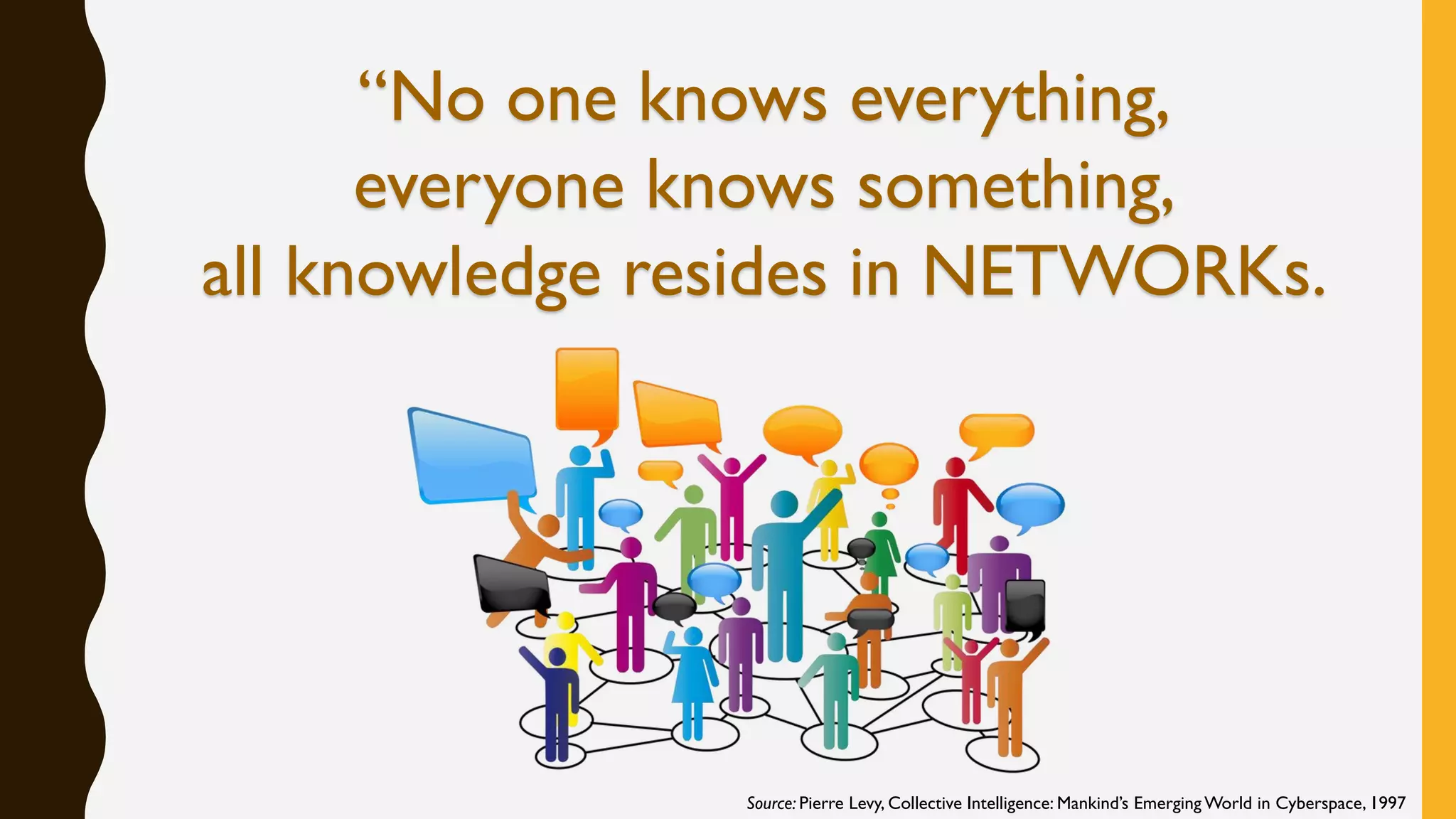
“No one knows everything,
everyone knows something,
all knowledge resides in NETWORKs.
Source: Pierre Levy, Collective Intelligence: Mankind’s Emerging World in Cyberspace, 1997
WHAT IS Community Of Practice (CoP)
Communities of practice can drive strategy, generate new lines of
business, solve problems, promote the spread of best practices, develop
people's professional skills, and help companies recruit and retain talent.
• Peer-to-peer help in problem solving
• Developing and verifying best practices
• Upgrading and distributing knowledge in daily use
• Fostering unexpected ideas and innovation
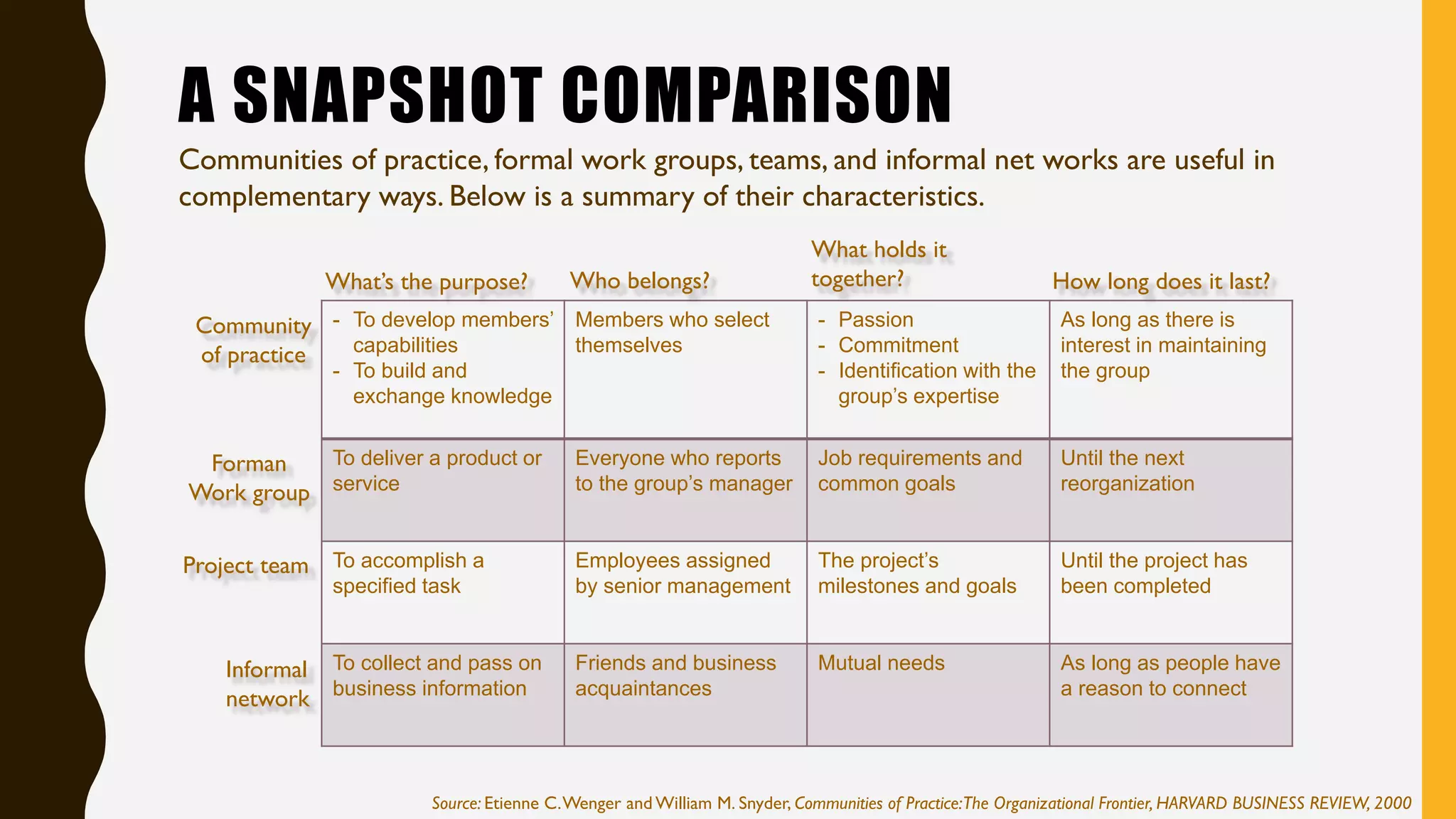
- To develop members’
capabilities
- To build and
exchange knowledge
Members who select
themselves
- Passion
- Commitment
- Identification with the
group’s expertise
As long as there is
interest in maintaining
the group
To deliver a product or
service
Everyone who reports
to the group’s manager
Job requirements and
common goals
Until the next
reorganization
To accomplish a
specified task
Employees assigned
by senior management
The project’s
milestones and goals
Until the project has
been completed
To collect and pass on
business information
Friends and business
acquaintances
Mutual needs As long as people have
a reason to connect
Communities of practice, formal work groups, teams, and informal net works are useful in
complementary ways. Below is a summary of their characteristics.
What’s the purpose? Who belongs?
What holds it
together? How long does it last?
Informal
network
Project team
Forman
Work group
Community
of practice
Source: Etienne C.Wenger and William M. Snyder, Communities of Practice:The Organizational Frontier, HARVARD BUSINESS REVIEW, 2000
A SNAPSHOT COMPARISON
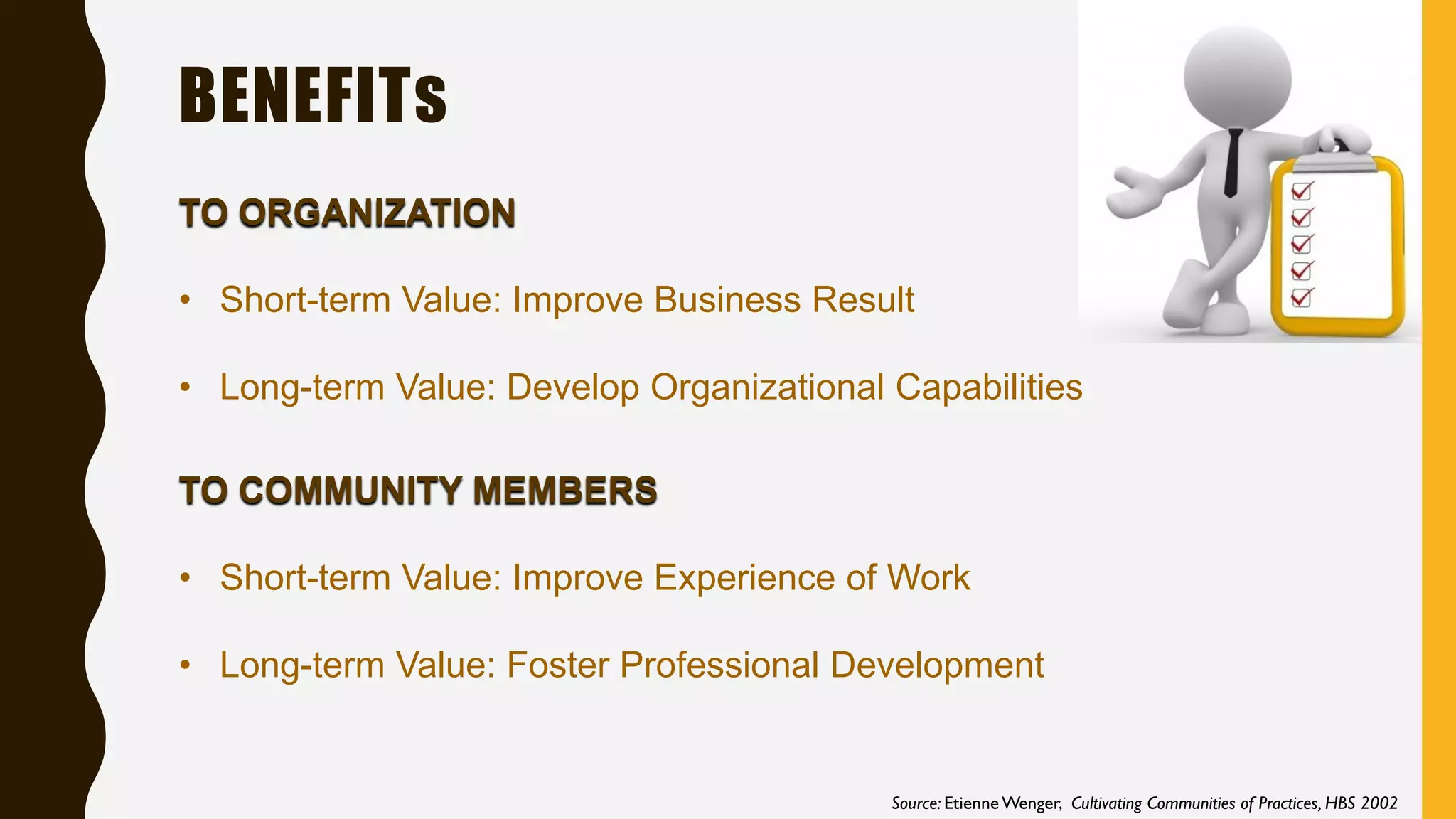
BENEFITs
TO ORGANIZATION
• Short-term Value: Improve Business Result
• Long-term Value: Develop Organizational Capabilities
TO COMMUNITY MEMBERS
• Short-term Value: Improve Experience of Work
• Long-term Value: Foster Professional Development
Source: Etienne Wenger, Cultivating Communities of Practices, HBS 2002
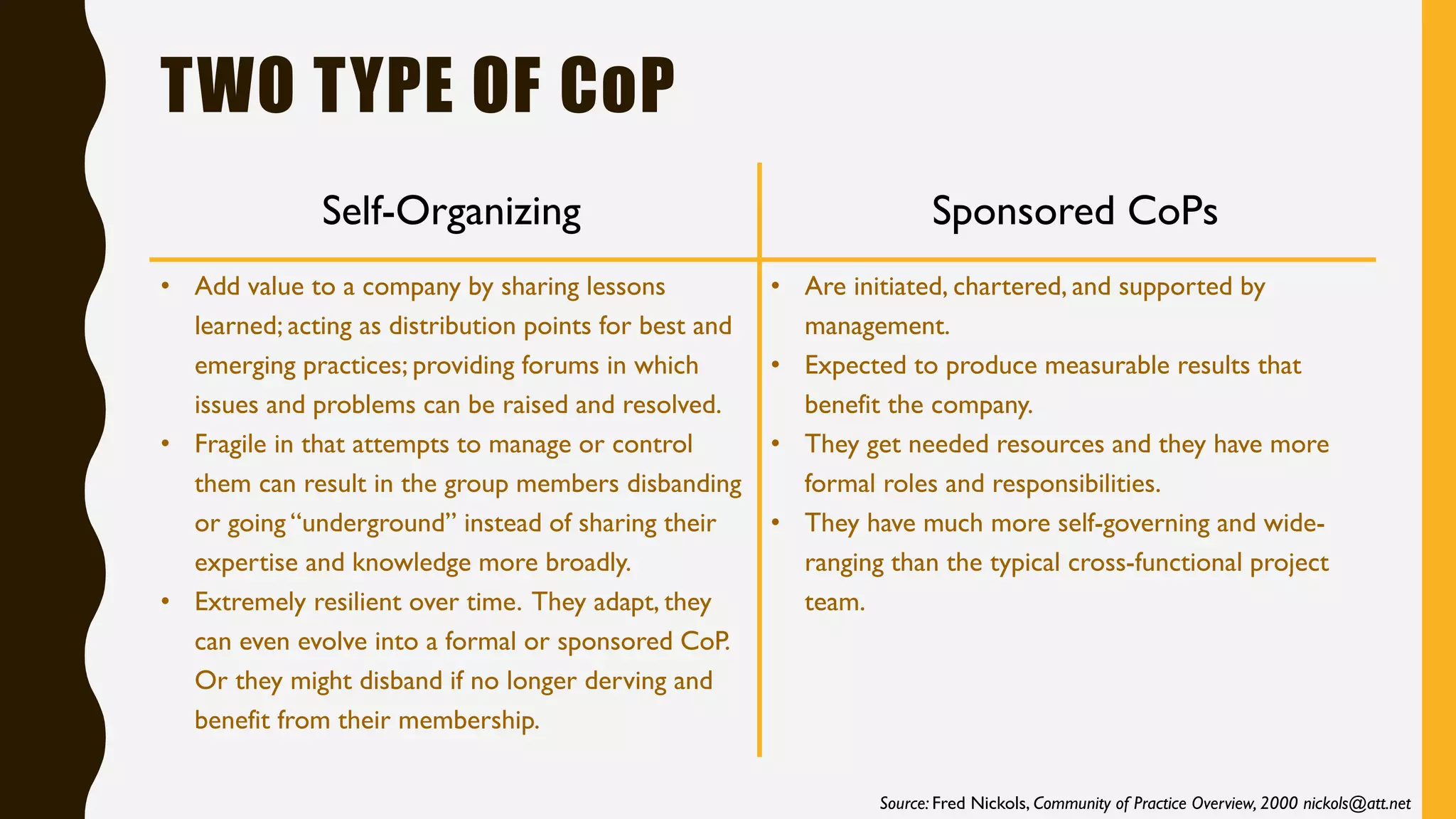
TWO TYPE OF CoP
Self-Organizing Sponsored CoPs
Source: Fred Nickols, Community of Practice Overview, 2000 nickols@att.net
• Add value to a company by sharing lessons
learned; acting as distribution points for best and
emerging practices; providing forums in which
issues and problems can be raised and resolved.
• Fragile in that attempts to manage or control
them can result in the group members disbanding
or going “underground” instead of sharing their
expertise and knowledge more broadly.
• Extremely resilient over time. They adapt, they
can even evolve into a formal or sponsored CoP.
Or they might disband if no longer derving and
benefit from their membership.
• Are initiated, chartered, and supported by
management.
• Expected to produce measurable results that
benefit the company.
• They get needed resources and they have more
formal roles and responsibilities.
• They have much more self-governing and wide-
ranging than the typical cross-functional project
team.
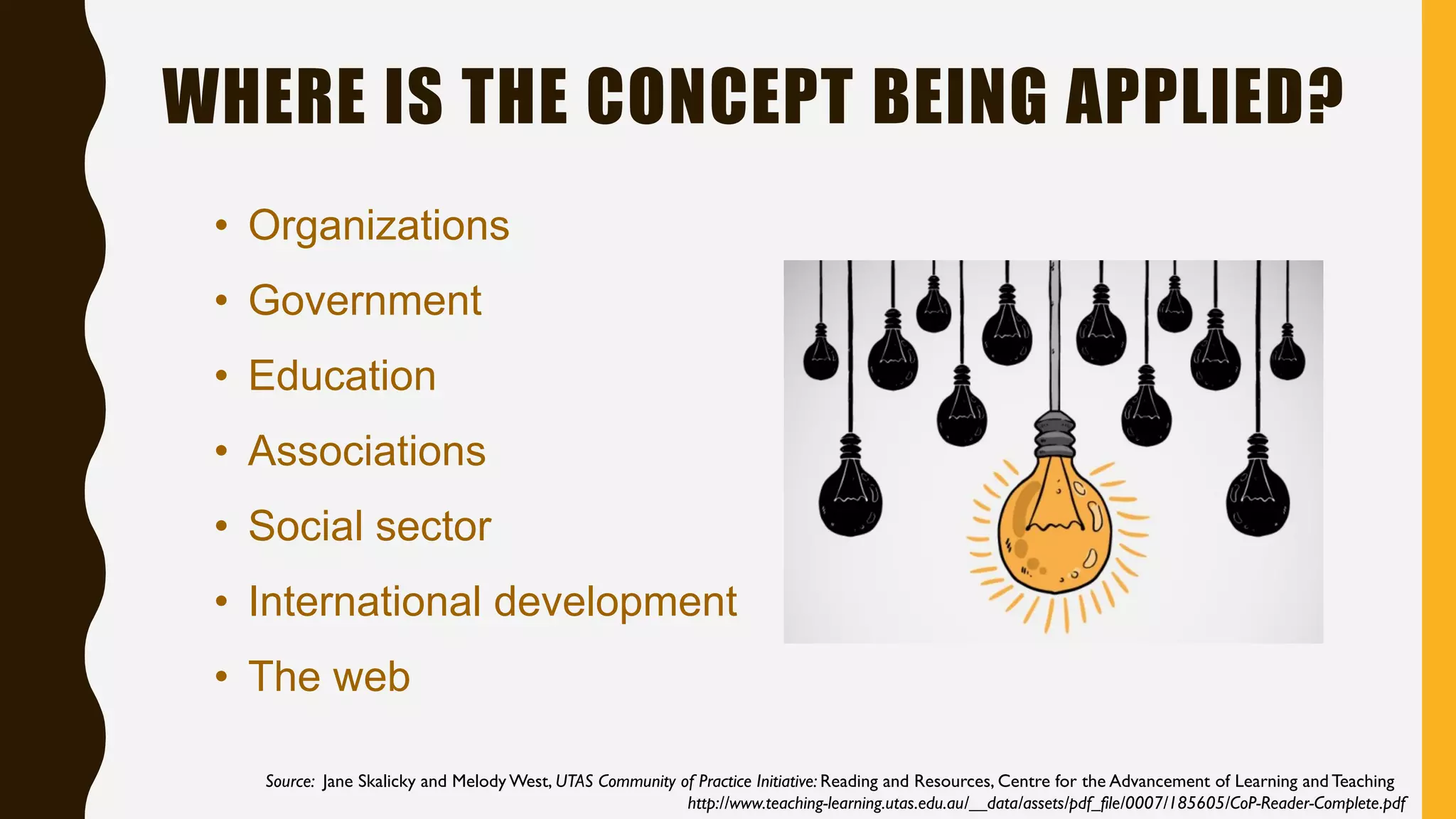
WHERE IS THE CONCEPT BEING APPLIED?
• Organizations
• Government
• Education
• Associations
• Social sector
• International development
• The web
Source: Jane Skalicky and Melody West, UTAS Community of Practice Initiative: Reading and Resources, Centre for the Advancement of Learning and Teaching
http://www.teaching-learning.utas.edu.au/__data/assets/pdf_file/0007/185605/CoP-Reader-Complete.pdf
WHERE IS THE CONCEPT BEING APPLIED?
• Organizations: The concept has been adopted most readily by people in
business because of the recognition that knowledge is a critical asset that needs
to be managed strategically.
• Government: Like businesses, government organizations face knowledge
challenges of increasing complexity and scale. They have adopted communities
of practice for much the same reasons, though the formality of the bureaucracy
can come in the way of open knowledge sharing.
• Education: Schools and districts are organizations in their own right, and they
too face increasing knowledge challenges.
Source: Jane Skalicky and Melody West, UTAS Community of Practice Initiative: Reading and Resources, Centre for the Advancement of Learning and Teaching
http://www.teaching-learning.utas.edu.au/__data/assets/pdf_file/0007/185605/CoP-Reader-Complete.pdf
WHERE IS THE CONCEPT BEING APPLIED?
Source: Jane Skalicky and Melody West, UTAS Community of Practice Initiative: Reading and Resources, Centre for the Advancement of Learning and Teaching
http://www.teaching-learning.utas.edu.au/__data/assets/pdf_file/0007/185605/CoP-Reader-Complete.pdf
• Associations: A growing number of associations, professional and otherwise,
are seeking ways to focus on learning through reflection on practice.
• Social sector: In the civic domain, there is an emergent interest in building
communities among practitioners.
• International development: There is increasing recognition that the challenge
of developing nations is as much a knowledge as a financial challenge.
• The web: New technologies such as the Internet have extended the reach of
our interactions beyond the geographical limitations of traditional communities,
but the increase in flow of information does not obviate the need for community.
HOW TO BUILD A CoP?
• Purpose
• Enablers
• Leadership
• Processes
• People
• Time
Key elements to build a CoP:
Leadership roles and responsibilities in fostering CoP:
HOW TO BUILD A CoP?
• Virtual conversations
• Virtual environment
• To be strategized
• To believe that CoP is valuable
• To make sure CoP is forward-thinking
Sustainable Development and Maintenance
• Maintain formal and regular meetings
• Keep consistent growth
• Upgrade community knowledge
• Add value to the organization
HOW TO MAINTAIN OF A CoP?
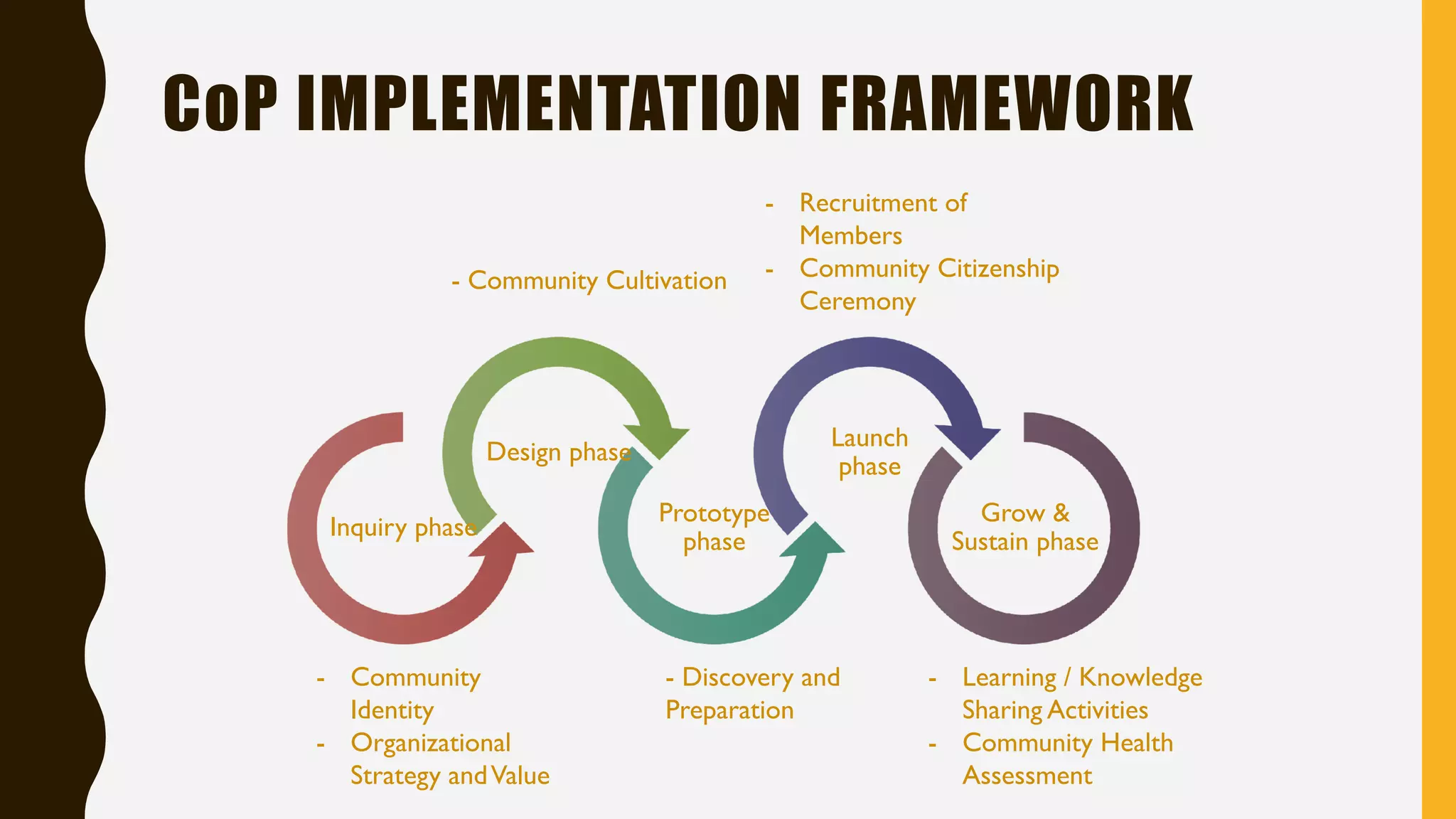
CoP IMPLEMENTATION FRAMEWORK
Inquiry phase
Design phase
Prototype
phase
Launch
phase
Grow &
Sustain phase
- Community Cultivation
- Community
Identity
- Organizational
Strategy andValue
- Discovery and
Preparation
- Recruitment of
Members
- Community Citizenship
Ceremony
- Learning / Knowledge
Sharing Activities
- Community Health
Assessment
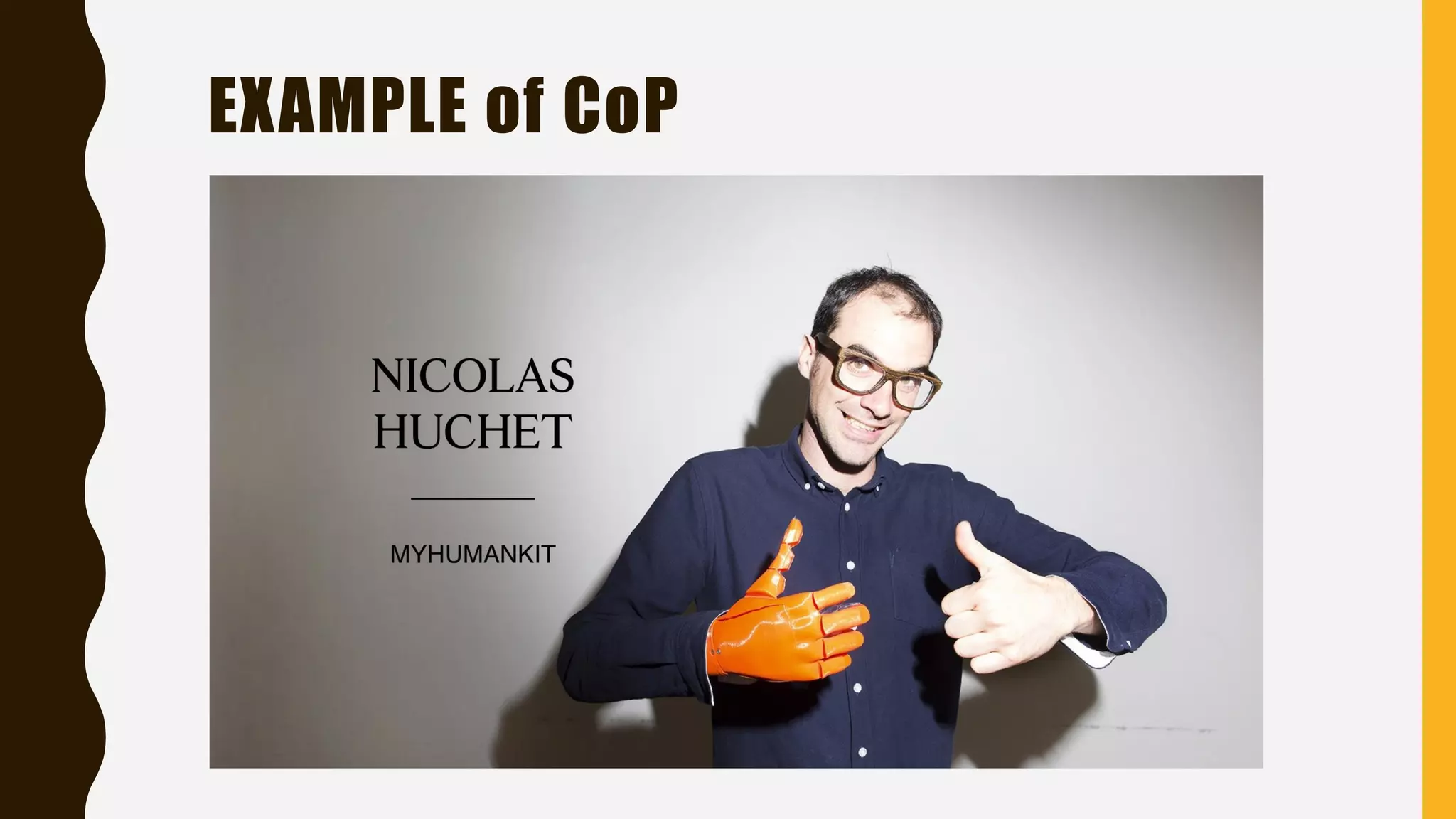
EXAMPLE of CoP
FabLab - A COMMUNITY of PRACTICE
• Build almost everything by your own - DIY
• Digital manufacturing machine - prototyping platform
• Interdisciplinary collaboration
• A FabLab is Open :
- Open for everybody: young, old, student, teacher engineer…
- Open source
- Open Learning for communities
- Open organization
RESEAU ENTREPRENDRE
• Values:
• People First
• Free
• Reciprocity
• French Entrepreneur Network Created by A.Mulliez.
• Entrepreneurs are coming from different business.
• Very practical approach.
CRITICS
Not particularly easy to integrate communities of practice with the rest of
an organization - supervision and interference
4 main critics on CoP
 Showing Off: in some communities of practice the guys will share and participate just
to reach recognition and reward for their own profit (like for job search).
 Business: in some critical sector like Sciences, Tech, Biotech, people will stop
sharing and discussing if there is a risk to have a patent stolen (intellectual property)
 Can lose time if there is a lack of frame (Management and Tempo)
 Intellectual Property Rights
CONCLUSIONS
Communities of practice are a new frontier, self-perpetuating in the
defining domains of generating, reinforcing and renewing knowledge.
CoP is emerging in the companies that thrive on the knowledge, and
managers need to:
• Understand what CoP are and how they work.
• Realize they are the hidden fountainhead of knowledge development.
• Specific managerial efforts to develop and integrate CoP into the
organization.
DISCUSSION
Q1 - Are some of you part of any CoP and would like to share his/her experience ?
And do you know a service or a product that was created by a CoP ?
Q2 - Do you think there must be a control of who is joining / leaving a CoP and if
yes, how ?
Q3 - How can a CoP ensure that a great idea would be implemented in a different
setting?
Q4 - Between Self-organized and Sponsored CoP, for you what would be the
more efficient ?
COMMUNITIES of PRACTICE

COMMUNITIES of PRACTICE

  • 1.
    COMMUNITIES OF PRACTICE: THEORGANIZATIONAL FRONTIER PRESENT BY LU CHEN/ YUAN GAO / ERIC VAUCHEY / YAN GAO /ULRICH ROUSSEAU -2016- by Etienne C.Wenger andWilliam M. Snyder
  • 2.
    AGENDA  INTRODUCTION:What isCommunity of Practice  BENEFITS of CoP  TYPE of CoP  WHERE ISTHE CONCEPT BEING APPLIED  HOWTO BUILD A CoP  HOWTO MAINTAIN OF A CoP  EXAMPLEs: FabLab & Reseau Entrepreneur  CRITICs  CONCLUSIONs  DISCUSSION
  • 3.
    “No one knowseverything, everyone knows something, all knowledge resides in NETWORKs. Source: Pierre Levy, Collective Intelligence: Mankind’s Emerging World in Cyberspace, 1997
  • 4.
    WHAT IS CommunityOf Practice (CoP) Communities of practice can drive strategy, generate new lines of business, solve problems, promote the spread of best practices, develop people's professional skills, and help companies recruit and retain talent. • Peer-to-peer help in problem solving • Developing and verifying best practices • Upgrading and distributing knowledge in daily use • Fostering unexpected ideas and innovation
  • 5.
    - To developmembers’ capabilities - To build and exchange knowledge Members who select themselves - Passion - Commitment - Identification with the group’s expertise As long as there is interest in maintaining the group To deliver a product or service Everyone who reports to the group’s manager Job requirements and common goals Until the next reorganization To accomplish a specified task Employees assigned by senior management The project’s milestones and goals Until the project has been completed To collect and pass on business information Friends and business acquaintances Mutual needs As long as people have a reason to connect Communities of practice, formal work groups, teams, and informal net works are useful in complementary ways. Below is a summary of their characteristics. What’s the purpose? Who belongs? What holds it together? How long does it last? Informal network Project team Forman Work group Community of practice Source: Etienne C.Wenger and William M. Snyder, Communities of Practice:The Organizational Frontier, HARVARD BUSINESS REVIEW, 2000 A SNAPSHOT COMPARISON
  • 6.
    BENEFITs TO ORGANIZATION • Short-termValue: Improve Business Result • Long-term Value: Develop Organizational Capabilities TO COMMUNITY MEMBERS • Short-term Value: Improve Experience of Work • Long-term Value: Foster Professional Development Source: Etienne Wenger, Cultivating Communities of Practices, HBS 2002
  • 7.
    TWO TYPE OFCoP Self-Organizing Sponsored CoPs Source: Fred Nickols, Community of Practice Overview, 2000 nickols@att.net • Add value to a company by sharing lessons learned; acting as distribution points for best and emerging practices; providing forums in which issues and problems can be raised and resolved. • Fragile in that attempts to manage or control them can result in the group members disbanding or going “underground” instead of sharing their expertise and knowledge more broadly. • Extremely resilient over time. They adapt, they can even evolve into a formal or sponsored CoP. Or they might disband if no longer derving and benefit from their membership. • Are initiated, chartered, and supported by management. • Expected to produce measurable results that benefit the company. • They get needed resources and they have more formal roles and responsibilities. • They have much more self-governing and wide- ranging than the typical cross-functional project team.
  • 8.
    WHERE IS THECONCEPT BEING APPLIED? • Organizations • Government • Education • Associations • Social sector • International development • The web Source: Jane Skalicky and Melody West, UTAS Community of Practice Initiative: Reading and Resources, Centre for the Advancement of Learning and Teaching http://www.teaching-learning.utas.edu.au/__data/assets/pdf_file/0007/185605/CoP-Reader-Complete.pdf
  • 9.
    WHERE IS THECONCEPT BEING APPLIED? • Organizations: The concept has been adopted most readily by people in business because of the recognition that knowledge is a critical asset that needs to be managed strategically. • Government: Like businesses, government organizations face knowledge challenges of increasing complexity and scale. They have adopted communities of practice for much the same reasons, though the formality of the bureaucracy can come in the way of open knowledge sharing. • Education: Schools and districts are organizations in their own right, and they too face increasing knowledge challenges. Source: Jane Skalicky and Melody West, UTAS Community of Practice Initiative: Reading and Resources, Centre for the Advancement of Learning and Teaching http://www.teaching-learning.utas.edu.au/__data/assets/pdf_file/0007/185605/CoP-Reader-Complete.pdf
  • 10.
    WHERE IS THECONCEPT BEING APPLIED? Source: Jane Skalicky and Melody West, UTAS Community of Practice Initiative: Reading and Resources, Centre for the Advancement of Learning and Teaching http://www.teaching-learning.utas.edu.au/__data/assets/pdf_file/0007/185605/CoP-Reader-Complete.pdf • Associations: A growing number of associations, professional and otherwise, are seeking ways to focus on learning through reflection on practice. • Social sector: In the civic domain, there is an emergent interest in building communities among practitioners. • International development: There is increasing recognition that the challenge of developing nations is as much a knowledge as a financial challenge. • The web: New technologies such as the Internet have extended the reach of our interactions beyond the geographical limitations of traditional communities, but the increase in flow of information does not obviate the need for community.
  • 11.
    HOW TO BUILDA CoP? • Purpose • Enablers • Leadership • Processes • People • Time Key elements to build a CoP:
  • 12.
    Leadership roles andresponsibilities in fostering CoP: HOW TO BUILD A CoP? • Virtual conversations • Virtual environment • To be strategized • To believe that CoP is valuable • To make sure CoP is forward-thinking
  • 13.
    Sustainable Development andMaintenance • Maintain formal and regular meetings • Keep consistent growth • Upgrade community knowledge • Add value to the organization HOW TO MAINTAIN OF A CoP?
  • 14.
    CoP IMPLEMENTATION FRAMEWORK Inquiryphase Design phase Prototype phase Launch phase Grow & Sustain phase - Community Cultivation - Community Identity - Organizational Strategy andValue - Discovery and Preparation - Recruitment of Members - Community Citizenship Ceremony - Learning / Knowledge Sharing Activities - Community Health Assessment
  • 15.
  • 16.
    FabLab - ACOMMUNITY of PRACTICE • Build almost everything by your own - DIY • Digital manufacturing machine - prototyping platform • Interdisciplinary collaboration • A FabLab is Open : - Open for everybody: young, old, student, teacher engineer… - Open source - Open Learning for communities - Open organization
  • 17.
    RESEAU ENTREPRENDRE • Values: •People First • Free • Reciprocity • French Entrepreneur Network Created by A.Mulliez. • Entrepreneurs are coming from different business. • Very practical approach.
  • 18.
    CRITICS Not particularly easyto integrate communities of practice with the rest of an organization - supervision and interference 4 main critics on CoP  Showing Off: in some communities of practice the guys will share and participate just to reach recognition and reward for their own profit (like for job search).  Business: in some critical sector like Sciences, Tech, Biotech, people will stop sharing and discussing if there is a risk to have a patent stolen (intellectual property)  Can lose time if there is a lack of frame (Management and Tempo)  Intellectual Property Rights
  • 19.
    CONCLUSIONS Communities of practiceare a new frontier, self-perpetuating in the defining domains of generating, reinforcing and renewing knowledge. CoP is emerging in the companies that thrive on the knowledge, and managers need to: • Understand what CoP are and how they work. • Realize they are the hidden fountainhead of knowledge development. • Specific managerial efforts to develop and integrate CoP into the organization.
  • 20.
    DISCUSSION Q1 - Aresome of you part of any CoP and would like to share his/her experience ? And do you know a service or a product that was created by a CoP ? Q2 - Do you think there must be a control of who is joining / leaving a CoP and if yes, how ? Q3 - How can a CoP ensure that a great idea would be implemented in a different setting? Q4 - Between Self-organized and Sponsored CoP, for you what would be the more efficient ?