







> > > > > > > >
“Attitude is a little thing that
makes a big difference”
- Anonymous
Developing Good
Work Ethics
By: Norvin Rapin
Discussant
Jo Bitonio
Professor
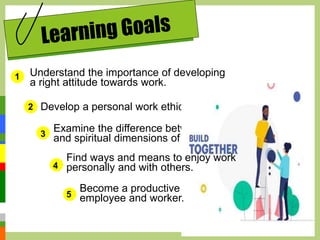
Understand the importance of developing
a right attitude towards work.
1
2
3
4
5
Develop a personal work ethic.
Examine the difference between human
and spiritual dimensions of work.
Find ways and means to enjoy work
personally and with others.
Become a productive
employee and worker.
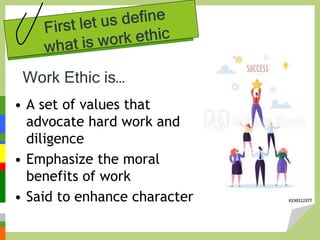
• A set of values that
advocate hard work and
diligence
• Emphasize the moral
benefits of work
• Said to enhance character
Work Ethic is…
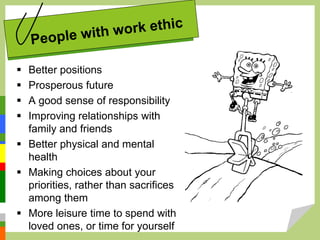
 Better positions
 Prosperous future
 A good sense of responsibility
 Improving relationships with
family and friends
 Better physical and mental
health
 Making choices about your
priorities, rather than sacrifices
among them
 More leisure time to spend with
loved ones, or time for yourself
 Unmotivated
 Poorly trained or
managed
 Minor position
 No standards
 Lack of willingness
 Don’t want to work hard
 Don’t want to overtime
 Impatient
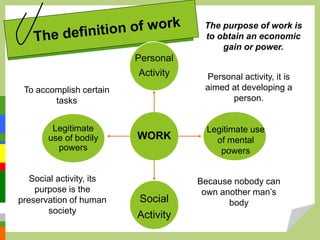
Personal activity, it is
aimed at developing a
person.
Social activity, its
purpose is the
preservation of human
society
To accomplish certain
tasks
Because nobody can
own another man’s
body
The purpose of work is
to obtain an economic
gain or power.
WORK
Personal
Activity
Social
Activity
Legitimate
use of bodily
powers
Legitimate use
of mental
powers
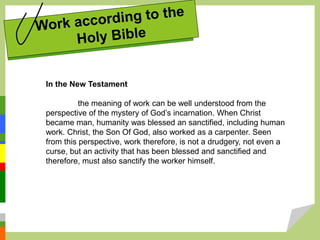
In the New Testament
the meaning of work can be well understood from the
perspective of the mystery of God’s incarnation. When Christ
became man, humanity was blessed an sanctified, including human
work. Christ, the Son Of God, also worked as a carpenter. Seen
from this perspective, work therefore, is not a drudgery, not even a
curse, but an activity that has been blessed and sanctified and
therefore, must also sanctify the worker himself.
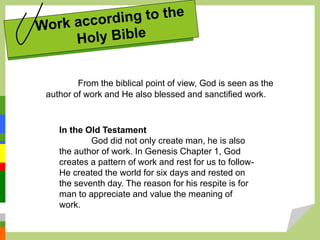
From the biblical point of view, God is seen as the
author of work and He also blessed and sanctified work.
In the Old Testament
God did not only create man, he is also
the author of work. In Genesis Chapter 1, God
creates a pattern of work and rest for us to follow-
He created the world for six days and rested on
the seventh day. The reason for his respite is for
man to appreciate and value the meaning of
work.
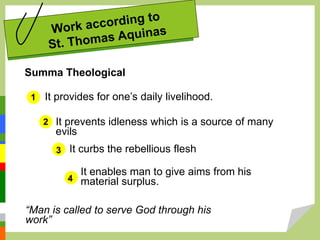
Summa Theological
It provides for one’s daily livelihood.
1
2
3
4
It prevents idleness which is a source of many
evils
It curbs the rebellious flesh
It enables man to give aims from his
material surplus.
“Man is called to serve God through his
work”
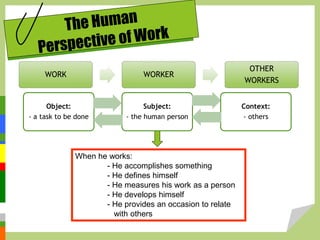
WORK WORKER
OTHER
WORKERS
Object:
- a task to be done
Subject:
- the human person
Context:
- others
When he works:
- He accomplishes something
- He defines himself
- He measures his work as a person
- He develops himself
- He provides an occasion to relate
with others
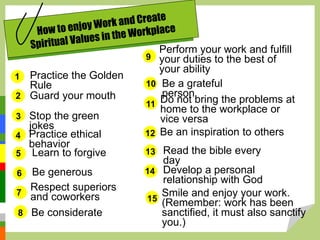
Practice the Golden
Rule
1
2
3
4
5
Guard your mouth
Stop the green
jokes
Practice ethical
behavior
Learn to forgive
Be generous
6
7
8
9
Respect superiors
and coworkers
Be considerate
Perform your work and fulfill
your duties to the best of
your ability
10
11
12
13
Be a grateful
person
Do not bring the problems at
home to the workplace or
vice versa
Be an inspiration to others
Read the bible every
day
Develop a personal
relationship with God
14
15
Smile and enjoy your work.
(Remember: work has been
sanctified, it must also sanctify
you.)
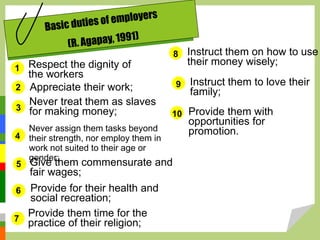
Respect the dignity of
the workers
1
2
3
4
5
Appreciate their work;
Never treat them as slaves
for making money;
Never assign them tasks beyond
their strength, nor employ them in
work not suited to their age or
gender;
Give them commensurate and
fair wages;
Provide for their health and
social recreation;
6
7
8
Provide them time for the
practice of their religion;
Instruct them on how to use
their money wisely;
9 Instruct them to love their
family;
10 Provide them with
opportunities for
promotion.
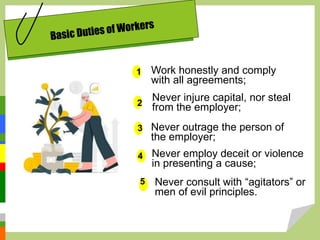
Work honestly and comply
with all agreements;
1
2
3
4
5
Never injure capital, nor steal
from the employer;
Never outrage the person of
the employer;
Never employ deceit or violence
in presenting a cause;
Never consult with “agitators” or
men of evil principles.
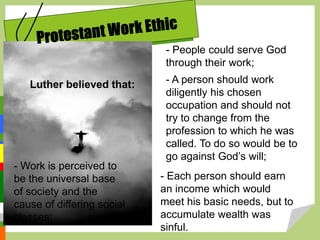
Luther believed that:
- People could serve God
through their work;
- A person should work
diligently his chosen
occupation and should not
try to change from the
profession to which he was
called. To do so would be to
go against God’s will;
- Work is perceived to
be the universal base
of society and the
cause of differing social
classes;
- Each person should earn
an income which would
meet his basic needs, but to
accumulate wealth was
sinful.
But it was Max Weber who developed further
the Protestant Work Ethic.
- Predestination –the belief that God has chosen the
elect
HARDWORK SUCCESS HEAVEN
- All men must work, even the rich,
because to work is the will of God.
- Key elements of Protestant Work Ethic –
Self-Discipline, hard work and ability to save
money.
- Living ascetically, e.g., frugally,
self-denial, taboo, pleasures of the
flesh.
- Reinvest the profits of their labor
into financing further ventures.
- Selection of an occupation and
pursuing it to the achieve the
greatest profit possible is
perceived as a religious duty.
- Other key elements of
the Protestant work ethic
include the following:
diligence, punctuality,
deferment of gratification,
an primacy of the work
domain. For the
Protestants, working hard
is a mark of commitment
to their religion.
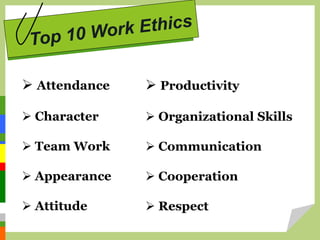
 Attendance
 Character
 Team Work
 Appearance
 Attitude
 Productivity
 Organizational Skills
 Communication
 Cooperation
 Respect
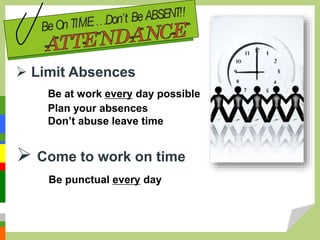
 Limit Absences
Be at work every day possible
Plan your absences
Don’t abuse leave time
 Come to work on time
Be punctual every day
 Be dependable
Complete
assigned tasks correctly
and promptly
 Be loyal
Speak positively
about the company
 Leadership abilities
The ability to be led and/or to become the leader
 Be a team player
The ability to get along with others
– including those you don’t necessarily
like, Cooperation is the key to productivity
 Be a contributing member
The ability to carry your own weight and
help others who are struggling
 Accept compromise
Recognize when to speak up with an idea
and when to compromise by blending ideas
together
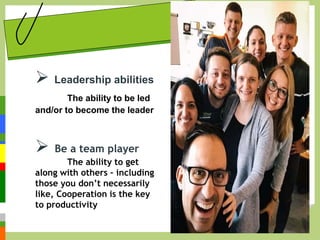
 Leadership abilities
The ability to be led
and/or to become the leader
 Be a team player
The ability to get
along with others – including
those you don’t necessarily
like, Cooperation is the key
to productivity
 Dress Appropriately
No organization likes to have a shabbily dressed employee.
Shave daily if you have to and do not use strong perfumes.
Dress for Success!
Remember that you are a representative of your
organization, how you dress &
Act can reflect on the organization.
Never wear revealing clothes to work. Body piercing and tattoo are a strict no at the
workplace. Females should avoid wearing heavy jewelry/make-up to work.
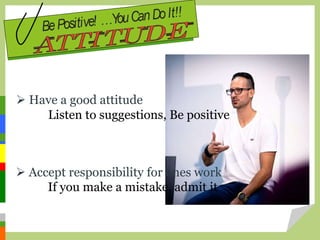
 Have a good attitude
Listen to suggestions, Be positive
 Accept responsibility for ones work
If you make a mistake, admit it
 Take pride in your work
Do things the best you know
how
 Don’t be dissatisfied all the
time You agreed to the
work/pay/hours
 Written
Communications
Being able to
correctly write reports
and memos
 Verbal Communications Being
able to communicate one on one or
to a group
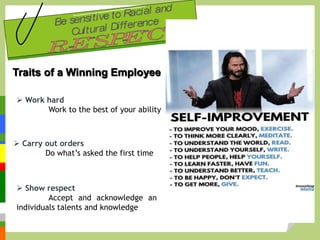
 Work hard
Work to the best of your ability
Traits of a Winning Employee
 Carry out orders
Do what’s asked the first time
 Show respect
Accept and acknowledge an
individuals talents and knowledge
RA 6713
REFERENCE
http://www.csc.gov.ph/
https://www.scribd.com/presenta
tion/422573519/Developing-
Good-Work-Ethics-ppt

Developing Good Ethics.ppt

  • 1.
    > > >> > > > > “Attitude is a little thing that makes a big difference” - Anonymous Developing Good Work Ethics By: Norvin Rapin Discussant Jo Bitonio Professor
  • 2.
    Understand the importanceof developing a right attitude towards work. 1 2 3 4 5 Develop a personal work ethic. Examine the difference between human and spiritual dimensions of work. Find ways and means to enjoy work personally and with others. Become a productive employee and worker.
  • 3.
    • A setof values that advocate hard work and diligence • Emphasize the moral benefits of work • Said to enhance character Work Ethic is…
  • 4.
     Better positions Prosperous future  A good sense of responsibility  Improving relationships with family and friends  Better physical and mental health  Making choices about your priorities, rather than sacrifices among them  More leisure time to spend with loved ones, or time for yourself
  • 5.
     Unmotivated  Poorlytrained or managed  Minor position  No standards  Lack of willingness  Don’t want to work hard  Don’t want to overtime  Impatient
  • 6.
    Personal activity, itis aimed at developing a person. Social activity, its purpose is the preservation of human society To accomplish certain tasks Because nobody can own another man’s body The purpose of work is to obtain an economic gain or power. WORK Personal Activity Social Activity Legitimate use of bodily powers Legitimate use of mental powers
  • 7.
    In the NewTestament the meaning of work can be well understood from the perspective of the mystery of God’s incarnation. When Christ became man, humanity was blessed an sanctified, including human work. Christ, the Son Of God, also worked as a carpenter. Seen from this perspective, work therefore, is not a drudgery, not even a curse, but an activity that has been blessed and sanctified and therefore, must also sanctify the worker himself.
  • 8.
    From the biblicalpoint of view, God is seen as the author of work and He also blessed and sanctified work. In the Old Testament God did not only create man, he is also the author of work. In Genesis Chapter 1, God creates a pattern of work and rest for us to follow- He created the world for six days and rested on the seventh day. The reason for his respite is for man to appreciate and value the meaning of work.
  • 9.
    Summa Theological It providesfor one’s daily livelihood. 1 2 3 4 It prevents idleness which is a source of many evils It curbs the rebellious flesh It enables man to give aims from his material surplus. “Man is called to serve God through his work”
  • 10.
    WORK WORKER OTHER WORKERS Object: - atask to be done Subject: - the human person Context: - others When he works: - He accomplishes something - He defines himself - He measures his work as a person - He develops himself - He provides an occasion to relate with others
  • 11.
    Practice the Golden Rule 1 2 3 4 5 Guardyour mouth Stop the green jokes Practice ethical behavior Learn to forgive Be generous 6 7 8 9 Respect superiors and coworkers Be considerate Perform your work and fulfill your duties to the best of your ability 10 11 12 13 Be a grateful person Do not bring the problems at home to the workplace or vice versa Be an inspiration to others Read the bible every day Develop a personal relationship with God 14 15 Smile and enjoy your work. (Remember: work has been sanctified, it must also sanctify you.)
  • 12.
    Respect the dignityof the workers 1 2 3 4 5 Appreciate their work; Never treat them as slaves for making money; Never assign them tasks beyond their strength, nor employ them in work not suited to their age or gender; Give them commensurate and fair wages; Provide for their health and social recreation; 6 7 8 Provide them time for the practice of their religion; Instruct them on how to use their money wisely; 9 Instruct them to love their family; 10 Provide them with opportunities for promotion.
  • 13.
    Work honestly andcomply with all agreements; 1 2 3 4 5 Never injure capital, nor steal from the employer; Never outrage the person of the employer; Never employ deceit or violence in presenting a cause; Never consult with “agitators” or men of evil principles.
  • 14.
    Luther believed that: -People could serve God through their work; - A person should work diligently his chosen occupation and should not try to change from the profession to which he was called. To do so would be to go against God’s will; - Work is perceived to be the universal base of society and the cause of differing social classes; - Each person should earn an income which would meet his basic needs, but to accumulate wealth was sinful.
  • 15.
    But it wasMax Weber who developed further the Protestant Work Ethic. - Predestination –the belief that God has chosen the elect HARDWORK SUCCESS HEAVEN - All men must work, even the rich, because to work is the will of God. - Key elements of Protestant Work Ethic – Self-Discipline, hard work and ability to save money.
  • 16.
    - Living ascetically,e.g., frugally, self-denial, taboo, pleasures of the flesh. - Reinvest the profits of their labor into financing further ventures. - Selection of an occupation and pursuing it to the achieve the greatest profit possible is perceived as a religious duty.
  • 17.
    - Other keyelements of the Protestant work ethic include the following: diligence, punctuality, deferment of gratification, an primacy of the work domain. For the Protestants, working hard is a mark of commitment to their religion.
  • 18.
     Attendance  Character Team Work  Appearance  Attitude  Productivity  Organizational Skills  Communication  Cooperation  Respect
  • 19.
     Limit Absences Beat work every day possible Plan your absences Don’t abuse leave time  Come to work on time Be punctual every day
  • 20.
     Be dependable Complete assignedtasks correctly and promptly  Be loyal Speak positively about the company
  • 23.
     Leadership abilities Theability to be led and/or to become the leader  Be a team player The ability to get along with others – including those you don’t necessarily like, Cooperation is the key to productivity  Be a contributing member The ability to carry your own weight and help others who are struggling  Accept compromise Recognize when to speak up with an idea and when to compromise by blending ideas together
  • 24.
     Leadership abilities Theability to be led and/or to become the leader  Be a team player The ability to get along with others – including those you don’t necessarily like, Cooperation is the key to productivity
  • 25.
     Dress Appropriately Noorganization likes to have a shabbily dressed employee. Shave daily if you have to and do not use strong perfumes. Dress for Success! Remember that you are a representative of your organization, how you dress & Act can reflect on the organization. Never wear revealing clothes to work. Body piercing and tattoo are a strict no at the workplace. Females should avoid wearing heavy jewelry/make-up to work.
  • 26.
     Have agood attitude Listen to suggestions, Be positive  Accept responsibility for ones work If you make a mistake, admit it
  • 27.
     Take pridein your work Do things the best you know how  Don’t be dissatisfied all the time You agreed to the work/pay/hours
  • 28.
     Written Communications Being ableto correctly write reports and memos  Verbal Communications Being able to communicate one on one or to a group
  • 29.
     Work hard Workto the best of your ability Traits of a Winning Employee  Carry out orders Do what’s asked the first time  Show respect Accept and acknowledge an individuals talents and knowledge
  • 31.
  • 32.