WORK ANDWORK
ATTITUDE
•Work and work attitude are subjects of utmost
interest to many as they affect a greater part of
our waking hours.
•In the world of business and industry
everything gets done through people power
and through the power of work all goals are
achieved.
WORK AND PLAY
WORK is what one should do and must do
regularly, grimly and purposefully. Work is
viewed as a means of attaining whatever
one desires-and it is best (a cultural value)
that one has great achievement
motivation.
Work is a fundamental dimension of
human existence. It is a physical or an
intellectual effort directed towards a
desired end.
•PLAY is different. It is fun, an outlet
from work, without serious purpose
except to make us happier, more
efficient, more relaxed and longer
lasting working human machines.
ATTITUDE AND WORK
POSITIVE ATTITUDES are objects or ideas
that we like and have a tendency to
acquire, as for example, money, diamonds,
beauty, knowledge, industriousness,
honesty, love for work, etc.
NEGATIVE ATTITUDES are those we shun
or dislike for they do not give any
satisfaction.
It is our attitude and values which will
ultimately determine the achievement of our
goals.
Our attitude towards work will strongly
determine our direction, adjustment and
satisfaction in different changing situation.
Attitude in other words, is a tendency to act
with respect to a certain value.
The key word in this definition is “value”. We
value our relationship with others, we value
an object which has been given to us, and
WORK.
Attitudes maybe grouped into four (4)
fundamental types:
1. Utilitarian method – are adjustive ones that
can be recognized most easily in change
situations.
2. Ego defensive attitudes – protect the person
from threats to the ego and the anxiety
generated by them.
3. Value expressive attitudes – are those
maintaining self identity or leading to self
expression and determination.
4. Attitudes serving the knowledge function –
tend to promote meaningfulness in all
activity.
•An opinion is the expression of one’s
adjustment of a particular set of facts,
an evaluation of the circumstances
presented to him. An opinion is a
response to a specifically limited
stimulus, but the response is certainly
influenced by the predisposition with
which the individual is operating, that
is the attitude structure.
FORMATION OF ATTITUDE
ATTITUDE CHANGE
Attitudes can be changed if the value
system is changed.
Intellectual attitude towards the work
system is easy to change for with reason
and logic we can change one’s mind.
Most of our poor attitude towards work
arises from our emotions or feelings. It is
not easy to change one’s feelings as we can
change one’s mind.
•To change value system we have to look into
the person’s background.
•To understand the root of his poor attitude
towards his work, first we have to consider the
family influence which has a strong impact on
such attitudes.
•Second, the class structure of our country. This
is a determinant of many of our values which
affect our attitudes.
•Third is experience.
CONCEPTS OFWORK
Work is universal. This universal thinking
is expounded by IdaTarbel, a naturalist.
She says in her formal essay “Work is
something that reaches the deepest needs;
that helps to reconcile the frustrating and
confusing mystery of the universe. That it
helps establish order in a disorderly
society; puts despair to sleep and given
experience to youth.”
Calvin Coolidge expresses work as a
means to social progress and culture. He
expresses, “ All growth depends upon
activity. There is no development –
physically and intellectually without effort
and effort means work. Work is not a curse;
it is the prerogative of intelligence, the only
means to manhood and the measure of
civilization.”
•Pope Paul II, in his Laborem Exercens
says that work is honorable, and
dignifies man. He said, “Man’s life is
built up everyday from work; from
work it derives its specific dignity.”
Among the ancient people, work was not a
pleasant sort of thing.
◦Labor – in Latin signifies trouble, distress and
difficulty.
◦Travail – in French originally denotes a three-
pronged instrument of torture employed by
the Roman legions.
◦Occupation – among the latins is something to
seize , hold or grapple with.
◦Work – to the Greeks is synonymous with
trouble.
Kahlil Gibran, in his book The prophet
expresses in his poem on work that it is
love made visible.
The Judaic-Christian religious concept of
work is that it is a curse due to man’s first
disobedience to God.
The Jews feel that work well-done honors
God; lastly old Protestants believe that in
work, one pursues calling as a part of an
effort to achieve salvation.
Classification of work
Work is classified as mental or
physical, sedentary or muscular.
Sedentary work involves control,
timing and direction of activity, while
in muscular work, the main
consideration is mechanical force.
Mental and Physical Work
•Mental work has something to do with
remembering, thinking, reasoning,
judging, etc.,
•Physical work refers to activities
where speed, coordination, and
intensity of muscular responses are
needed.
Blue Collar and KnowledgeWorker
•Antonio Ozaeta classified workers into:
• the blue collar or manual worker such as
those who account for direct labor cost
•knowledge workers include accountants,
clerks, tellers, programmers,
supervisors, and executives.
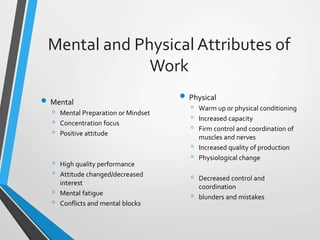
Mental and Physical Attributes of
Work
 Mental
◦ Mental Preparation or Mindset
◦ Concentration focus
◦ Positive attitude
◦ High quality performance
◦ Attitude changed/decreased
interest
◦ Mental fatigue
◦ Conflicts and mental blocks
 Physical
◦ Warm up or physical conditioning
◦ Increased capacity
◦ Firm control and coordination of
muscles and nerves
◦ Increased quality of production
◦ Physiological change
◦ Decreased control and
coordination
◦ blunders and mistakes
•The mental and physical attributes of
work will lead to high tolerance of
errors which cause low level of
achievement and poor quality of work.
ELEMENTS OFWORK
Elements of work are derived from the word
work itself.
W – will power (desire, motives, urge)
O – objective (aims, targets, goals)
R – Responsibility (commitment, love, reliability)
K – knowledge (perception, understanding,
wisdom).
Work has its objective and subjective
viewpoints.
Dimensions of Work
• Objective point of view – refers to the various
ways and processes whereby man manifests
and confirms himself as one who controls all
activities – mental and physical.
• Subjective point of view – take into account the
personal, familial and societal spheres. Through
work man not only transforms nature adopting
it to his own needs, but, he also achieves
fulfillment as a human being
Ethics ofWork
•Moral Obligation
•Honesty
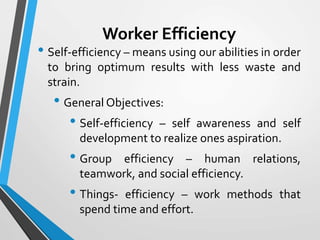
Worker Efficiency
• Self-efficiency – means using our abilities in order
to bring optimum results with less waste and
strain.
• General Objectives:
• Self-efficiency – self awareness and self
development to realize ones aspiration.
• Group efficiency – human relations,
teamwork, and social efficiency.
• Things- efficiency – work methods that
spend time and effort.
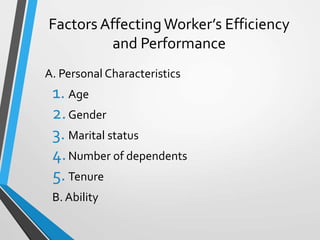
Factors AffectingWorker’s Efficiency
and Performance
A. Personal Characteristics
1. Age
2.Gender
3. Marital status
4.Number of dependents
5.Tenure
B. Ability
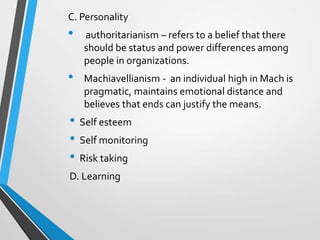
C. Personality
• authoritarianism – refers to a belief that there
should be status and power differences among
people in organizations.
• Machiavellianism - an individual high in Mach is
pragmatic, maintains emotional distance and
believes that ends can justify the means.
• Self esteem
• Self monitoring
• Risk taking
D. Learning
The Changing Concepts ofWork
•Motivation
•Promotions
•Fear of failure
•Work Loss

WORK-AND-WORK-ATTITUDE/HUMAN BEHAVIOR.ppt

  • 1.
  • 2.
    •Work and workattitude are subjects of utmost interest to many as they affect a greater part of our waking hours. •In the world of business and industry everything gets done through people power and through the power of work all goals are achieved.
  • 3.
    WORK AND PLAY WORKis what one should do and must do regularly, grimly and purposefully. Work is viewed as a means of attaining whatever one desires-and it is best (a cultural value) that one has great achievement motivation. Work is a fundamental dimension of human existence. It is a physical or an intellectual effort directed towards a desired end.
  • 4.
    •PLAY is different.It is fun, an outlet from work, without serious purpose except to make us happier, more efficient, more relaxed and longer lasting working human machines.
  • 5.
    ATTITUDE AND WORK POSITIVEATTITUDES are objects or ideas that we like and have a tendency to acquire, as for example, money, diamonds, beauty, knowledge, industriousness, honesty, love for work, etc. NEGATIVE ATTITUDES are those we shun or dislike for they do not give any satisfaction.
  • 6.
    It is ourattitude and values which will ultimately determine the achievement of our goals. Our attitude towards work will strongly determine our direction, adjustment and satisfaction in different changing situation. Attitude in other words, is a tendency to act with respect to a certain value. The key word in this definition is “value”. We value our relationship with others, we value an object which has been given to us, and WORK.
  • 7.
    Attitudes maybe groupedinto four (4) fundamental types: 1. Utilitarian method – are adjustive ones that can be recognized most easily in change situations. 2. Ego defensive attitudes – protect the person from threats to the ego and the anxiety generated by them. 3. Value expressive attitudes – are those maintaining self identity or leading to self expression and determination. 4. Attitudes serving the knowledge function – tend to promote meaningfulness in all activity.
  • 8.
    •An opinion isthe expression of one’s adjustment of a particular set of facts, an evaluation of the circumstances presented to him. An opinion is a response to a specifically limited stimulus, but the response is certainly influenced by the predisposition with which the individual is operating, that is the attitude structure.
  • 9.
  • 10.
    ATTITUDE CHANGE Attitudes canbe changed if the value system is changed. Intellectual attitude towards the work system is easy to change for with reason and logic we can change one’s mind. Most of our poor attitude towards work arises from our emotions or feelings. It is not easy to change one’s feelings as we can change one’s mind.
  • 11.
    •To change valuesystem we have to look into the person’s background. •To understand the root of his poor attitude towards his work, first we have to consider the family influence which has a strong impact on such attitudes. •Second, the class structure of our country. This is a determinant of many of our values which affect our attitudes. •Third is experience.
  • 12.
    CONCEPTS OFWORK Work isuniversal. This universal thinking is expounded by IdaTarbel, a naturalist. She says in her formal essay “Work is something that reaches the deepest needs; that helps to reconcile the frustrating and confusing mystery of the universe. That it helps establish order in a disorderly society; puts despair to sleep and given experience to youth.”
  • 13.
    Calvin Coolidge expresseswork as a means to social progress and culture. He expresses, “ All growth depends upon activity. There is no development – physically and intellectually without effort and effort means work. Work is not a curse; it is the prerogative of intelligence, the only means to manhood and the measure of civilization.”
  • 14.
    •Pope Paul II,in his Laborem Exercens says that work is honorable, and dignifies man. He said, “Man’s life is built up everyday from work; from work it derives its specific dignity.”
  • 15.
    Among the ancientpeople, work was not a pleasant sort of thing. ◦Labor – in Latin signifies trouble, distress and difficulty. ◦Travail – in French originally denotes a three- pronged instrument of torture employed by the Roman legions. ◦Occupation – among the latins is something to seize , hold or grapple with. ◦Work – to the Greeks is synonymous with trouble.
  • 16.
    Kahlil Gibran, inhis book The prophet expresses in his poem on work that it is love made visible. The Judaic-Christian religious concept of work is that it is a curse due to man’s first disobedience to God. The Jews feel that work well-done honors God; lastly old Protestants believe that in work, one pursues calling as a part of an effort to achieve salvation.
  • 17.
    Classification of work Workis classified as mental or physical, sedentary or muscular. Sedentary work involves control, timing and direction of activity, while in muscular work, the main consideration is mechanical force.
  • 18.
    Mental and PhysicalWork •Mental work has something to do with remembering, thinking, reasoning, judging, etc., •Physical work refers to activities where speed, coordination, and intensity of muscular responses are needed.
  • 19.
    Blue Collar andKnowledgeWorker •Antonio Ozaeta classified workers into: • the blue collar or manual worker such as those who account for direct labor cost •knowledge workers include accountants, clerks, tellers, programmers, supervisors, and executives.
  • 20.
    Mental and PhysicalAttributes of Work  Mental ◦ Mental Preparation or Mindset ◦ Concentration focus ◦ Positive attitude ◦ High quality performance ◦ Attitude changed/decreased interest ◦ Mental fatigue ◦ Conflicts and mental blocks  Physical ◦ Warm up or physical conditioning ◦ Increased capacity ◦ Firm control and coordination of muscles and nerves ◦ Increased quality of production ◦ Physiological change ◦ Decreased control and coordination ◦ blunders and mistakes
  • 21.
    •The mental andphysical attributes of work will lead to high tolerance of errors which cause low level of achievement and poor quality of work.
  • 22.
    ELEMENTS OFWORK Elements ofwork are derived from the word work itself. W – will power (desire, motives, urge) O – objective (aims, targets, goals) R – Responsibility (commitment, love, reliability) K – knowledge (perception, understanding, wisdom). Work has its objective and subjective viewpoints.
  • 23.
    Dimensions of Work •Objective point of view – refers to the various ways and processes whereby man manifests and confirms himself as one who controls all activities – mental and physical. • Subjective point of view – take into account the personal, familial and societal spheres. Through work man not only transforms nature adopting it to his own needs, but, he also achieves fulfillment as a human being
  • 24.
  • 25.
    Worker Efficiency • Self-efficiency– means using our abilities in order to bring optimum results with less waste and strain. • General Objectives: • Self-efficiency – self awareness and self development to realize ones aspiration. • Group efficiency – human relations, teamwork, and social efficiency. • Things- efficiency – work methods that spend time and effort.
  • 26.
    Factors AffectingWorker’s Efficiency andPerformance A. Personal Characteristics 1. Age 2.Gender 3. Marital status 4.Number of dependents 5.Tenure B. Ability
  • 27.
    C. Personality • authoritarianism– refers to a belief that there should be status and power differences among people in organizations. • Machiavellianism - an individual high in Mach is pragmatic, maintains emotional distance and believes that ends can justify the means. • Self esteem • Self monitoring • Risk taking D. Learning
  • 28.
    The Changing ConceptsofWork •Motivation •Promotions •Fear of failure •Work Loss

Editor's Notes

  • #3 Then to say that work and workers have been and will always be the indispensable partners of business and industry toward achieving productivity and economic development is a truism.
  • #4 Man is judged by his work and what he must do to deserve his leisure and play. Work is serious adult business that enables one to get ahead and make a contribution in society.
  • #5 It is the man equipped with proper skills and positive attitude towards work and values that can help recover a tattered economy and transform a nation.
  • #7 One must bear in mind that values are not constant. They change and as they change, our attitude changes.
  • #8 Utilitarian - When employees are well treated, they are likely to develop a positive attitude toward management and the organization and vise versa Ego-defensive - Mechanisms include denial, repression, projection, rationalization, etc. Value expressive - Central values tend to establish our identity and gain us social approval thereby showing us who we are, and what we stand for. Serving the knowledge- this allows us to predict what is likely to happen, and so gives us a sense of control. Stereotyping is another example. In the absence of knowledge about a person, we may use a stereotyped attitude for judging the person.