1
Enhancing Workplace
Spirituality for Higher Education
Academicians
2
Exploration into the reasons behind the increased interest in
Spirituality in the Workplace - Satiation of Maslow’s hierarchy of need
Shifting Maslowvian needs
 Some of the literature suggests
that as society [North
American and Europe] has
advanced in terms of leisure,
technology and the
communication of ideas, to the
point where individuals have
an increasing desire to
experience spirituality not only
in their personal life but also in
their work
Krishnakumar & Neck [2002], Tischler [1999], Brandt [1996],
Cacioppe [2000, Part 1]
3
Exploration into the reasons behind the increased interest in
Spirituality in the Workplace - The search for greater meaning & purpose
The search for greater
meaning and purpose
Cash 2000; Cacioppe
2000; King and
Nicoll1999 and
Cavanagh 1999
suggests that
employees are
looking for greater
meaning and purpose
in their lives [with
some contending that
this search has been
underpinned by the
advance of
technology and the
restructuring of
organizations]
4
Exploration into the reasons behind the increased interest in
Spirituality in the Workplace – Change in global economy
Cavanagh 1999; Bell 2001;
Darwin 2002; make
reference to one of the
reasons for the rise in
interest in SiW is that
the changes to the
global economy [and the
consequent downsizing]
have left workers
demoralized, creating a
sense of alienation and
the inability to cope with
the compartmentalizing
nature of their work and
non-work lives
Owners, managers and
employees are having to
change the way they
think and work
5
Exploration into the reasons behind the increased interest in
Spirituality in the Workplace – Improved productivity and commitment
Another answer to this question arguably
could involve the benefits to an
organization for encouraging spirituality
in the workplace.
Krishnakumar & Neck 2002 suggest that
there is some evidence linking
workplace spirituality and
a. Enhanced creativity [Freshman
1999]
b. Enhanced sense of personal
fulfilment of employees [Burack
1999]
c. Increased commitment to
organizational goals [Delbecq, 1999]
King and Nicol 1999 suggested that
organizations who foster spiritual
development will realize heightened
individual and organizational
performance
6
Exploration into the reasons behind the increased interest in
Spirituality in the Workplace – Collapse of traditional community
structures
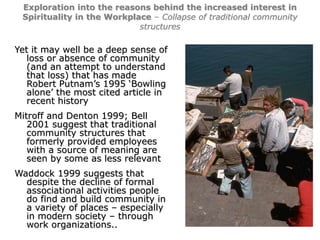
Yet it may well be a deep sense of
loss or absence of community
(and an attempt to understand
that loss) that has made
Robert Putnam’s 1995 ‘Bowling
alone’ the most cited article in
recent history
Mitroff and Denton 1999; Bell
2001 suggest that traditional
community structures that
formerly provided employees
with a source of meaning are
seen by some as less relevant
Waddock 1999 suggests that
despite the decline of formal
associational activities people
do find and build community in
a variety of places – especially
in modern society – through
work organizations..
7
Spirituality – what is it that we are talking about – Confusion may stop
initial understanding of what we are talking about
‘There is a great deal of
confusion in our
Western culture about
spirituality. There are
many defenses that
arise when the topic of
spirituality is introduced
because most people
think that the comments
are religious’.
(Akins E., 2000)
8
Spirituality – what is it that we are talking about – Confusion
may stop initial understanding of what we are talking about
‘Part of the confusion arises out of
how we distinguish the term
‘spirituality’ from ‘religion’ in our
language. Spirit comes from the
word ‘spiritus’ which means breath
of life. Spirit is the unseen force
that breathes life into us, enlivens
us gives energy to us. Spirit helps
to define the true, real unique self
that is us and confirms our
individuality
Moxley 2000 p. 23
…..Religion comes from the Latin
‘religio’ which has been translated
as reliance or connection
Scott-Peck 1993 p. 233) in Howard (2002) p. 232
9
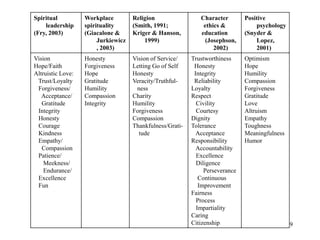
Spiritual
leadership
(Fry, 2003)
Workplace
spirituality
(Giacalone &
Jurkiewicz
, 2003)
Religion
(Smith, 1991;
Kriger & Hanson,
1999)
Character
ethics &
education
(Josephson,
2002)
Positive
psychology
(Snyder &
Lopez,
2001)
Vision
Hope/Faith
Altruistic Love:
Trust/Loyalty
Forgiveness/
Acceptance/
Gratitude
Integrity
Honesty
Courage
Kindness
Empathy/
Compassion
Patience/
Meekness/
Endurance/
Excellence
Fun
Honesty
Forgiveness
Hope
Gratitude
Humility
Compassion
Integrity
Vision of Service/
Letting Go of Self
Honesty
Veracity/Truthful-
ness
Charity
Humility
Forgiveness
Compassion
Thankfulness/Grati-
tude
Trustworthiness
Honesty
Integrity
Reliability
Loyalty
Respect
Civility
Courtesy
Dignity
Tolerance
Acceptance
Responsibility
Accountability
Excellence
Diligence
Perseverance
Continuous
Improvement
Fairness
Process
Impartiality
Caring
Citizenship
Optimism
Hope
Humility
Compassion
Forgiveness
Gratitude
Love
Altruism
Empathy
Toughness
Meaningfulness
Humor
10
What then is spirituality? And do we need a categorical
definition?
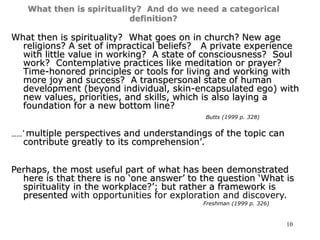
What then is spirituality? What goes on in church? New age
religions? A set of impractical beliefs? A private experience
with little value in working? A state of consciousness? Soul
work? Contemplative practices like meditation or prayer?
Time-honored principles or tools for living and working with
more joy and success? A transpersonal state of human
development (beyond individual, skin-encapsulated ego) with
new values, priorities, and skills, which is also laying a
foundation for a new bottom line?
Butts (1999 p. 328)
……‘ multiple perspectives and understandings of the topic can
contribute greatly to its comprehension’.
Perhaps, the most useful part of what has been demonstrated
here is that there is no ‘one answer’ to the question ‘What is
spirituality in the workplace?’; but rather a framework is
presented with opportunities for exploration and discovery.
Freshman (1999 p. 326)
11
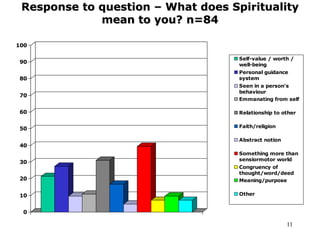
Response to question – What does Spirituality
mean to you? n=84
0
10
20
30
40
50
60
70
80
90
100
Self-value / worth /
well-being
Personal guidance
system
Seen in a person's
behaviour
Emmanating from self
Relationship to other
Faith/religion
Abstract notion
Something more than
sensiormotor world
Congruency of
thought/word/deed
Meaning/purpose
Other
12
Dimensions of spirituality in the workplace – a review of current
literature
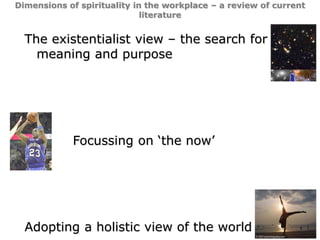
The existentialist view – the search for
meaning and purpose
Focussing on ‘the now’
Adopting a holistic view of the world
13
The existentialist view – the
search for meaning and purpose
Purpose
Wisdom
Choice
Ethics
Values
14
The existentialist view – the search for meaning and purpose
The search for meaning has been one of the most
quoted phrases in examples of people who quit their
jobs to lead more spiritually enriching life
Naylor et al., (1996, p. 56) cited in Krishnakumar and Neck, (2002 pp. 156)
This is not a new quest
… …‘The question, which in my fiftieth year had
brought me to the notion of suicide, was the simplest
of all question, lying in the soul of every man: ‘What
will come from what I am doing now, and may do
tomorrow? What will come from my whole life?’
Wilber (1995 p. 271) quotes Tolstoy
15
Focussing on the NOW
Paying attention
Focus of attention
Authentic presence
Resonating with what you are
doing
Being in the zone Flow
16
Focussing on the NOW
Csikszentmihalyi (1990)
describes the experience
as a feeling of being in the
flow. It is a sense of
wholeness, an oneness
with who we are and an
awareness of how we fit
with our external
environment.
17
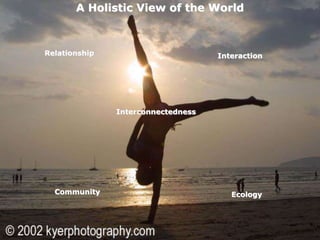
A Holistic View of the World
Relationship Interaction
Interconnectedness
Ecology
Community
18
A Holistic View of the World
'The natural sciences support the third aspect
of Spirituality, which is a holistic view of the
world. Everything is connected to everything
else. ‘Globally, recent insights from the natural
sciences have shown the world to be an
individual whole, a web of relationships in
which any action has complex, non-linear and
unpredictable effects. Accepting the veracity
of this research requires a shift in how we
perceive and experience our world.’
Gleick, J., (1987), ‘Chaos; Making a New Science’, Penguin, New York NY; Capra, F., (1996), ‘The Web of
Life’, Anchor Book, New York, NY (cited in Neal (1999) Journal of Change Management, Vol. 12. No.3 p.176-7)
19
A Holistic View of the World
Indra, the king of the gods, has a wonderful
net made entirely of strings of jewels.
Imagine this net arrayed in space,
extending in all directions. In every
diamond you can see the reflection of the
whole net – the entire net is contained and
reflected by every jewel in it. Imagine you
are one of the jewels, and every person in
the world is also – each reflecting all the
others.’
20
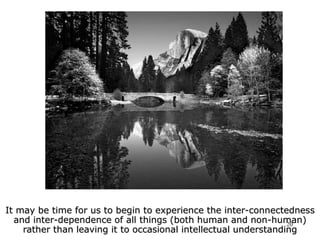
It may be time for us to begin to experience the inter-connectedness
and inter-dependence of all things (both human and non-human)
rather than leaving it to occasional intellectual understanding
21
Relationship with others –
separation or intrinsic
connection?
‘The relationship to the Thou is direct. No systems of
ideas, no foreknowledge, and no fancy intervene
between I and Thou. The memory itself is transformed,
as it plunges out of its isolation into the unity of the
whole. No aim, no lust, and no anticipation intervene
between I and Thou. Desire itself is transformed as it
plunges out of its dream into the appearance. Every
means is an obstacle. Only when every means has
collapsed does the meeting come about.’
Martin Buber, I and Thou, translated by Ronald Gregor Smith p. 26
22
And from that way of being, individually and collectively begin to
create, relate and experience a richer, dynamic and more meaningful
life – both professionally and personally
23
To believe in love in the face of hatred, life
in the face of death, day in the dark of
night, good in the face of evil – to some, all
of these may seem to be hopelessly naïve,
wishful thinking…….but, to Tillich, all of
these are manifestations of enormous
courage, the courage of confidence in more
than the sovereignty of fact and
appearance’ …… Paul Tillich, ‘The Courage to be’, p. xxiii
‘But everything great is just as difficult to
realize as it is rare to find’ – reads the last
sentence of the Ethics of Spinoza.
Viktor Frankl, Man’s Search for Meaning p. 179
24
Some things to ponder?
• Human experience is broader,
deeper and higher than science
allows us to accept or
adequately describe.
• It may be time for us to begin
to experience the inter-
connectedness and inter-
dependence of all things (both
human and non-human) rather
than leaving it to occasional
intellectual speculative debate.
When this occurs separation
dissipates into authentic
relationship
• And from that way of being,
individually and collectively
begin to create, relate and
experience a richer, dynamic
and more meaningful life – both
professionally and personally
25
26
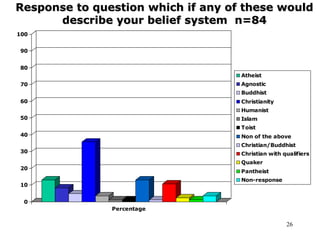
Response to question which if any of these would
describe your belief system n=84
0
10
20
30
40
50
60
70
80
90
100
Percentage
Atheist
Agnostic
Buddhist
Christianity
Humanist
Islam
Toist
Non of the above
Christian/Buddhist
Christian with qualifiers
Quaker
Pantheist
Non-response
27
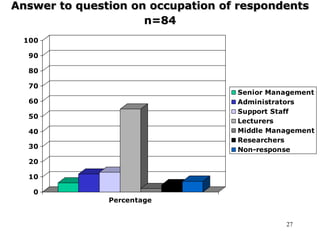
Answer to question on occupation of respondents
n=84
0
10
20
30
40
50
60
70
80
90
100
Percentage
Senior Management
Administrators
Support Staff
Lecturers
Middle Management
Researchers
Non-response
28
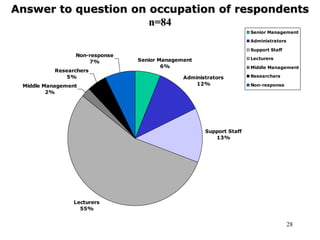
Answer to question on occupation of respondents
n=84
Senior Management
6%
Administrators
12%
Lecturers
55%
Middle Management
2%
Researchers
5%
Non-response
7%
Support Staff
13%
Senior Management
Administrators
Support Staff
Lecturers
Middle Management
Researchers
Non-response
29
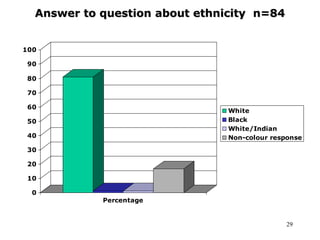
Answer to question about ethnicity n=84
0
10
20
30
40
50
60
70
80
90
100
Percentage
White
Black
White/Indian
Non-colour response
30
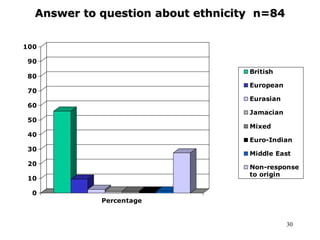
Answer to question about ethnicity n=84
0
10
20
30
40
50
60
70
80
90
100
Percentage
British
European
Eurasian
Jamacian
Mixed
Euro-Indian
Middle East
Non-response
to origin
31
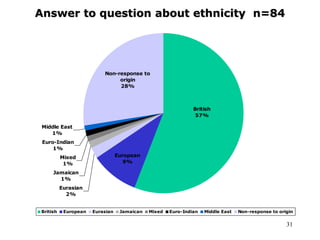
Answer to question about ethnicity n=84
Eurasian
2%
Jamaican
1%
Mixed
1%
Euro-Indian
1%
Middle East
1%
European
9%
Non-response to
origin
28%
British
57%
British European Eurasian Jamaican Mixed Euro-Indian Middle East Non-response to origin
32
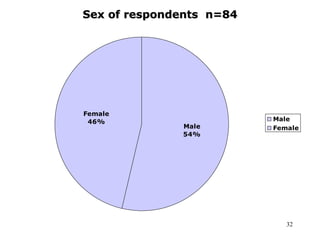
Sex of respondents n=84
Male
54%
Female
46% Male
Female
33
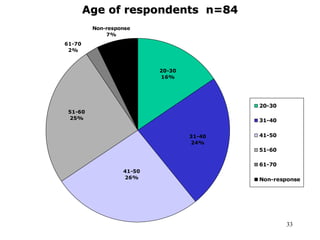
Age of respondents n=84
61-70
2%
Non-response
7%
51-60
25%
41-50
26%
31-40
24%
20-30
16%
20-30
31-40
41-50
51-60
61-70
Non-response
34
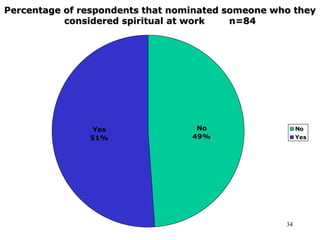
Percentage of respondents that nominated someone who they
considered spiritual at work n=84
Yes
51%
No
49%
No
Yes

Spirituality presentation Ruth presented

  • 1.
    1 Enhancing Workplace Spirituality forHigher Education Academicians
  • 2.
    2 Exploration into thereasons behind the increased interest in Spirituality in the Workplace - Satiation of Maslow’s hierarchy of need Shifting Maslowvian needs  Some of the literature suggests that as society [North American and Europe] has advanced in terms of leisure, technology and the communication of ideas, to the point where individuals have an increasing desire to experience spirituality not only in their personal life but also in their work Krishnakumar & Neck [2002], Tischler [1999], Brandt [1996], Cacioppe [2000, Part 1]
  • 3.
    3 Exploration into thereasons behind the increased interest in Spirituality in the Workplace - The search for greater meaning & purpose The search for greater meaning and purpose Cash 2000; Cacioppe 2000; King and Nicoll1999 and Cavanagh 1999 suggests that employees are looking for greater meaning and purpose in their lives [with some contending that this search has been underpinned by the advance of technology and the restructuring of organizations]
  • 4.
    4 Exploration into thereasons behind the increased interest in Spirituality in the Workplace – Change in global economy Cavanagh 1999; Bell 2001; Darwin 2002; make reference to one of the reasons for the rise in interest in SiW is that the changes to the global economy [and the consequent downsizing] have left workers demoralized, creating a sense of alienation and the inability to cope with the compartmentalizing nature of their work and non-work lives Owners, managers and employees are having to change the way they think and work
  • 5.
    5 Exploration into thereasons behind the increased interest in Spirituality in the Workplace – Improved productivity and commitment Another answer to this question arguably could involve the benefits to an organization for encouraging spirituality in the workplace. Krishnakumar & Neck 2002 suggest that there is some evidence linking workplace spirituality and a. Enhanced creativity [Freshman 1999] b. Enhanced sense of personal fulfilment of employees [Burack 1999] c. Increased commitment to organizational goals [Delbecq, 1999] King and Nicol 1999 suggested that organizations who foster spiritual development will realize heightened individual and organizational performance
  • 6.
    6 Exploration into thereasons behind the increased interest in Spirituality in the Workplace – Collapse of traditional community structures Yet it may well be a deep sense of loss or absence of community (and an attempt to understand that loss) that has made Robert Putnam’s 1995 ‘Bowling alone’ the most cited article in recent history Mitroff and Denton 1999; Bell 2001 suggest that traditional community structures that formerly provided employees with a source of meaning are seen by some as less relevant Waddock 1999 suggests that despite the decline of formal associational activities people do find and build community in a variety of places – especially in modern society – through work organizations..
  • 7.
    7 Spirituality – whatis it that we are talking about – Confusion may stop initial understanding of what we are talking about ‘There is a great deal of confusion in our Western culture about spirituality. There are many defenses that arise when the topic of spirituality is introduced because most people think that the comments are religious’. (Akins E., 2000)
  • 8.
    8 Spirituality – whatis it that we are talking about – Confusion may stop initial understanding of what we are talking about ‘Part of the confusion arises out of how we distinguish the term ‘spirituality’ from ‘religion’ in our language. Spirit comes from the word ‘spiritus’ which means breath of life. Spirit is the unseen force that breathes life into us, enlivens us gives energy to us. Spirit helps to define the true, real unique self that is us and confirms our individuality Moxley 2000 p. 23 …..Religion comes from the Latin ‘religio’ which has been translated as reliance or connection Scott-Peck 1993 p. 233) in Howard (2002) p. 232
  • 9.
    9 Spiritual leadership (Fry, 2003) Workplace spirituality (Giacalone & Jurkiewicz ,2003) Religion (Smith, 1991; Kriger & Hanson, 1999) Character ethics & education (Josephson, 2002) Positive psychology (Snyder & Lopez, 2001) Vision Hope/Faith Altruistic Love: Trust/Loyalty Forgiveness/ Acceptance/ Gratitude Integrity Honesty Courage Kindness Empathy/ Compassion Patience/ Meekness/ Endurance/ Excellence Fun Honesty Forgiveness Hope Gratitude Humility Compassion Integrity Vision of Service/ Letting Go of Self Honesty Veracity/Truthful- ness Charity Humility Forgiveness Compassion Thankfulness/Grati- tude Trustworthiness Honesty Integrity Reliability Loyalty Respect Civility Courtesy Dignity Tolerance Acceptance Responsibility Accountability Excellence Diligence Perseverance Continuous Improvement Fairness Process Impartiality Caring Citizenship Optimism Hope Humility Compassion Forgiveness Gratitude Love Altruism Empathy Toughness Meaningfulness Humor
  • 10.
    10 What then isspirituality? And do we need a categorical definition? What then is spirituality? What goes on in church? New age religions? A set of impractical beliefs? A private experience with little value in working? A state of consciousness? Soul work? Contemplative practices like meditation or prayer? Time-honored principles or tools for living and working with more joy and success? A transpersonal state of human development (beyond individual, skin-encapsulated ego) with new values, priorities, and skills, which is also laying a foundation for a new bottom line? Butts (1999 p. 328) ……‘ multiple perspectives and understandings of the topic can contribute greatly to its comprehension’. Perhaps, the most useful part of what has been demonstrated here is that there is no ‘one answer’ to the question ‘What is spirituality in the workplace?’; but rather a framework is presented with opportunities for exploration and discovery. Freshman (1999 p. 326)
  • 11.
    11 Response to question– What does Spirituality mean to you? n=84 0 10 20 30 40 50 60 70 80 90 100 Self-value / worth / well-being Personal guidance system Seen in a person's behaviour Emmanating from self Relationship to other Faith/religion Abstract notion Something more than sensiormotor world Congruency of thought/word/deed Meaning/purpose Other
  • 12.
    12 Dimensions of spiritualityin the workplace – a review of current literature The existentialist view – the search for meaning and purpose Focussing on ‘the now’ Adopting a holistic view of the world
  • 13.
    13 The existentialist view– the search for meaning and purpose Purpose Wisdom Choice Ethics Values
  • 14.
    14 The existentialist view– the search for meaning and purpose The search for meaning has been one of the most quoted phrases in examples of people who quit their jobs to lead more spiritually enriching life Naylor et al., (1996, p. 56) cited in Krishnakumar and Neck, (2002 pp. 156) This is not a new quest … …‘The question, which in my fiftieth year had brought me to the notion of suicide, was the simplest of all question, lying in the soul of every man: ‘What will come from what I am doing now, and may do tomorrow? What will come from my whole life?’ Wilber (1995 p. 271) quotes Tolstoy
  • 15.
    15 Focussing on theNOW Paying attention Focus of attention Authentic presence Resonating with what you are doing Being in the zone Flow
  • 16.
    16 Focussing on theNOW Csikszentmihalyi (1990) describes the experience as a feeling of being in the flow. It is a sense of wholeness, an oneness with who we are and an awareness of how we fit with our external environment.
  • 17.
    17 A Holistic Viewof the World Relationship Interaction Interconnectedness Ecology Community
  • 18.
    18 A Holistic Viewof the World 'The natural sciences support the third aspect of Spirituality, which is a holistic view of the world. Everything is connected to everything else. ‘Globally, recent insights from the natural sciences have shown the world to be an individual whole, a web of relationships in which any action has complex, non-linear and unpredictable effects. Accepting the veracity of this research requires a shift in how we perceive and experience our world.’ Gleick, J., (1987), ‘Chaos; Making a New Science’, Penguin, New York NY; Capra, F., (1996), ‘The Web of Life’, Anchor Book, New York, NY (cited in Neal (1999) Journal of Change Management, Vol. 12. No.3 p.176-7)
  • 19.
    19 A Holistic Viewof the World Indra, the king of the gods, has a wonderful net made entirely of strings of jewels. Imagine this net arrayed in space, extending in all directions. In every diamond you can see the reflection of the whole net – the entire net is contained and reflected by every jewel in it. Imagine you are one of the jewels, and every person in the world is also – each reflecting all the others.’
  • 20.
    20 It may betime for us to begin to experience the inter-connectedness and inter-dependence of all things (both human and non-human) rather than leaving it to occasional intellectual understanding
  • 21.
    21 Relationship with others– separation or intrinsic connection? ‘The relationship to the Thou is direct. No systems of ideas, no foreknowledge, and no fancy intervene between I and Thou. The memory itself is transformed, as it plunges out of its isolation into the unity of the whole. No aim, no lust, and no anticipation intervene between I and Thou. Desire itself is transformed as it plunges out of its dream into the appearance. Every means is an obstacle. Only when every means has collapsed does the meeting come about.’ Martin Buber, I and Thou, translated by Ronald Gregor Smith p. 26
  • 22.
    22 And from thatway of being, individually and collectively begin to create, relate and experience a richer, dynamic and more meaningful life – both professionally and personally
  • 23.
    23 To believe inlove in the face of hatred, life in the face of death, day in the dark of night, good in the face of evil – to some, all of these may seem to be hopelessly naïve, wishful thinking…….but, to Tillich, all of these are manifestations of enormous courage, the courage of confidence in more than the sovereignty of fact and appearance’ …… Paul Tillich, ‘The Courage to be’, p. xxiii ‘But everything great is just as difficult to realize as it is rare to find’ – reads the last sentence of the Ethics of Spinoza. Viktor Frankl, Man’s Search for Meaning p. 179
  • 24.
    24 Some things toponder? • Human experience is broader, deeper and higher than science allows us to accept or adequately describe. • It may be time for us to begin to experience the inter- connectedness and inter- dependence of all things (both human and non-human) rather than leaving it to occasional intellectual speculative debate. When this occurs separation dissipates into authentic relationship • And from that way of being, individually and collectively begin to create, relate and experience a richer, dynamic and more meaningful life – both professionally and personally
  • 25.
  • 26.
    26 Response to questionwhich if any of these would describe your belief system n=84 0 10 20 30 40 50 60 70 80 90 100 Percentage Atheist Agnostic Buddhist Christianity Humanist Islam Toist Non of the above Christian/Buddhist Christian with qualifiers Quaker Pantheist Non-response
  • 27.
    27 Answer to questionon occupation of respondents n=84 0 10 20 30 40 50 60 70 80 90 100 Percentage Senior Management Administrators Support Staff Lecturers Middle Management Researchers Non-response
  • 28.
    28 Answer to questionon occupation of respondents n=84 Senior Management 6% Administrators 12% Lecturers 55% Middle Management 2% Researchers 5% Non-response 7% Support Staff 13% Senior Management Administrators Support Staff Lecturers Middle Management Researchers Non-response
  • 29.
    29 Answer to questionabout ethnicity n=84 0 10 20 30 40 50 60 70 80 90 100 Percentage White Black White/Indian Non-colour response
  • 30.
    30 Answer to questionabout ethnicity n=84 0 10 20 30 40 50 60 70 80 90 100 Percentage British European Eurasian Jamacian Mixed Euro-Indian Middle East Non-response to origin
  • 31.
    31 Answer to questionabout ethnicity n=84 Eurasian 2% Jamaican 1% Mixed 1% Euro-Indian 1% Middle East 1% European 9% Non-response to origin 28% British 57% British European Eurasian Jamaican Mixed Euro-Indian Middle East Non-response to origin
  • 32.
    32 Sex of respondentsn=84 Male 54% Female 46% Male Female
  • 33.
    33 Age of respondentsn=84 61-70 2% Non-response 7% 51-60 25% 41-50 26% 31-40 24% 20-30 16% 20-30 31-40 41-50 51-60 61-70 Non-response
  • 34.
    34 Percentage of respondentsthat nominated someone who they considered spiritual at work n=84 Yes 51% No 49% No Yes