Transfer Function fora PID Controller
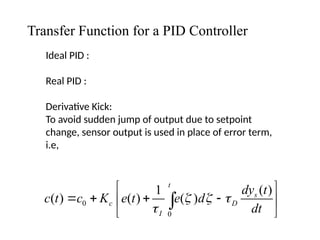
Ideal PID :
Real PID :
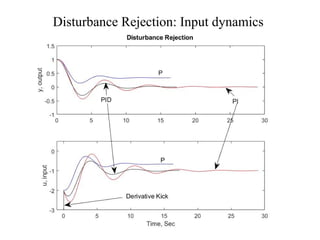
Derivative Kick:
To avoid sudden jump of output due to setpoint
change, sensor output is used in place of error term,
i.e,
0
0
( )
1
( ) ( ) ( )
t
s
c D
I
dy t
c t c K e t e d
dt
3.
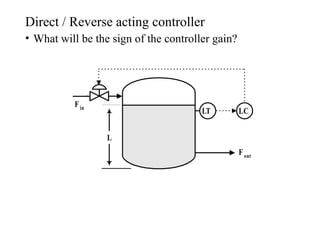
Direct / Reverseacting controller
• What will be the sign of the controller gain?
Fout
Fin
L
LC
LT
4.
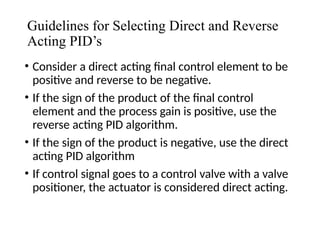
Guidelines for SelectingDirect and Reverse
Acting PID’s
• Consider a direct acting final control element to be
positive and reverse to be negative.
• If the sign of the product of the final control
element and the process gain is positive, use the
reverse acting PID algorithm.
• If the sign of the product is negative, use the direct
acting PID algorithm
• If control signal goes to a control valve with a valve
positioner, the actuator is considered direct acting.
5.
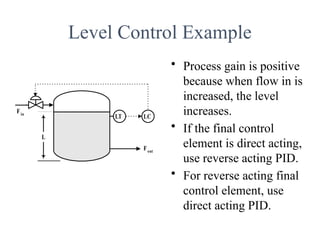
Level Control Example
•Process gain is positive
because when flow in is
increased, the level
increases.
• If the final control
element is direct acting,
use reverse acting PID.
• For reverse acting final
control element, use
direct acting PID.
Fout
Fin
L
LC
LT
6.
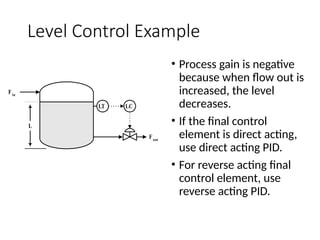
Level Control Example
Fout
Fin
L
LC
LT
•Process gain is negative
because when flow out is
increased, the level
decreases.
• If the final control
element is direct acting,
use direct acting PID.
• For reverse acting final
control element, use
reverse acting PID.
7.
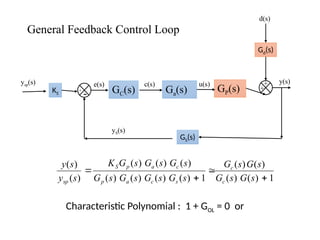
General Feedback ControlLoop
GP(s)
Ga(s)
GC(s)
KS
GS(s)
Gd(s)
d(s)
ysp(s)
+
-
+
+
u(s) y(s)
c(s)
e(s)
yS(s)
1
)
(
)
(
)
(
)
(
1
)
(
)
(
)
(
)
(
)
(
)
(
)
(
)
(
)
(
s
G
s
G
s
G
s
G
s
G
s
G
s
G
s
G
s
G
s
G
s
G
K
s
y
s
y
c
c
s
c
a
p
c
a
p
S
sp
Characteristic Polynomial : 1 + GOL = 0 or
8.
Controller actions onfeedback dynamics
Process G(s) : Controller : Proportional, ;
Matlab:
s=tf(‘s’); g=1/(s+1)^3;
step(g); hold on
for kc=[0.5:0.5:2],
gcl=feedback(kc*g,1);
step(gcl);
end
9.
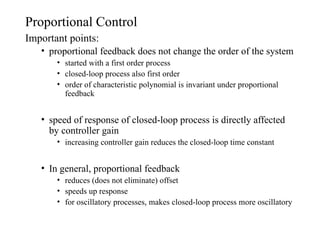
Proportional Control
Important points:
•proportional feedback does not change the order of the system
• started with a first order process
• closed-loop process also first order
• order of characteristic polynomial is invariant under proportional
feedback
• speed of response of closed-loop process is directly affected
by controller gain
• increasing controller gain reduces the closed-loop time constant
• In general, proportional feedback
• reduces (does not eliminate) offset
• speeds up response
• for oscillatory processes, makes closed-loop process more oscillatory
10.
Controller actions onfeedback dynamics
Process G(s) : Controller : PI (I varying) ;
Matlab:
figure; hold on; kc=2;
for Ti=[2:1:5],
gc=tf(kc*[1,1/Ti],[1,0]);
gcl=feedback(gc*g,1);
step(gcl);
end
11.
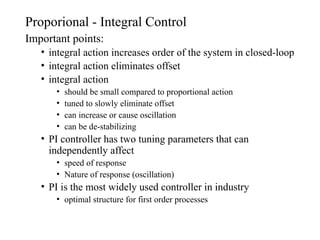
Proporional - IntegralControl
Important points:
• integral action increases order of the system in closed-loop
• integral action eliminates offset
• integral action
• should be small compared to proportional action
• tuned to slowly eliminate offset
• can increase or cause oscillation
• can be de-stabilizing
• PI controller has two tuning parameters that can
independently affect
• speed of response
• Nature of response (oscillation)
• PI is the most widely used controller in industry
• optimal structure for first order processes
12.
Controller actions onfeedback dynamics
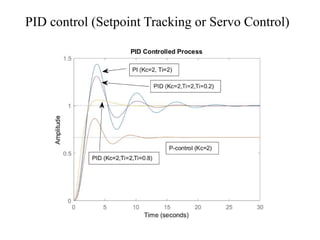
Process G(s) : Controller : PD, ;
Matlab:
figure; hold on; kc=2;
for Td=[0:0.2:0.8],
gc=tf(kc*[Td,1],[1]);
gcl=feedback(gc*g,1);
step(gcl); end
13.
Proportional Derivative
Important Points:
•derivative action does not increase the order of the system
• Used to compensate for trends in output
• measure of speed of error signal change
• provides predictive or anticipatory action
• adding derivative action affects the period of oscillation
of the process
• good for disturbance rejection
• poor for tracking
• derivative action
• should be small compared to integral action
• has a stabilizing influence
• difficult to use for noisy signals
• usually modified in practical implementation
Closed-loop Stability
Every controlproblem involves a consideration of closed-
loop stability
General concepts:
BIBO Stability:
“ An (unconstrained) linear system is said to be stable if the
output response is bounded for all bounded inputs.
Otherwise it is unstable.”
Comments:
• Stability is much easier to prove than instability
• This is just one type of stability
17.
Closed-loop Stability
General Stabilitycriterion:
“ A closed-loop feedback control system is stable if and only
if all roots of the characteristic polynomial (1+ GOL=0) are
negative or have negative real parts. Otherwise, the system
is unstable.”
• Unstable region is the right half plane of the complex plane.
• Valid for any linear systems.
• Underlying system is almost always nonlinear so stability
holds only locally. Moving away from the point of
linearization may cause instability
18.
Stability Analysis Methods
Problemreduces to finding roots of a polynomial
Traditional:
1. Routh array:
• Test for positivity of roots of a polynomial
2. Direct substitution
• Complex axis separates stable and unstable regions
• Find controller gain that yields purely complex roots
3. Root locus diagram
• Vary location of poles as controller gain is varied
• Of limited use
• Bode stability criteria
• Niquist Stability criteria
19.
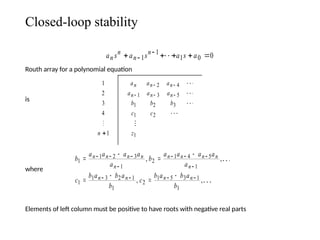
Closed-loop stability
Routh arrayfor a polynomial equation
is
where
Elements of left column must be positive to have roots with negative real parts
a s a s a s a
n
n
n
n
1
1
1 0 0
a a a
a a a
b b b
c c
z
n n n
n n n
2 4
1 3 5
1 2 3
1 2
1
1
2
3
4
1
n
b
a a a a
a
b
a a a a
a
c
b a b a
b
c
b a b a
b
n n n n
n
n n n n
n
n n n n
1
1 2 3
1
2
1 4 5
1
1
1 3 2 1
1
2
1 5 3 1
1
, ,
, ,
20.
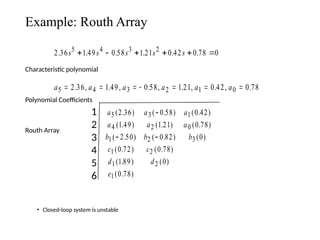
Example: Routh Array
Characteristicpolynomial
Polynomial Coefficients
Routh Array
• Closed-loop system is unstable
2 36 1 49 0 58 1 21 0 42 0 78 0
5 4 3 2
. . . . . .
s s s s s
a a a
a a a
b b b
c c
d d
e
5 3 1
4 2 0
1 2 3
1 2
1 2
1
2 36 0 58 0 42
1 49 1 21 0 78
2 50 0 82 0
0 72 0 78
1 89 0
0 78
( . ) ( . ) ( . )
( . ) ( . ) ( . )
( . ) ( . ) ( )
( . ) ( . )
( . ) ( )
( . )
a a a a a a
5 4 3 2 1 0
2 36 1 49 0 58 1 21 0 42 0 78
. , . , . , . , . , .
1
2
3
4
5
6
21.
Direct Substitution
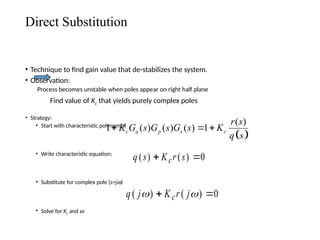
• Techniqueto find gain value that de-stabilizes the system.
• Observation:
Process becomes unstable when poles appear on right half plane
Find value of Kc that yields purely complex poles
• Strategy:
• Start with characteristic polynomial
• Write characteristic equation:
• Substitute for complex pole (s=jw)
• Solve for Kc and w
q j K r j
c
( ) ( )
0
( )
1 ( ) ( ) ( ) 1
c a p s c
r s
K G s G s G s K
q s
q s K r s
c
( ) ( )
0
22.
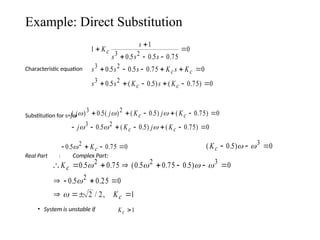
Example: Direct Substitution
Characteristicequation
Substitution for s=jw
Real Part : Complex Part:
• System is unstable if
1
1
0 5 0 5 0 75
0
0 5 0 5 0 75 0
0 5 0 5 0 75 0
3 2
3 2
3 2
K
s
s s s
s s s K s K
s s K s K
c
c c
c c
. . .
. . .
. ( . ) ( . )
( ) . ( ) ( . ) ( . )
. ( . ) ( . )
j j K j K
j K j K
c c
c c
3 2
3 2
0 5 0 5 0 75 0
0 5 0 5 0 75 0
0 5 0 75 0
2
. .
Kc ( . )
Kc
0 5 0
3
K
K
c
c
0 5 0 75 0 5 0 75 0 5 0
0 5 0 25 0
2 2 1
2 2 3
2
. . ( . . . )
. .
/ ,
Kc 1
23.
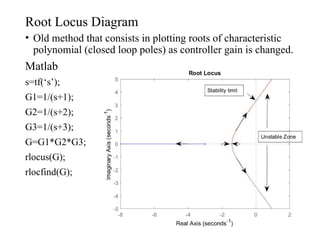
Root Locus Diagram
•Old method that consists in plotting roots of characteristic
polynomial (closed loop poles) as controller gain is changed.
Matlab
s=tf(‘s’);
G1=1/(s+1);
G2=1/(s+2);
G3=1/(s+3);
G=G1*G2*G3;
rlocus(G);
rlocfind(G);
24.
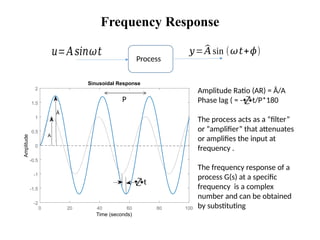
Frequency Response
Process
𝑢=𝐴𝑠𝑖𝑛𝜔𝑡 𝑦=^
𝐴sin(𝜔𝑡+𝜙)
0 20 40 60 80 100
-2
-1.5
-1
-0.5
0
0.5
1
1.5
2
Sinusoidal Response
Time (seconds)
Amplitude
A
Â
t
Amplitude Ratio (AR) = Â/A
Phase lag ( = -t/P*180
The process acts as a “filter”
or “amplifier” that attenuates
or amplifies the input at
frequency .
The frequency response of a
process G(s) at a specific
frequency is a complex
number and can be obtained
by substituting
P
25.
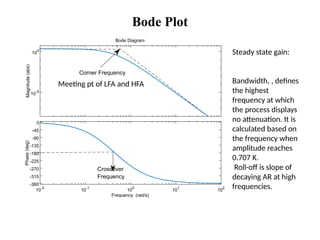
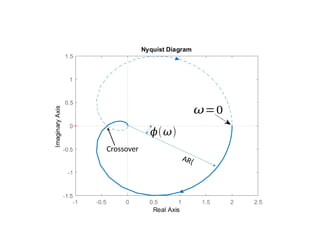
Frequency Response
• Twoways of representing the frequency response
• Bode Plot
• Log-Log plot of AR vs and semi-log plot vs
• Nyquist Plot
• Plot of Re() vs Im() for various values of .
• Frequency does not appear explicitly in this plot.
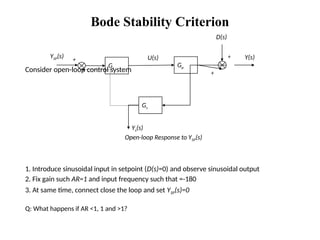
Bode Stability Criterion
Consideropen-loop control system
1. Introduce sinusoidal input in setpoint (D(s)=0) and observe sinusoidal output
2. Fix gain such AR=1 and input frequency such that =-180
3. At same time, connect close the loop and set YSP(s)=0
Q: What happens if AR <1, 1 and >1?
Open-loop Response to YSP(s)
Gp
Gc
Gs
D(s)
Y(s)
Ys(s)
YSP(s) U(s)
+
-
+
+
29.
Bode Stability Criterion
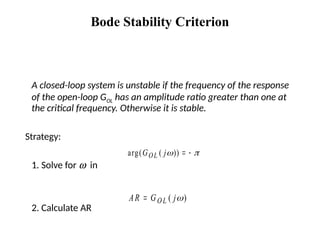
Aclosed-loop system is unstable if the frequency of the response
of the open-loop GOL has an amplitude ratio greater than one at
the critical frequency. Otherwise it is stable.
Strategy:
1. Solve for w in
2. Calculate AR
arg( ( ))
G j
OL
AR G j
OL
( )
30.
Bode Stability Criterion
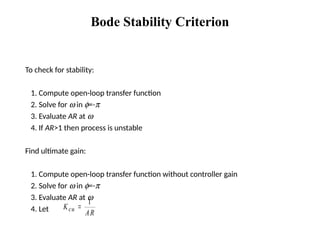
Tocheck for stability:
1. Compute open-loop transfer function
2. Solve for w in f=-p
3. Evaluate AR at w
4. If AR>1 then process is unstable
Find ultimate gain:
1. Compute open-loop transfer function without controller gain
2. Solve for w in f=-p
3. Evaluate AR at w
4. Let K
AR
cu
1
31.
Bode Criterion
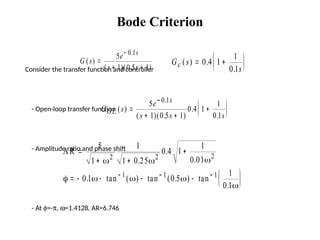
Consider thetransfer function and controller
- Open-loop transfer function
- Amplitude ratio and phase shift
- At f=-p, w=1.4128, AR=6.746
G s
e
s s
s
( )
( )( . )
.
5
1 0 5 1
0 1
G s
s
c ( ) .
.
0 4 1
1
0 1
G s
e
s s s
OL
s
( )
( )( . )
.
.
.
5
1 0 5 1
0 4 1
1
0 1
0 1
AR
5
1
1
1 0 25
0 4 1
1
0 01
0 1 0 5
1
0 1
2 2 2
1 1 1
.
.
.
. tan ( ) tan ( . ) tan
.
32.
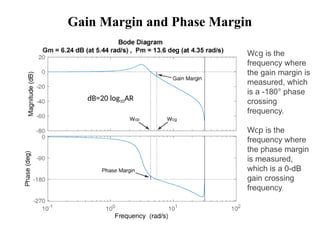
Bode Stability
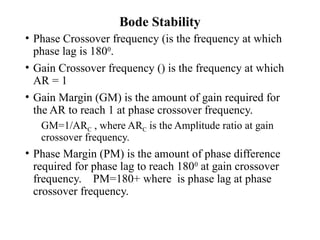
• PhaseCrossover frequency (is the frequency at which
phase lag is 1800
.
• Gain Crossover frequency () is the frequency at which
AR = 1
• Gain Margin (GM) is the amount of gain required for
the AR to reach 1 at phase crossover frequency.
GM=1/ARC , where ARC is the Amplitude ratio at gain
crossover frequency.
• Phase Margin (PM) is the amount of phase difference
required for phase lag to reach 1800
at gain crossover
frequency. PM=180+ where is phase lag at phase
crossover frequency.
33.
Gain Margin andPhase Margin
dB=20 log10AR
Wcg is the
frequency where
the gain margin is
measured, which
is a -180° phase
crossing
frequency.
Wcp is the
frequency where
the phase margin
is measured,
which is a 0-dB
gain crossing
frequency.
34.
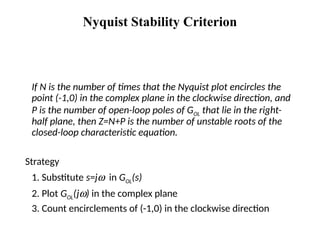
Nyquist Stability Criterion
IfN is the number of times that the Nyquist plot encircles the
point (-1,0) in the complex plane in the clockwise direction, and
P is the number of open-loop poles of GOL that lie in the right-
half plane, then Z=N+P is the number of unstable roots of the
closed-loop characteristic equation.
Strategy
1. Substitute s=jw in GOL(s)
2. Plot GOL(jw) in the complex plane
3. Count encirclements of (-1,0) in the clockwise direction
35.
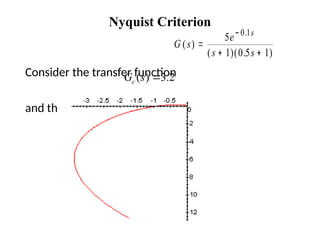
Nyquist Criterion
Consider thetransfer function
and the P controller
G s
e
s s
s
( )
( )( . )
.
5
1 0 5 1
0 1
( ) 3.2
c
G s


![Controller actions on feedback dynamics
Process G(s) : Controller : Proportional, ;
Matlab:
s=tf(‘s’); g=1/(s+1)^3;
step(g); hold on
for kc=[0.5:0.5:2],
gcl=feedback(kc*g,1);
step(gcl);
end](https://image.slidesharecdn.com/pc-lec4-250515211111-baf4d6f6/85/pc-lec4-1-pptx-pid-controller-presentation-8-320.jpg)
![Controller actions on feedback dynamics
Process G(s) : Controller : PI (I varying) ;
Matlab:
figure; hold on; kc=2;
for Ti=[2:1:5],
gc=tf(kc*[1,1/Ti],[1,0]);
gcl=feedback(gc*g,1);
step(gcl);
end](https://image.slidesharecdn.com/pc-lec4-250515211111-baf4d6f6/85/pc-lec4-1-pptx-pid-controller-presentation-10-320.jpg)
![Controller actions on feedback dynamics
Process G(s) : Controller : PD, ;
Matlab:
figure; hold on; kc=2;
for Td=[0:0.2:0.8],
gc=tf(kc*[Td,1],[1]);
gcl=feedback(gc*g,1);
step(gcl); end](https://image.slidesharecdn.com/pc-lec4-250515211111-baf4d6f6/85/pc-lec4-1-pptx-pid-controller-presentation-12-320.jpg)