STEADY-STATE ERRORS
Steady-State Errors
Control systems analysis and design focus on three specifications:
(1) transient response,
(2) stability, and
(3) steady-state errors.
Definition and Test Inputs
➢ Steady-state error is the difference between the input and the output for a
prescribed test input as t approaches infinity.
✓ we are interested in the final value of the error, e(∞).
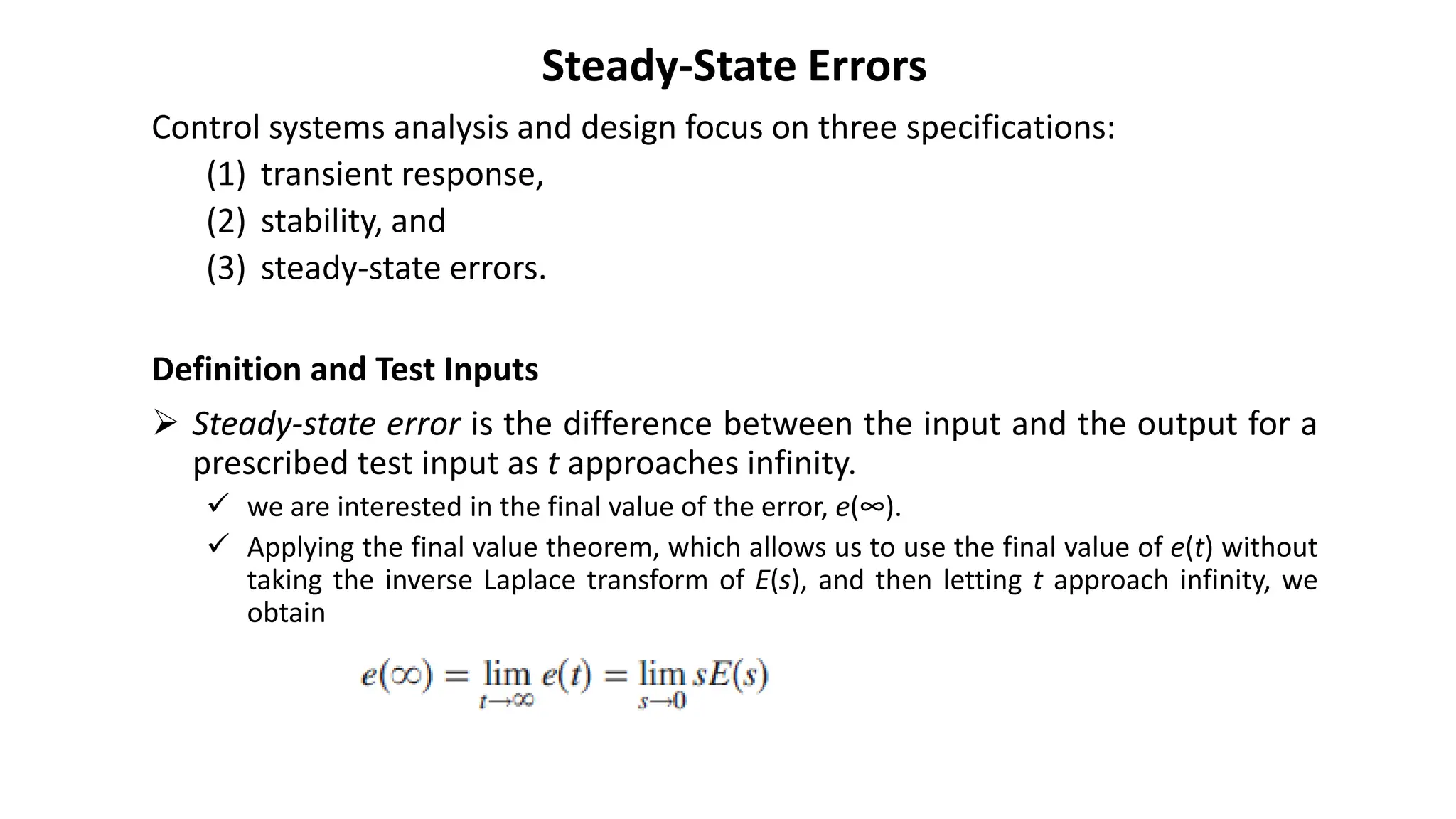
✓ Applying the final value theorem, which allows us to use the final value of e(t) without
taking the inverse Laplace transform of E(s), and then letting t approach infinity, we
obtain
Steady-State Errors
➢ Test inputs used for steady-state error analysis and design are summarized
in Table below
Steady-State Errors
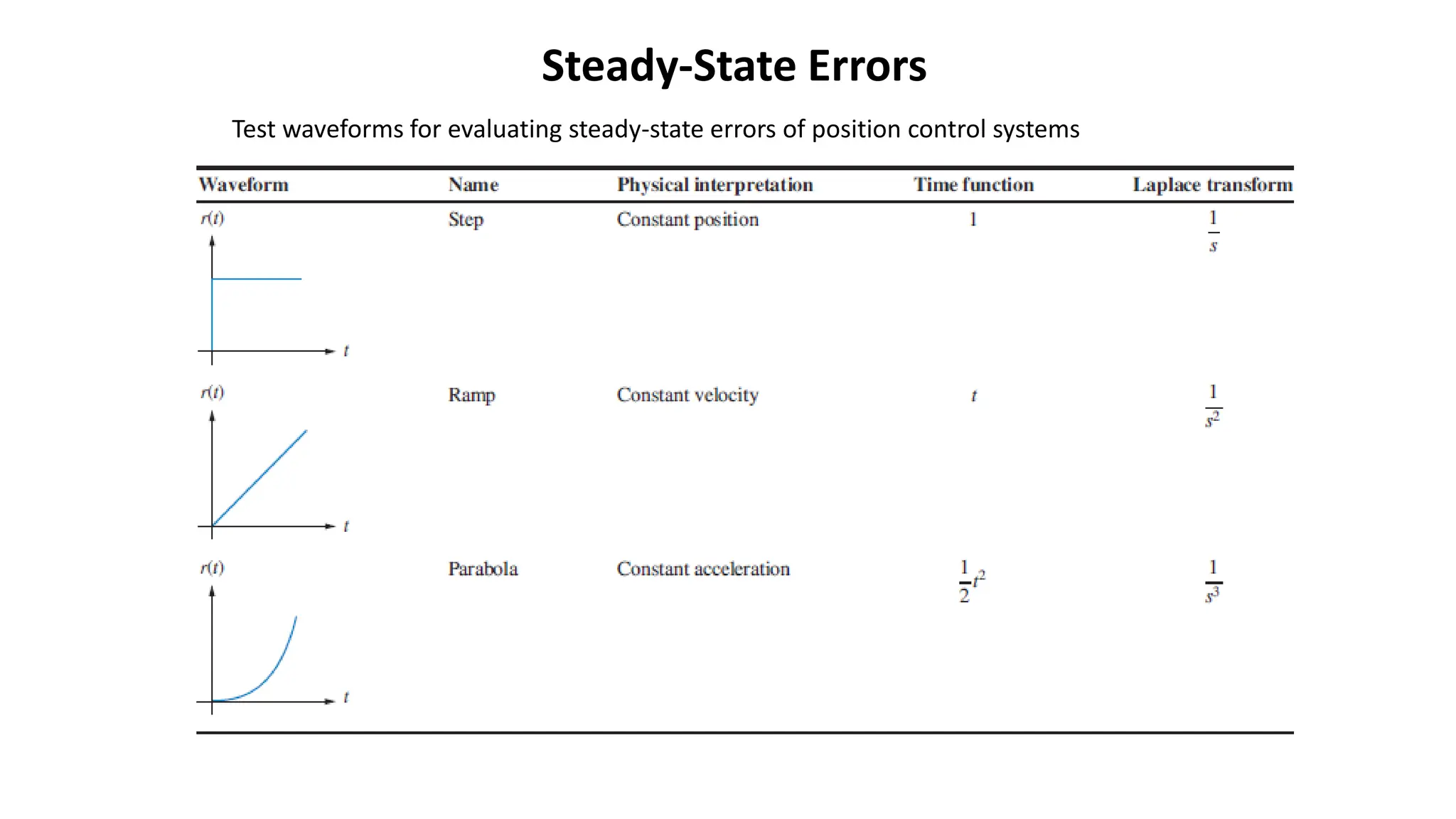
Test waveforms for evaluating steady-state errors of position control systems
Steady-State Errors
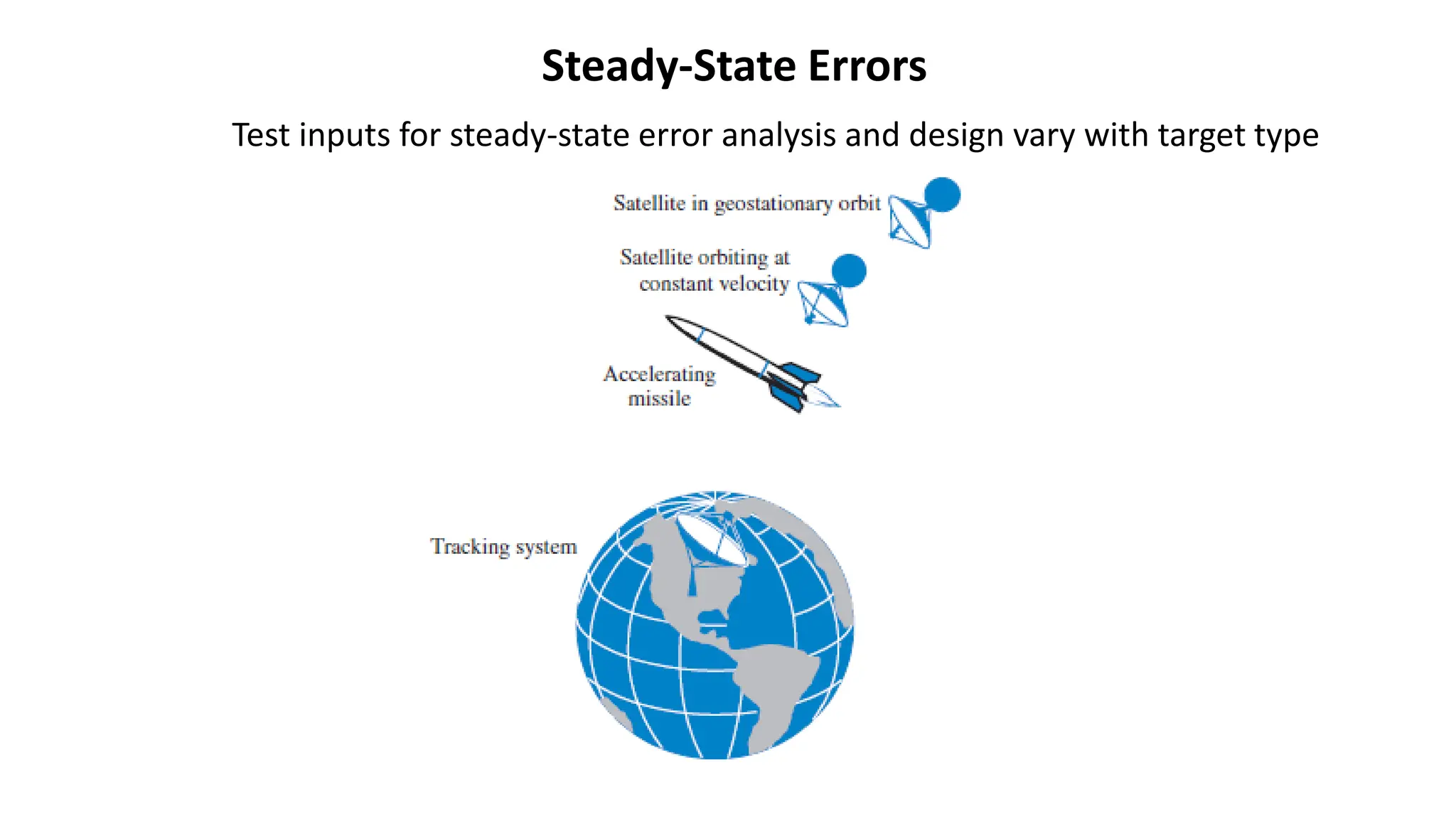
Test inputs for steady-state error analysis and design vary with target type
Steady-State Errors
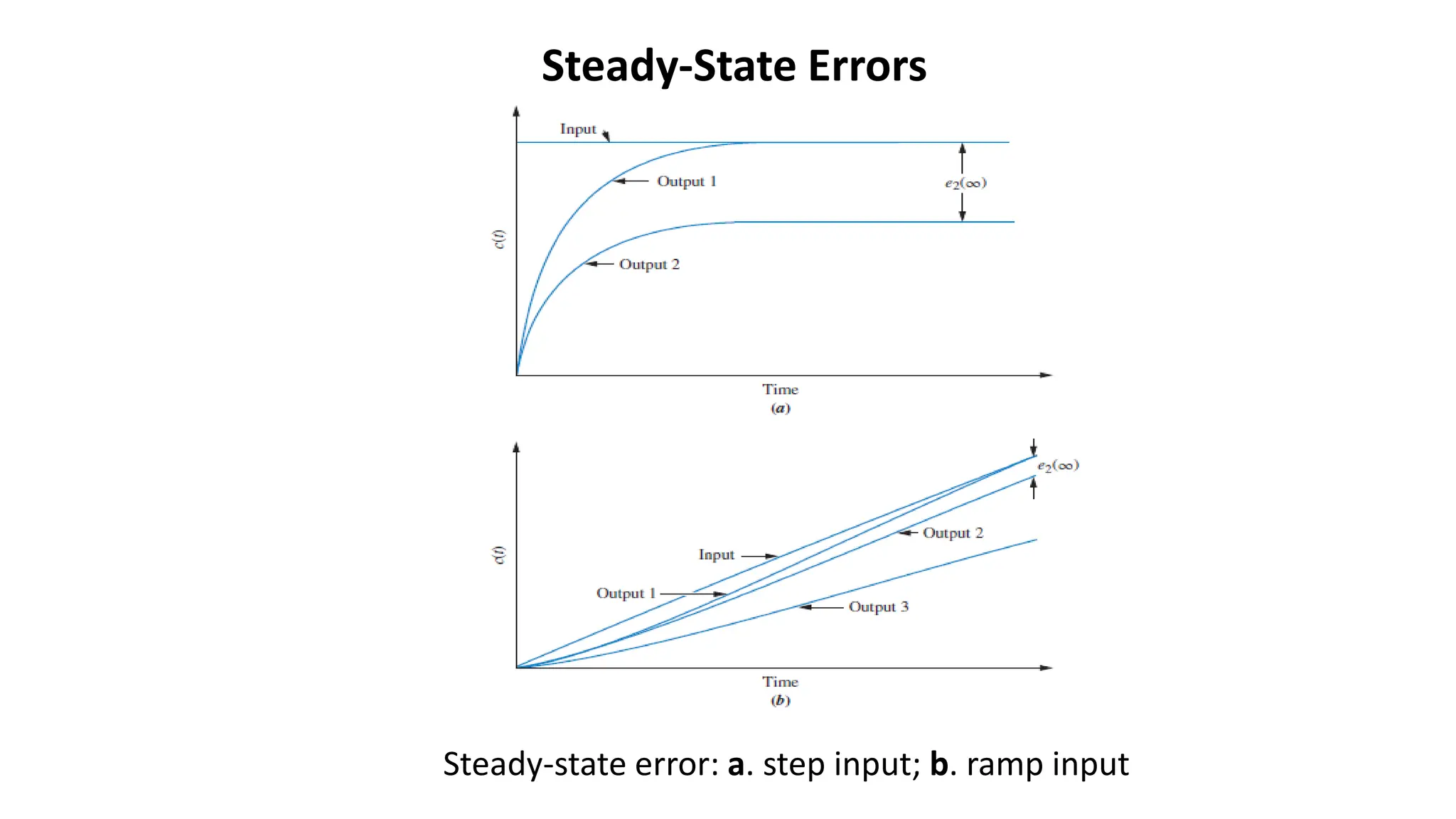
Steady-state error: a. step input; b. ramp input
Steady-State Errors
Steady-State Error for Unity Feedback Systems
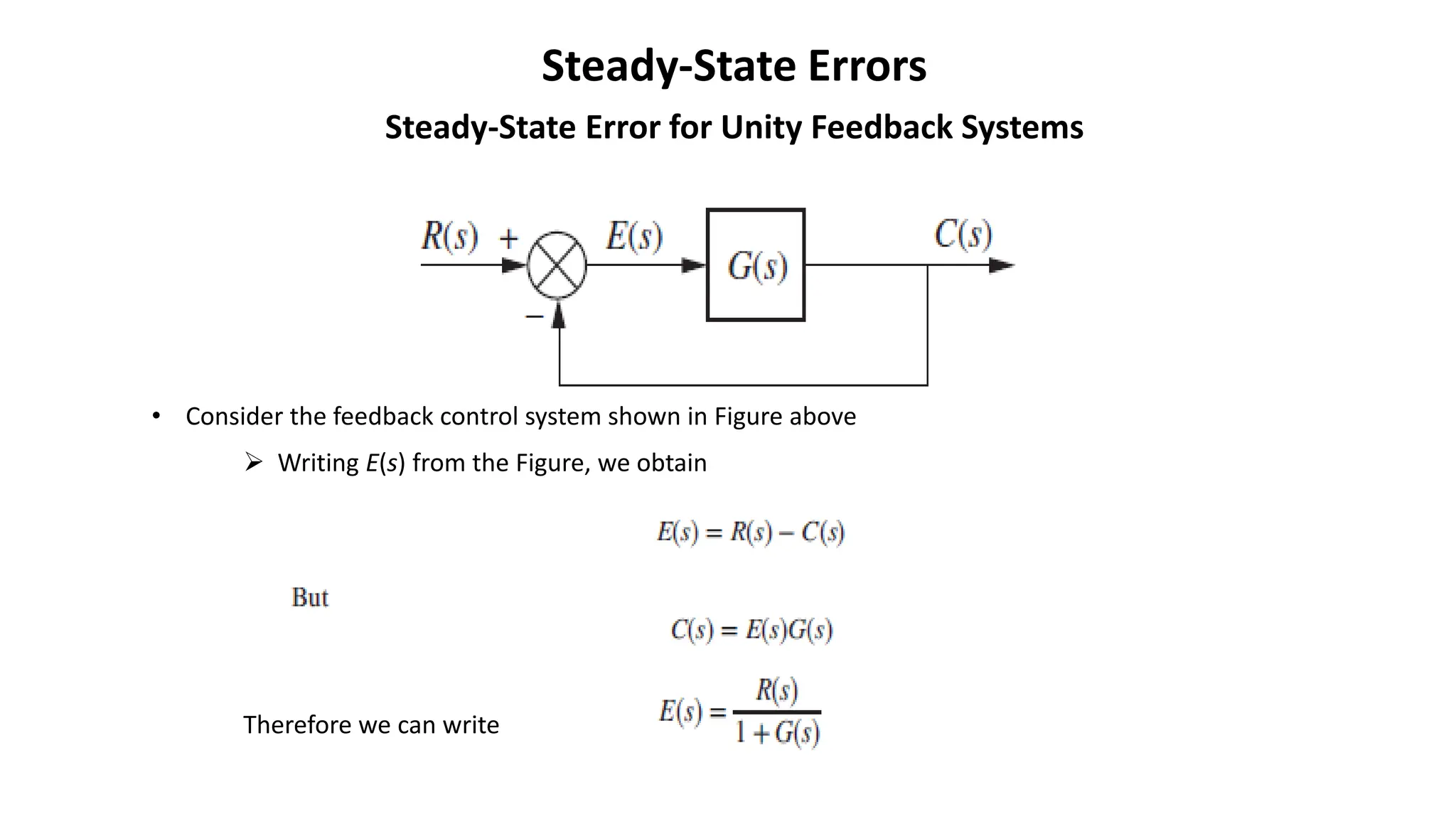
• Consider the feedback control system shown in Figure above
➢ Writing E(s) from the Figure, we obtain
Therefore we can write
Steady-State Errors
Steady-State Error for Unity Feedback Systems
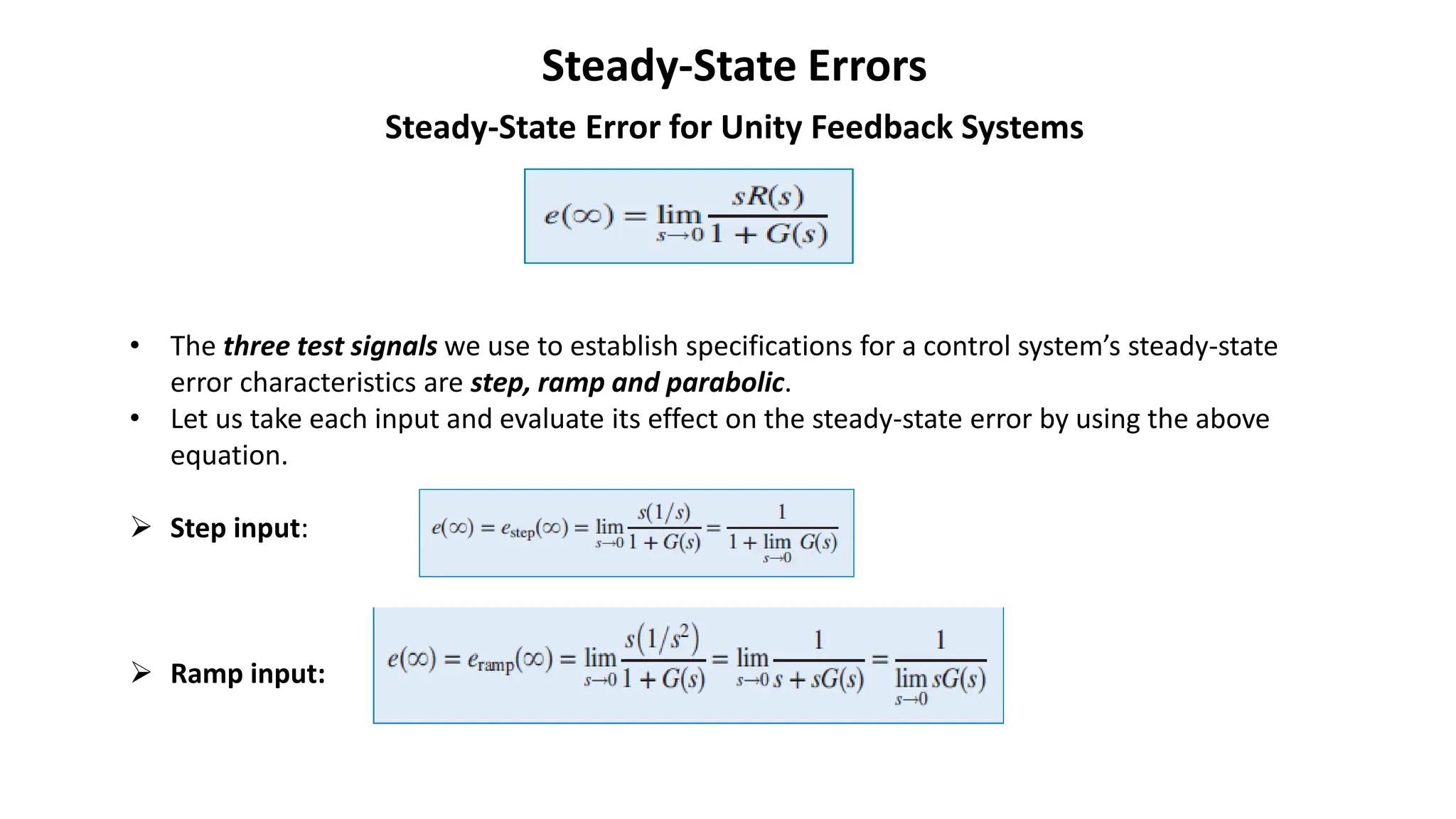
• The three test signals we use to establish specifications for a control system’s steady-state
error characteristics are step, ramp and parabolic.
• Let us take each input and evaluate its effect on the steady-state error by using the above
equation.
➢ Step input:
➢ Ramp input:
Steady-State Errors
Steady-State Error for Unity Feedback Systems
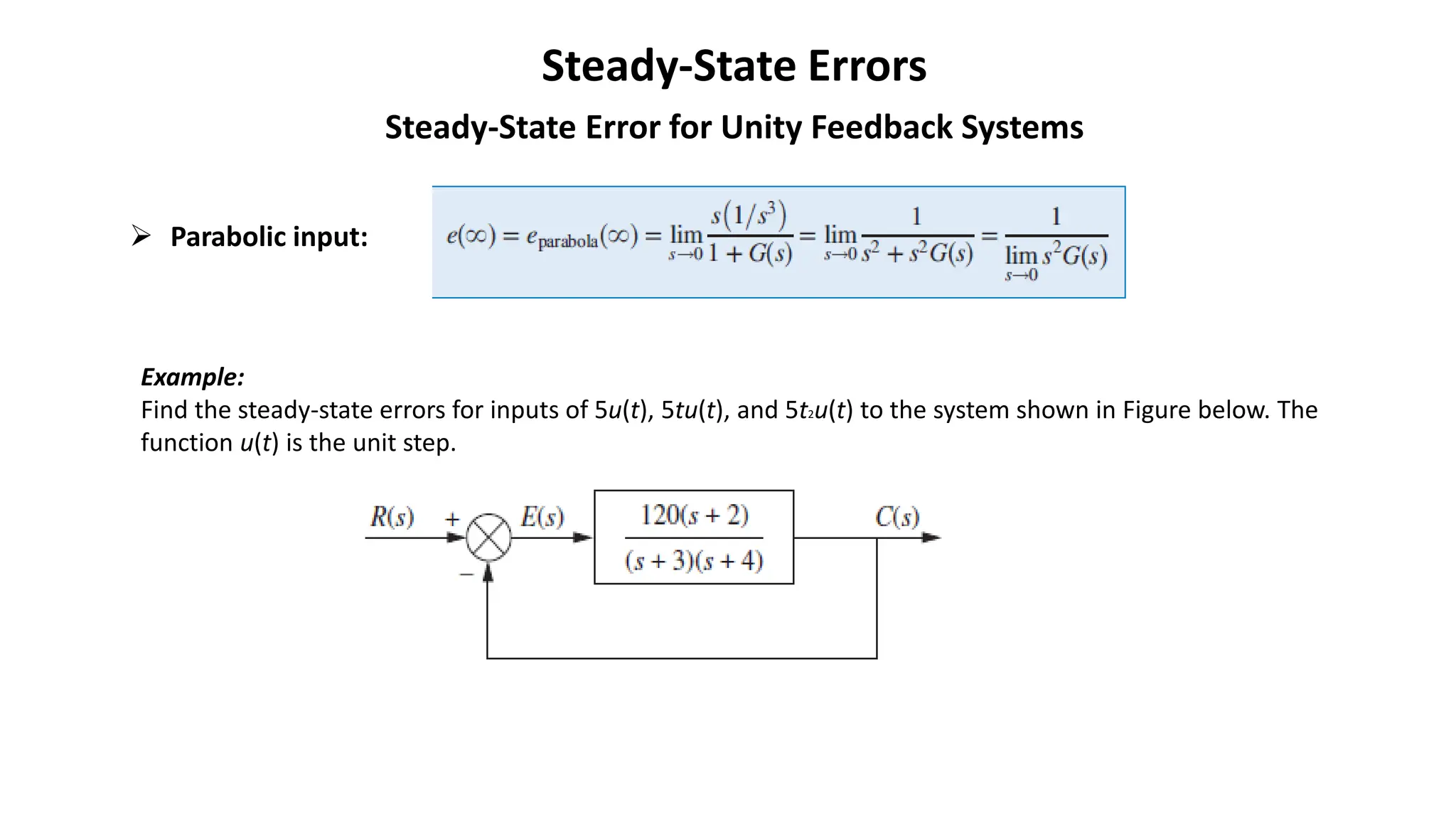
➢ Parabolic input:
Example:
Find the steady-state errors for inputs of 5u(t), 5tu(t), and 5t2u(t) to the system shown in Figure below. The
function u(t) is the unit step.
Steady-State Errors
Steady-State Error for Unity Feedback Systems
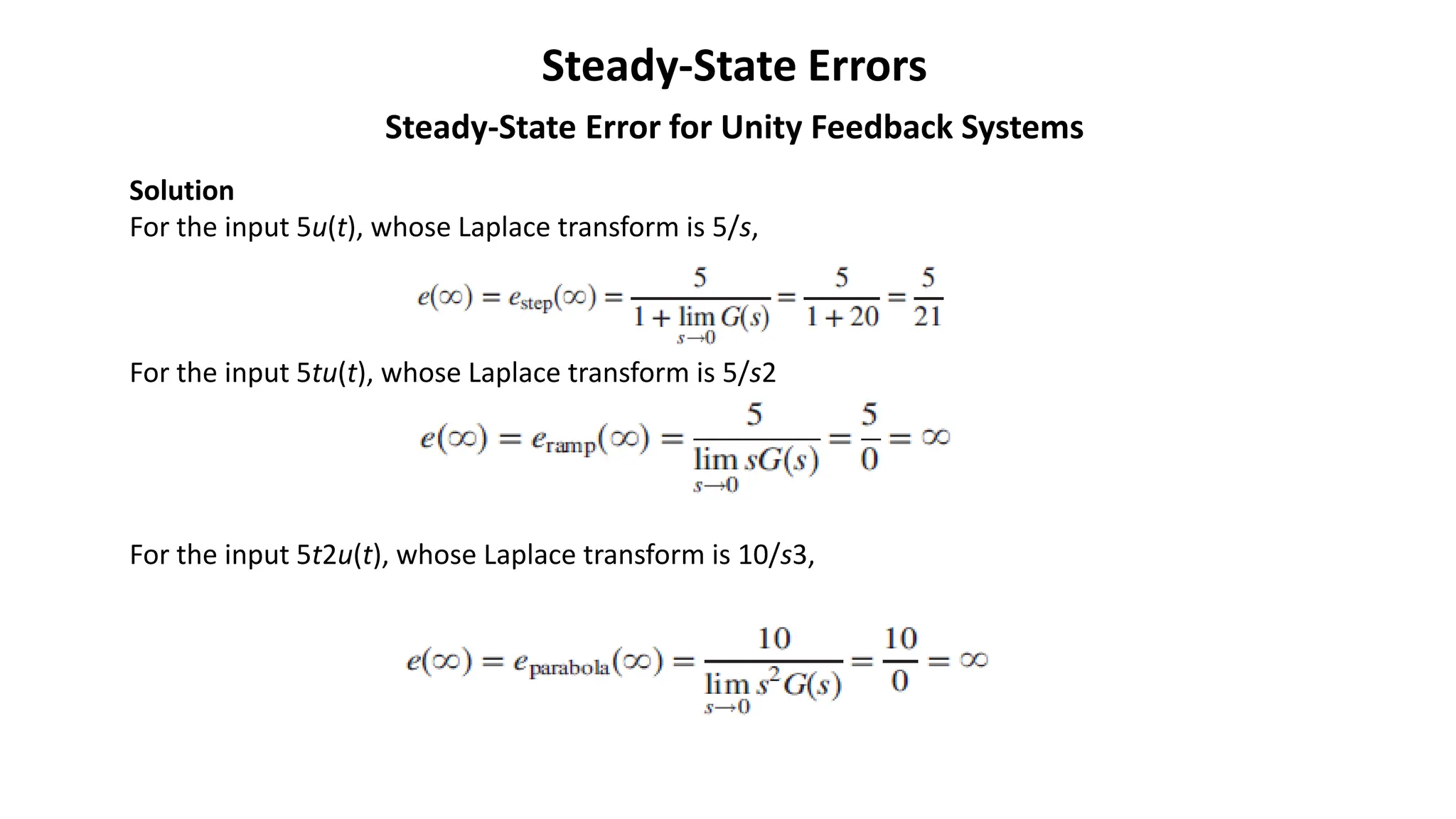
Solution
For the input 5u(t), whose Laplace transform is 5/s,
For the input 5tu(t), whose Laplace transform is 5/s2
For the input 5t2u(t), whose Laplace transform is 10/s3,
Steady-State Errors
Steady-State Error for Unity Feedback Systems
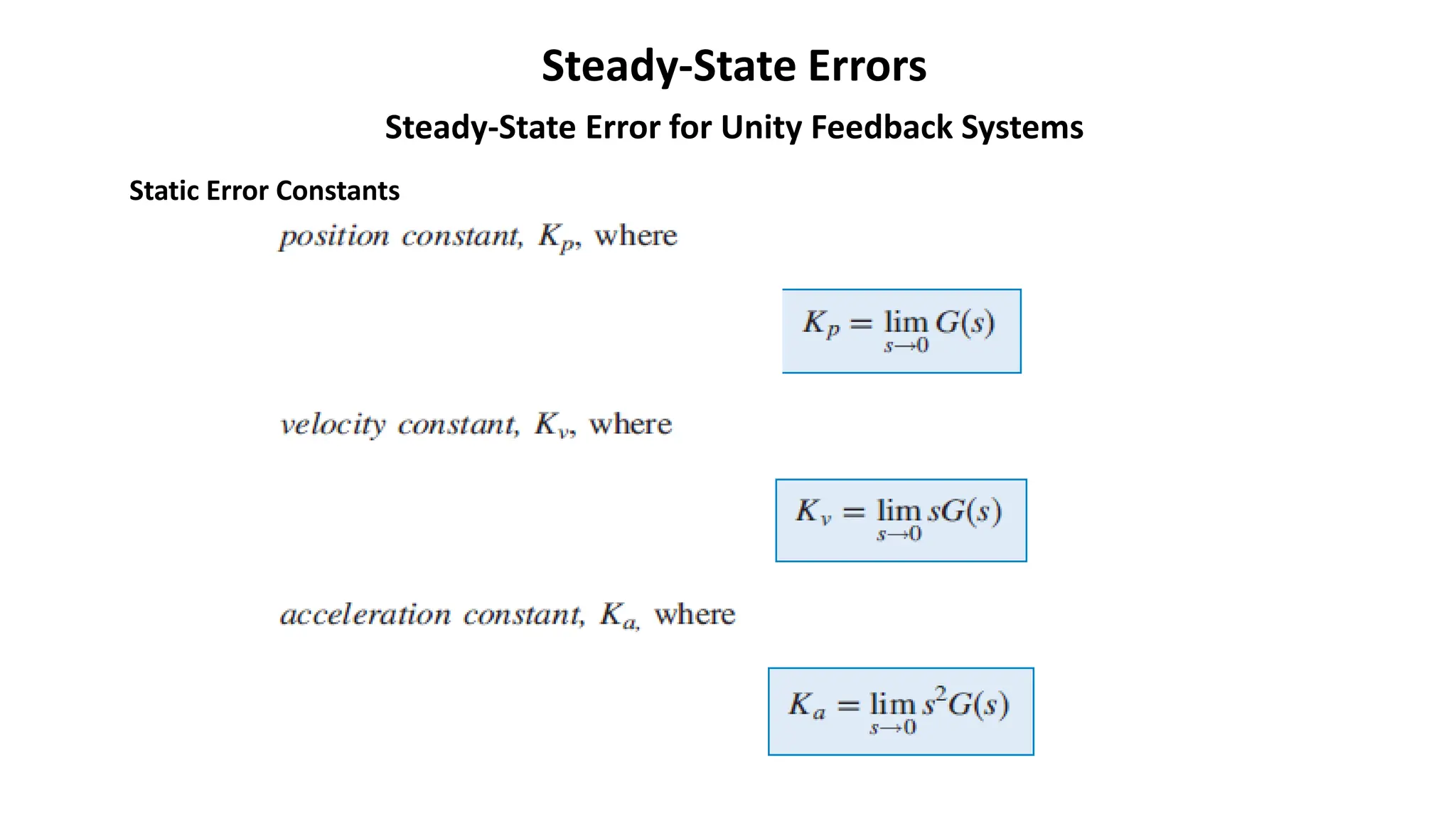
Static Error Constants
Steady-State Errors
Steady-State Error for Unity Feedback Systems
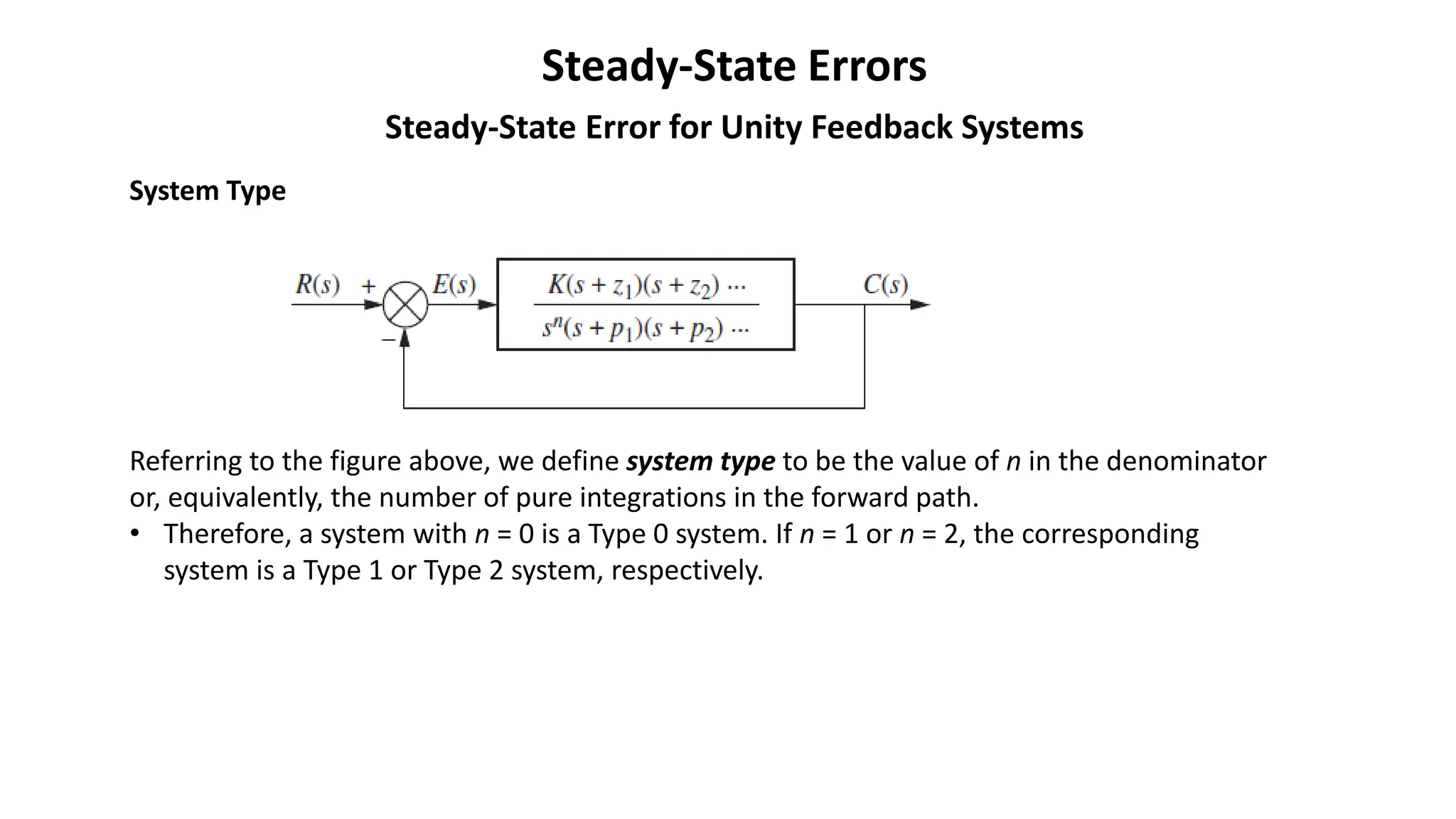
System Type
Referring to the figure above, we define system type to be the value of n in the denominator
or, equivalently, the number of pure integrations in the forward path.
• Therefore, a system with n = 0 is a Type 0 system. If n = 1 or n = 2, the corresponding
system is a Type 1 or Type 2 system, respectively.
Steady-State Errors
Steady-State Error for Unity Feedback Systems
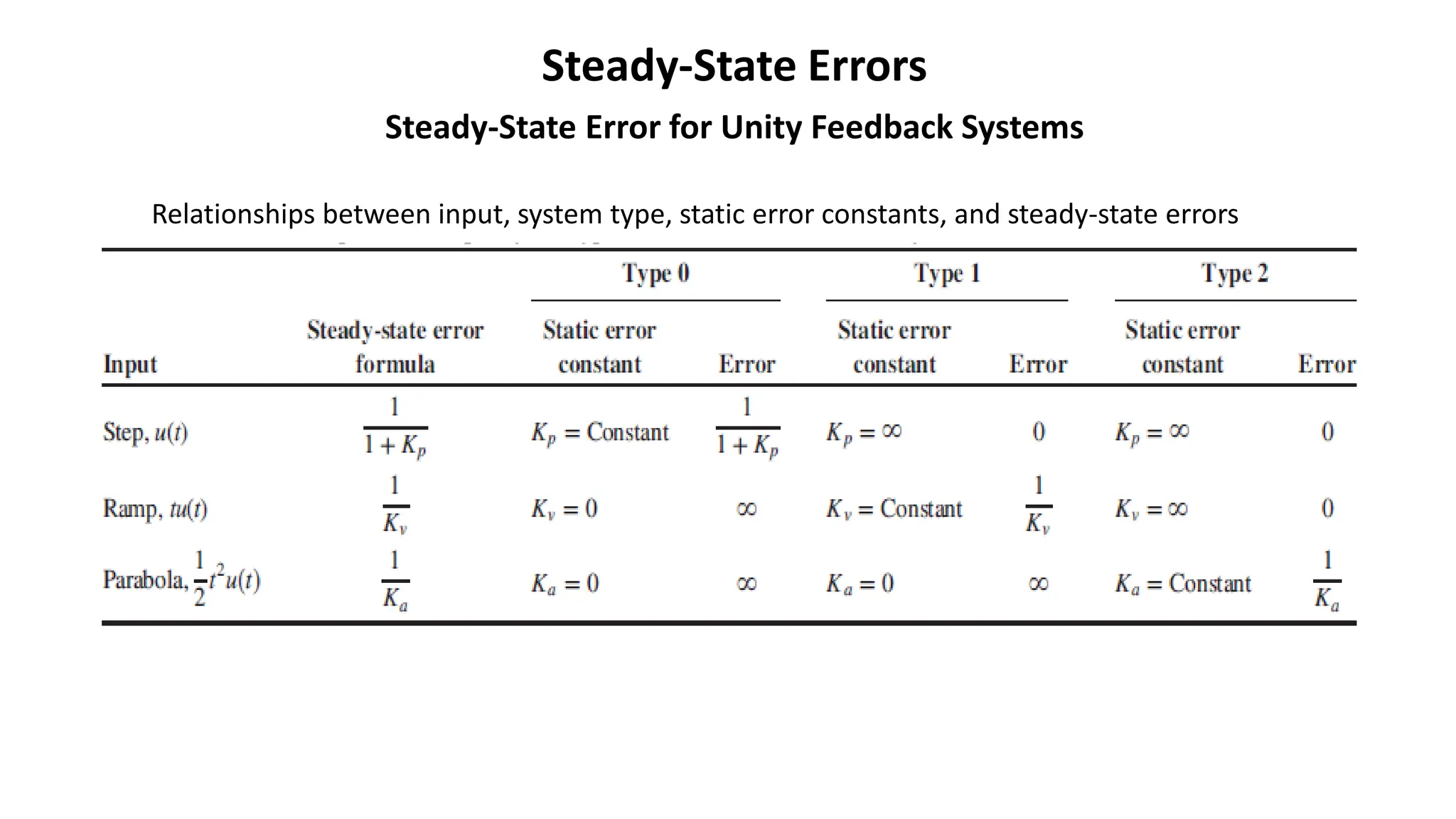
Relationships between input, system type, static error constants, and steady-state errors
Steady-State Errors
Steady-State Error for Unity Feedback Systems
Steady-State Error Specifications
➢ Static error constants can be used to specify the steady-state error characteristics of control
systems.
➢ Just as damping ratio, ζ, settling time, Ts, peak time, Tp, and percent overshoot, %OS, are used
as specifications for a control system’s transient response, so the position constant, Kp, velocity
constant, Kv, and acceleration constant, Ka, can be used as specifications for a control system’s
steady-state errors.
Steady-State Errors
Steady-State Error for Unity Feedback Systems
Steady-State Error Specifications
For example, if a control system has the specification Kv = 1000, we can draw several
conclusions:
1. The system is stable.
2. The system is of Type 1, since only Type 1 systems have Kv’s that are finite constants. Recall
that Kv = 0 for Type 0 systems, whereas Kv = ∞ for Type 2 systems.
3. A ramp input is the test signal. Since Kv is specified as a finite constant, and the steady-state
error for a ramp input is inversely proportional to Kv, we know the test input is a ramp.
4. The steady-state error between the input ramp and the output ramp is 1/Kv per unit of input
slope.

Steady state error control systems elect

  • 1.
  • 2.
    Steady-State Errors Control systemsanalysis and design focus on three specifications: (1) transient response, (2) stability, and (3) steady-state errors. Definition and Test Inputs ➢ Steady-state error is the difference between the input and the output for a prescribed test input as t approaches infinity. ✓ we are interested in the final value of the error, e(∞). ✓ Applying the final value theorem, which allows us to use the final value of e(t) without taking the inverse Laplace transform of E(s), and then letting t approach infinity, we obtain
  • 3.
    Steady-State Errors ➢ Testinputs used for steady-state error analysis and design are summarized in Table below
  • 4.
    Steady-State Errors Test waveformsfor evaluating steady-state errors of position control systems
  • 5.
    Steady-State Errors Test inputsfor steady-state error analysis and design vary with target type
  • 6.
    Steady-State Errors Steady-state error:a. step input; b. ramp input
  • 7.
    Steady-State Errors Steady-State Errorfor Unity Feedback Systems • Consider the feedback control system shown in Figure above ➢ Writing E(s) from the Figure, we obtain Therefore we can write
  • 8.
    Steady-State Errors Steady-State Errorfor Unity Feedback Systems • The three test signals we use to establish specifications for a control system’s steady-state error characteristics are step, ramp and parabolic. • Let us take each input and evaluate its effect on the steady-state error by using the above equation. ➢ Step input: ➢ Ramp input:
  • 9.
    Steady-State Errors Steady-State Errorfor Unity Feedback Systems ➢ Parabolic input: Example: Find the steady-state errors for inputs of 5u(t), 5tu(t), and 5t2u(t) to the system shown in Figure below. The function u(t) is the unit step.
  • 10.
    Steady-State Errors Steady-State Errorfor Unity Feedback Systems Solution For the input 5u(t), whose Laplace transform is 5/s, For the input 5tu(t), whose Laplace transform is 5/s2 For the input 5t2u(t), whose Laplace transform is 10/s3,
  • 11.
    Steady-State Errors Steady-State Errorfor Unity Feedback Systems Static Error Constants
  • 12.
    Steady-State Errors Steady-State Errorfor Unity Feedback Systems System Type Referring to the figure above, we define system type to be the value of n in the denominator or, equivalently, the number of pure integrations in the forward path. • Therefore, a system with n = 0 is a Type 0 system. If n = 1 or n = 2, the corresponding system is a Type 1 or Type 2 system, respectively.
  • 13.
    Steady-State Errors Steady-State Errorfor Unity Feedback Systems Relationships between input, system type, static error constants, and steady-state errors
  • 14.
    Steady-State Errors Steady-State Errorfor Unity Feedback Systems Steady-State Error Specifications ➢ Static error constants can be used to specify the steady-state error characteristics of control systems. ➢ Just as damping ratio, ζ, settling time, Ts, peak time, Tp, and percent overshoot, %OS, are used as specifications for a control system’s transient response, so the position constant, Kp, velocity constant, Kv, and acceleration constant, Ka, can be used as specifications for a control system’s steady-state errors.
  • 15.
    Steady-State Errors Steady-State Errorfor Unity Feedback Systems Steady-State Error Specifications For example, if a control system has the specification Kv = 1000, we can draw several conclusions: 1. The system is stable. 2. The system is of Type 1, since only Type 1 systems have Kv’s that are finite constants. Recall that Kv = 0 for Type 0 systems, whereas Kv = ∞ for Type 2 systems. 3. A ramp input is the test signal. Since Kv is specified as a finite constant, and the steady-state error for a ramp input is inversely proportional to Kv, we know the test input is a ramp. 4. The steady-state error between the input ramp and the output ramp is 1/Kv per unit of input slope.