Maximum Flow
Chapter 26
Flow Graph
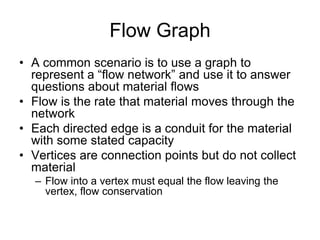
• A common scenario is to use a graph to
represent a “flow network” and use it to answer
questions about material flows
• Flow is the rate that material moves through the
network
• Each directed edge is a conduit for the material
with some stated capacity
• Vertices are connection points but do not collect
material
– Flow into a vertex must equal the flow leaving the
vertex, flow conservation
Sample Networks
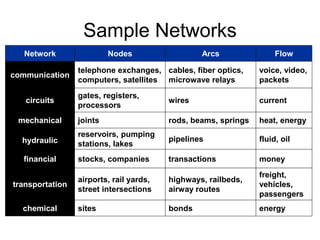
communication
Network
telephone exchanges,
computers, satellites
Nodes Arcs
cables, fiber optics,
microwave relays
Flow
voice, video,
packets
circuits
gates, registers,
processors
wires current
mechanical joints rods, beams, springs heat, energy
hydraulic
reservoirs, pumping
stations, lakes
pipelines fluid, oil
financial stocks, companies transactions money
transportation
airports, rail yards,
street intersections
highways, railbeds,
airway routes
freight,
vehicles,
passengers
chemical sites bonds energy
Flow Concepts
• Source vertex s
– where material is produced
• Sink vertex t
– where material is consumed
• For all other vertices – what goes in must go out
– Flow conservation
• Goal: determine maximum rate of material
flow from source to sink
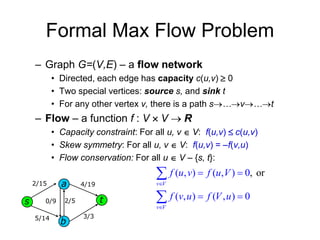
Formal Max Flow Problem
– Graph G=(V,E) – a flow network
• Directed, each edge has capacity c(u,v)  0
• Two special vertices: source s, and sink t
• For any other vertex v, there is a path s…v…t
– Flow – a function f : V  V R
• Capacity constraint: For all u, v  V: f(u,v)  c(u,v)
• Skew symmetry: For all u, v  V: f(u,v) = –f(v,u)
• Flow conservation: For all u  V – {s, t}:
, or( , ) ( , ) 0
( , ) ( , ) 0
v V
v V
f u v f u V
f v u f V u


 
 

2/5
2/15
5/14
4/19
3/3
s t0/9
a
b
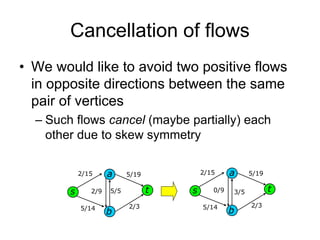
Cancellation of flows
• We would like to avoid two positive flows
in opposite directions between the same
pair of vertices
– Such flows cancel (maybe partially) each
other due to skew symmetry
5/5
2/15
5/14
5/19
2/3
s t2/9
a
b
3/5
2/15
5/14
5/19
2/3
s t0/9
a
b
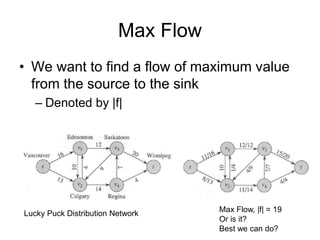
Max Flow
• We want to find a flow of maximum value
from the source to the sink
– Denoted by |f|
Lucky Puck Distribution Network Max Flow, |f| = 19
Or is it?
Best we can do?
Ford-Fulkerson method
• Contains several algorithms:
– Residue networks
– Augmenting paths
• Find a path p from s to t (augmenting path), such that there is
some value x > 0, and for each edge (u,v) in p we can add x
units of flow
– f(u,v) + x  c(u,v)
8/13
8/11
5/52/4
10/15
10
6/14
13/19
3/3
s t9
a b
c d
Augmenting Path?
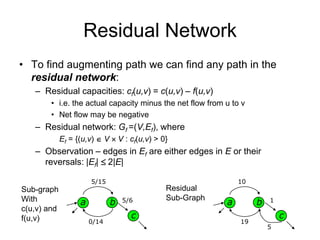
Residual Network
• To find augmenting path we can find any path in the
residual network:
– Residual capacities: cf(u,v) = c(u,v) – f(u,v)
• i.e. the actual capacity minus the net flow from u to v
• Net flow may be negative
– Residual network: Gf =(V,Ef), where
Ef = {(u,v)  V  V : cf(u,v) > 0}
– Observation – edges in Ef are either edges in E or their
reversals: |Ef|  2|E|
0/14
5/15
a b
19
10
a b
Sub-graph
With
c(u,v) and
f(u,v)
Residual
Sub-Graph
c
5/6
c
1
5
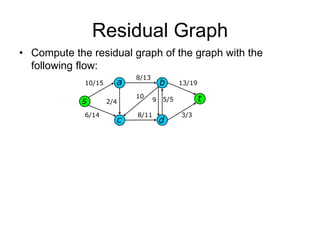
Residual Graph
• Compute the residual graph of the graph with the
following flow:
8/13
8/11
5/52/4
10/15
10
6/14
13/19
3/3
s t9
a b
c d
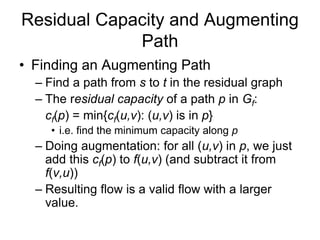
Residual Capacity and Augmenting
Path
• Finding an Augmenting Path
– Find a path from s to t in the residual graph
– The residual capacity of a path p in Gf:
cf(p) = min{cf(u,v): (u,v) is in p}
• i.e. find the minimum capacity along p
– Doing augmentation: for all (u,v) in p, we just
add this cf(p) to f(u,v) (and subtract it from
f(v,u))
– Resulting flow is a valid flow with a larger
value.
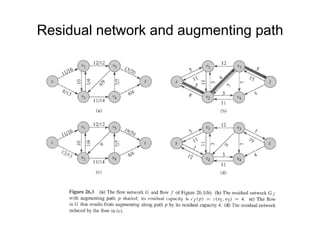
Residual network and augmenting path
The Ford-Fulkerson method
Ford-Fulkerson(G,s,t)
1 for each edge (u,v) in G.E do
2 f(u,v)  f(v,u)  0
3 while there exists a path p from s to t in residual
network Gf do
4 cf = min{cf(u,v): (u,v) is in p}
5 for each edge (u,v) in p do
6 f(u,v)  f(u,v) + cf
7 f(v,u)  -f(u,v)
8 return f
The algorithms based on this method differ in how they choose p in step 3.
If chosen poorly the algorithm might not terminate.
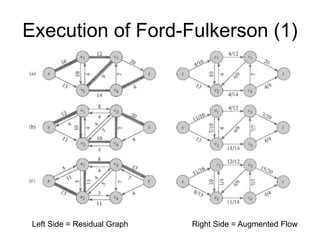
Execution of Ford-Fulkerson (1)
Left Side = Residual Graph Right Side = Augmented Flow
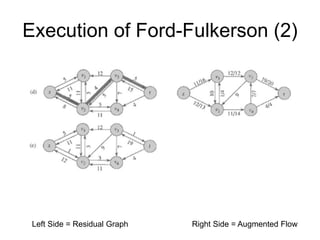
Execution of Ford-Fulkerson (2)
Left Side = Residual Graph Right Side = Augmented Flow
Cuts
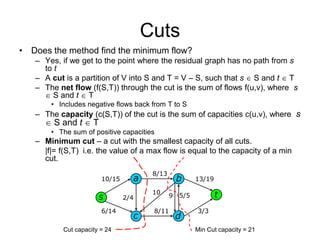
• Does the method find the minimum flow?
– Yes, if we get to the point where the residual graph has no path from s
to t
– A cut is a partition of V into S and T = V – S, such that s  S and t  T
– The net flow (f(S,T)) through the cut is the sum of flows f(u,v), where s
 S and t  T
• Includes negative flows back from T to S
– The capacity (c(S,T)) of the cut is the sum of capacities c(u,v), where s
 S and t  T
• The sum of positive capacities
– Minimum cut – a cut with the smallest capacity of all cuts.
|f|= f(S,T) i.e. the value of a max flow is equal to the capacity of a min
cut.
8/13
8/11
5/52/4
10/15
10
6/14
13/19
3/3
s t9
a b
c d
Cut capacity = 24 Min Cut capacity = 21
Max Flow / Min Cut Theorem
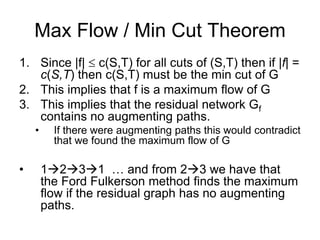
1. Since |f|  c(S,T) for all cuts of (S,T) then if |f| =
c(S,T) then c(S,T) must be the min cut of G
2. This implies that f is a maximum flow of G
3. This implies that the residual network Gf
contains no augmenting paths.
• If there were augmenting paths this would contradict
that we found the maximum flow of G
• 1231 … and from 23 we have that
the Ford Fulkerson method finds the maximum
flow if the residual graph has no augmenting
paths.
Worst Case Running Time
• Assuming integer flow
• Each augmentation increases the value of the flow by
some positive amount.
• Augmentation can be done in O(E).
• Total worst-case running time O(E|f*|), where f* is the
max-flow found by the algorithm.
• Example of worst case:
Augmenting path of 1 Resulting Residual Network Resulting Residual Network
Edmonds Karp
• Take shortest path (in terms of number of
edges) as an augmenting path –
Edmonds-Karp algorithm
– How do we find such a shortest path?
– Running time O(VE2), because the number of
augmentations is O(VE)
– Skipping the proof here
– Even better method: push-relabel, O(V2E)
runtime
Multiple Sources or Sinks
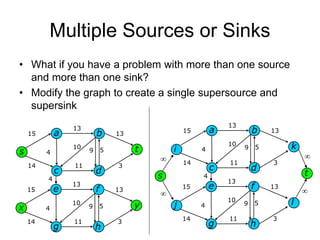
• What if you have a problem with more than one source
and more than one sink?
• Modify the graph to create a single supersource and
supersink
13
11
54
15
10
14
13
3
s t9
a b
c d
13
11
54
15
10
14
13
3
x y9
e f
g h
4
13
11
54
15
10
14
13
3
9
a b
c d
13
11
54
15
10
14
13
3
9
e f
g h
4s
i
j
k
l
t




Application – Bipartite Matching
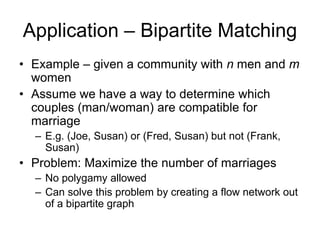
• Example – given a community with n men and m
women
• Assume we have a way to determine which
couples (man/woman) are compatible for
marriage
– E.g. (Joe, Susan) or (Fred, Susan) but not (Frank,
Susan)
• Problem: Maximize the number of marriages
– No polygamy allowed
– Can solve this problem by creating a flow network out
of a bipartite graph
Bipartite Graph
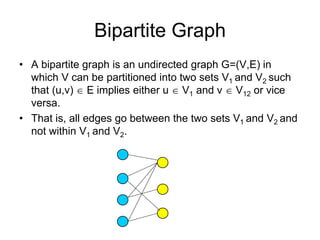
• A bipartite graph is an undirected graph G=(V,E) in
which V can be partitioned into two sets V1 and V2 such
that (u,v)  E implies either u  V1 and v  V12 or vice
versa.
• That is, all edges go between the two sets V1 and V2 and
not within V1 and V2.
Model for Matching Problem
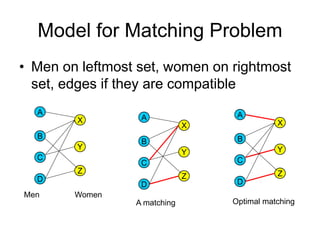
• Men on leftmost set, women on rightmost
set, edges if they are compatible
A
B
C
D
X
Y
Z
Men Women
A
B
C
D
X
Y
Z
A matching
A
B
C
D
X
Y
Z
Optimal matching
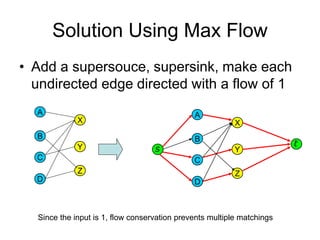
Solution Using Max Flow
• Add a supersouce, supersink, make each
undirected edge directed with a flow of 1
A
B
C
D
X
Y
Z
A
B
C
D
X
Y
Z
s
t
Since the input is 1, flow conservation prevents multiple matchings

Maxflow

  • 1.
  • 2.
    Flow Graph • Acommon scenario is to use a graph to represent a “flow network” and use it to answer questions about material flows • Flow is the rate that material moves through the network • Each directed edge is a conduit for the material with some stated capacity • Vertices are connection points but do not collect material – Flow into a vertex must equal the flow leaving the vertex, flow conservation
  • 3.
    Sample Networks communication Network telephone exchanges, computers,satellites Nodes Arcs cables, fiber optics, microwave relays Flow voice, video, packets circuits gates, registers, processors wires current mechanical joints rods, beams, springs heat, energy hydraulic reservoirs, pumping stations, lakes pipelines fluid, oil financial stocks, companies transactions money transportation airports, rail yards, street intersections highways, railbeds, airway routes freight, vehicles, passengers chemical sites bonds energy
  • 4.
    Flow Concepts • Sourcevertex s – where material is produced • Sink vertex t – where material is consumed • For all other vertices – what goes in must go out – Flow conservation • Goal: determine maximum rate of material flow from source to sink
  • 5.
    Formal Max FlowProblem – Graph G=(V,E) – a flow network • Directed, each edge has capacity c(u,v)  0 • Two special vertices: source s, and sink t • For any other vertex v, there is a path s…v…t – Flow – a function f : V  V R • Capacity constraint: For all u, v  V: f(u,v)  c(u,v) • Skew symmetry: For all u, v  V: f(u,v) = –f(v,u) • Flow conservation: For all u  V – {s, t}: , or( , ) ( , ) 0 ( , ) ( , ) 0 v V v V f u v f u V f v u f V u        2/5 2/15 5/14 4/19 3/3 s t0/9 a b
  • 6.
    Cancellation of flows •We would like to avoid two positive flows in opposite directions between the same pair of vertices – Such flows cancel (maybe partially) each other due to skew symmetry 5/5 2/15 5/14 5/19 2/3 s t2/9 a b 3/5 2/15 5/14 5/19 2/3 s t0/9 a b
  • 7.
    Max Flow • Wewant to find a flow of maximum value from the source to the sink – Denoted by |f| Lucky Puck Distribution Network Max Flow, |f| = 19 Or is it? Best we can do?
  • 8.
    Ford-Fulkerson method • Containsseveral algorithms: – Residue networks – Augmenting paths • Find a path p from s to t (augmenting path), such that there is some value x > 0, and for each edge (u,v) in p we can add x units of flow – f(u,v) + x  c(u,v) 8/13 8/11 5/52/4 10/15 10 6/14 13/19 3/3 s t9 a b c d Augmenting Path?
  • 9.
    Residual Network • Tofind augmenting path we can find any path in the residual network: – Residual capacities: cf(u,v) = c(u,v) – f(u,v) • i.e. the actual capacity minus the net flow from u to v • Net flow may be negative – Residual network: Gf =(V,Ef), where Ef = {(u,v)  V  V : cf(u,v) > 0} – Observation – edges in Ef are either edges in E or their reversals: |Ef|  2|E| 0/14 5/15 a b 19 10 a b Sub-graph With c(u,v) and f(u,v) Residual Sub-Graph c 5/6 c 1 5
  • 10.
    Residual Graph • Computethe residual graph of the graph with the following flow: 8/13 8/11 5/52/4 10/15 10 6/14 13/19 3/3 s t9 a b c d
  • 11.
    Residual Capacity andAugmenting Path • Finding an Augmenting Path – Find a path from s to t in the residual graph – The residual capacity of a path p in Gf: cf(p) = min{cf(u,v): (u,v) is in p} • i.e. find the minimum capacity along p – Doing augmentation: for all (u,v) in p, we just add this cf(p) to f(u,v) (and subtract it from f(v,u)) – Resulting flow is a valid flow with a larger value.
  • 12.
    Residual network andaugmenting path
  • 13.
    The Ford-Fulkerson method Ford-Fulkerson(G,s,t) 1for each edge (u,v) in G.E do 2 f(u,v)  f(v,u)  0 3 while there exists a path p from s to t in residual network Gf do 4 cf = min{cf(u,v): (u,v) is in p} 5 for each edge (u,v) in p do 6 f(u,v)  f(u,v) + cf 7 f(v,u)  -f(u,v) 8 return f The algorithms based on this method differ in how they choose p in step 3. If chosen poorly the algorithm might not terminate.
  • 14.
    Execution of Ford-Fulkerson(1) Left Side = Residual Graph Right Side = Augmented Flow
  • 15.
    Execution of Ford-Fulkerson(2) Left Side = Residual Graph Right Side = Augmented Flow
  • 16.
    Cuts • Does themethod find the minimum flow? – Yes, if we get to the point where the residual graph has no path from s to t – A cut is a partition of V into S and T = V – S, such that s  S and t  T – The net flow (f(S,T)) through the cut is the sum of flows f(u,v), where s  S and t  T • Includes negative flows back from T to S – The capacity (c(S,T)) of the cut is the sum of capacities c(u,v), where s  S and t  T • The sum of positive capacities – Minimum cut – a cut with the smallest capacity of all cuts. |f|= f(S,T) i.e. the value of a max flow is equal to the capacity of a min cut. 8/13 8/11 5/52/4 10/15 10 6/14 13/19 3/3 s t9 a b c d Cut capacity = 24 Min Cut capacity = 21
  • 17.
    Max Flow /Min Cut Theorem 1. Since |f|  c(S,T) for all cuts of (S,T) then if |f| = c(S,T) then c(S,T) must be the min cut of G 2. This implies that f is a maximum flow of G 3. This implies that the residual network Gf contains no augmenting paths. • If there were augmenting paths this would contradict that we found the maximum flow of G • 1231 … and from 23 we have that the Ford Fulkerson method finds the maximum flow if the residual graph has no augmenting paths.
  • 18.
    Worst Case RunningTime • Assuming integer flow • Each augmentation increases the value of the flow by some positive amount. • Augmentation can be done in O(E). • Total worst-case running time O(E|f*|), where f* is the max-flow found by the algorithm. • Example of worst case: Augmenting path of 1 Resulting Residual Network Resulting Residual Network
  • 19.
    Edmonds Karp • Takeshortest path (in terms of number of edges) as an augmenting path – Edmonds-Karp algorithm – How do we find such a shortest path? – Running time O(VE2), because the number of augmentations is O(VE) – Skipping the proof here – Even better method: push-relabel, O(V2E) runtime
  • 20.
    Multiple Sources orSinks • What if you have a problem with more than one source and more than one sink? • Modify the graph to create a single supersource and supersink 13 11 54 15 10 14 13 3 s t9 a b c d 13 11 54 15 10 14 13 3 x y9 e f g h 4 13 11 54 15 10 14 13 3 9 a b c d 13 11 54 15 10 14 13 3 9 e f g h 4s i j k l t    
  • 21.
    Application – BipartiteMatching • Example – given a community with n men and m women • Assume we have a way to determine which couples (man/woman) are compatible for marriage – E.g. (Joe, Susan) or (Fred, Susan) but not (Frank, Susan) • Problem: Maximize the number of marriages – No polygamy allowed – Can solve this problem by creating a flow network out of a bipartite graph
  • 22.
    Bipartite Graph • Abipartite graph is an undirected graph G=(V,E) in which V can be partitioned into two sets V1 and V2 such that (u,v)  E implies either u  V1 and v  V12 or vice versa. • That is, all edges go between the two sets V1 and V2 and not within V1 and V2.
  • 23.
    Model for MatchingProblem • Men on leftmost set, women on rightmost set, edges if they are compatible A B C D X Y Z Men Women A B C D X Y Z A matching A B C D X Y Z Optimal matching
  • 24.
    Solution Using MaxFlow • Add a supersouce, supersink, make each undirected edge directed with a flow of 1 A B C D X Y Z A B C D X Y Z s t Since the input is 1, flow conservation prevents multiple matchings