“Job
Sequencing
With
Deadlines”
.............a Greedy Algorithm
Define-
The sequencing of jobs on a single processor
with deadline constraints is called as Job
Sequencing with Deadlines.
Here-
• You are given a set of jobs.
• Each job has a defined deadline and some
profit associated with it.
• The profit of a job is given only when that
job is completed within its deadline.
Assumptions-
• Only one processor is available for processing
all the jobs.
• Processor takes one unit of time to complete
a job.
• Non-preemption is there.
The problem states-
“How can the total profit be maximized if only
one job can be completed at a time?”
Approach to Solution-
• A feasible solution would be where each
job in the subset gets completed within its
deadline.
• Value of the feasible solution would be the
sum of profit of all the jobs contained in the
subset.
• An optimal solution of the problem would
be a feasible solution which gives the
maximum profit.
Greedy Algorithm-
Greedy Algorithm is adopted to determine
how the next job is selected for an optimal
solution.
The greedy algorithm described in the next
slide always gives an optimal solution to the
job sequencing problem.
Steps to solve-
Step-01:
•Sort all the given jobs in decreasing order of
their profit.
Step-02:
•Check the value of maximum deadline.
•Draw a Gantt chart where maximum time on
Gantt chart is the value of maximum deadline.
Step-03:
•Pick up the jobs one by one.
•Put the job on Gantt chart as far as possible
from 0 ensuring that the job gets completed
before its deadline.
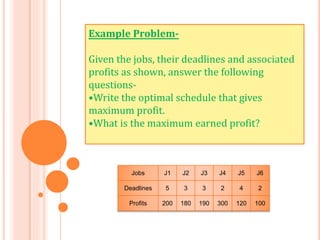
Jobs J1 J2 J3 J4 J5 J6
Deadlines 5 3 3 2 4 2
Profits 200 180 190 300 120 100
Example Problem-
Given the jobs, their deadlines and associated
profits as shown, answer the following
questions-
•Write the optimal schedule that gives
maximum profit.
•What is the maximum earned profit?
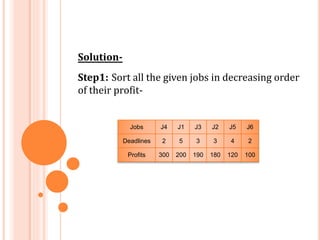
Jobs J4 J1 J3 J2 J5 J6
Deadlines 2 5 3 3 4 2
Profits 300 200 190 180 120 100
Solution-
Step1: Sort all the given jobs in decreasing order
of their profit-
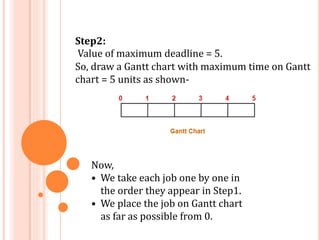
Step2:
Value of maximum deadline = 5.
So, draw a Gantt chart with maximum time on Gantt
chart = 5 units as shown-
Now,
• We take each job one by one in
the order they appear in Step1.
• We place the job on Gantt chart
as far as possible from 0.
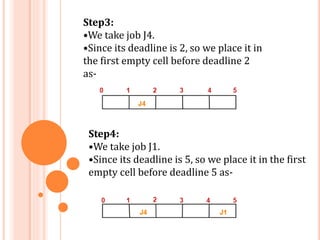
Step3:
•We take job J4.
•Since its deadline is 2, so we place it in
the first empty cell before deadline 2
as-
Step4:
•We take job J1.
•Since its deadline is 5, so we place it in the first
empty cell before deadline 5 as-
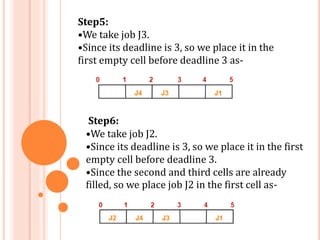
Step5:
•We take job J3.
•Since its deadline is 3, so we place it in the
first empty cell before deadline 3 as-
Step6:
•We take job J2.
•Since its deadline is 3, so we place it in the first
empty cell before deadline 3.
•Since the second and third cells are already
filled, so we place job J2 in the first cell as-
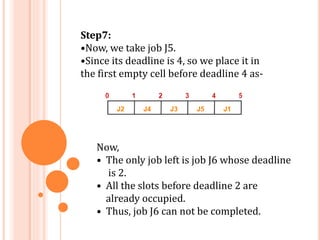
Step7:
•Now, we take job J5.
•Since its deadline is 4, so we place it in
the first empty cell before deadline 4 as-
Now,
• The only job left is job J6 whose deadline
is 2.
• All the slots before deadline 2 are
already occupied.
• Thus, job J6 can not be completed.
The optimal schedule is-
J2 , J4 , J3 , J5 , J1
This is the required order in which the jobs must
be completed in order to obtain the maximum
profit.
Maximum earned profit
= Sum of profit of all the jobs in optimal schedule
= Profit of job J2 + Profit of job J4 + Profit of job
J3 + Profit of job J5 + Profit of job J1
= 180 + 300 + 190 + 120 + 200
= 990 units
Time Complexity Analysis:
Time for sorting on basis of profits = O (n log n)
Next, two loops are used one within
the other, for which complexity = O (n^2)
Hence, the overall complexity of this algorithm
becomes O(n^2).
Program-
#include<iostream>
#include<algorithm>
using namespace std;
struct Job //stores details of each job
{ char id;
int dead;
int profit; };
bool comparison(Job a, Job b) //used in sorting acc. to profits
{ return (a.profit > b.profit); }
void printJobScheduling(Job arr[], int n)
{
sort(arr, arr+n, comparison);
int result[n];
bool slot[n];
for (int i=0; i<n; i++)
slot[i] = false;
for (int i=0; i<n; i++)
{ for (int j=min(n, arr[i].dead)-1; j>=0; j--)
{ if (slot[j]==false)
{ result[j] = i;
slot[j] = true;
break;
} } }
for (int i=0; i<n; i++)
if (slot[i])
cout << arr[result[i]].id << " ";
}
int main()
{
Job arr[] = { {'a', 5, 200}, {'b', 3, 180}, {'c', 3, 190}, {'d', 2, 300},
{'e', 4, 120}, {‘f’, 2, 100} };
int n = sizeof(arr)/sizeof(arr[0]);
cout << "Following is maximum profit sequence of jobs n";
printJobScheduling(arr, n);
return 0;
}
Job sequencing with Deadlines

Job sequencing with Deadlines

  • 1.
  • 2.
    Define- The sequencing ofjobs on a single processor with deadline constraints is called as Job Sequencing with Deadlines. Here- • You are given a set of jobs. • Each job has a defined deadline and some profit associated with it. • The profit of a job is given only when that job is completed within its deadline.
  • 3.
    Assumptions- • Only oneprocessor is available for processing all the jobs. • Processor takes one unit of time to complete a job. • Non-preemption is there. The problem states- “How can the total profit be maximized if only one job can be completed at a time?”
  • 4.
    Approach to Solution- •A feasible solution would be where each job in the subset gets completed within its deadline. • Value of the feasible solution would be the sum of profit of all the jobs contained in the subset. • An optimal solution of the problem would be a feasible solution which gives the maximum profit.
  • 5.
    Greedy Algorithm- Greedy Algorithmis adopted to determine how the next job is selected for an optimal solution. The greedy algorithm described in the next slide always gives an optimal solution to the job sequencing problem.
  • 6.
    Steps to solve- Step-01: •Sortall the given jobs in decreasing order of their profit. Step-02: •Check the value of maximum deadline. •Draw a Gantt chart where maximum time on Gantt chart is the value of maximum deadline. Step-03: •Pick up the jobs one by one. •Put the job on Gantt chart as far as possible from 0 ensuring that the job gets completed before its deadline.
  • 7.
    Jobs J1 J2J3 J4 J5 J6 Deadlines 5 3 3 2 4 2 Profits 200 180 190 300 120 100 Example Problem- Given the jobs, their deadlines and associated profits as shown, answer the following questions- •Write the optimal schedule that gives maximum profit. •What is the maximum earned profit?
  • 8.
    Jobs J4 J1J3 J2 J5 J6 Deadlines 2 5 3 3 4 2 Profits 300 200 190 180 120 100 Solution- Step1: Sort all the given jobs in decreasing order of their profit-
  • 9.
    Step2: Value of maximumdeadline = 5. So, draw a Gantt chart with maximum time on Gantt chart = 5 units as shown- Now, • We take each job one by one in the order they appear in Step1. • We place the job on Gantt chart as far as possible from 0.
  • 10.
    Step3: •We take jobJ4. •Since its deadline is 2, so we place it in the first empty cell before deadline 2 as- Step4: •We take job J1. •Since its deadline is 5, so we place it in the first empty cell before deadline 5 as-
  • 11.
    Step5: •We take jobJ3. •Since its deadline is 3, so we place it in the first empty cell before deadline 3 as- Step6: •We take job J2. •Since its deadline is 3, so we place it in the first empty cell before deadline 3. •Since the second and third cells are already filled, so we place job J2 in the first cell as-
  • 12.
    Step7: •Now, we takejob J5. •Since its deadline is 4, so we place it in the first empty cell before deadline 4 as- Now, • The only job left is job J6 whose deadline is 2. • All the slots before deadline 2 are already occupied. • Thus, job J6 can not be completed.
  • 13.
    The optimal scheduleis- J2 , J4 , J3 , J5 , J1 This is the required order in which the jobs must be completed in order to obtain the maximum profit. Maximum earned profit = Sum of profit of all the jobs in optimal schedule = Profit of job J2 + Profit of job J4 + Profit of job J3 + Profit of job J5 + Profit of job J1 = 180 + 300 + 190 + 120 + 200 = 990 units
  • 14.
    Time Complexity Analysis: Timefor sorting on basis of profits = O (n log n) Next, two loops are used one within the other, for which complexity = O (n^2) Hence, the overall complexity of this algorithm becomes O(n^2).
  • 15.
    Program- #include<iostream> #include<algorithm> using namespace std; structJob //stores details of each job { char id; int dead; int profit; }; bool comparison(Job a, Job b) //used in sorting acc. to profits { return (a.profit > b.profit); } void printJobScheduling(Job arr[], int n) { sort(arr, arr+n, comparison); int result[n]; bool slot[n]; for (int i=0; i<n; i++) slot[i] = false;
  • 16.
    for (int i=0;i<n; i++) { for (int j=min(n, arr[i].dead)-1; j>=0; j--) { if (slot[j]==false) { result[j] = i; slot[j] = true; break; } } } for (int i=0; i<n; i++) if (slot[i]) cout << arr[result[i]].id << " "; } int main() { Job arr[] = { {'a', 5, 200}, {'b', 3, 180}, {'c', 3, 190}, {'d', 2, 300}, {'e', 4, 120}, {‘f’, 2, 100} }; int n = sizeof(arr)/sizeof(arr[0]); cout << "Following is maximum profit sequence of jobs n"; printJobScheduling(arr, n); return 0; }