Travelling Salesman Problem
Chapter 1 & 2


Raditya W Erlangga (G651120714)
Jemy Arieswanto (G651120664)
Amalia Rahmawati (G651120634)
Bogor, February 16th 2013
AGENDA

• Introduction
• NP-Complete Overview
• TSP
•Q&A
TRAVELLING SALESMAN
            PROBLEM
Find the shortest possible route
that visits each city exactly once
   and returns to the origin city


    SECURITY UPDATE

    <ISC SA or IR Number>
    <Date>
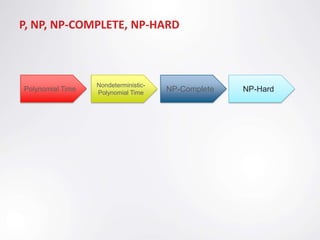
P, NP, NP-COMPLETE, NP-HARD


                  Nondeterministic-
Polynomial Time   Polynomial Time     NP-Complete   NP-Hard
P (POLYNOMIAL TIME)

» P is the set of all decision problems which can be solved in polynomial
  time by a deterministic Turing machine. Since it can be solved in
  polynomial time, it can also be verified in polynomial time
» E.g:
   • Linear Programming -> determining a way to achieve the best
       outcome (such as maximum profit or lowest cost) in a given
       mathematical model
   • finding Maximum Matching -> graph matching
NP (NON-DETERMINISTIC POLYNOMIAL)

» NP is the set of all decision problems (question with yes-or-no answer)
  for which the 'yes'-answers can be verified in polynomial time (O(nk)
  where n is the problem size, and k is a constant) by a deterministic
  Turing machine. Polynomial time is sometimes used as the definition of
  fast or quickly
» P is a subset of NP
» E.g:
   • TSP
NP-COMPLETE

» A problem x that is in NP is also in NP-Complete if and only if every
  other problem in NP can be quickly (ie. in polynomial time)
  transformed into x. In other words:
   • x is in NP, and
   • Every problem in NP is reducible to x
» So what makes NP-Complete so interesting is that if any one of the NP-
  Complete problems was to be solved quickly then all NP problems can
  be solved quickly
» E.g:
   • TSP
NP-HARD
» NP-Hard are problems that are at least as hard as the hardest problems
  in NP. Note that NP-Complete problems are also NP-hard. However not
  all NP-hard problems are NP (or even a decision problem), despite
  having 'NP' as a prefix. That is the NP in NP-hard does not mean 'non-
  deterministic polynomial time’
» E.g:
   • TSP
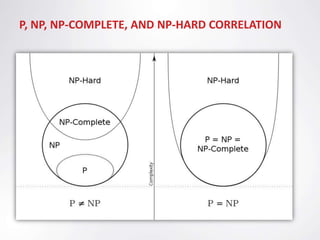
P, NP, NP-COMPLETE, AND NP-HARD CORRELATION
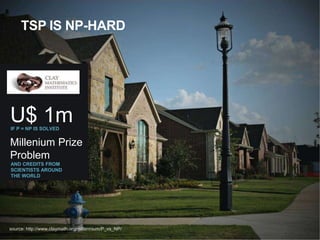
TSP IS NP-HARD


U$ 1m
IF P = NP IS SOLVED


Millenium Prize
Problem
AND CREDITS FROM
SCIENTISTS AROUND
THE WORLD


source: http://www.claymath.org/millennium/P_vs_NP/
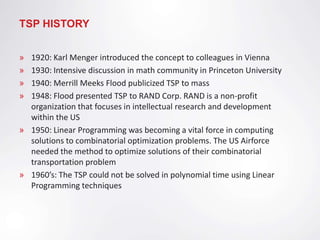
TSP HISTORY


» 1920: Karl Menger introduced the concept to colleagues in Vienna
» 1930: Intensive discussion in math community in Princeton University
» 1940: Merrill Meeks Flood publicized TSP to mass
» 1948: Flood presented TSP to RAND Corp. RAND is a non-profit
  organization that focuses in intellectual research and development
  within the US
» 1950: Linear Programming was becoming a vital force in computing
  solutions to combinatorial optimization problems. The US Airforce
  needed the method to optimize solutions of their combinatorial
  transportation problem
» 1960’s: The TSP could not be solved in polynomial time using Linear
  Programming techniques
TSP has never been
solved
 by scientists and experts so far
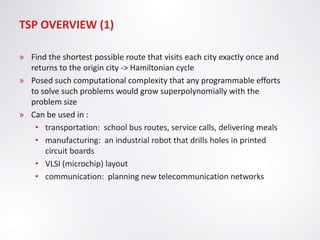
TSP OVERVIEW (1)

» Find the shortest possible route that visits each city exactly once and
  returns to the origin city -> Hamiltonian cycle
» Posed such computational complexity that any programmable efforts
  to solve such problems would grow superpolynomially with the
  problem size
» Can be used in :
   • transportation: school bus routes, service calls, delivering meals
   • manufacturing: an industrial robot that drills holes in printed
      circuit boards
   • VLSI (microchip) layout
   • communication: planning new telecommunication networks
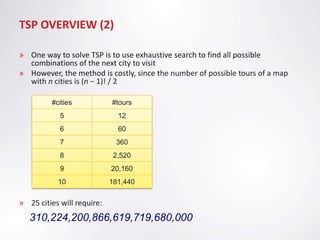
TSP OVERVIEW (2)

» One way to solve TSP is to use exhaustive search to find all possible
  combinations of the next city to visit
» However, the method is costly, since the number of possible tours of a map
  with n cities is (n − 1)! / 2

         #cities            #tours
            5                 12
            6                 60
            7                360
            8                2,520
            9               20,160
           10               181,440


» 25 cities will require:
   310,224,200,866,619,719,680,000
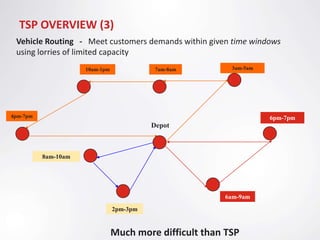
TSP OVERVIEW (3)
 Vehicle Routing - Meet customers demands within given time windows
 using lorries of limited capacity
                     10am-1pm              7am-8am        3am-5am


4pm-7pm                                                             6pm-7pm
                                          Depot


          8am-10am


                                                        6am-9am
                                2pm-3pm


                                Much more difficult than TSP
TSP OVERVIEW (4)

» Until this very day, an efficient solution to the general case TSP, or even
  to any of its NP-hard variations, has not been found
» However, there are approximation solutions to solve the TSP:
   • Polynomial Time Approximation Scheme (PTAS)
   • Christofides Algorithm
   • Double MST Algorithm
   • Arora’s Algorithm
   • Mitchell’s Algorithm
QUESTIONS?
THANK YOU

Travelling Salesman Problem

  • 1.
    Travelling Salesman Problem Chapter1 & 2 Raditya W Erlangga (G651120714) Jemy Arieswanto (G651120664) Amalia Rahmawati (G651120634) Bogor, February 16th 2013
  • 2.
  • 3.
    TRAVELLING SALESMAN PROBLEM Find the shortest possible route that visits each city exactly once and returns to the origin city SECURITY UPDATE <ISC SA or IR Number> <Date>
  • 4.
    P, NP, NP-COMPLETE,NP-HARD Nondeterministic- Polynomial Time Polynomial Time NP-Complete NP-Hard
  • 5.
    P (POLYNOMIAL TIME) »P is the set of all decision problems which can be solved in polynomial time by a deterministic Turing machine. Since it can be solved in polynomial time, it can also be verified in polynomial time » E.g: • Linear Programming -> determining a way to achieve the best outcome (such as maximum profit or lowest cost) in a given mathematical model • finding Maximum Matching -> graph matching
  • 6.
    NP (NON-DETERMINISTIC POLYNOMIAL) »NP is the set of all decision problems (question with yes-or-no answer) for which the 'yes'-answers can be verified in polynomial time (O(nk) where n is the problem size, and k is a constant) by a deterministic Turing machine. Polynomial time is sometimes used as the definition of fast or quickly » P is a subset of NP » E.g: • TSP
  • 7.
    NP-COMPLETE » A problemx that is in NP is also in NP-Complete if and only if every other problem in NP can be quickly (ie. in polynomial time) transformed into x. In other words: • x is in NP, and • Every problem in NP is reducible to x » So what makes NP-Complete so interesting is that if any one of the NP- Complete problems was to be solved quickly then all NP problems can be solved quickly » E.g: • TSP
  • 8.
    NP-HARD » NP-Hard areproblems that are at least as hard as the hardest problems in NP. Note that NP-Complete problems are also NP-hard. However not all NP-hard problems are NP (or even a decision problem), despite having 'NP' as a prefix. That is the NP in NP-hard does not mean 'non- deterministic polynomial time’ » E.g: • TSP
  • 9.
    P, NP, NP-COMPLETE,AND NP-HARD CORRELATION
  • 10.
    TSP IS NP-HARD U$1m IF P = NP IS SOLVED Millenium Prize Problem AND CREDITS FROM SCIENTISTS AROUND THE WORLD source: http://www.claymath.org/millennium/P_vs_NP/
  • 11.
    TSP HISTORY » 1920:Karl Menger introduced the concept to colleagues in Vienna » 1930: Intensive discussion in math community in Princeton University » 1940: Merrill Meeks Flood publicized TSP to mass » 1948: Flood presented TSP to RAND Corp. RAND is a non-profit organization that focuses in intellectual research and development within the US » 1950: Linear Programming was becoming a vital force in computing solutions to combinatorial optimization problems. The US Airforce needed the method to optimize solutions of their combinatorial transportation problem » 1960’s: The TSP could not be solved in polynomial time using Linear Programming techniques
  • 12.
    TSP has neverbeen solved by scientists and experts so far
  • 13.
    TSP OVERVIEW (1) »Find the shortest possible route that visits each city exactly once and returns to the origin city -> Hamiltonian cycle » Posed such computational complexity that any programmable efforts to solve such problems would grow superpolynomially with the problem size » Can be used in : • transportation: school bus routes, service calls, delivering meals • manufacturing: an industrial robot that drills holes in printed circuit boards • VLSI (microchip) layout • communication: planning new telecommunication networks
  • 14.
    TSP OVERVIEW (2) »One way to solve TSP is to use exhaustive search to find all possible combinations of the next city to visit » However, the method is costly, since the number of possible tours of a map with n cities is (n − 1)! / 2 #cities #tours 5 12 6 60 7 360 8 2,520 9 20,160 10 181,440 » 25 cities will require: 310,224,200,866,619,719,680,000
  • 15.
    TSP OVERVIEW (3) Vehicle Routing - Meet customers demands within given time windows using lorries of limited capacity 10am-1pm 7am-8am 3am-5am 4pm-7pm 6pm-7pm Depot 8am-10am 6am-9am 2pm-3pm Much more difficult than TSP
  • 16.
    TSP OVERVIEW (4) »Until this very day, an efficient solution to the general case TSP, or even to any of its NP-hard variations, has not been found » However, there are approximation solutions to solve the TSP: • Polynomial Time Approximation Scheme (PTAS) • Christofides Algorithm • Double MST Algorithm • Arora’s Algorithm • Mitchell’s Algorithm
  • 17.
  • 18.

Editor's Notes

  • #4 Slide title text color may be changed once the photo background is added.