Prepared by-
▪ Bhavin Darji
Guided by –
SUBJECT-ADA (2150703)
Introduction to Dynamic Programming, Principle of Optimality
Introduction
▪ Typically applied to optimization problem.
▪ Invented by a U.S. Mathematician Richard Bellman in 1950.
▪ In the word Dynamic Programming the word programming stands for
planning.
▪ Dynamic Programming is technique for solving problems with
overlapping subproblems.
▪ In this method each subproblem is solved only once.
▪ The result of each subproblem is recorded in a table from which we
can obtain a solution to the original problem.
▪ In Dynamic computing duplications in solution is avoided totally.
▪ Efficient then Divide and conquer strategy.
▪ Uses bottom up approach of problem solving.
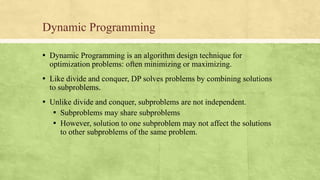
Dynamic Programming
▪ Dynamic Programming is an algorithm design technique for
optimization problems: often minimizing or maximizing.
▪ Like divide and conquer, DP solves problems by combining solutions
to subproblems.
▪ Unlike divide and conquer, subproblems are not independent.
▪ Subproblems may share subproblems
▪ However, solution to one subproblem may not affect the solutions
to other subproblems of the same problem.
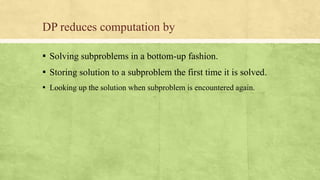
DP reduces computation by
▪ Solving subproblems in a bottom-up fashion.
▪ Storing solution to a subproblem the first time it is solved.
▪ Looking up the solution when subproblem is encountered again.
Key Idea
 The key idea is to save answers of overlapping smaller sub-problems
to avoid recomputation.
▪ determine structure of optimal solutions.
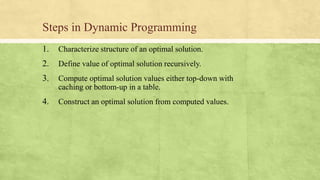
Steps in Dynamic Programming
1. Characterize structure of an optimal solution.
2. Define value of optimal solution recursively.
3. Compute optimal solution values either top-down with
caching or bottom-up in a table.
4. Construct an optimal solution from computed values.
Dynamic Programming Properties
• An instance is solved using the solutions for smaller instances.
• The solutions for a smaller instance might be needed multiple times, so
store their results in a table.
• Thus each smaller instance is solved only once.
• Additional space is used to save time.
Principle of Optimality
▪ Obtains the solution using principle of optimality.
▪ In an optimal sequence of decisions or choices, each subsequence must
also be optimal.
▪ When it is not possible to apply the principle of optimality it is almost
impossible to obtain the solution using the dynamic programming
approach.
▪ Example: Finding of shortest path in a given graph uses the principle
of optimality.
Problem solving using Dynamic Programming
▪ Various problem that can be solved using dynamic
programming are-
▪ Calculating the Binomial coefficient
▪ Making change problem
▪ Assembly line scheduling
▪ Knapsack problem
▪ Shortest path
▪ Matrix chain Multiplication
ThankYou 

Introduction to Dynamic Programming, Principle of Optimality

  • 1.
    Prepared by- ▪ BhavinDarji Guided by – SUBJECT-ADA (2150703) Introduction to Dynamic Programming, Principle of Optimality
  • 2.
    Introduction ▪ Typically appliedto optimization problem. ▪ Invented by a U.S. Mathematician Richard Bellman in 1950. ▪ In the word Dynamic Programming the word programming stands for planning.
  • 3.
    ▪ Dynamic Programmingis technique for solving problems with overlapping subproblems. ▪ In this method each subproblem is solved only once. ▪ The result of each subproblem is recorded in a table from which we can obtain a solution to the original problem. ▪ In Dynamic computing duplications in solution is avoided totally. ▪ Efficient then Divide and conquer strategy. ▪ Uses bottom up approach of problem solving.
  • 4.
    Dynamic Programming ▪ DynamicProgramming is an algorithm design technique for optimization problems: often minimizing or maximizing. ▪ Like divide and conquer, DP solves problems by combining solutions to subproblems. ▪ Unlike divide and conquer, subproblems are not independent. ▪ Subproblems may share subproblems ▪ However, solution to one subproblem may not affect the solutions to other subproblems of the same problem.
  • 5.
    DP reduces computationby ▪ Solving subproblems in a bottom-up fashion. ▪ Storing solution to a subproblem the first time it is solved. ▪ Looking up the solution when subproblem is encountered again.
  • 6.
    Key Idea  Thekey idea is to save answers of overlapping smaller sub-problems to avoid recomputation. ▪ determine structure of optimal solutions.
  • 7.
    Steps in DynamicProgramming 1. Characterize structure of an optimal solution. 2. Define value of optimal solution recursively. 3. Compute optimal solution values either top-down with caching or bottom-up in a table. 4. Construct an optimal solution from computed values.
  • 8.
    Dynamic Programming Properties •An instance is solved using the solutions for smaller instances. • The solutions for a smaller instance might be needed multiple times, so store their results in a table. • Thus each smaller instance is solved only once. • Additional space is used to save time.
  • 9.
    Principle of Optimality ▪Obtains the solution using principle of optimality. ▪ In an optimal sequence of decisions or choices, each subsequence must also be optimal. ▪ When it is not possible to apply the principle of optimality it is almost impossible to obtain the solution using the dynamic programming approach. ▪ Example: Finding of shortest path in a given graph uses the principle of optimality.
  • 10.
    Problem solving usingDynamic Programming ▪ Various problem that can be solved using dynamic programming are- ▪ Calculating the Binomial coefficient ▪ Making change problem ▪ Assembly line scheduling ▪ Knapsack problem ▪ Shortest path ▪ Matrix chain Multiplication
  • 11.