MATRICES Precalculus
Chapter 9
This Slideshow was developed to accompany the textbook
Precalculus
By Richard Wright
https://www.andrews.edu/~rwright/Precalculus-RLW/Text/TOC.html
Some examples and diagrams are taken from the textbook.
Slides created by
Richard Wright, Andrews Academy
rwright@andrews.edu
9-01 MATRICES AND
SYSTEMS OF
EQUATIONS
In this section, you will:
• Identify the order of a matrix.
• Write an augmented matrix for a
system of equations.
• Write a matrix in row-echelon
form.
• Solve a system of linear equations
using an augmented matrix.
9-01 MATRICES AND SYSTEMS OF
EQUATIONS
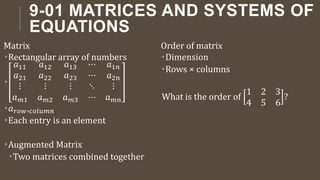
Matrix
Rectangular array of numbers

𝑎11 𝑎12 𝑎13 ⋯ 𝑎1𝑛
𝑎21 𝑎22 𝑎23 ⋯ 𝑎2𝑛
⋮ ⋮ ⋮ ⋱ ⋮
𝑎𝑚1 𝑎𝑚2 𝑎𝑚3 ⋯ 𝑎𝑚𝑛
𝑎𝑟𝑜𝑤,𝑐𝑜𝑙𝑢𝑚𝑛
Each entry is an element
Augmented Matrix
Two matrices combined together
Order of matrix
Dimension
Rows × columns
What is the order of
1 2 3
4 5 6
?
9-01 MATRICES AND SYSTEMS OF
EQUATIONS
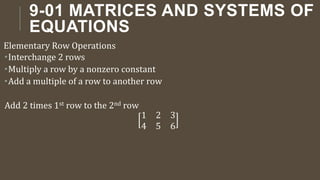
Elementary Row Operations
Interchange 2 rows
Multiply a row by a nonzero constant
Add a multiple of a row to another row
Add 2 times 1st row to the 2nd row
1 2 3
4 5 6
9-01 MATRICES AND SYSTEMS OF
EQUATIONS
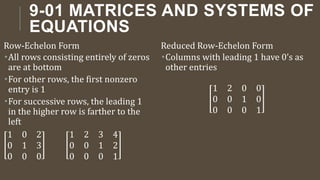
Row-Echelon Form
All rows consisting entirely of zeros
are at bottom
For other rows, the first nonzero
entry is 1
For successive rows, the leading 1
in the higher row is farther to the
left
1 0 2
0 1 3
0 0 0
1 2 3 4
0 0 1 2
0 0 0 1
Reduced Row-Echelon Form
Columns with leading 1 have 0’s as
other entries
1 2 0 0
0 0 1 0
0 0 0 1
9-01 MATRICES AND SYSTEMS OF
EQUATIONS
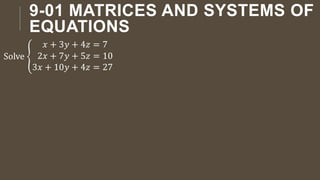
Solve
𝑥 + 3𝑦 + 4𝑧 = 7
2𝑥 + 7𝑦 + 5𝑧 = 10
3𝑥 + 10𝑦 + 4𝑧 = 27
9-02 GAUSSIAN
ELIMINATION
In this section, you will:
• Write a matrix in reduced-row
echelon form.
• Solve a system of linear
equations using Gauss-Jordan
Elimination.
9-02 GAUSSIAN ELIMINATION
Gaussian Elimination
Solving a system of linear equations by putting it into row-echelon form with
elementary row operations
Gauss-Jordan Elimination
Solve by putting the system into Reduced row-echelon form
If a row becomes all zeros with final entry not zero = no solution
If a row becomes all zeros = many solutions (do the z = a thing to write the
parametric equations of the line of intersection)
9-02 GAUSSIAN ELIMINATION
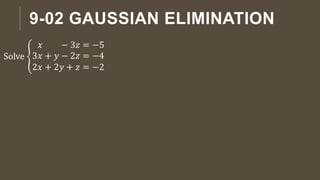
Solve
𝑥 − 3𝑧 = −5
3𝑥 + 𝑦 − 2𝑧 = −4
2𝑥 + 2𝑦 + 𝑧 = −2
9-02 GAUSSIAN ELIMINATION
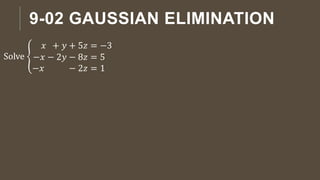
Solve
𝑥 + 𝑦 + 5𝑧 = −3
−𝑥 − 2𝑦 − 8𝑧 = 5
−𝑥 − 2𝑧 = 1
9-03 MATRIX
OPERATIONS
In this section, you will:
• Add and subtract matrices.
• Multiply a scalar with a matrix.
• Multiply a matrix with a matrix.
9-03 MATRIX OPERATIONS
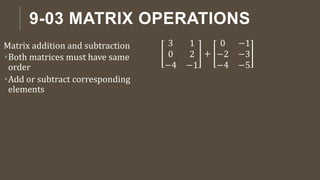
Matrix addition and subtraction
Both matrices must have same
order
Add or subtract corresponding
elements
3 1
0 2
−4 −1
+
0 −1
−2 −3
−4 −5
9-03 MATRIX OPERATIONS
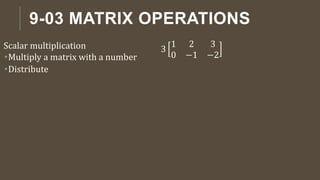
Scalar multiplication
Multiply a matrix with a number
Distribute
3
1 2 3
0 −1 −2
9-03 MATRIX OPERATIONS
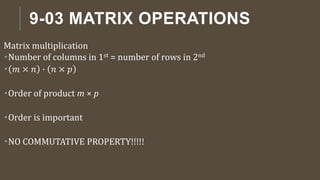
Matrix multiplication
Number of columns in 1st = number of rows in 2nd
 𝑚 × 𝑛 ∙ 𝑛 × 𝑝
Order of product m × p
Order is important
NO COMMUTATIVE PROPERTY!!!!!
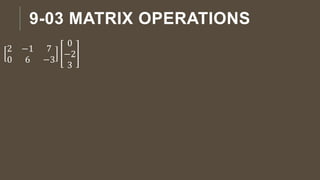
9-03 MATRIX OPERATIONS
2 −1 7
0 6 −3
0
−2
3
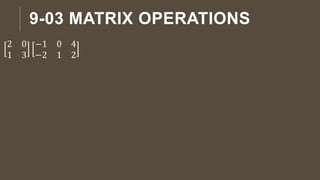
9-03 MATRIX OPERATIONS
2 0
1 3
−1 0 4
−2 1 2
9-04 INVERSE
MATRICES
In this section, you will:
• Decompose rational expressions
into partial fractions with:
• Find the inverse of a 2×2
matrix
• Find the inverse of any
square matrix
• Solve a system of equations
using an inverse matrix
9-04 INVERSE MATRICES
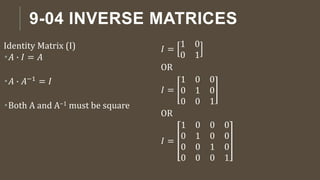
Identity Matrix (I)
𝐴 ∙ 𝐼 = 𝐴
𝐴 ∙ 𝐴−1 = 𝐼
Both A and A−1 must be square
𝐼 =
1 0
0 1
OR
𝐼 =
1 0 0
0 1 0
0 0 1
OR
𝐼 =
1 0 0 0
0 1 0 0
0 0 1 0
0 0 0 1
9-04 INVERSE MATRICES
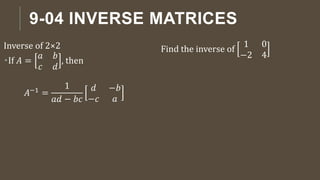
Inverse of 2×2
If 𝐴 =
𝑎 𝑏
𝑐 𝑑
, then
𝐴−1
=
1
𝑎𝑑 − 𝑏𝑐
𝑑 −𝑏
−𝑐 𝑎
Find the inverse of
1 0
−2 4
9-04 INVERSE MATRICES
Find other inverses
Augment the matrix with the identity matrix
Use Gauss-Jordan elimination to turn the original matrix into the identity
matrix
𝐴 ⋮ 𝐼 → [𝐼 ⋮ 𝐴−1]
9-04 INVERSE MATRICES
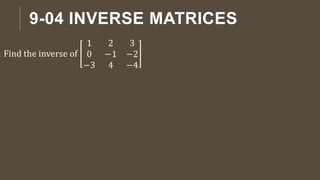
Find the inverse of
1 2 3
0 −1 −2
−3 4 −4
9-04 INVERSE MATRICES
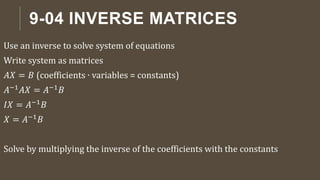
Use an inverse to solve system of equations
Write system as matrices
𝐴𝑋 = 𝐵 (coefficients ∙ variables = constants)
𝐴−1𝐴𝑋 = 𝐴−1𝐵
𝐼𝑋 = 𝐴−1𝐵
𝑋 = 𝐴−1𝐵
Solve by multiplying the inverse of the coefficients with the constants
9-04 INVERSE MATRICES
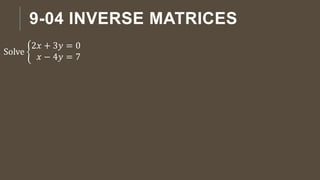
Solve
2𝑥 + 3𝑦 = 0
𝑥 − 4𝑦 = 7
9-05 DETERMINANTS
OF MATRICES
In this section, you will:
• Find a determinant 2×2 or 3×3
matrix using shortcuts.
• Find a determinant of any
square matrix using expansion
by cofactors.
9-05 DETERMINANTS OF
MATRICES
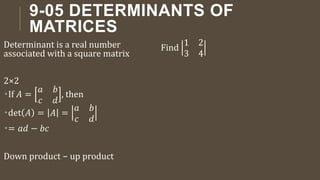
Determinant is a real number
associated with a square matrix
2×2
If 𝐴 =
𝑎 𝑏
𝑐 𝑑
, then
det 𝐴 = 𝐴 =
𝑎 𝑏
𝑐 𝑑
= 𝑎𝑑 − 𝑏𝑐
Down product − up product
Find
1 2
3 4
9-05 DETERMINANTS OF
MATRICES
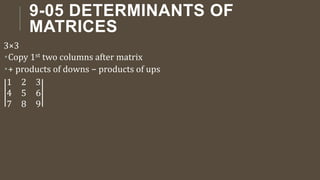
3×3
Copy 1st two columns after matrix
+ products of downs − products of ups
1 2 3
4 5 6
7 8 9
9-05 DETERMINANTS OF
MATRICES
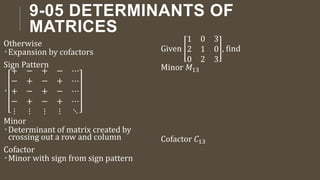
Otherwise
Expansion by cofactors
Sign Pattern

+ − + − ⋯
− + − + ⋯
+ − + − ⋯
− + − + ⋯
⋮ ⋮ ⋮ ⋮ ⋱
Minor
Determinant of matrix created by
crossing out a row and column
Cofactor
Minor with sign from sign pattern
Given
1 0 3
2 1 0
0 2 3
, find
Minor 𝑀13
Cofactor 𝐶13
9-05 DETERMINANTS OF
MATRICES
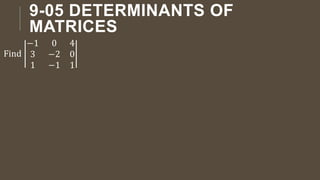
Find
−1 0 4
3 −2 0
1 −1 1
9-05 DETERMINANTS OF
MATRICES
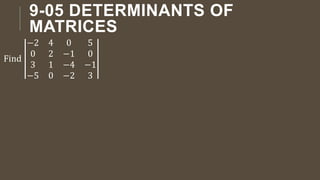
Find
−2 4 0 5
0 2 −1 0
3 1 −4 −1
−5 0 −2 3
9-06 APPLICATIONS
OF MATRICES
In this section, you will:
• Solve a System of Linear
Equations by Cramer's Rule.
• Use a determinant to find the
area of a triangle.
• Use a determinant to determine
if three points are collinear.
• Use a determinant to find the
equation of a line.
• Use a matrix to encode and
decode a message.
9-06 APPLICATIONS OF MATRICES
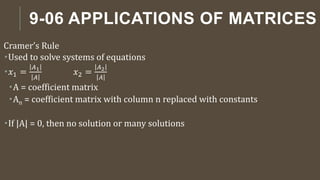
Cramer’s Rule
Used to solve systems of equations
𝑥1 =
𝐴1
𝐴
𝑥2 =
𝐴2
𝐴
A = coefficient matrix
An = coefficient matrix with column n replaced with constants
If |A| = 0, then no solution or many solutions
9-06 APPLICATIONS OF MATRICES
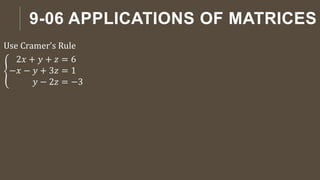
Use Cramer’s Rule
2𝑥 + 𝑦 + 𝑧 = 6
−𝑥 − 𝑦 + 3𝑧 = 1
𝑦 − 2𝑧 = −3
9-06 APPLICATIONS OF MATRICES
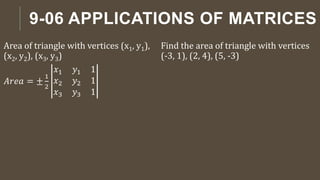
Area of triangle with vertices (x1, y1),
(x2, y2), (x3, y3)
𝐴𝑟𝑒𝑎 = ±
1
2
𝑥1 𝑦1 1
𝑥2 𝑦2 1
𝑥3 𝑦3 1
Find the area of triangle with vertices
(-3, 1), (2, 4), (5, -3)
9-06 APPLICATIONS OF MATRICES
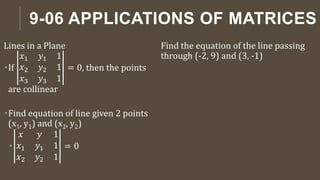
Lines in a Plane
If
𝑥1 𝑦1 1
𝑥2 𝑦2 1
𝑥3 𝑦3 1
= 0, then the points
are collinear
Find equation of line given 2 points
(x1, y1) and (x2, y2)

𝑥 𝑦 1
𝑥1 𝑦1 1
𝑥2 𝑦2 1
= 0
Find the equation of the line passing
through (-2, 9) and (3, -1)
9-06 APPLICATIONS OF MATRICES
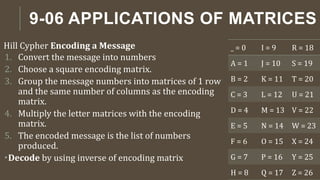
Hill Cypher Encoding a Message
1. Convert the message into numbers
2. Choose a square encoding matrix.
3. Group the message numbers into matrices of 1 row
and the same number of columns as the encoding
matrix.
4. Multiply the letter matrices with the encoding
matrix.
5. The encoded message is the list of numbers
produced.
Decode by using inverse of encoding matrix
_ = 0 I = 9 R = 18
A = 1 J = 10 S = 19
B = 2 K = 11 T = 20
C = 3 L = 12 U = 21
D = 4 M = 13 V = 22
E = 5 N = 14 W = 23
F = 6 O = 15 X = 24
G = 7 P = 16 Y = 25
H = 8 Q = 17 Z = 26
9-06 APPLICATIONS OF MATRICES
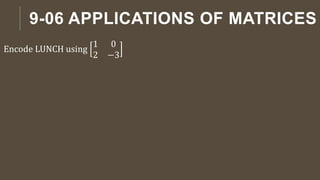
Encode LUNCH using
1 0
2 −3

Precalculus 09 Matrices.pptx

  • 1.
  • 2.
    This Slideshow wasdeveloped to accompany the textbook Precalculus By Richard Wright https://www.andrews.edu/~rwright/Precalculus-RLW/Text/TOC.html Some examples and diagrams are taken from the textbook. Slides created by Richard Wright, Andrews Academy rwright@andrews.edu
  • 3.
    9-01 MATRICES AND SYSTEMSOF EQUATIONS In this section, you will: • Identify the order of a matrix. • Write an augmented matrix for a system of equations. • Write a matrix in row-echelon form. • Solve a system of linear equations using an augmented matrix.
  • 4.
    9-01 MATRICES ANDSYSTEMS OF EQUATIONS Matrix Rectangular array of numbers  𝑎11 𝑎12 𝑎13 ⋯ 𝑎1𝑛 𝑎21 𝑎22 𝑎23 ⋯ 𝑎2𝑛 ⋮ ⋮ ⋮ ⋱ ⋮ 𝑎𝑚1 𝑎𝑚2 𝑎𝑚3 ⋯ 𝑎𝑚𝑛 𝑎𝑟𝑜𝑤,𝑐𝑜𝑙𝑢𝑚𝑛 Each entry is an element Augmented Matrix Two matrices combined together Order of matrix Dimension Rows × columns What is the order of 1 2 3 4 5 6 ?
  • 5.
    9-01 MATRICES ANDSYSTEMS OF EQUATIONS Elementary Row Operations Interchange 2 rows Multiply a row by a nonzero constant Add a multiple of a row to another row Add 2 times 1st row to the 2nd row 1 2 3 4 5 6
  • 6.
    9-01 MATRICES ANDSYSTEMS OF EQUATIONS Row-Echelon Form All rows consisting entirely of zeros are at bottom For other rows, the first nonzero entry is 1 For successive rows, the leading 1 in the higher row is farther to the left 1 0 2 0 1 3 0 0 0 1 2 3 4 0 0 1 2 0 0 0 1 Reduced Row-Echelon Form Columns with leading 1 have 0’s as other entries 1 2 0 0 0 0 1 0 0 0 0 1
  • 7.
    9-01 MATRICES ANDSYSTEMS OF EQUATIONS Solve 𝑥 + 3𝑦 + 4𝑧 = 7 2𝑥 + 7𝑦 + 5𝑧 = 10 3𝑥 + 10𝑦 + 4𝑧 = 27
  • 8.
    9-02 GAUSSIAN ELIMINATION In thissection, you will: • Write a matrix in reduced-row echelon form. • Solve a system of linear equations using Gauss-Jordan Elimination.
  • 9.
    9-02 GAUSSIAN ELIMINATION GaussianElimination Solving a system of linear equations by putting it into row-echelon form with elementary row operations Gauss-Jordan Elimination Solve by putting the system into Reduced row-echelon form If a row becomes all zeros with final entry not zero = no solution If a row becomes all zeros = many solutions (do the z = a thing to write the parametric equations of the line of intersection)
  • 10.
    9-02 GAUSSIAN ELIMINATION Solve 𝑥− 3𝑧 = −5 3𝑥 + 𝑦 − 2𝑧 = −4 2𝑥 + 2𝑦 + 𝑧 = −2
  • 11.
    9-02 GAUSSIAN ELIMINATION Solve 𝑥+ 𝑦 + 5𝑧 = −3 −𝑥 − 2𝑦 − 8𝑧 = 5 −𝑥 − 2𝑧 = 1
  • 12.
    9-03 MATRIX OPERATIONS In thissection, you will: • Add and subtract matrices. • Multiply a scalar with a matrix. • Multiply a matrix with a matrix.
  • 13.
    9-03 MATRIX OPERATIONS Matrixaddition and subtraction Both matrices must have same order Add or subtract corresponding elements 3 1 0 2 −4 −1 + 0 −1 −2 −3 −4 −5
  • 14.
    9-03 MATRIX OPERATIONS Scalarmultiplication Multiply a matrix with a number Distribute 3 1 2 3 0 −1 −2
  • 15.
    9-03 MATRIX OPERATIONS Matrixmultiplication Number of columns in 1st = number of rows in 2nd  𝑚 × 𝑛 ∙ 𝑛 × 𝑝 Order of product m × p Order is important NO COMMUTATIVE PROPERTY!!!!!
  • 16.
    9-03 MATRIX OPERATIONS 2−1 7 0 6 −3 0 −2 3
  • 17.
    9-03 MATRIX OPERATIONS 20 1 3 −1 0 4 −2 1 2
  • 18.
    9-04 INVERSE MATRICES In thissection, you will: • Decompose rational expressions into partial fractions with: • Find the inverse of a 2×2 matrix • Find the inverse of any square matrix • Solve a system of equations using an inverse matrix
  • 19.
    9-04 INVERSE MATRICES IdentityMatrix (I) 𝐴 ∙ 𝐼 = 𝐴 𝐴 ∙ 𝐴−1 = 𝐼 Both A and A−1 must be square 𝐼 = 1 0 0 1 OR 𝐼 = 1 0 0 0 1 0 0 0 1 OR 𝐼 = 1 0 0 0 0 1 0 0 0 0 1 0 0 0 0 1
  • 20.
    9-04 INVERSE MATRICES Inverseof 2×2 If 𝐴 = 𝑎 𝑏 𝑐 𝑑 , then 𝐴−1 = 1 𝑎𝑑 − 𝑏𝑐 𝑑 −𝑏 −𝑐 𝑎 Find the inverse of 1 0 −2 4
  • 21.
    9-04 INVERSE MATRICES Findother inverses Augment the matrix with the identity matrix Use Gauss-Jordan elimination to turn the original matrix into the identity matrix 𝐴 ⋮ 𝐼 → [𝐼 ⋮ 𝐴−1]
  • 22.
    9-04 INVERSE MATRICES Findthe inverse of 1 2 3 0 −1 −2 −3 4 −4
  • 23.
    9-04 INVERSE MATRICES Usean inverse to solve system of equations Write system as matrices 𝐴𝑋 = 𝐵 (coefficients ∙ variables = constants) 𝐴−1𝐴𝑋 = 𝐴−1𝐵 𝐼𝑋 = 𝐴−1𝐵 𝑋 = 𝐴−1𝐵 Solve by multiplying the inverse of the coefficients with the constants
  • 24.
    9-04 INVERSE MATRICES Solve 2𝑥+ 3𝑦 = 0 𝑥 − 4𝑦 = 7
  • 25.
    9-05 DETERMINANTS OF MATRICES Inthis section, you will: • Find a determinant 2×2 or 3×3 matrix using shortcuts. • Find a determinant of any square matrix using expansion by cofactors.
  • 26.
    9-05 DETERMINANTS OF MATRICES Determinantis a real number associated with a square matrix 2×2 If 𝐴 = 𝑎 𝑏 𝑐 𝑑 , then det 𝐴 = 𝐴 = 𝑎 𝑏 𝑐 𝑑 = 𝑎𝑑 − 𝑏𝑐 Down product − up product Find 1 2 3 4
  • 27.
    9-05 DETERMINANTS OF MATRICES 3×3 Copy1st two columns after matrix + products of downs − products of ups 1 2 3 4 5 6 7 8 9
  • 28.
    9-05 DETERMINANTS OF MATRICES Otherwise Expansionby cofactors Sign Pattern  + − + − ⋯ − + − + ⋯ + − + − ⋯ − + − + ⋯ ⋮ ⋮ ⋮ ⋮ ⋱ Minor Determinant of matrix created by crossing out a row and column Cofactor Minor with sign from sign pattern Given 1 0 3 2 1 0 0 2 3 , find Minor 𝑀13 Cofactor 𝐶13
  • 29.
  • 30.
    9-05 DETERMINANTS OF MATRICES Find −24 0 5 0 2 −1 0 3 1 −4 −1 −5 0 −2 3
  • 31.
    9-06 APPLICATIONS OF MATRICES Inthis section, you will: • Solve a System of Linear Equations by Cramer's Rule. • Use a determinant to find the area of a triangle. • Use a determinant to determine if three points are collinear. • Use a determinant to find the equation of a line. • Use a matrix to encode and decode a message.
  • 32.
    9-06 APPLICATIONS OFMATRICES Cramer’s Rule Used to solve systems of equations 𝑥1 = 𝐴1 𝐴 𝑥2 = 𝐴2 𝐴 A = coefficient matrix An = coefficient matrix with column n replaced with constants If |A| = 0, then no solution or many solutions
  • 33.
    9-06 APPLICATIONS OFMATRICES Use Cramer’s Rule 2𝑥 + 𝑦 + 𝑧 = 6 −𝑥 − 𝑦 + 3𝑧 = 1 𝑦 − 2𝑧 = −3
  • 34.
    9-06 APPLICATIONS OFMATRICES Area of triangle with vertices (x1, y1), (x2, y2), (x3, y3) 𝐴𝑟𝑒𝑎 = ± 1 2 𝑥1 𝑦1 1 𝑥2 𝑦2 1 𝑥3 𝑦3 1 Find the area of triangle with vertices (-3, 1), (2, 4), (5, -3)
  • 35.
    9-06 APPLICATIONS OFMATRICES Lines in a Plane If 𝑥1 𝑦1 1 𝑥2 𝑦2 1 𝑥3 𝑦3 1 = 0, then the points are collinear Find equation of line given 2 points (x1, y1) and (x2, y2)  𝑥 𝑦 1 𝑥1 𝑦1 1 𝑥2 𝑦2 1 = 0 Find the equation of the line passing through (-2, 9) and (3, -1)
  • 36.
    9-06 APPLICATIONS OFMATRICES Hill Cypher Encoding a Message 1. Convert the message into numbers 2. Choose a square encoding matrix. 3. Group the message numbers into matrices of 1 row and the same number of columns as the encoding matrix. 4. Multiply the letter matrices with the encoding matrix. 5. The encoded message is the list of numbers produced. Decode by using inverse of encoding matrix _ = 0 I = 9 R = 18 A = 1 J = 10 S = 19 B = 2 K = 11 T = 20 C = 3 L = 12 U = 21 D = 4 M = 13 V = 22 E = 5 N = 14 W = 23 F = 6 O = 15 X = 24 G = 7 P = 16 Y = 25 H = 8 Q = 17 Z = 26
  • 37.
    9-06 APPLICATIONS OFMATRICES Encode LUNCH using 1 0 2 −3

Editor's Notes

  • #5 2×3
  • #6  1 2 3 6 9 12
  • #8  1 3 4 ⋮ 7 2 7 5 ⋮ 10 3 10 4 ⋮ 27 -2×1st add to 2nd 1 3 4 ⋮ 7 0 1 −3 ⋮ −4 3 10 4 ⋮ 27 -3×1st add to 3rd 1 3 4 ⋮ 7 0 1 −3 ⋮ −4 0 1 −8 ⋮ 6 -1×2nd add to 3rd 1 3 4 ⋮ 7 0 1 −3 ⋮ −4 0 0 −5 ⋮ 10 -1/5×3rd 1 3 4 ⋮ 7 0 1 −3 ⋮ −4 0 0 1 ⋮ −2 𝑧=−2 𝑦−3𝑧=−4→𝑦=−10 𝑥+3𝑦+4𝑧=7→𝑥=45 (45, -10, -2)
  • #11  1 0 −3 ⋮ −5 3 1 −2 ⋮ −4 2 2 1 ⋮ −2 -3×1st add to 2nd 1 0 −3 ⋮ −5 0 1 7 ⋮ 11 2 2 1 ⋮ −2 -2×1st add to 3rd 1 0 −3 ⋮ −5 0 1 7 ⋮ 11 0 2 7 ⋮ 8 -2×2nd add to 3rd 1 0 −3 ⋮ −5 0 1 7 ⋮ 11 0 0 −7 ⋮ −14 -1/7×3rd 1 0 −3 ⋮ −5 0 1 7 ⋮ 11 0 0 1 ⋮ 2 -7×3rd add to 2nd 1 0 −3 ⋮ −5 0 1 0 ⋮ −3 0 0 1 ⋮ 2 3×3rd add to 1st 1 0 0 ⋮ 1 0 1 0 ⋮ −3 0 0 1 ⋮ 2 (1, -3, 2)
  • #12  1 1 5 ⋮ −3 −1 −2 −8 ⋮ 5 −1 0 −2 ⋮ 1 1st add to 2nd 1 1 5 ⋮ −3 0 −1 −3 ⋮ 2 −1 0 −2 ⋮ 1 1st add to 3rd 1 1 5 ⋮ −3 0 −1 −3 ⋮ 2 0 1 3 ⋮ −2 2nd add to 3rd 1 1 5 ⋮ −3 0 −1 −3 ⋮ 2 0 0 0 ⋮ 0 Many solutions -1×2nd 1 1 5 ⋮ −3 0 1 3 ⋮ −2 0 0 0 ⋮ 0 -1×2nd add to 1st 1 0 2 ⋮ −1 0 1 3 ⋮ −2 0 0 0 ⋮ 0 𝑧=𝑎 𝑦+3𝑧=−2→𝑦=−2−3𝑎 𝑥+2𝑧=−1→𝑥=−1−2𝑎 (-1-2a, -2-3a, a)
  • #14  3+0 1+ −1 0+ −2 2+ −3 −4+ −4 −1+ −5 3 0 −2 −1 −8 −6
  • #15  3∙1 3∙2 3∙3 3∙0 3∙−1 3∙−2 3 6 9 0 −3 −6
  • #17  2∙0+ −1 −2 +7∙3 0∙0+6∙ −2 + −3 ∙3 23 −21
  • #18  2 −1 +0 −2 2 0 +0 1 2 4 +0 2 1 −1 +3 −2 1 0 +3 1 1 4 +3 2 −2 0 8 −7 3 10
  • #21  1 1 4 − −2 0 4 −0 2 1 1 4 4 0 2 1 1 0 1/2 1/4
  • #23 Augment with identity 1 2 3 ⋮ 1 0 0 0 −1 −2 ⋮ 0 1 0 −3 4 −4 ⋮ 0 0 1 3×1st add to 3rd 1 2 3 ⋮ 1 0 0 0 −1 −2 ⋮ 0 1 0 0 10 5 ⋮ 3 0 1 10×2nd add to 3rd 1 2 3 ⋮ 1 0 0 0 −1 −2 ⋮ 0 1 0 0 0 −15 ⋮ 3 10 1 -2×3rd add to 15×2nd 1 2 3 ⋮ 1 0 0 0 −15 0 ⋮ −6 −5 −2 0 0 −15 ⋮ 3 10 1 3rd add to 5×1st 5 10 0 ⋮ 8 10 1 0 −15 0 ⋮ −6 −5 −2 0 0 −15 ⋮ 3 10 1 2×2nd add to 3×1st 15 0 0 ⋮ 12 20 −1 0 −15 0 ⋮ −6 −5 −2 0 0 −15 ⋮ 3 10 1 1/15×1st, -1/15×2nd, -1/15×3rd 1 0 0 ⋮ 4/5 4/3 −1/15 0 1 0 ⋮ 2/5 1/3 2/15 0 0 1 ⋮ −1/5 −2/5 −1/15 4 5 4 3 − 1 15 2 5 1 3 2 15 − 1 5 − 2 5 − 1 15
  • #25  2 3 1 −4 𝑥 𝑦 = 0 7 Find inverse of coefficients 2 3 ⋮ 1 0 1 −4 ⋮ 0 1 1st add to -2×3rd 2 3 ⋮ 1 0 0 11 ⋮ 1 −2 -3×2nd add to 11×1st 22 0 ⋮ 8 6 0 11 ⋮ 1 −2 1/22×1st, 1/11×2nd 1 0 ⋮ 4/11 3/11 0 1 ⋮ 1/11 −2/11 Multiply inverse with constants 𝑥 𝑦 = 4 11 3 11 1 11 − 2 11 0 7 𝑥 𝑦 = 21 11 − 14 11 (21/11, -14/11)
  • #27  1 2 3 4 =1 4 −3 2 =4−6 =−2
  • #28  1 2 3 4 5 6 7 8 9 1 2 4 5 7 8 =1∙5∙9+2∙6∙7+3∙4∙8−7∙5∙3−8∙6∙1−9∙4∙2 =45+84+96−105−48−72 =0
  • #29 Minor 𝑀 13 = 1 0 3 2 1 0 0 2 3 2 1 0 2 =4−0=4 Cofactor 𝐶 13 =+ 4 =4
  • #30 Pick a row or column with 0’s like 1st row Find all the cofactors of 1st row −1 0 4 3 −2 0 1 −1 1 =+ −1 ∙ −2 0 −1 1 −0∙ 3 0 1 1 +4 3 −2 1 −1 =−1 −2−0 −0 +4 −3− −2 =2+ −4 =−2
  • #31 Pick 2nd row −0 +2 −2 0 5 3 −4 −1 −5 −2 3 − −1 −2 4 5 3 1 −1 −5 0 3 +0 =−0 +2 24+0+ −30 −100− −4 −0 +1 −6+20+0− −25 −0−36 +0 =2 −102 +1 3 =−201
  • #34 𝑥= 6 1 1 1 −1 3 −3 1 −2 6 1 1 −1 −3 1 2 1 1 −1 −1 3 0 1 −2 2 1 −1 −1 0 1 = 12+ −9 +1−3−18− −2 4+0+ −1 −0−6−2 =− 15 −5 =3 𝑦= 2 6 1 −1 1 3 0 −3 −2 2 6 −1 1 0 −3 −5 = −4+0+3−0− −18 −12 −5 = 5 −5 =−1 𝑧= 2 1 6 −1 −1 1 0 1 −3 2 1 −1 −1 0 1 −5 = 6+0+ −6 −0−2−3 −5 =− 5 −5 =1 (3, -1, 1)
  • #35 𝐴𝑟𝑒𝑎=± 1 2 𝑥 1 𝑦 1 1 𝑥 2 𝑦 2 1 𝑥 3 𝑦 3 1 𝐴𝑟𝑒𝑎=± 1 2 −3 1 1 2 4 1 5 −3 1 −3 1 2 4 5 −3 =± 1 2 ((−12+5+ −6 −20−9−2) =± 1 2 −44 =22
  • #36 0= 𝑥 𝑦 1 −2 9 1 3 −1 1 𝑥 𝑦 −2 9 3 −1 9𝑥+3𝑦+2−27− −𝑥 − −2𝑦 =0 10𝑥+5𝑦−25=0 2𝑥+𝑦−5=0
  • #38 Letters become 12, 21, 14, 3, 8, 0 12 21 1 0 2 −3 = 54 −63 14 3 1 0 2 −3 = 20 −9 8 0 1 0 2 −3 = 8 0 Message: 24, -63, 20, -9, 8, 0