2- 1
Chapter 2 Matrices
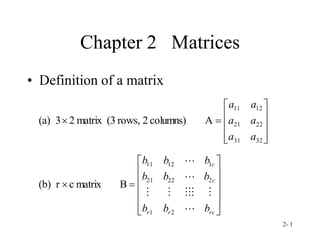
• Definition of a matrix












32
31
22
21
12
11
A
columns)
2
rows,
(3
matrix
2
3
(a)
a
a
a
a
a
a














rc
r
r
c
c
b
b
b
b
b
b
b
b
b









2
1
2
22
21
1
12
11
B
matrix
c
r
(b)
2- 2
6
4
24
-
3
4
24
3
4
1
2
2
1
1
3
2
1
1
3
2
1
E
PL
d
L
E
wL
d
L
E
wL
d
L















A system of 3 equations:
Represented by a matrix:






















1
2
1
3
1
3
6
4
1
1
24
3
4
1
24
3
1
4
E
PL
L
E
wL
L
E
wL
L
2- 3
Types of Matrices
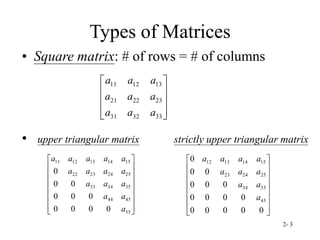
• Square matrix: # of rows = # of columns
• upper triangular matrix strictly upper triangular matrix










33
32
31
23
22
21
13
12
11
a
a
a
a
a
a
a
a
a
0
0
0
0
0
0
0
0
0
0
55
45
44
35
34
33
25
24
23
22
15
14
13
12
11
















a
a
a
a
a
a
a
a
a
a
a
a
a
a
a
0
0
0
0
0
0
0
0
0
0
0
0
0
0
0
45
35
34
25
24
23
15
14
13
12
















a
a
a
a
a
a
a
a
a
a
2- 4
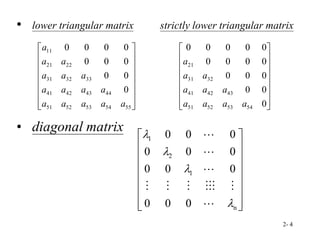
• lower triangular matrix strictly lower triangular matrix
• diagonal matrix
0
0
0
0
0
0
0
0
0
0
55
54
53
52
51
44
43
42
41
33
32
31
22
21
11
















a
a
a
a
a
a
a
a
a
a
a
a
a
a
a
0
0
0
0
0
0
0
0
0
0
0
0
0
0
0
54
53
52
51
43
42
41
32
31
21
















a
a
a
a
a
a
a
a
a
a
0
0
0
0
0
0
0
0
0
0
0
0
n
1
2
1































2- 5
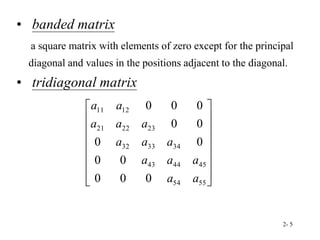
• banded matrix
a square matrix with elements of zero except for the principal
diagonal and values in the positions adjacent to the diagonal.
• tridiagonal matrix
0
0
0
0
0
0
0
0
0
0
0
0
55
54
45
44
43
34
33
32
23
22
21
12
11
















a
a
a
a
a
a
a
a
a
a
a
a
a
2- 6
• unit matrix: 1 on the principal diagonal
• null matrix: All elements are zero.
1
0
0
0
0
0
1
0
0
0
0
0
1
0
0
0
0
0
1
0
0
0
0
0
1

















Ι
0
0
0
0
0
0
0
0
0
0
0
0
0
0
0
0
0
0
0
0
0
0
0
0
0

















O
2- 7
• symmetric matrix:
a square matrix in which
• skew-symmetric matrix:
a square matrix in which for all i
and j
ji
ij a
a 
1.00
0.64
0.27
-
0.64
1.00
0.23
-
0.27
-
0.23
-
1.00










ji
ij a
a 

2- 8
• transpose of matrix A: AT
• (AT) T = A
ji
T
ij a
a 




























5
.
6
3
.
8
4
.
6
1
.
7
7
.
7
55
188
53
12
35
60
132
283
195
140
5
.
6
55
60
3
.
8
188
132
4
.
6
53
283
1
.
7
12
195
7
.
7
35
140
T
A
A
2- 9
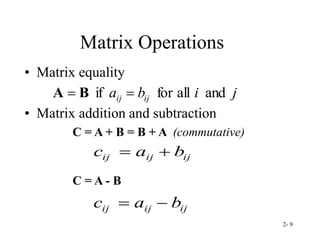
Matrix Operations
• Matrix equality
• Matrix addition and subtraction
C = A + B = B + A (commutative)
C = A - B
ij
ij
ij b
a
c 

ij
ij
ij b
a
c 

j
i
b
a ij
ij and
all
for
if 
 B
A
2- 10
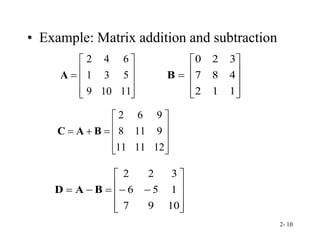
• Example: Matrix addition and subtraction
11
10
9
5
3
1
6
4
2











A
1
1
2
4
8
7
3
2
0











B
12
11
11
9
11
8
9
6
2












 B
A
C















10
9
7
1
5
6
3
2
2
B
A
D
2- 11
Matrix Multiplication
• One example
81
43
55
35
4(9)
8(3)
3(7)
4(3)
8(2)
3(5)
1(9)
6(3)
4(7)
)
3
(
1
)
2
(
6
)
5
(
4
9
3
3
2
7
5
4
8
3
1
6
4









































 C
S
T
2- 12
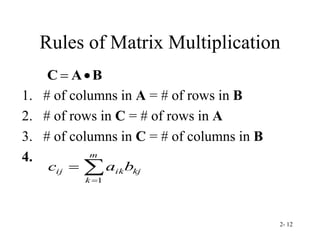
Rules of Matrix Multiplication
1. # of columns in A = # of rows in B
2. # of rows in C = # of rows in A
3. # of columns in C = # of columns in B
4.
B
A
C 




m
k
kj
ik
ij b
a
c
1
2- 13
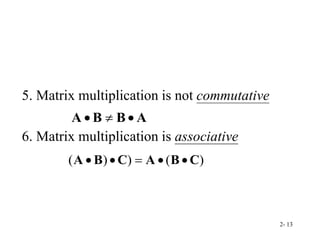
5. Matrix multiplication is not commutative
6. Matrix multiplication is associative
A
B
B
A 


)
(
)
)
( C
B
A
C
B
A 




2- 14
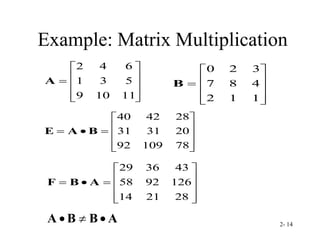
Example: Matrix Multiplication











11
10
9
5
3
1
6
4
2
A











1
1
2
4
8
7
3
2
0
B
78
109
92
20
31
31
28
42
40












 B
A
E
28
21
14
126
92
58
43
36
29












 A
B
F
A
B
B
A 


2- 15
Matrix Multiplication by a Scalar
ij
ij sa
b
s 
 A
B
10
11
10
9
5
3
1
6
4
2











 s
A












110
100
90
50
30
10
60
40
20
A
B s
An example:
2- 16
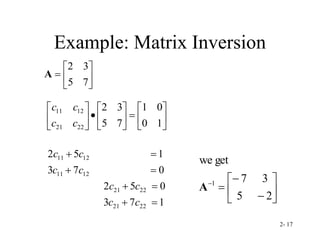
Matrix Inversion
where A-1 is the inverse of A, and I is the
unit matrix
I
A
A 1



1
c
0
c
0
c
1
c
22
22
12
21
21
22
11
21
22
12
12
11
21
12
11
11








a
c
a
a
c
a
a
c
a
a
c
a
equations
us
simultaneo
following
by the
determined
be
can
inverse
the
,
)
(
and
2
If
2
n
c
n ij

 1
A
2- 17
Example: Matrix Inversion




















1
0
0
1
7
5
3
2
22
21
12
11
c
c
c
c







7
5
3
2
A
1
7
3
0
5
2
0
7
3
1
5
2
22
21
22
21
12
11
12
11








c
c
c
c
c
c
c
c










2
5
3
7
get
we
1
A
2- 18
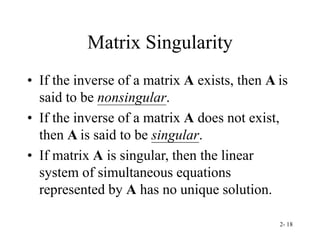
Matrix Singularity
• If the inverse of a matrix A exists, then A is
said to be nonsingular.
• If the inverse of a matrix A does not exist,
then A is said to be singular.
• If matrix A is singular, then the linear
system of simultaneous equations
represented by A has no unique solution.
2- 19
There are an infinite number of solutions if 2a = b.
There is no feasible solution if 2a  b.
Thus matrix A is singular.
b
X
X
a
X
X




2
1
2
1
6
4
3
2
6
4
3
2
Let 






A




















1
0
0
1
6
4
3
2
for
solution
No
22
21
12
11
c
c
c
c
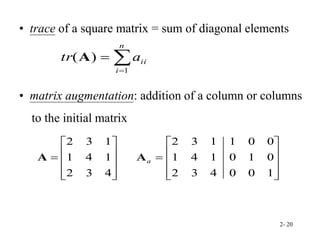
2- 20
• trace of a square matrix = sum of diagonal elements
• matrix augmentation: addition of a column or columns
to the initial matrix



n
i
ii
a
tr
1
)
(A
1
0
0
0
1
0
0
0
1
4
3
2
1
4
1
1
3
2
4
3
2
1
4
1
1
3
2





















 a
A
A
2- 21
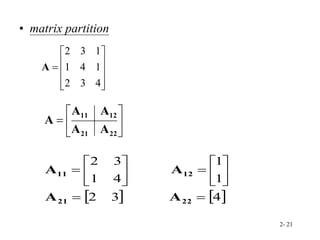
• matrix partition







22
21
12
11
A
A
A
A
A
4
3
2
1
4
1
1
3
2











A
   
4
3
2
1
1
4
1
3
2
















22
21
12
11
A
A
A
A
2- 22
Vectors
• Column vector
• Row vector
• Vectors of two ordinates
 
1
3
2










2
1
2
2- 23
• orthogonal vectors
Two vectors are said to be orthogonal if their product
is equal to zero.
If two vector are orthogonal, they are perpendicular to
each other in the n-dimensional space.
   
0
1
3
2
example,
For
3
2 








2- 24
5
0
1
2
length
vector
.
n
i
i )
v
( 


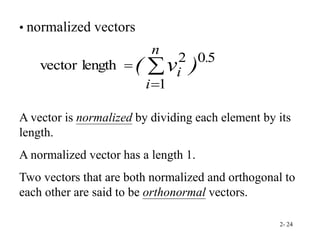
• normalized vectors
A vector is normalized by dividing each element by its
length.
A normalized vector has a length 1.
Two vectors that are both normalized and orthogonal to
each other are said to be orthonormal vectors.
2- 25
Example: Vectors
5]
3
-
[2
1 
V
1
1
1
2











V
6.164
38
)
5
(
)
3
(
(2)
of
length 2
2
2
1 





V
732
.
1
3
)
1
(
)
1
(
(-1)
of
length 2
2
2
2 




V
2- 26





 

38
5
38
3
38
2
1n
V





 

3
1
3
1
3
1
2n
V
Normalized vectors:
l.
orthonorma
are
and
.
orthogonal
are
and
,
0
Since
2
1
1
1
n
n V
V
V
V
V
V 2
2 

2- 27
Determinants
• A determinant of a matrix A is denoted by |A|.
• The determinant of a 22 matrix:
• The determinant of a 33 matrix:
bc
ad
c d
a b


a
a
a
a
a
a
a
a
a
a
a
a
a
a
a
a
a
a
a
a
a
a
a
a
32
31
22
21
13
33
31
23
21
12
33
32
23
22
11
33
32
31
23
22
21
13
12
11



2- 28
• The minor of aij, denoted by Aij, is the matrix after
removing row i and column j.
• The determinant of an nn matrix:
• The general expression for the determinant
of an nn matrix:
|
|
a
1)
(
|
|
a
|
|
a
|
|
a
|
| 1n
1
n
13
12
11 1n
13
12
11 A
A
A
A
A 





 
|
|
)
1
(
|
|
)
1
(
|
|
)
1
(
|
|
)
1
(
|
| 3
3
3
2
2
2
1
1
1
in
in
n
i
i
i
i
i
i
i
i
i
i
a
a
a
a A
A
A
A
A 











 
2- 29
Example: Matrix Determinant
• with the first row and their minors:











11
10
9
5
3
1
6
4
2
A
|
|
|
|
|
|
|
| 13
12
11 13
12
11 A
A
A
A a
a
a 


0
)]
9
(
3
)
10
(
1
[
6
)]
9
(
5
)
11
(
1
[
4
)]
10
(
5
2[3(11)
10
9
3
1
6
11
9
5
1
4
11
10
5
3
2
11
10
9
5
3
1
6
4
2
|
|











A
2- 30
• with the second column and their minors:
• Since |A|=0, A is a singular matrix; that is the
inverse of A doest not exist.
|
|
|
|
|
|
|
| 23
22
12 23
22
12 A
A
A
A a
a
a 



0
]
6
10
[
10
]
54
22
[
3
]
45
11
[
4
5
1
6
2
10
11
9
6
2
3
11
9
5
1
4
11
10
9
5
3
1
6
4
2
|
|













A











11
10
9
5
3
1
6
4
2
A
2- 31
Properties of Determinants
1. If the values in any row (column) are proportional
to the corresponding values in another
row(column), the determinant equals zero
0
|
|
where
,
3
5
3
2
14
2
1
2
1











 A
A
0
|
|
where
,
6
5
3
4
14
2
2
2
1











 A
A
2- 32
2. If all the elements in any row(column) equal zero,
the determinant equals zero.
3. If all the elements of any row(column) are
multiplied by a constant c, the value of the
determinant is multiplied by c.
14
)]
4
(
2
)
5
(
3
[
2
|
|
where
,
5
4
)
2
(
2
)
3
(
2
5
4
4
6
















 A
A
2- 33
4. The value of the determinant is not changed by adding any
row (column) multiplied by a constant c to another row
(column).
5. If any two rows (columns) are interchanged, the sign of the
determinant is changed.
7
)]
4
(
2
)
5
(
3
|
|
where
,
5
4
2
3









 A
A
7
)
4
(
3
)
5
(
1
|
|
where
,
5
4
3
-
1
-










 B
B
-7
3(5)
-
2(4)
4
5
3
2
and
7
2(4)
-
3(5)
5
4
2
3




2- 34
6. The determinant of a matrix equals that of its
transpose; that is, |A| = |AT|.
7. If a matrix A is placed in diagonal form, then the
product of the elements on the diagonal equals the
determinant of A.
7
4(2)
-
3(5)
5
2
4
3
and
7
2(4)
-
3(5)
5
4
2
3




7
)
3
7
(
3
3
7
0
0
3
|
|
3
7
0
0
3
3
7
0
2
3
7
2(4)
3(5)
|
A
|
with
,
5
4
2
3































A
A
A
2- 35
8. If a matrix A has a zero determinant, then A is a
singular matrix; that is, the inverse of A does not
exist.
2- 36
Rank of A Matrix
• A matrix of r rows and c columns is said to be of
order r by c. If it is a square matrix, r by r, then
the matrix is of order r.
• The rank of a matrix equals the order of highest-
order nonsingular submatrix.
2- 37
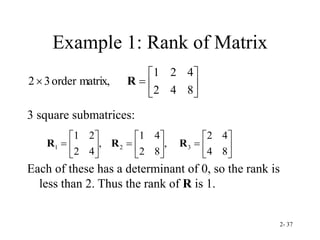
3 square submatrices:
Each of these has a determinant of 0, so the rank is
less than 2. Thus the rank of R is 1.
Example 1: Rank of Matrix








8
4
2
4
2
1
matrix,
order
3
2 R
8
4
4
2
,
8
2
4
1
,
4
2
2
1
3
2
1 



















 R
R
R
2- 38
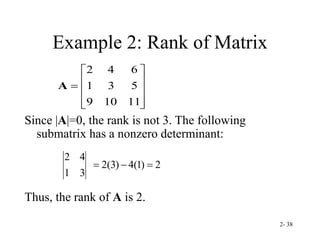
Since |A|=0, the rank is not 3. The following
submatrix has a nonzero determinant:
Thus, the rank of A is 2.
Example 2: Rank of Matrix











11
10
9
5
3
1
6
4
2
A
2
)
1
(
4
)
3
(
2
3
1
4
2




Matrices

  • 1.
    2- 1 Chapter 2Matrices • Definition of a matrix             32 31 22 21 12 11 A columns) 2 rows, (3 matrix 2 3 (a) a a a a a a               rc r r c c b b b b b b b b b          2 1 2 22 21 1 12 11 B matrix c r (b)
  • 2.
    2- 2 6 4 24 - 3 4 24 3 4 1 2 2 1 1 3 2 1 1 3 2 1 E PL d L E wL d L E wL d L                A systemof 3 equations: Represented by a matrix:                       1 2 1 3 1 3 6 4 1 1 24 3 4 1 24 3 1 4 E PL L E wL L E wL L
  • 3.
    2- 3 Types ofMatrices • Square matrix: # of rows = # of columns • upper triangular matrix strictly upper triangular matrix           33 32 31 23 22 21 13 12 11 a a a a a a a a a 0 0 0 0 0 0 0 0 0 0 55 45 44 35 34 33 25 24 23 22 15 14 13 12 11                 a a a a a a a a a a a a a a a 0 0 0 0 0 0 0 0 0 0 0 0 0 0 0 45 35 34 25 24 23 15 14 13 12                 a a a a a a a a a a
  • 4.
    2- 4 • lowertriangular matrix strictly lower triangular matrix • diagonal matrix 0 0 0 0 0 0 0 0 0 0 55 54 53 52 51 44 43 42 41 33 32 31 22 21 11                 a a a a a a a a a a a a a a a 0 0 0 0 0 0 0 0 0 0 0 0 0 0 0 54 53 52 51 43 42 41 32 31 21                 a a a a a a a a a a 0 0 0 0 0 0 0 0 0 0 0 0 n 1 2 1                               
  • 5.
    2- 5 • bandedmatrix a square matrix with elements of zero except for the principal diagonal and values in the positions adjacent to the diagonal. • tridiagonal matrix 0 0 0 0 0 0 0 0 0 0 0 0 55 54 45 44 43 34 33 32 23 22 21 12 11                 a a a a a a a a a a a a a
  • 6.
    2- 6 • unitmatrix: 1 on the principal diagonal • null matrix: All elements are zero. 1 0 0 0 0 0 1 0 0 0 0 0 1 0 0 0 0 0 1 0 0 0 0 0 1                  Ι 0 0 0 0 0 0 0 0 0 0 0 0 0 0 0 0 0 0 0 0 0 0 0 0 0                  O
  • 7.
    2- 7 • symmetricmatrix: a square matrix in which • skew-symmetric matrix: a square matrix in which for all i and j ji ij a a  1.00 0.64 0.27 - 0.64 1.00 0.23 - 0.27 - 0.23 - 1.00           ji ij a a  
  • 8.
    2- 8 • transposeof matrix A: AT • (AT) T = A ji T ij a a                              5 . 6 3 . 8 4 . 6 1 . 7 7 . 7 55 188 53 12 35 60 132 283 195 140 5 . 6 55 60 3 . 8 188 132 4 . 6 53 283 1 . 7 12 195 7 . 7 35 140 T A A
  • 9.
    2- 9 Matrix Operations •Matrix equality • Matrix addition and subtraction C = A + B = B + A (commutative) C = A - B ij ij ij b a c   ij ij ij b a c   j i b a ij ij and all for if   B A
  • 10.
    2- 10 • Example:Matrix addition and subtraction 11 10 9 5 3 1 6 4 2            A 1 1 2 4 8 7 3 2 0            B 12 11 11 9 11 8 9 6 2              B A C                10 9 7 1 5 6 3 2 2 B A D
  • 11.
    2- 11 Matrix Multiplication •One example 81 43 55 35 4(9) 8(3) 3(7) 4(3) 8(2) 3(5) 1(9) 6(3) 4(7) ) 3 ( 1 ) 2 ( 6 ) 5 ( 4 9 3 3 2 7 5 4 8 3 1 6 4                                           C S T
  • 12.
    2- 12 Rules ofMatrix Multiplication 1. # of columns in A = # of rows in B 2. # of rows in C = # of rows in A 3. # of columns in C = # of columns in B 4. B A C      m k kj ik ij b a c 1
  • 13.
    2- 13 5. Matrixmultiplication is not commutative 6. Matrix multiplication is associative A B B A    ) ( ) ) ( C B A C B A     
  • 14.
    2- 14 Example: MatrixMultiplication            11 10 9 5 3 1 6 4 2 A            1 1 2 4 8 7 3 2 0 B 78 109 92 20 31 31 28 42 40              B A E 28 21 14 126 92 58 43 36 29              A B F A B B A   
  • 15.
    2- 15 Matrix Multiplicationby a Scalar ij ij sa b s   A B 10 11 10 9 5 3 1 6 4 2             s A             110 100 90 50 30 10 60 40 20 A B s An example:
  • 16.
    2- 16 Matrix Inversion whereA-1 is the inverse of A, and I is the unit matrix I A A 1    1 c 0 c 0 c 1 c 22 22 12 21 21 22 11 21 22 12 12 11 21 12 11 11         a c a a c a a c a a c a equations us simultaneo following by the determined be can inverse the , ) ( and 2 If 2 n c n ij   1 A
  • 17.
    2- 17 Example: MatrixInversion                     1 0 0 1 7 5 3 2 22 21 12 11 c c c c        7 5 3 2 A 1 7 3 0 5 2 0 7 3 1 5 2 22 21 22 21 12 11 12 11         c c c c c c c c           2 5 3 7 get we 1 A
  • 18.
    2- 18 Matrix Singularity •If the inverse of a matrix A exists, then A is said to be nonsingular. • If the inverse of a matrix A does not exist, then A is said to be singular. • If matrix A is singular, then the linear system of simultaneous equations represented by A has no unique solution.
  • 19.
    2- 19 There arean infinite number of solutions if 2a = b. There is no feasible solution if 2a  b. Thus matrix A is singular. b X X a X X     2 1 2 1 6 4 3 2 6 4 3 2 Let        A                     1 0 0 1 6 4 3 2 for solution No 22 21 12 11 c c c c
  • 20.
    2- 20 • traceof a square matrix = sum of diagonal elements • matrix augmentation: addition of a column or columns to the initial matrix    n i ii a tr 1 ) (A 1 0 0 0 1 0 0 0 1 4 3 2 1 4 1 1 3 2 4 3 2 1 4 1 1 3 2                       a A A
  • 21.
    2- 21 • matrixpartition        22 21 12 11 A A A A A 4 3 2 1 4 1 1 3 2            A     4 3 2 1 1 4 1 3 2                 22 21 12 11 A A A A
  • 22.
    2- 22 Vectors • Columnvector • Row vector • Vectors of two ordinates   1 3 2           2 1 2
  • 23.
    2- 23 • orthogonalvectors Two vectors are said to be orthogonal if their product is equal to zero. If two vector are orthogonal, they are perpendicular to each other in the n-dimensional space.     0 1 3 2 example, For 3 2         
  • 24.
    2- 24 5 0 1 2 length vector . n i i ) v (   • normalized vectors A vector is normalized by dividing each element by its length. A normalized vector has a length 1. Two vectors that are both normalized and orthogonal to each other are said to be orthonormal vectors.
  • 25.
    2- 25 Example: Vectors 5] 3 - [2 1 V 1 1 1 2            V 6.164 38 ) 5 ( ) 3 ( (2) of length 2 2 2 1       V 732 . 1 3 ) 1 ( ) 1 ( (-1) of length 2 2 2 2      V
  • 26.
    2- 26         38 5 38 3 38 2 1n V        3 1 3 1 3 1 2n V Normalized vectors: l. orthonorma are and . orthogonal are and , 0 Since 2 1 1 1 n n V V V V V V 2 2  
  • 27.
    2- 27 Determinants • Adeterminant of a matrix A is denoted by |A|. • The determinant of a 22 matrix: • The determinant of a 33 matrix: bc ad c d a b   a a a a a a a a a a a a a a a a a a a a a a a a 32 31 22 21 13 33 31 23 21 12 33 32 23 22 11 33 32 31 23 22 21 13 12 11   
  • 28.
    2- 28 • Theminor of aij, denoted by Aij, is the matrix after removing row i and column j. • The determinant of an nn matrix: • The general expression for the determinant of an nn matrix: | | a 1) ( | | a | | a | | a | | 1n 1 n 13 12 11 1n 13 12 11 A A A A A         | | ) 1 ( | | ) 1 ( | | ) 1 ( | | ) 1 ( | | 3 3 3 2 2 2 1 1 1 in in n i i i i i i i i i i a a a a A A A A A              
  • 29.
    2- 29 Example: MatrixDeterminant • with the first row and their minors:            11 10 9 5 3 1 6 4 2 A | | | | | | | | 13 12 11 13 12 11 A A A A a a a    0 )] 9 ( 3 ) 10 ( 1 [ 6 )] 9 ( 5 ) 11 ( 1 [ 4 )] 10 ( 5 2[3(11) 10 9 3 1 6 11 9 5 1 4 11 10 5 3 2 11 10 9 5 3 1 6 4 2 | |            A
  • 30.
    2- 30 • withthe second column and their minors: • Since |A|=0, A is a singular matrix; that is the inverse of A doest not exist. | | | | | | | | 23 22 12 23 22 12 A A A A a a a     0 ] 6 10 [ 10 ] 54 22 [ 3 ] 45 11 [ 4 5 1 6 2 10 11 9 6 2 3 11 9 5 1 4 11 10 9 5 3 1 6 4 2 | |              A            11 10 9 5 3 1 6 4 2 A
  • 31.
    2- 31 Properties ofDeterminants 1. If the values in any row (column) are proportional to the corresponding values in another row(column), the determinant equals zero 0 | | where , 3 5 3 2 14 2 1 2 1             A A 0 | | where , 6 5 3 4 14 2 2 2 1             A A
  • 32.
    2- 32 2. Ifall the elements in any row(column) equal zero, the determinant equals zero. 3. If all the elements of any row(column) are multiplied by a constant c, the value of the determinant is multiplied by c. 14 )] 4 ( 2 ) 5 ( 3 [ 2 | | where , 5 4 ) 2 ( 2 ) 3 ( 2 5 4 4 6                  A A
  • 33.
    2- 33 4. Thevalue of the determinant is not changed by adding any row (column) multiplied by a constant c to another row (column). 5. If any two rows (columns) are interchanged, the sign of the determinant is changed. 7 )] 4 ( 2 ) 5 ( 3 | | where , 5 4 2 3           A A 7 ) 4 ( 3 ) 5 ( 1 | | where , 5 4 3 - 1 -            B B -7 3(5) - 2(4) 4 5 3 2 and 7 2(4) - 3(5) 5 4 2 3    
  • 34.
    2- 34 6. Thedeterminant of a matrix equals that of its transpose; that is, |A| = |AT|. 7. If a matrix A is placed in diagonal form, then the product of the elements on the diagonal equals the determinant of A. 7 4(2) - 3(5) 5 2 4 3 and 7 2(4) - 3(5) 5 4 2 3     7 ) 3 7 ( 3 3 7 0 0 3 | | 3 7 0 0 3 3 7 0 2 3 7 2(4) 3(5) | A | with , 5 4 2 3                                A A A
  • 35.
    2- 35 8. Ifa matrix A has a zero determinant, then A is a singular matrix; that is, the inverse of A does not exist.
  • 36.
    2- 36 Rank ofA Matrix • A matrix of r rows and c columns is said to be of order r by c. If it is a square matrix, r by r, then the matrix is of order r. • The rank of a matrix equals the order of highest- order nonsingular submatrix.
  • 37.
    2- 37 3 squaresubmatrices: Each of these has a determinant of 0, so the rank is less than 2. Thus the rank of R is 1. Example 1: Rank of Matrix         8 4 2 4 2 1 matrix, order 3 2 R 8 4 4 2 , 8 2 4 1 , 4 2 2 1 3 2 1                      R R R
  • 38.
    2- 38 Since |A|=0,the rank is not 3. The following submatrix has a nonzero determinant: Thus, the rank of A is 2. Example 2: Rank of Matrix            11 10 9 5 3 1 6 4 2 A 2 ) 1 ( 4 ) 3 ( 2 3 1 4 2   