The presentation covers the definition and operations of matrices, including addition, subtraction, scalar multiplication, and multiplication, along with properties and applications in various fields such as geology, statistics, animation, and physics. Key concepts such as determinants, inverse matrices, and the representation of linear systems as matrix equations are also discussed. Overall, it highlights the significance of matrices in mathematical computations and real-world applications.
Presentation on
Matrix andit`sApplications
Presented by
Pritom Chaki
Roll: 19021060
MBA (Professional) Batch-21
Bangladesh University of Professionals
1
2.
Contents
Definition of aMatrix
Operations of Matrices
Determinant of Matrix
Inverse of Matrix
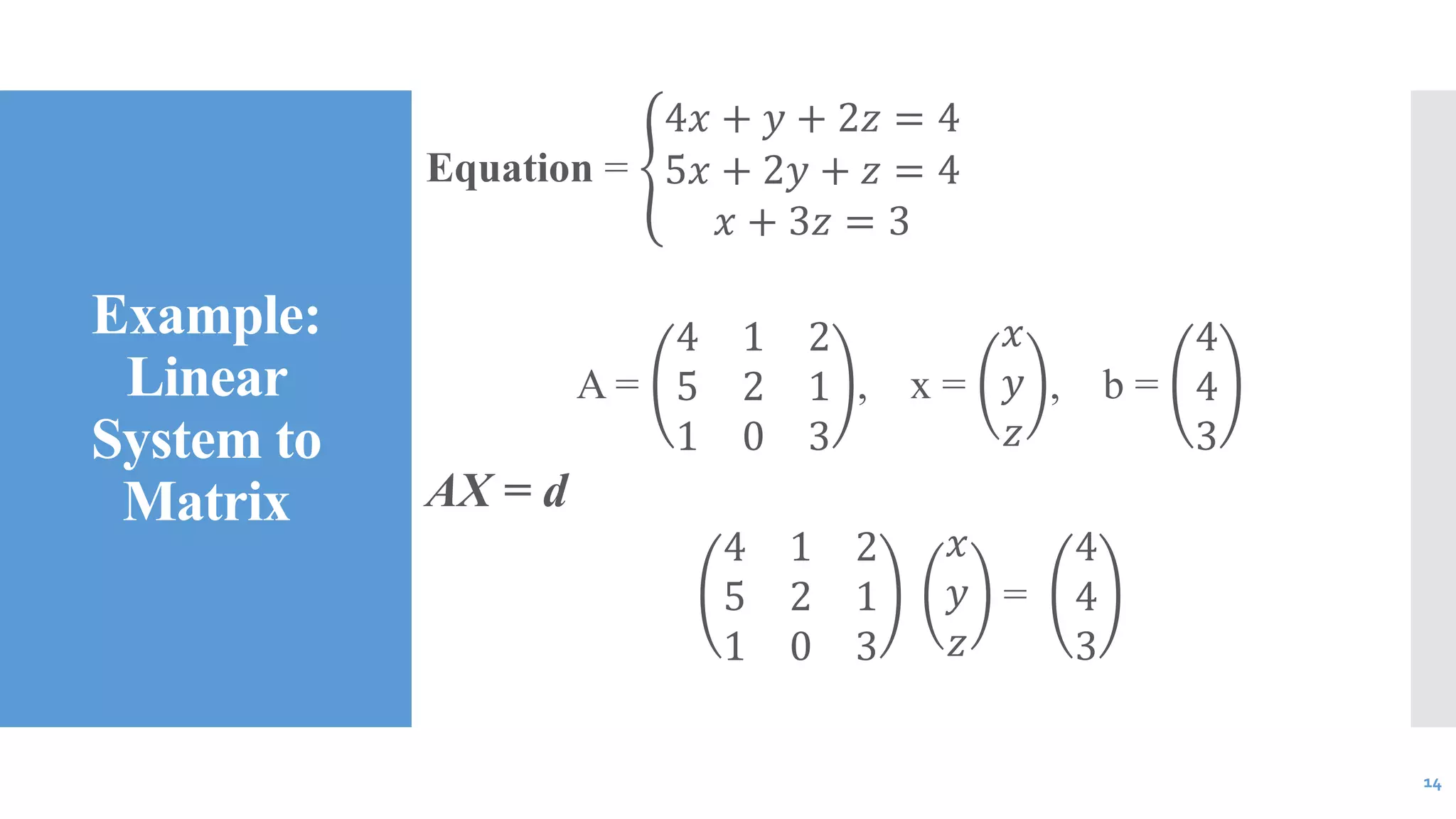
Linear System to Matrix
Unique Properties of Matrix
Applications of Matrices
2
3.
Matrix
(Basic
Definition)
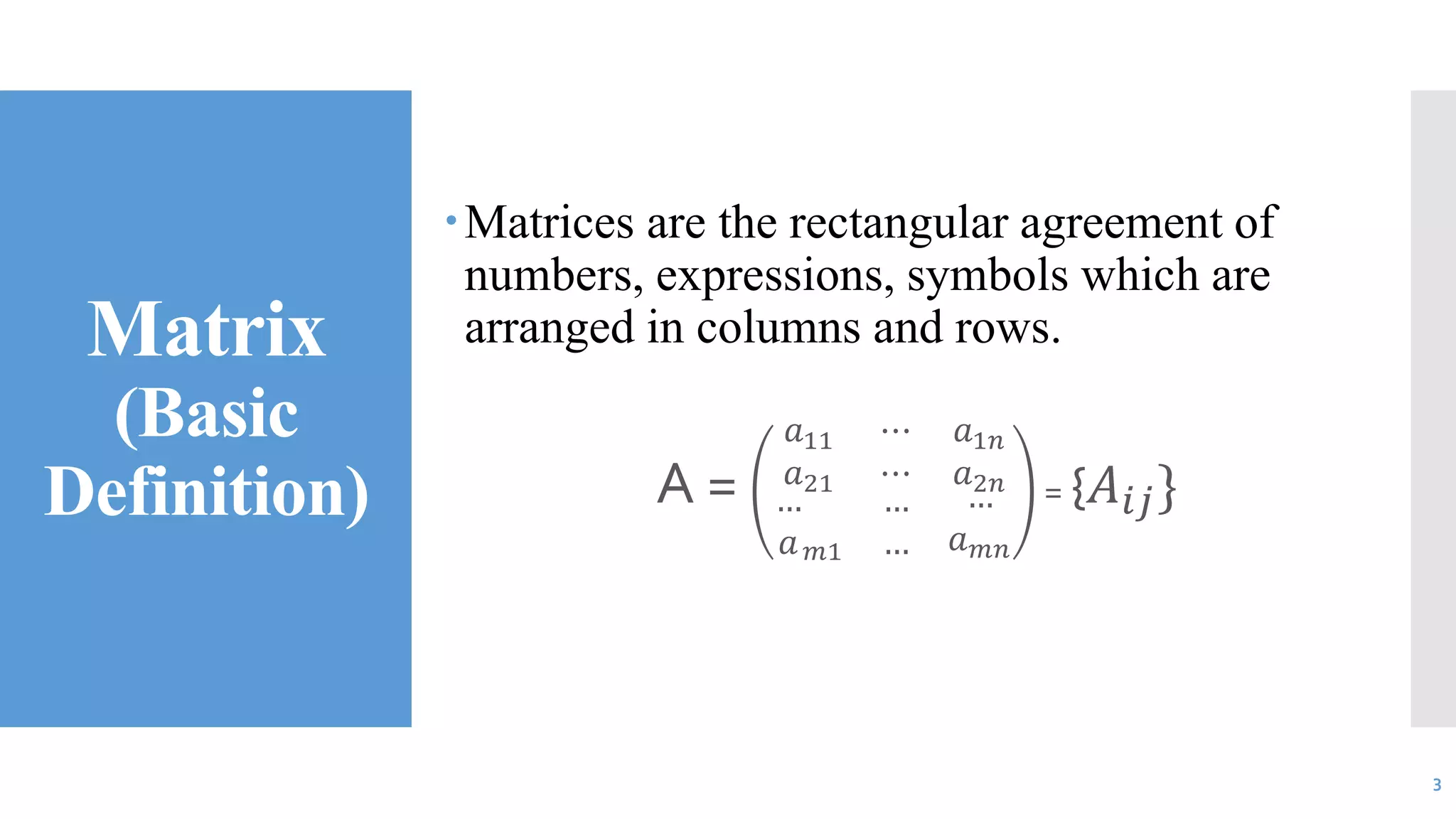
Matrices are therectangular agreement of
numbers, expressions, symbols which are
arranged in columns and rows.
A =
𝑎11 ⋯ 𝑎1𝑛
𝑎21 ⋯ 𝑎2𝑛
…
𝑎 𝑚1
…
…
…
𝑎 𝑚𝑛
= {𝐴𝑖𝑗}
3
4.
Operations
with
Matrices
(Sum,
Difference)
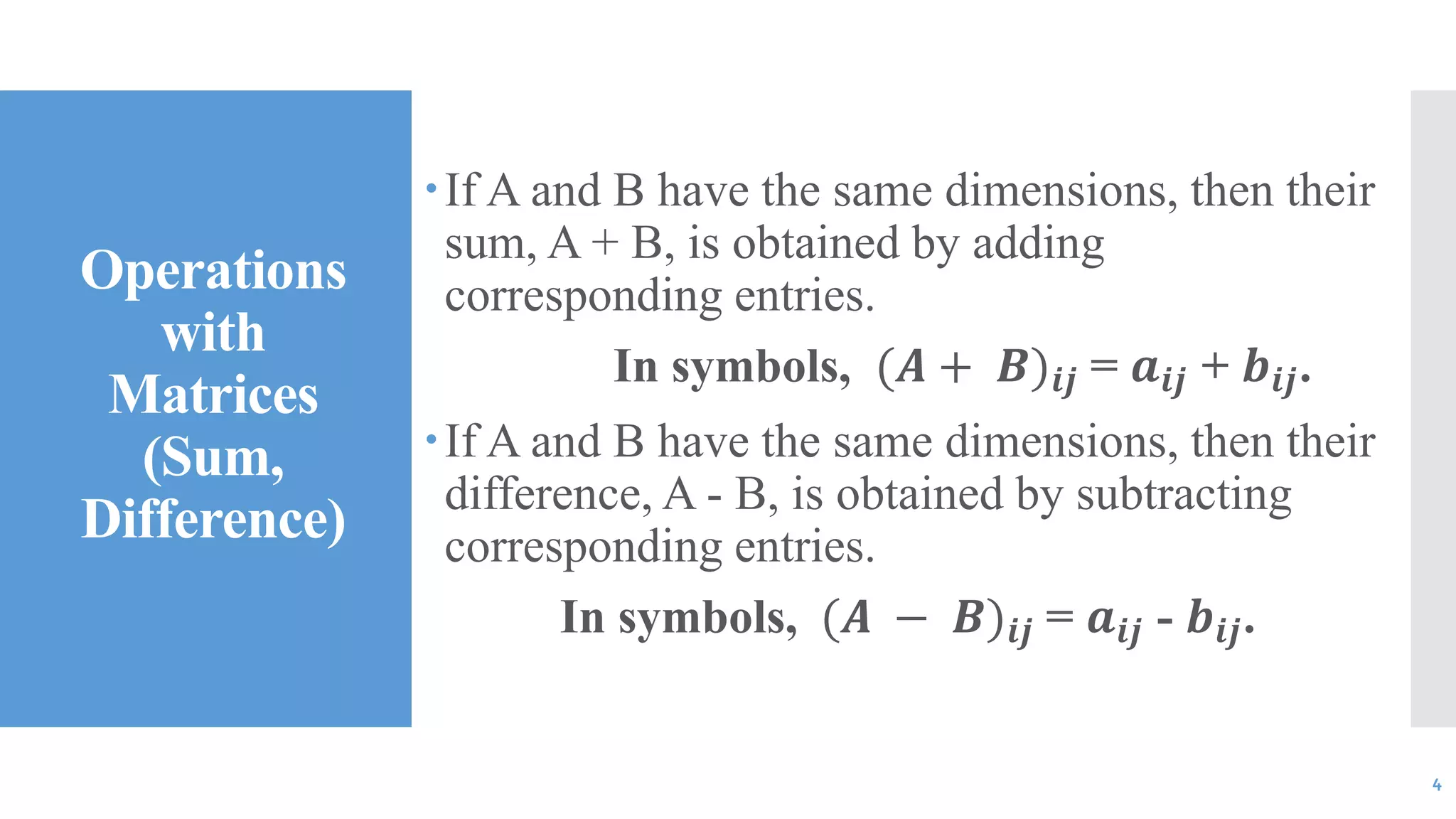
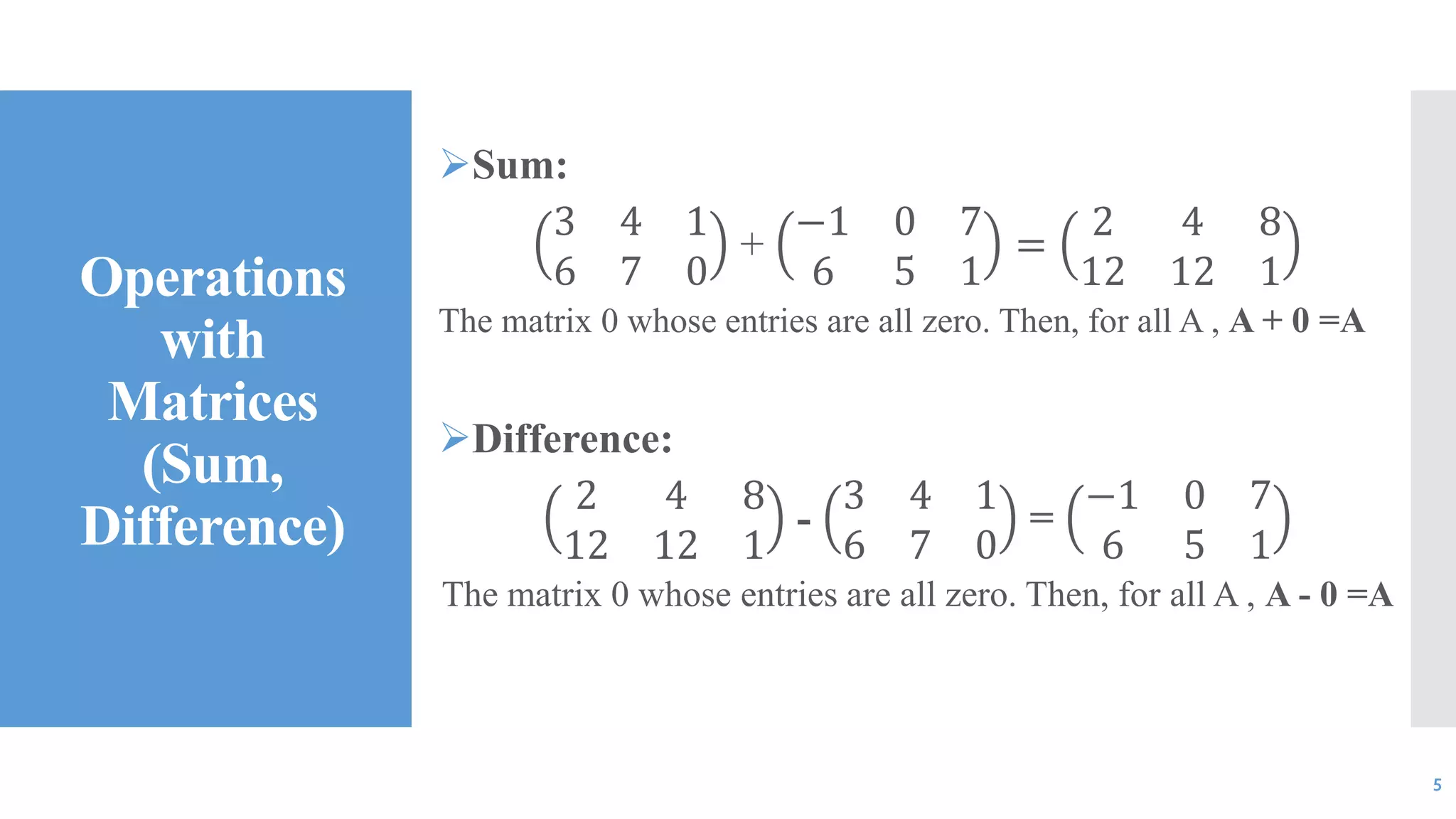
If A andB have the same dimensions, then their
sum, A + B, is obtained by adding
corresponding entries.
In symbols, (𝑨 + 𝑩)𝒊𝒋 = 𝒂𝒊𝒋 + 𝒃𝒊𝒋.
If A and B have the same dimensions, then their
difference, A - B, is obtained by subtracting
corresponding entries.
In symbols, (𝑨 − 𝑩)𝒊𝒋 = 𝒂𝒊𝒋 - 𝒃𝒊𝒋.
4
5.
Operations
with
Matrices
(Sum,
Difference)
Sum:
3 4 1
67 0
+
−1 0 7
6 5 1
=
2 4 8
12 12 1
The matrix 0 whose entries are all zero. Then, for all A , A + 0 =A
Difference:
2 4 8
12 12 1
-
3 4 1
6 7 0
=
−1 0 7
6 5 1
The matrix 0 whose entries are all zero. Then, for all A , A - 0 =A
5
6.
Operations
with Matrices
(Scalar
Multiple)
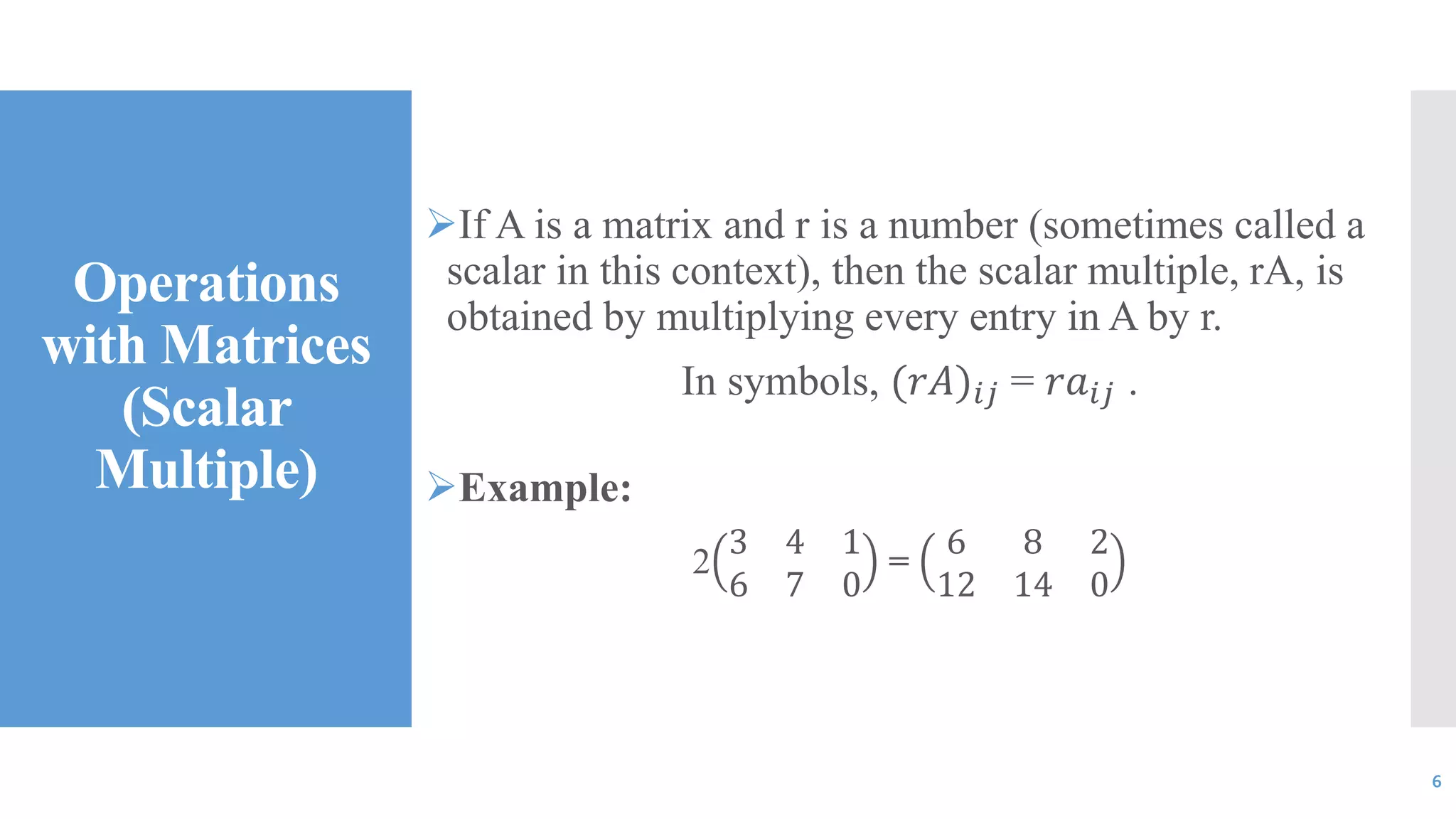
If Ais a matrix and r is a number (sometimes called a
scalar in this context), then the scalar multiple, rA, is
obtained by multiplying every entry in A by r.
In symbols, (𝑟𝐴)𝑖𝑗 = 𝑟𝑎𝑖𝑗 .
Example:
2
3 4 1
6 7 0
=
6 8 2
12 14 0
6
7.
Operations
with Matrices
(Product)
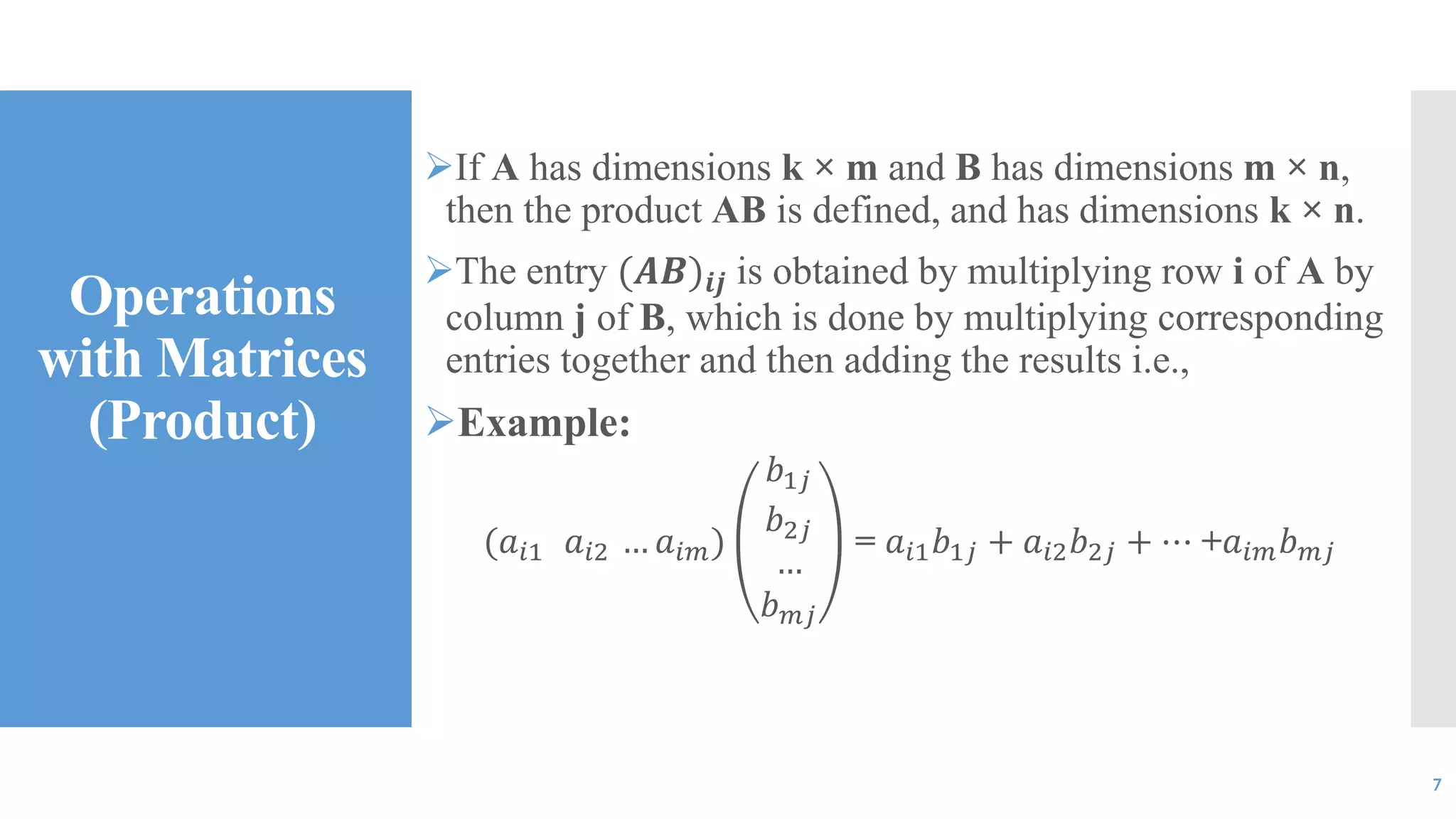
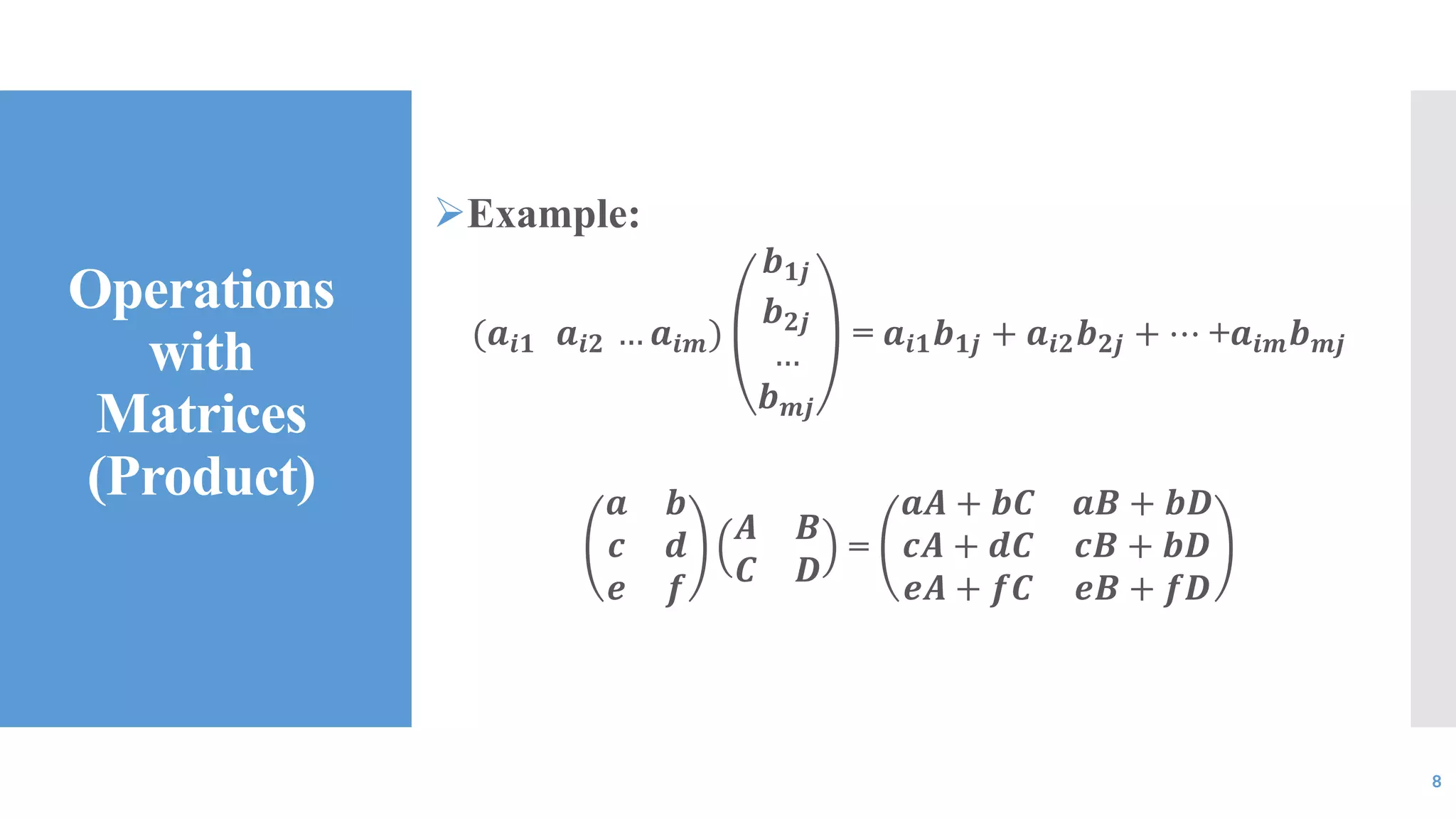
If Ahas dimensions k × m and B has dimensions m × n,
then the product AB is defined, and has dimensions k × n.
The entry (𝑨𝑩)𝒊𝒋 is obtained by multiplying row i of A by
column j of B, which is done by multiplying corresponding
entries together and then adding the results i.e.,
Example:
(𝑎𝑖1 𝑎𝑖2 … 𝑎𝑖𝑚)
𝑏1𝑗
𝑏2𝑗
…
𝑏 𝑚𝑗
= 𝑎𝑖1 𝑏1𝑗 + 𝑎𝑖2 𝑏2𝑗 + ⋯ +𝑎𝑖𝑚 𝑏 𝑚𝑗
7
Operations
with Matrices
(Transpose)
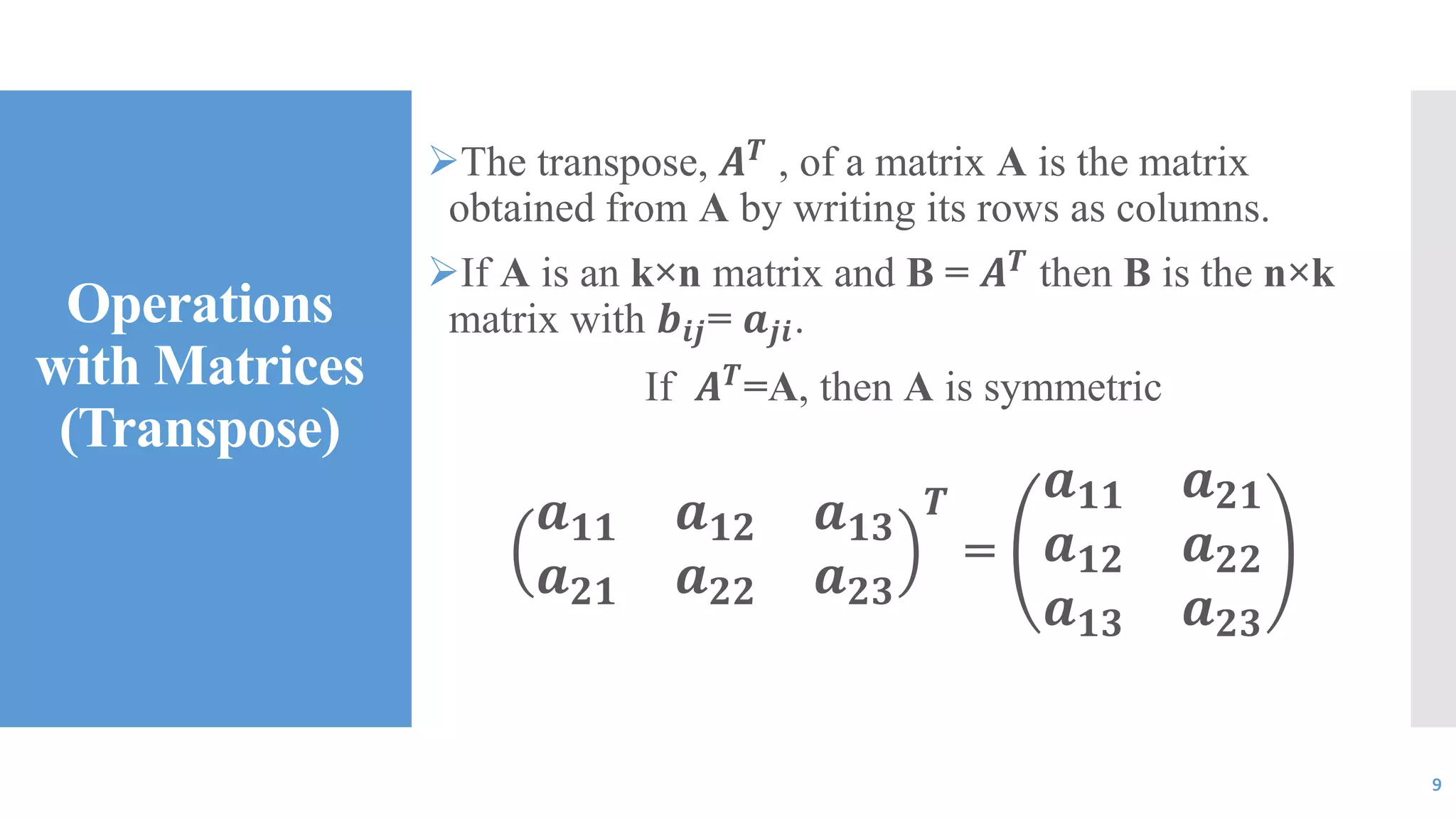
The transpose,𝑨 𝑻 , of a matrix A is the matrix
obtained from A by writing its rows as columns.
If A is an k×n matrix and B = 𝑨 𝑻 then B is the n×k
matrix with 𝒃𝒊𝒋= 𝒂𝒋𝒊.
If 𝑨 𝑻=A, then A is symmetric
𝒂 𝟏𝟏 𝒂 𝟏𝟐 𝒂 𝟏𝟑
𝒂 𝟐𝟏 𝒂 𝟐𝟐 𝒂 𝟐𝟑
𝑻
=
𝒂 𝟏𝟏 𝒂 𝟐𝟏
𝒂 𝟏𝟐 𝒂 𝟐𝟐
𝒂 𝟏𝟑 𝒂 𝟐𝟑
9
10.
Laws of
Matrix
Algebra
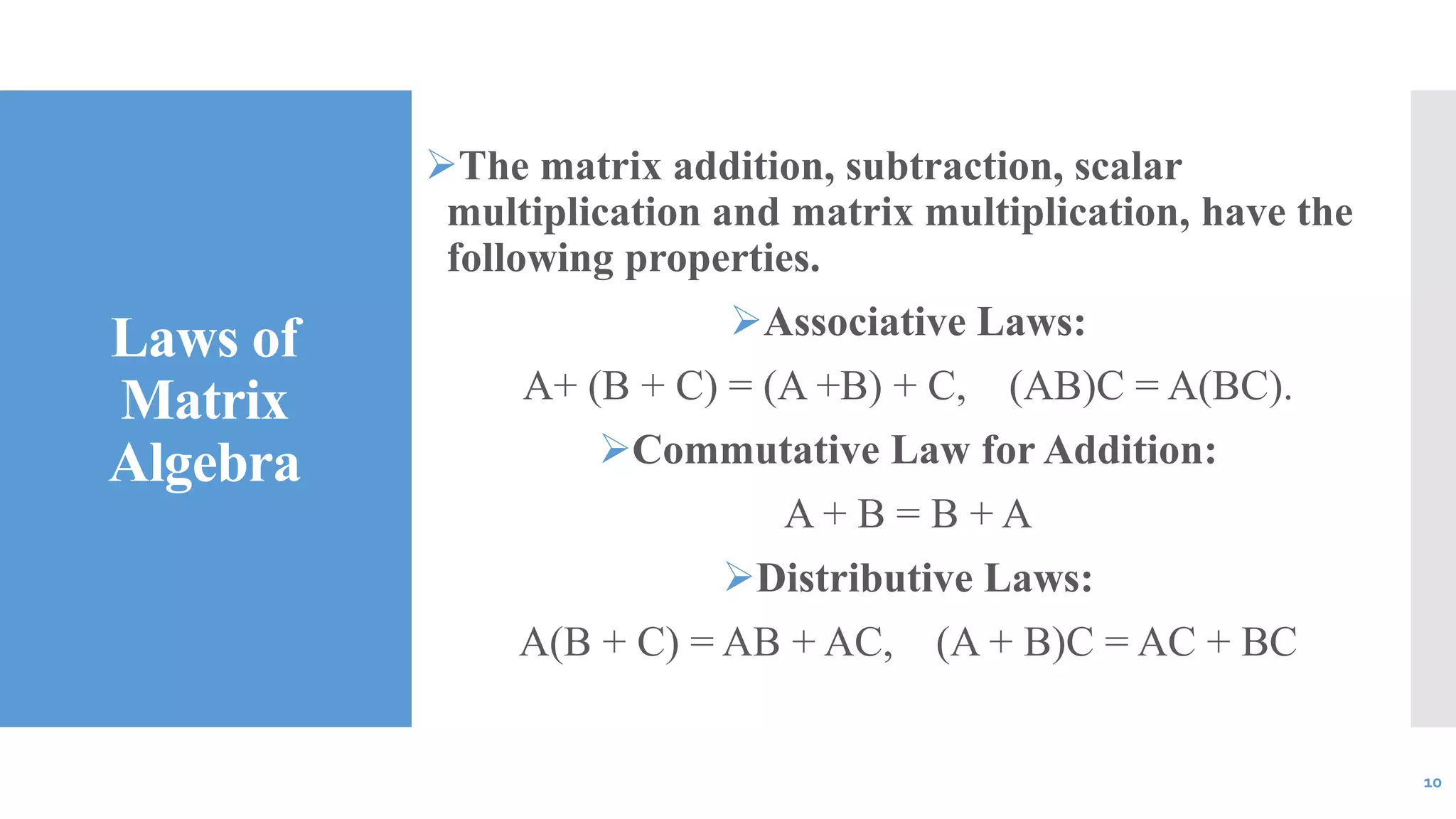
The matrixaddition, subtraction, scalar
multiplication and matrix multiplication, have the
following properties.
Associative Laws:
A+ (B + C) = (A +B) + C, (AB)C = A(BC).
Commutative Law for Addition:
A + B = B + A
Distributive Laws:
A(B + C) = AB + AC, (A + B)C = AC + BC
10
11.
Determinant
of Matrix
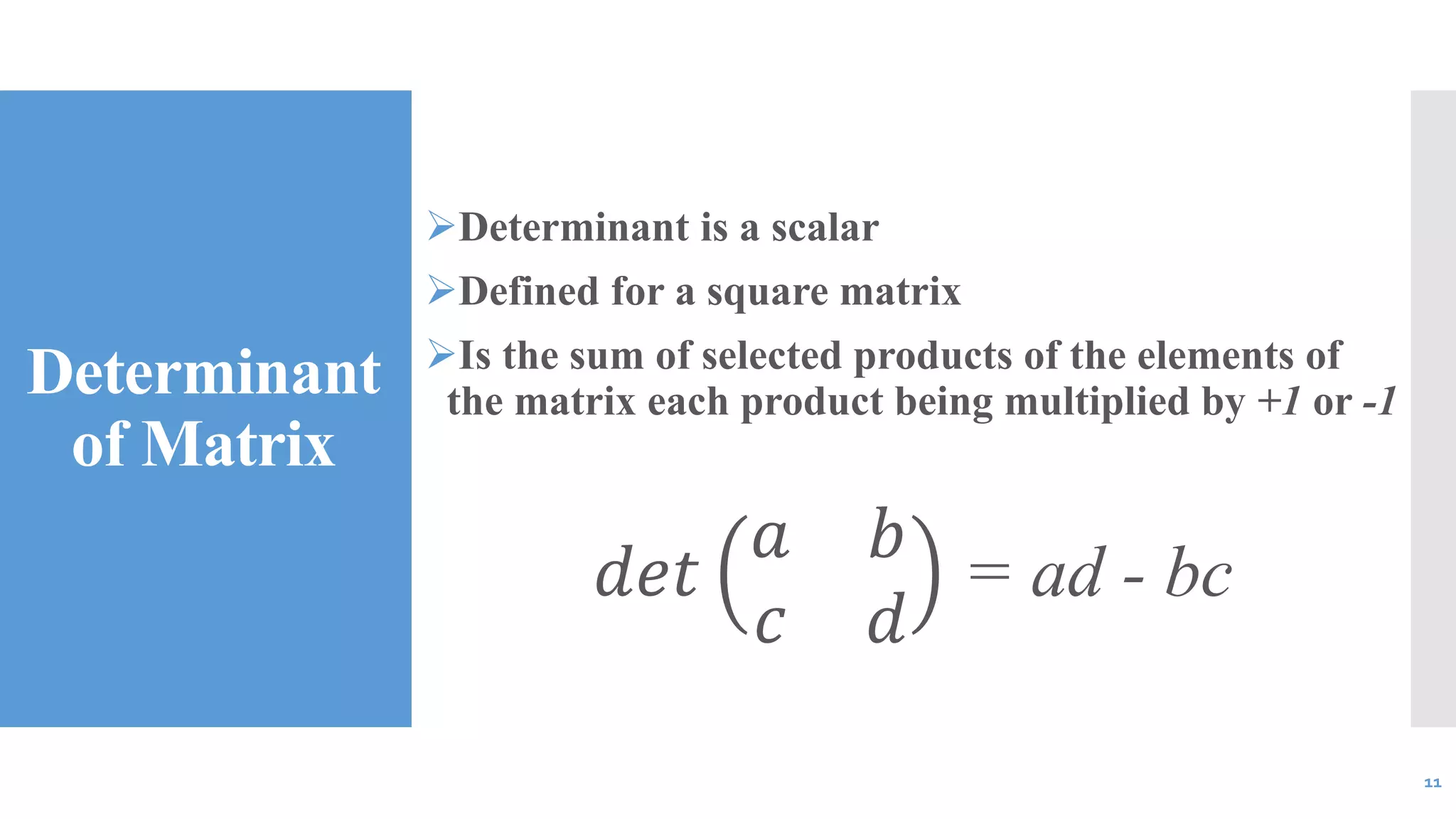
Determinant isa scalar
Defined for a square matrix
Is the sum of selected products of the elements of
the matrix each product being multiplied by +1 or -1
𝑑𝑒𝑡
𝑎 𝑏
𝑐 𝑑
= ad - bc
11
12.
Inverse of
Matrix
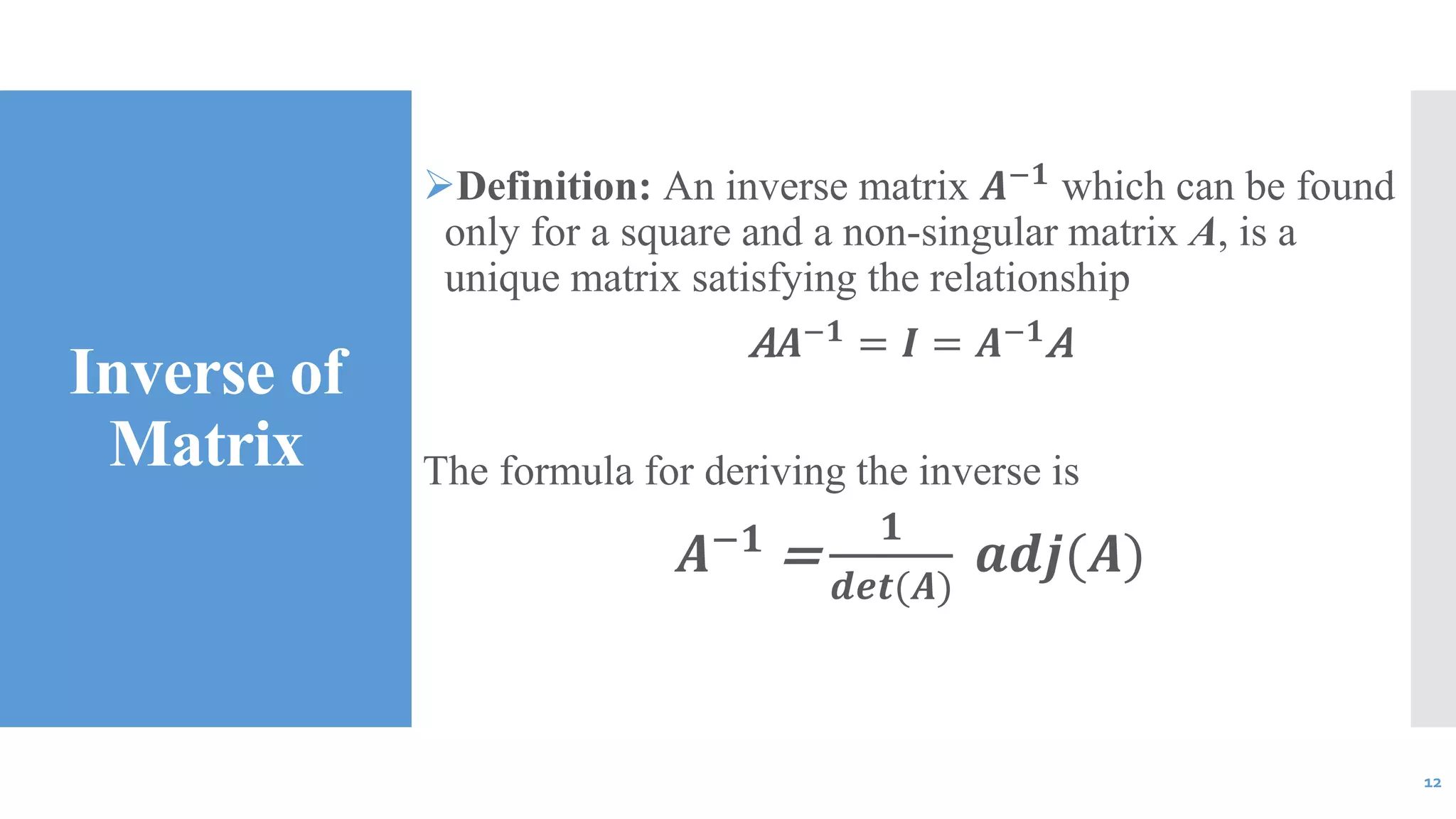
Definition: Aninverse matrix 𝑨−𝟏
which can be found
only for a square and a non-singular matrix A, is a
unique matrix satisfying the relationship
A 𝑨−𝟏
= 𝑰 = 𝑨−𝟏
A
The formula for deriving the inverse is
𝑨−𝟏
=
𝟏
𝒅𝒆𝒕(𝑨)
𝒂𝒅𝒋(𝑨)
12
13.
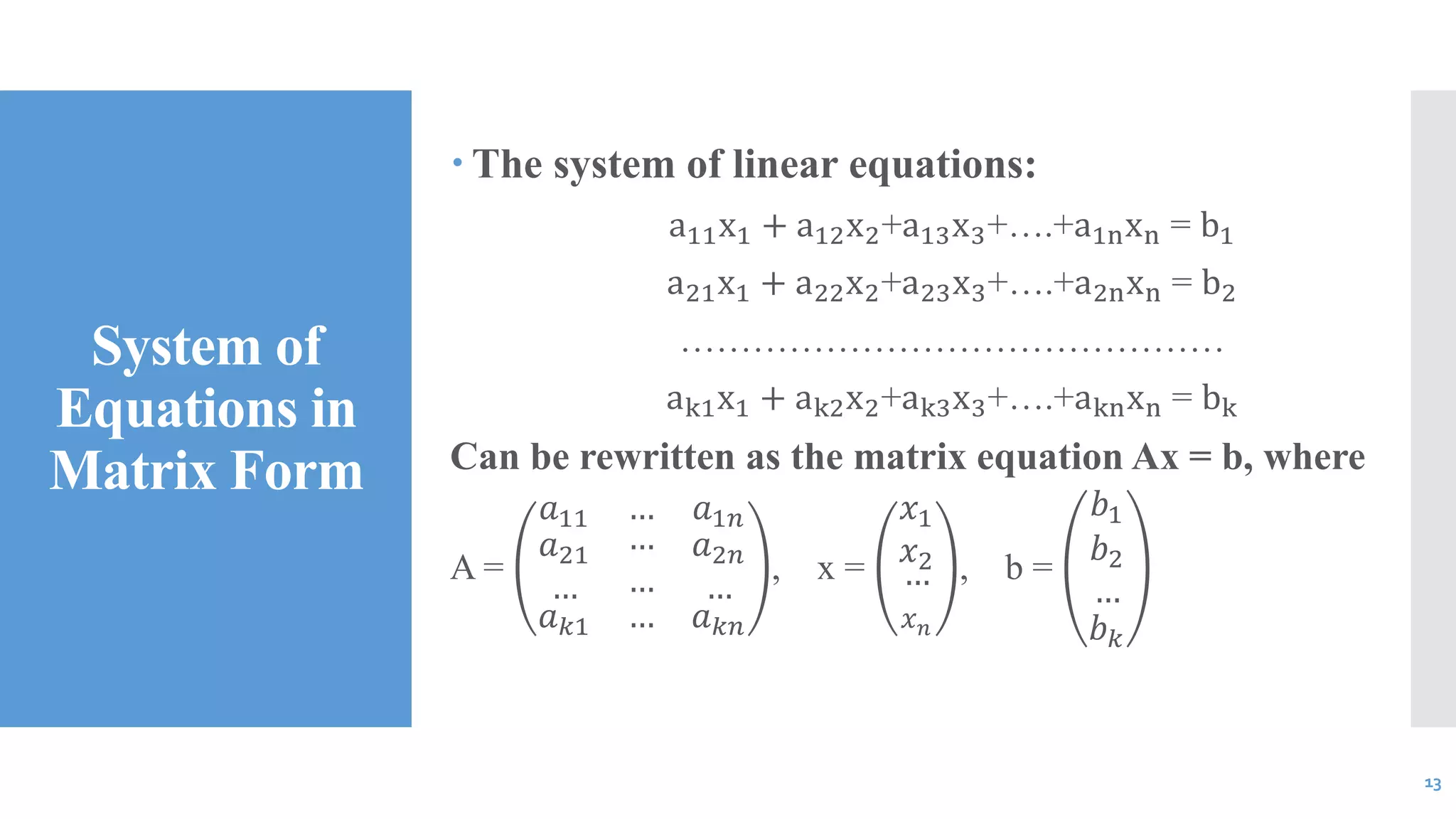
System of
Equations in
MatrixForm
The system of linear equations:
a11x1 + a12x2+a13x3+….+a1nxn = b1
a21x1 + a22x2+a23x3+….+a2nxn = b2
………………………………………
ak1x1 + ak2x2+ak3x3+….+aknxn = bk
Can be rewritten as the matrix equation Ax = b, where
A =
𝑎11 … 𝑎1𝑛
𝑎21
…
…
…
𝑎2𝑛
…
𝑎 𝑘1 … 𝑎 𝑘𝑛
, x =
𝑥1
𝑥2
…
𝑥 𝑛
, b =
𝑏1
𝑏2
…
𝑏 𝑘
13
Unique
Properties of
Matrices
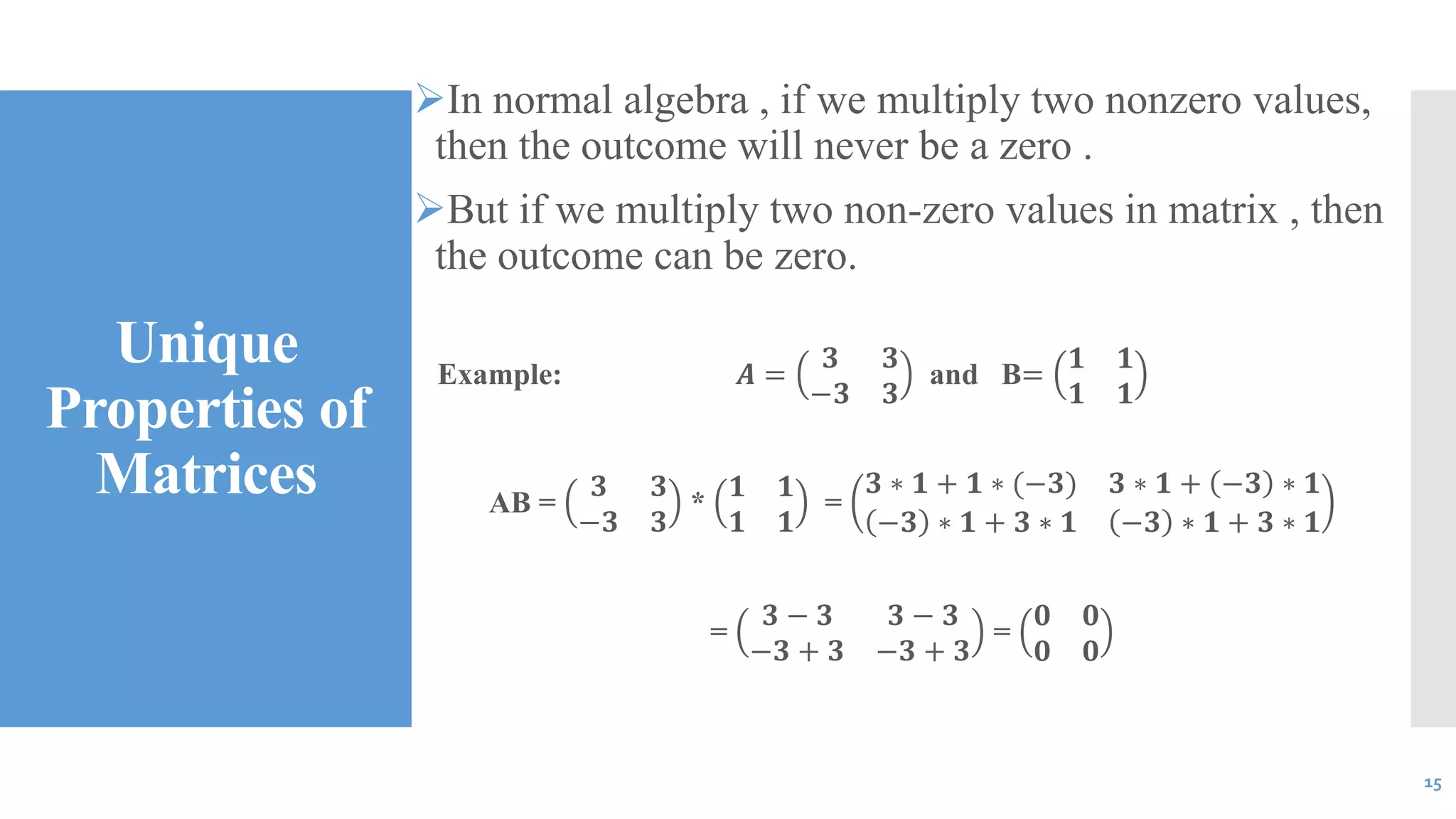
In normalalgebra , if we multiply two nonzero values,
then the outcome will never be a zero .
But if we multiply two non-zero values in matrix , then
the outcome can be zero.
Example: 𝑨 =
𝟑 𝟑
−𝟑 𝟑
and B=
𝟏 𝟏
𝟏 𝟏
AB =
𝟑 𝟑
−𝟑 𝟑
*
𝟏 𝟏
𝟏 𝟏
=
𝟑 ∗ 𝟏 + 𝟏 ∗ (−𝟑) 𝟑 ∗ 𝟏 + −𝟑 ∗ 𝟏
−𝟑 ∗ 𝟏 + 𝟑 ∗ 𝟏 −𝟑 ∗ 𝟏 + 𝟑 ∗ 𝟏
=
𝟑 − 𝟑 𝟑 − 𝟑
−𝟑 + 𝟑 −𝟑 + 𝟑
=
𝟎 𝟎
𝟎 𝟎
15
16.
Application
of Matrix
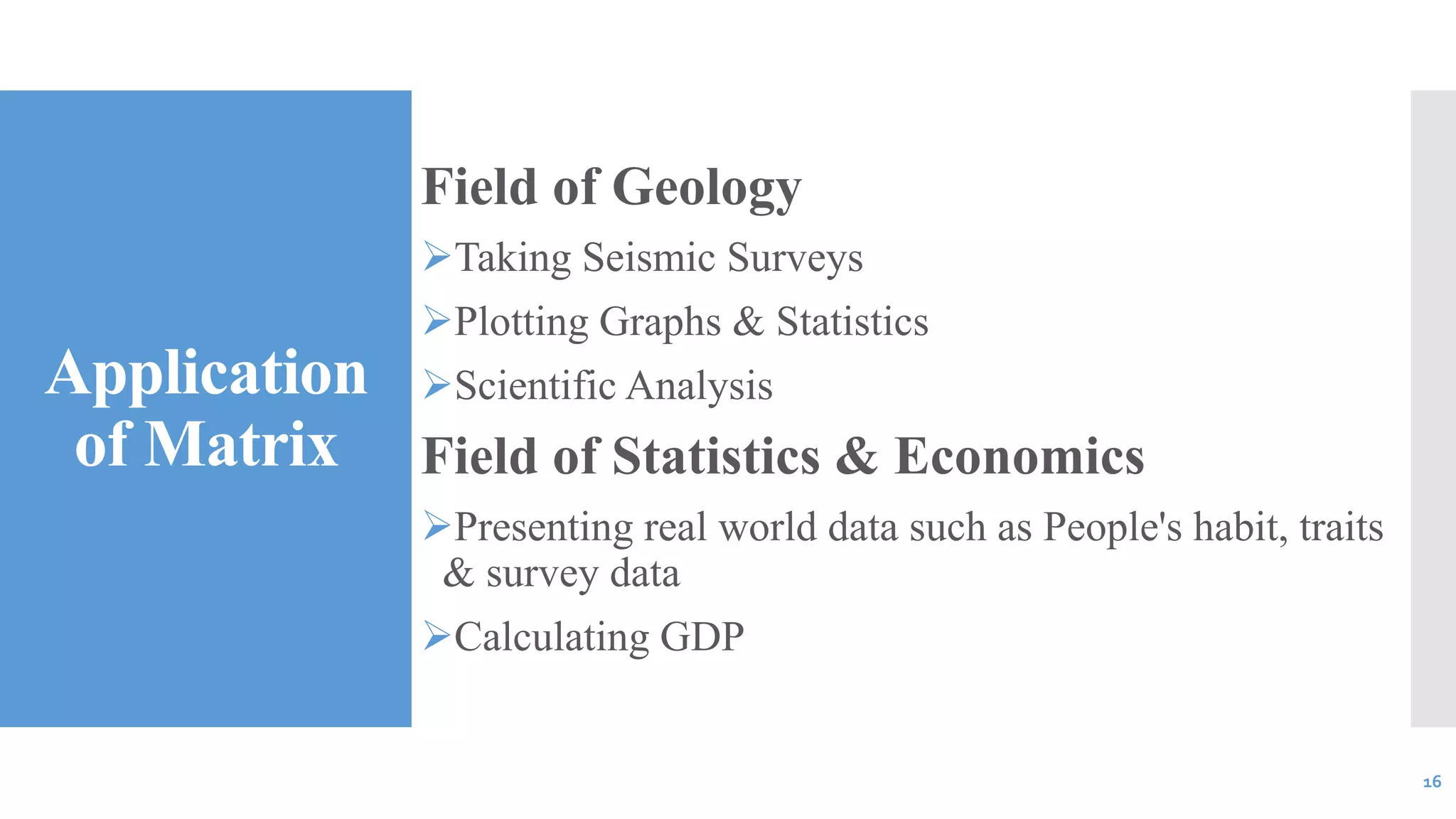
Field ofGeology
Taking Seismic Surveys
Plotting Graphs & Statistics
Scientific Analysis
Field of Statistics & Economics
Presenting real world data such as People's habit, traits
& survey data
Calculating GDP
16
17.
Application
of Matrix
Field ofAnimation
Operating 3D software & Tools
Performing 3D scaling/Transforming
Giving reflection, rotation
Physics & Electronics
Elementary particles in quantum field theory
Traditional mesh & nodal analysis
Behavior of electronic components
17