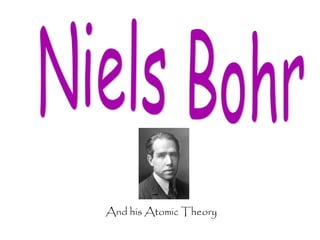
And his Atomic Theory
Niels Bohr was born on October 7, 1885 and he died on
November 18, 1962. He was born in Copenhagen, Denmark
and he died in the same area. His parents were Christian Bohr
and Ellen Adler, (Bohr). He had an older sister named Jenny,
who was born in 1883, and a younger brother named Harald who
was born in 1887. Harald and Niels were very close through out
his childhood and he was often heard saying that Harald was his
best friend all through his life.
Niels entered the Grammelholms school in October of 1891, he
attended this school for his complete secondary education. He
did fairly well in school but could never lay claim to a brilliant mind,
he usually came in forth or fifth in a class of twenty. In his last two
years in school Niels specialized in mathematics and physics, he
frightened his math teacher with his exceptional skills and would
work ahead in the physics textbook often pointing out errors in
the text. He was learned more about this subject than he did from
his teachers.
Bohr entered the University of Copenhagen in 1903. Physics
was his major and he had minors in mathematics and chemistry.
When he was in University he wouldn’t have been able to carry out
any experiments in physics because the University didn’t have a
laboratory, so he used his father’s physiology lab. And his first paper
describes some of the experiments he did in the lab, he dedicated this
paper to his brother, Harald. Due to this paper, Bohr, won the Gold
Medal for 1906 from the Royal Danish Academy of Sciences, this
was for his analysis of water jets being used to determine surface
tension. He got his masters degree from the University of
Copenhagen in 1909, and his doctorate in 1911for his thesis,
Studies on the electron theory of metals. This thesis was dedicated
to his father, who had died earlier in the year from a heart attack Bohr
was engaged to Margrethe Norlund, who, many say, placed a key role
in his successfulness, at the time of his father’s death.
In 1911 in the month of September Bohr went to England to study
with J J Thompson at Cambridge, he had hoped to spend a long
period of time with Thompson, but, unfortunately, they didn’t get
along. Lucky for him, he had met Rutherford earlier in that year and
went to study with him instead, this was right after Rutherford had
published his theory, which states that the bulk of the mass of an atom
can be found in the nucleus.
Bohr began developing his theory in June of 1912 He did his fundamental
work on the hydrogen atom eventually he even did some work on some
heavier atoms. Bohr returned to Copenhagen to continue working on his
theory which he completed to his satisfaction in and around July of 1913.
The University recommended his name for a chair in theoretical physics,
he expected his position to be confirmed within a year. It wasn’t to be. He
spent the next four years working with Rutherford and his group yet again,
he enjoyed his time with the group immensely, participating in many break
through activities.
His completed theory of the atom gave us the clue as to where, exactly,
electrons were found in an atom. He stated that electrons traveled on fixed
energy levels. Sort of like a ladder, these electrons could change orbits
but they would always be found in an orbit and there would always be a
certain number of electrons in the orbital.
Changing Energy Levels
The fact that there were certain orbits and energies in an atom was part of
Bohr’s theory. When these energies change levels there is a different color
given off.
Orbits were the key to Bohr’s theory
Bohr Model of the
Atom
• Outline
– emissiOn spectrum Of atOmic
hydrOgen.
– the BOhr mOdel.
– extensiOn tO higher atOmic numBer.
Photon Emission
• Relaxat ion
f rom one
energy level t o
anot her by
emit t ing a
phot on.
• Wit h DE = hc/ l
Emission
Emission spectrum of H
“Continuous”
spectrum “Quantized”
spectrum
Any DE is
possible
Only certain
DE are
allowed
∆E
∆E
Emission spectrum of H
Light Bulb
Hydrogen Lamp
Quantized, not continuous
Emission spectrum of H
We can use the emission spectrum to determine the
energy levels forthe hydrogen atom.
Balmer Model
• Joseph Balmer (1885) first noticed that the
frequency of visiblelinesin theH atom spectrum
could bereproduced by:
ν∝
1
22
−
1
n2
n = 3, 4, 5, …..
• Theaboveequation predictsthat asn increases,
thefrequenciesbecomemoreclosely spaced.
Rydberg Model
• Johann Rydberg extendstheBalmer model by
finding moreemission linesoutsidethevisible
region of thespectrum:
ν=Ry
1
n1
2
−
1
n2
2






n1 = 1, 2, 3, …..
• Thissuggeststhat theenergy levelsof theH atom
areproportional to 1/n2
n2 = n1+1, n1+2, …
Ry = 3.29 x 10¹⁵
1/s
The Bohr
Model
• NielsBohr usestheemission spectrum of
hydrogen to develop aquantum model for H.
• Central idea: electron circlesthe“nucleus” in
only certain allowed circular orbitals.
• Bohr postulatesthat thereisCoulombic attraction
between e- and nucleus. However, classical
physicsisunableto explain why an H atom
doesn’t simply collapse.
The Bohr Model (cont.)
• Bohr model for theH atom iscapableof
reproducing theenergy levelsgiven by the
empirical formulasof Balmer and Rydberg.
E=−2.178x10⁻¹⁸
J
Z2
n2






Z = atomic number (1 for H)
n = integer (1, 2, ….)
• Ry x h = -2.178 x 10⁻¹⁸
J(!)
The Bohr Model (cont.)
E=−2.178x10⁻¹⁸
J
Z2
n2






• Energy levelsget closer together
asn increases
• at n = infinity, E = 0
The Bohr Model (cont.)
• Wecan usetheBohr model to predict what DE is
for any two energy levels
∆E=Efinal−Einitial
∆E=−2.178x10⁻¹⁸
J
1
nfinal
2





−(−2.178x10⁻¹⁸
J)
1
ninitial
2






∆E=−2.178x10⁻¹⁸
J
1
nfinal
2
−
1
ninitial
2






The Bohr Model (cont.)
• Example: At what wavelength will emission from
n = 4 to n = 1 for theH atom beobserved?
∆E=−2.178x10⁻¹⁸
J
1
nfinal
2
−
1
ninitial
2






1 4
∆E=−2.178x10⁻¹⁸
J1−
1
16





=−2.04x10⁻¹⁸
J
∆E=2.04x10⁻¹⁸
J=
hc
λ
λ=9.74x10⁻⁸
m=97.4nm
The Bohr Model (cont.)
• Example: What isthelongest wavelength of light
that will result in removal of thee-
from H?
∆E=−2.178x10⁻¹⁸
J
1
nfinal
2
−
1
ninitial
2






∞ 1
∆E=−2.178x10⁻¹⁸
J0−1( )=2.178x10⁻¹⁸
J
∆E=2.178x10⁻¹⁸
J=
hc
λ
λ=9.13x10⁻⁸
m=91.3nm
Extension to Higher Z
• TheBohr model can beextended to any single
electron system….must keep track of Z
(atomic number).
• Examples: He+
(Z = 2), Li+2
(Z = 3), etc.
E=−2.178x10⁻¹⁸
J
Z2
n2






Z = atomic number
n = integer (1, 2, ….)
Extension to Higher Z
(cont.)
• Example: At what wavelength will emission from
n = 4 to n = 1 for theHe+
atom beobserved?
∆E=−2.178x10⁻¹⁸
JZ2
( )
1
nfinal
2
−
1
ninitial
2






2
1 4
∆E=−2.178x10⁻¹⁸
J4()1−
1
16





=−8.16x10⁻¹⁸
J
∆E=8.16x10⁻¹⁸
J=
hc
λ
λ=2.43x10⁻⁸
m=24.3nm
λH>λHe+
Where does
this go
wrong?
• TheBohr model’ssuccessesarelimited:
• Doesn’t work for multi-electron atoms.
• The“electron racetrack” pictureisincorrect.
• That said, theBohr model wasapioneering,
“quantized” pictureof atomic energy levels.

Mgc bohr

  • 1.
  • 2.
    Niels Bohr wasborn on October 7, 1885 and he died on November 18, 1962. He was born in Copenhagen, Denmark and he died in the same area. His parents were Christian Bohr and Ellen Adler, (Bohr). He had an older sister named Jenny, who was born in 1883, and a younger brother named Harald who was born in 1887. Harald and Niels were very close through out his childhood and he was often heard saying that Harald was his best friend all through his life. Niels entered the Grammelholms school in October of 1891, he attended this school for his complete secondary education. He did fairly well in school but could never lay claim to a brilliant mind, he usually came in forth or fifth in a class of twenty. In his last two years in school Niels specialized in mathematics and physics, he frightened his math teacher with his exceptional skills and would work ahead in the physics textbook often pointing out errors in the text. He was learned more about this subject than he did from his teachers. Bohr entered the University of Copenhagen in 1903. Physics was his major and he had minors in mathematics and chemistry.
  • 3.
    When he wasin University he wouldn’t have been able to carry out any experiments in physics because the University didn’t have a laboratory, so he used his father’s physiology lab. And his first paper describes some of the experiments he did in the lab, he dedicated this paper to his brother, Harald. Due to this paper, Bohr, won the Gold Medal for 1906 from the Royal Danish Academy of Sciences, this was for his analysis of water jets being used to determine surface tension. He got his masters degree from the University of Copenhagen in 1909, and his doctorate in 1911for his thesis, Studies on the electron theory of metals. This thesis was dedicated to his father, who had died earlier in the year from a heart attack Bohr was engaged to Margrethe Norlund, who, many say, placed a key role in his successfulness, at the time of his father’s death. In 1911 in the month of September Bohr went to England to study with J J Thompson at Cambridge, he had hoped to spend a long period of time with Thompson, but, unfortunately, they didn’t get along. Lucky for him, he had met Rutherford earlier in that year and went to study with him instead, this was right after Rutherford had published his theory, which states that the bulk of the mass of an atom can be found in the nucleus.
  • 4.
    Bohr began developinghis theory in June of 1912 He did his fundamental work on the hydrogen atom eventually he even did some work on some heavier atoms. Bohr returned to Copenhagen to continue working on his theory which he completed to his satisfaction in and around July of 1913. The University recommended his name for a chair in theoretical physics, he expected his position to be confirmed within a year. It wasn’t to be. He spent the next four years working with Rutherford and his group yet again, he enjoyed his time with the group immensely, participating in many break through activities. His completed theory of the atom gave us the clue as to where, exactly, electrons were found in an atom. He stated that electrons traveled on fixed energy levels. Sort of like a ladder, these electrons could change orbits but they would always be found in an orbit and there would always be a certain number of electrons in the orbital.
  • 5.
    Changing Energy Levels Thefact that there were certain orbits and energies in an atom was part of Bohr’s theory. When these energies change levels there is a different color given off.
  • 6.
    Orbits were thekey to Bohr’s theory
  • 7.
    Bohr Model ofthe Atom • Outline – emissiOn spectrum Of atOmic hydrOgen. – the BOhr mOdel. – extensiOn tO higher atOmic numBer.
  • 8.
    Photon Emission • Relaxation f rom one energy level t o anot her by emit t ing a phot on. • Wit h DE = hc/ l Emission
  • 9.
    Emission spectrum ofH “Continuous” spectrum “Quantized” spectrum Any DE is possible Only certain DE are allowed ∆E ∆E
  • 10.
    Emission spectrum ofH Light Bulb Hydrogen Lamp Quantized, not continuous
  • 11.
    Emission spectrum ofH We can use the emission spectrum to determine the energy levels forthe hydrogen atom.
  • 12.
    Balmer Model • JosephBalmer (1885) first noticed that the frequency of visiblelinesin theH atom spectrum could bereproduced by: ν∝ 1 22 − 1 n2 n = 3, 4, 5, ….. • Theaboveequation predictsthat asn increases, thefrequenciesbecomemoreclosely spaced.
  • 13.
    Rydberg Model • JohannRydberg extendstheBalmer model by finding moreemission linesoutsidethevisible region of thespectrum: ν=Ry 1 n1 2 − 1 n2 2       n1 = 1, 2, 3, ….. • Thissuggeststhat theenergy levelsof theH atom areproportional to 1/n2 n2 = n1+1, n1+2, … Ry = 3.29 x 10¹⁵ 1/s
  • 14.
    The Bohr Model • NielsBohrusestheemission spectrum of hydrogen to develop aquantum model for H. • Central idea: electron circlesthe“nucleus” in only certain allowed circular orbitals. • Bohr postulatesthat thereisCoulombic attraction between e- and nucleus. However, classical physicsisunableto explain why an H atom doesn’t simply collapse.
  • 15.
    The Bohr Model(cont.) • Bohr model for theH atom iscapableof reproducing theenergy levelsgiven by the empirical formulasof Balmer and Rydberg. E=−2.178x10⁻¹⁸ J Z2 n2       Z = atomic number (1 for H) n = integer (1, 2, ….) • Ry x h = -2.178 x 10⁻¹⁸ J(!)
  • 16.
    The Bohr Model(cont.) E=−2.178x10⁻¹⁸ J Z2 n2       • Energy levelsget closer together asn increases • at n = infinity, E = 0
  • 17.
    The Bohr Model(cont.) • Wecan usetheBohr model to predict what DE is for any two energy levels ∆E=Efinal−Einitial ∆E=−2.178x10⁻¹⁸ J 1 nfinal 2      −(−2.178x10⁻¹⁸ J) 1 ninitial 2       ∆E=−2.178x10⁻¹⁸ J 1 nfinal 2 − 1 ninitial 2      
  • 18.
    The Bohr Model(cont.) • Example: At what wavelength will emission from n = 4 to n = 1 for theH atom beobserved? ∆E=−2.178x10⁻¹⁸ J 1 nfinal 2 − 1 ninitial 2       1 4 ∆E=−2.178x10⁻¹⁸ J1− 1 16      =−2.04x10⁻¹⁸ J ∆E=2.04x10⁻¹⁸ J= hc λ λ=9.74x10⁻⁸ m=97.4nm
  • 19.
    The Bohr Model(cont.) • Example: What isthelongest wavelength of light that will result in removal of thee- from H? ∆E=−2.178x10⁻¹⁸ J 1 nfinal 2 − 1 ninitial 2       ∞ 1 ∆E=−2.178x10⁻¹⁸ J0−1( )=2.178x10⁻¹⁸ J ∆E=2.178x10⁻¹⁸ J= hc λ λ=9.13x10⁻⁸ m=91.3nm
  • 20.
    Extension to HigherZ • TheBohr model can beextended to any single electron system….must keep track of Z (atomic number). • Examples: He+ (Z = 2), Li+2 (Z = 3), etc. E=−2.178x10⁻¹⁸ J Z2 n2       Z = atomic number n = integer (1, 2, ….)
  • 21.
    Extension to HigherZ (cont.) • Example: At what wavelength will emission from n = 4 to n = 1 for theHe+ atom beobserved? ∆E=−2.178x10⁻¹⁸ JZ2 ( ) 1 nfinal 2 − 1 ninitial 2       2 1 4 ∆E=−2.178x10⁻¹⁸ J4()1− 1 16      =−8.16x10⁻¹⁸ J ∆E=8.16x10⁻¹⁸ J= hc λ λ=2.43x10⁻⁸ m=24.3nm λH>λHe+
  • 22.
    Where does this go wrong? •TheBohr model’ssuccessesarelimited: • Doesn’t work for multi-electron atoms. • The“electron racetrack” pictureisincorrect. • That said, theBohr model wasapioneering, “quantized” pictureof atomic energy levels.