Discrete Structures
Induction (Ch. 5)
Dr. Muhammad Humayoun
Assistant Professor
COMSATS Institute of Computer Science, Lahore.
mhumayoun@ciitlahore.edu.pk
https://sites.google.com/a/ciitlahore.edu.pk/dstruct/
A lot of material is taken from the slides of Dr. Atif and Dr. Mudassir
1
INDUCTION
• What is Induction?
• Generalization of statements from facts.
Statements may be True or False but not both.
•The principle of mathematical induction is a useful tool
for proving that a certain predicate is true for all natural
numbers.
•It cannot be used to discover theorems, but only to prove
them.
2
MATHEMATICAL INDUCTION
To prove that P(n) is true for all positive integers n,
where P(n) is a propositional function, we
complete two steps:
• BASIS STEP: We verify that P(1) is true.
• INDUCTIVE STEP: We show that the conditional
statement P(k) → P(k + 1) is true for all positive
integers k.
The assumption that P(k) is true is called the
inductive hypothesis.
3
Example
Suppose that we have an infinite ladder
1. We can reach the first rung of the
ladder.
2. If we can reach a particular rung of
the ladder, then we can reach the
next rung.
Then, we can conclude that we are able
to reach every rung of this infinite
ladder.
4
Example using Dominoes
5
• An infinite row of dominoes, labeled 1, 2, 3, ..., n
• P(n): Domino n is knocked over
• P(1): The first domino is knocked over
• P(k): The kth domino is knocked over
• The fact that
– The first domino is knocked over
– And whenever the kth domino is knocked
over, it also knocks the (k+1)st domino over
• Implies that all the dominoes are
knocked over
EXAMPLE 1
at Page#316
Show that 1+2+···+n=n(n+1)/2 for positive integers.
Let P(n): (1+2+···+n)=n(n+1)/2 for all +ve integers n.
BASIS STEP: P(1) is true, because 1 = 1(1 + 1)2.
INDUCTIVE STEP: ∀k [ P(k) -> P(k+1) ]
We assume that P(k) holds for an arbitrary positive
integer k: 1+2+···+k = k(k+1)/2 ----- (1).
Now we have to prove that P(k+1) holds. i.e.
1+2+···+(k+1) = (k+1)(k+1+1)/2.
1+2+···+(k+1) = (k+1)(k+2)/2. ----- (2). 6
EXAMPLE 1 Cont.
Add k+1 in equation 1 on both sides:
1+2+···+k + (k+1) = k(k+1)/2 + (k+1)
= [k(k + 1) + 2(k + 1)]/2
= (k + 1)(k + 2)/2
=(k + 1)((k + 1)+1)/2
• This last equation shows that P(k+1) is true under the
assumption that P(k) is true. This completes the
inductive step.
So by mathematical induction we know that P(n) is true
for all positive integers n:
1 + 2+· · ·+n = n(n + 1)/2 for all positive integers n.
7
p(k)
8
Example 2 at Page# 316
• Conjecture a formula for the sum of the first n positive odd
integers. Then prove your conjecture using mathematical
induction.
• The sums of the first n positive odd integers for n = 1, 2, 3, 4, 5 are
• 1 = 1 , 1 + 3 = 4, 1 + 3 + 5 = 9, 1 + 3 + 5 + 7 = 16,
1 + 3 + 5 + 7 + 9 = 25.
• 1 + 3 + 5+· · ·+(2n − 1) = n2
 Proposition: 1 + 3 + … + (2n-1) = n2
for all integers n≥1.
 Proof (by induction):
1) Basis step:
The statement is true for n=1: 1=12 .
2) Inductive step:
Assume the statement is true for some k≥1
(inductive hypothesis) ,
show that it is true for k+1 .
Example 2 at Page# 316 (Conti…)
 Proof (cont.):
The statement is true for k:
1+3+…+(2k-1) = k2 (1)
We need to show it for k+1:
1+3+…+(2(k+1)-1) = (k+1)2
1+3+…+(2k+1) = (k+1)2 (2)
Adding both sides (2k+1) in eqn (1), we get,
1+3+…+(2k-1)+(2k+1) = k2+(2k+1) = (k+1)2 .
We proved the basis and inductive steps,
so we conclude that the given statement is true. ■
p(k)
10
At Page# 318
1 – Hypothesis?
P(n) = 1 + 2 + 22 + … + 2n = 2 n+1 – 1 for all non-negative integers n.
2 - Base Step?
n = 0 10 = 21-1. not n=1! The base case can be
negative, zero, or positive
3 – Inductive Hypothesis
Assume P(k) = 1 + 2 + 22 + … + 2k = 2 k+1 – 1 ----- (1).
4 – Inductive Step: show that (k) P(k)  P(k+1), assuming P(k). How?
P(k+1)= 1 + 2 + 22 + … + 2k+1 = (2k+1+1 – 1)
Example 3 (Conti…)
• Adding 2k+1 both sides in eqn 1
We proved the basis and inductive steps,
So, we conclude that the given statement is true.
11
P(k+1)= 1 + 2 + 22 + … + 2k+ 2k+1 = (2k+1 – 1) + 2k+1
p(k)
----- (2).
= 2. 2k+1 - 1
P(k+1) = 2k+2 - 1
= 2(k+1)+1 - 1
EXAMPLE 4
at Page# 318
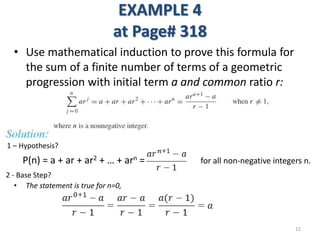
• Use mathematical induction to prove this formula for
the sum of a finite number of terms of a geometric
progression with initial term a and common ratio r:
• The statement is true for n=0,
12
1 – Hypothesis?
P(n) = a + ar + ar2 + … + arn = for all non-negative integers n.
2 - Base Step?
EXAMPLE 4 (Conti…)
at Page# 318
We proved the basis and inductive steps, so, we conclude that the given
statement is true
13
3 – Inductive Hypothesis
Assume P(k) = P(n) = a + ar + ar2 + … + ark = ----- (1).
4 – Inductive Step: show that (k) P(k)  P(k+1), assuming P(k). How?
Assume P(k+1) = P(n) = a + ar + ar2 + … + ark+1 = ---- (2)
Adding ark+1 both sides in eqn 1
P(k+1) = a + ar + ar2 + … + ark + ark+1 =
p(k)

11-Induction CIIT.pptx

  • 1.
    Discrete Structures Induction (Ch.5) Dr. Muhammad Humayoun Assistant Professor COMSATS Institute of Computer Science, Lahore. mhumayoun@ciitlahore.edu.pk https://sites.google.com/a/ciitlahore.edu.pk/dstruct/ A lot of material is taken from the slides of Dr. Atif and Dr. Mudassir 1
  • 2.
    INDUCTION • What isInduction? • Generalization of statements from facts. Statements may be True or False but not both. •The principle of mathematical induction is a useful tool for proving that a certain predicate is true for all natural numbers. •It cannot be used to discover theorems, but only to prove them. 2
  • 3.
    MATHEMATICAL INDUCTION To provethat P(n) is true for all positive integers n, where P(n) is a propositional function, we complete two steps: • BASIS STEP: We verify that P(1) is true. • INDUCTIVE STEP: We show that the conditional statement P(k) → P(k + 1) is true for all positive integers k. The assumption that P(k) is true is called the inductive hypothesis. 3
  • 4.
    Example Suppose that wehave an infinite ladder 1. We can reach the first rung of the ladder. 2. If we can reach a particular rung of the ladder, then we can reach the next rung. Then, we can conclude that we are able to reach every rung of this infinite ladder. 4
  • 5.
    Example using Dominoes 5 •An infinite row of dominoes, labeled 1, 2, 3, ..., n • P(n): Domino n is knocked over • P(1): The first domino is knocked over • P(k): The kth domino is knocked over • The fact that – The first domino is knocked over – And whenever the kth domino is knocked over, it also knocks the (k+1)st domino over • Implies that all the dominoes are knocked over
  • 6.
    EXAMPLE 1 at Page#316 Showthat 1+2+···+n=n(n+1)/2 for positive integers. Let P(n): (1+2+···+n)=n(n+1)/2 for all +ve integers n. BASIS STEP: P(1) is true, because 1 = 1(1 + 1)2. INDUCTIVE STEP: ∀k [ P(k) -> P(k+1) ] We assume that P(k) holds for an arbitrary positive integer k: 1+2+···+k = k(k+1)/2 ----- (1). Now we have to prove that P(k+1) holds. i.e. 1+2+···+(k+1) = (k+1)(k+1+1)/2. 1+2+···+(k+1) = (k+1)(k+2)/2. ----- (2). 6
  • 7.
    EXAMPLE 1 Cont. Addk+1 in equation 1 on both sides: 1+2+···+k + (k+1) = k(k+1)/2 + (k+1) = [k(k + 1) + 2(k + 1)]/2 = (k + 1)(k + 2)/2 =(k + 1)((k + 1)+1)/2 • This last equation shows that P(k+1) is true under the assumption that P(k) is true. This completes the inductive step. So by mathematical induction we know that P(n) is true for all positive integers n: 1 + 2+· · ·+n = n(n + 1)/2 for all positive integers n. 7 p(k)
  • 8.
    8 Example 2 atPage# 316 • Conjecture a formula for the sum of the first n positive odd integers. Then prove your conjecture using mathematical induction. • The sums of the first n positive odd integers for n = 1, 2, 3, 4, 5 are • 1 = 1 , 1 + 3 = 4, 1 + 3 + 5 = 9, 1 + 3 + 5 + 7 = 16, 1 + 3 + 5 + 7 + 9 = 25. • 1 + 3 + 5+· · ·+(2n − 1) = n2  Proposition: 1 + 3 + … + (2n-1) = n2 for all integers n≥1.  Proof (by induction): 1) Basis step: The statement is true for n=1: 1=12 . 2) Inductive step: Assume the statement is true for some k≥1 (inductive hypothesis) , show that it is true for k+1 .
  • 9.
    Example 2 atPage# 316 (Conti…)  Proof (cont.): The statement is true for k: 1+3+…+(2k-1) = k2 (1) We need to show it for k+1: 1+3+…+(2(k+1)-1) = (k+1)2 1+3+…+(2k+1) = (k+1)2 (2) Adding both sides (2k+1) in eqn (1), we get, 1+3+…+(2k-1)+(2k+1) = k2+(2k+1) = (k+1)2 . We proved the basis and inductive steps, so we conclude that the given statement is true. ■ p(k)
  • 10.
    10 At Page# 318 1– Hypothesis? P(n) = 1 + 2 + 22 + … + 2n = 2 n+1 – 1 for all non-negative integers n. 2 - Base Step? n = 0 10 = 21-1. not n=1! The base case can be negative, zero, or positive 3 – Inductive Hypothesis Assume P(k) = 1 + 2 + 22 + … + 2k = 2 k+1 – 1 ----- (1). 4 – Inductive Step: show that (k) P(k)  P(k+1), assuming P(k). How? P(k+1)= 1 + 2 + 22 + … + 2k+1 = (2k+1+1 – 1)
  • 11.
    Example 3 (Conti…) •Adding 2k+1 both sides in eqn 1 We proved the basis and inductive steps, So, we conclude that the given statement is true. 11 P(k+1)= 1 + 2 + 22 + … + 2k+ 2k+1 = (2k+1 – 1) + 2k+1 p(k) ----- (2). = 2. 2k+1 - 1 P(k+1) = 2k+2 - 1 = 2(k+1)+1 - 1
  • 12.
    EXAMPLE 4 at Page#318 • Use mathematical induction to prove this formula for the sum of a finite number of terms of a geometric progression with initial term a and common ratio r: • The statement is true for n=0, 12 1 – Hypothesis? P(n) = a + ar + ar2 + … + arn = for all non-negative integers n. 2 - Base Step?
  • 13.
    EXAMPLE 4 (Conti…) atPage# 318 We proved the basis and inductive steps, so, we conclude that the given statement is true 13 3 – Inductive Hypothesis Assume P(k) = P(n) = a + ar + ar2 + … + ark = ----- (1). 4 – Inductive Step: show that (k) P(k)  P(k+1), assuming P(k). How? Assume P(k+1) = P(n) = a + ar + ar2 + … + ark+1 = ---- (2) Adding ark+1 both sides in eqn 1 P(k+1) = a + ar + ar2 + … + ark + ark+1 = p(k)

Editor's Notes

  • #5 Rung: A crosspiece between the legs of a chair
  • #6 Dominoes: A small rectangular block used in playing the game of dominoes; the face of each block has two equal areas that can bear 0 to 6 dots