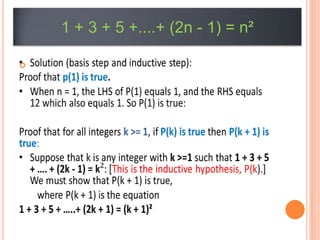
1 + 3 + 5 +....+ (2n - 1) = n²


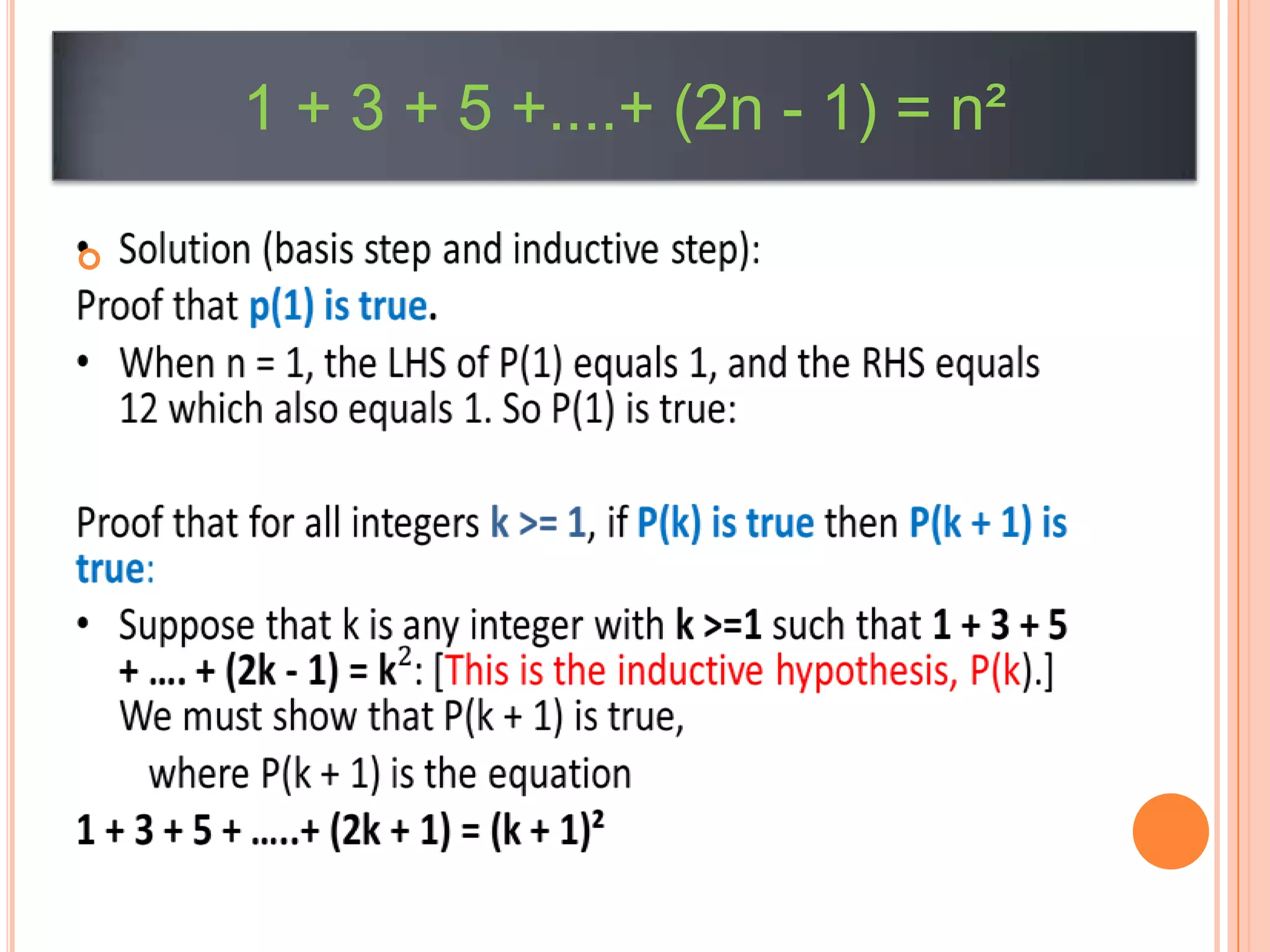
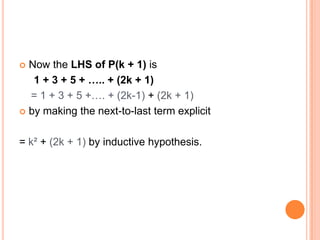
 Now the LHS of P(k + 1) is
   1 + 3 + 5 + ….. + (2k + 1)
  = 1 + 3 + 5 +…. + (2k-1) + (2k + 1)
 by making the next-to-last term explicit


= k² + (2k + 1) by inductive hypothesis.
 And the RHS of P(k + 1) is(k + 1)² = k²+ 2k + 1 by basic
  algebra.
    k² + (2k + 1) = k²+ 2k + 1
 So the left-hand and right-hand sides of P(k+1) equal the
  same quantity, and thus and thus P(k+1)
 is true [as was to be shown].
I
  NDUCTION
Example :          HYPOTHESIS

4 + 7 + 10 +- - - - + 3n+2= ½(3n² +5n ) prove by inductive.

-assume it is true ( hypothesis ) and then

If n= n+1 the sum should be ½ [3(n+1)² +5(n+1). prove it

-The term of n+1 = 3(n+1)+2

-The sum of (n+1) = ½(3n² +5n )+ 3(n+1)+2

 ½(3n² +5n + 6n+6+4)
= ½ [(3n² +6n + 3) + 5n+5
= ½[3(n+1)²+ 5(n+1)]

---> if inductive hypothesis P(n) is true , then P(n+1) must be true
MATHEMATICAL INDUCTION TO
CONSTRUCT PROOFS INVOLVING

FORMULAS, DIVISIBILITY PROPERTIES
AND INEQUALITIES
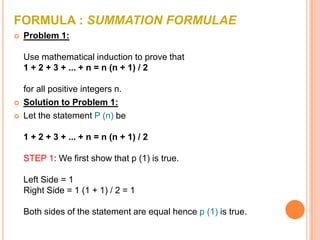
FORMULA : SUMMATION FORMULAE
   Problem 1:

    Use mathematical induction to prove that
    1 + 2 + 3 + ... + n = n (n + 1) / 2

    for all positive integers n.
   Solution to Problem 1:
   Let the statement P (n) be

    1 + 2 + 3 + ... + n = n (n + 1) / 2

    STEP 1: We first show that p (1) is true.

    Left Side = 1
    Right Side = 1 (1 + 1) / 2 = 1

    Both sides of the statement are equal hence p (1) is true.
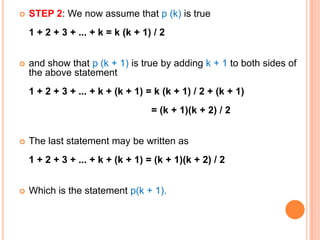
   STEP 2: We now assume that p (k) is true
    1 + 2 + 3 + ... + k = k (k + 1) / 2


   and show that p (k + 1) is true by adding k + 1 to both sides of
    the above statement
    1 + 2 + 3 + ... + k + (k + 1) = k (k + 1) / 2 + (k + 1)
                                   = (k + 1)(k + 2) / 2


   The last statement may be written as
    1 + 2 + 3 + ... + k + (k + 1) = (k + 1)(k + 2) / 2


   Which is the statement p(k + 1).
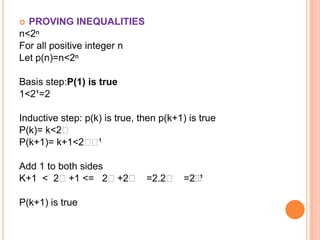
 PROVING INEQUALITIES
n<2ⁿ
For all positive integer n
Let p(n)=n<2ⁿ

Basis step:P(1) is true
1<2¹=2

Inductive step: p(k) is true, then p(k+1) is true
P(k)= k<2ᴷ
P(k+1)= k+1<2ᴷ ¹ ᴷ

Add 1 to both sides
K+1 < 2ᴷ+1 <= 2ᴷ+2ᴷ =2.2ᴷ =2ᴷ
                            ᴷ¹

P(k+1) is true
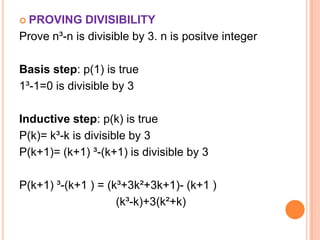
 PROVING    DIVISIBILITY
Prove n³-n is divisible by 3. n is positve integer

Basis step: p(1) is true
1³-1=0 is divisible by 3

Inductive step: p(k) is true
P(k)= k³-k is divisible by 3
P(k+1)= (k+1) ³-(k+1) is divisible by 3

P(k+1) ³-(k+1 ) = (k³+3k²+3k+1)- (k+1 )
                    (k³-k)+3(k²+k)

Induction q

  • 1.
    1 + 3+ 5 +....+ (2n - 1) = n² 
  • 2.
     Now theLHS of P(k + 1) is 1 + 3 + 5 + ….. + (2k + 1) = 1 + 3 + 5 +…. + (2k-1) + (2k + 1)  by making the next-to-last term explicit = k² + (2k + 1) by inductive hypothesis.
  • 3.
     And theRHS of P(k + 1) is(k + 1)² = k²+ 2k + 1 by basic algebra. k² + (2k + 1) = k²+ 2k + 1  So the left-hand and right-hand sides of P(k+1) equal the same quantity, and thus and thus P(k+1)  is true [as was to be shown].
  • 4.
    I NDUCTION Example: HYPOTHESIS 4 + 7 + 10 +- - - - + 3n+2= ½(3n² +5n ) prove by inductive. -assume it is true ( hypothesis ) and then If n= n+1 the sum should be ½ [3(n+1)² +5(n+1). prove it -The term of n+1 = 3(n+1)+2 -The sum of (n+1) = ½(3n² +5n )+ 3(n+1)+2 ½(3n² +5n + 6n+6+4) = ½ [(3n² +6n + 3) + 5n+5 = ½[3(n+1)²+ 5(n+1)] ---> if inductive hypothesis P(n) is true , then P(n+1) must be true
  • 5.
    MATHEMATICAL INDUCTION TO CONSTRUCTPROOFS INVOLVING FORMULAS, DIVISIBILITY PROPERTIES AND INEQUALITIES
  • 6.
    FORMULA : SUMMATIONFORMULAE  Problem 1: Use mathematical induction to prove that 1 + 2 + 3 + ... + n = n (n + 1) / 2 for all positive integers n.  Solution to Problem 1:  Let the statement P (n) be 1 + 2 + 3 + ... + n = n (n + 1) / 2 STEP 1: We first show that p (1) is true. Left Side = 1 Right Side = 1 (1 + 1) / 2 = 1 Both sides of the statement are equal hence p (1) is true.
  • 7.
    STEP 2: We now assume that p (k) is true 1 + 2 + 3 + ... + k = k (k + 1) / 2  and show that p (k + 1) is true by adding k + 1 to both sides of the above statement 1 + 2 + 3 + ... + k + (k + 1) = k (k + 1) / 2 + (k + 1) = (k + 1)(k + 2) / 2  The last statement may be written as 1 + 2 + 3 + ... + k + (k + 1) = (k + 1)(k + 2) / 2  Which is the statement p(k + 1).
  • 8.
     PROVING INEQUALITIES n<2ⁿ Forall positive integer n Let p(n)=n<2ⁿ Basis step:P(1) is true 1<2¹=2 Inductive step: p(k) is true, then p(k+1) is true P(k)= k<2ᴷ P(k+1)= k+1<2ᴷ ¹ ᴷ Add 1 to both sides K+1 < 2ᴷ+1 <= 2ᴷ+2ᴷ =2.2ᴷ =2ᴷ ᴷ¹ P(k+1) is true
  • 9.
     PROVING DIVISIBILITY Prove n³-n is divisible by 3. n is positve integer Basis step: p(1) is true 1³-1=0 is divisible by 3 Inductive step: p(k) is true P(k)= k³-k is divisible by 3 P(k+1)= (k+1) ³-(k+1) is divisible by 3 P(k+1) ³-(k+1 ) = (k³+3k²+3k+1)- (k+1 ) (k³-k)+3(k²+k)