Cryptography and Data
Security

   Number Theory (1 of 2)


   (presented by Aleksandr Yampolskiy)
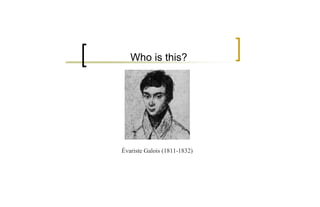
Who is this?


Évariste Galois (1811-1832)
Divisors

n   A non-zero number b divides a if 9m
    s.t. a=mb (a,b,m 2 Z)
n   That is, b divides into a with no
    remainder
n   We denote this b|a
n   Example:
    ¡   all of 1,2,3,4,6,8,12,24 divide 24
    ¡   6 | 24 (4*6 = 24), 1 | 24 (24*1 = 24),
        but 5 | 24 (no m2Z such that m*5 = 24)
Divisors (cont.)

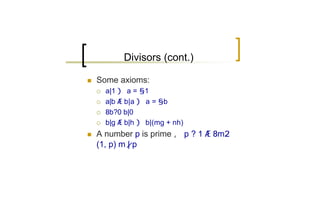
n   Some axioms:
    ¡   a|1 ) a = §1
    ¡   a|b Æ b|a ) a = §b
    ¡   8b?0 b|0
    ¡   b|g Æ b|h ) b|(mg + nh)
n   A number p is prime , p ? 1 Æ 8m2
    (1, p) m | p
Groups
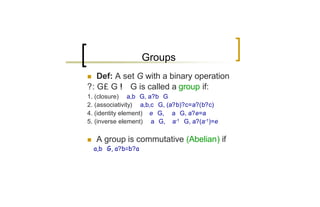
n  Def: A set G with a binary operation
?: G£ G ! G is called a group if:
1. (closure) ∀ a,b∈G, a?b∈G
2. (associativity) ∀ a,b,c∈G, (a?b)?c=a?(b?c)
4. (identity element) ∃ e∈G, ∀ a∈G, a?e=a
5. (inverse element) ∀ a∈G, ∃ a-1∈G, a?(a-1)=e

n   A group is commutative (Abelian) if
∀ a,b∈G, a?b=b?a
Examples of groups
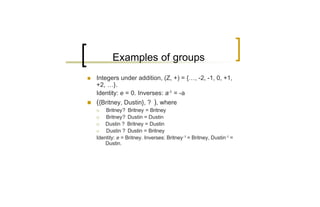
n Integers under addition, (Z, +) = {…, -2, -1, 0, +1,
  +2, …}.
  Identity: e = 0. Inverses: a-1 = -a
n ({Britney, Dustin}, ? ), where
    ¡   Britney? Britney = Britney
    ¡   Britney? Dustin = Dustin
    ¡   Dustin ? Britney = Dustin
    ¡   Dustin ? Dustin = Britney
    Identity: e = Britney. Inverses: Britney -1 = Britney, Dustin-1 =
        Dustin.
Subgroups

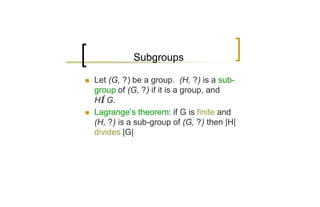
n   Let (G, ?) be a group. (H, ?) is a sub-
    group of (G, ?) if it is a group, and
    H⊆G.
n   Lagrange’s theorem: if G is finite and
    (H, ?) is a sub-group of (G, ?) then |H|
    divides |G|
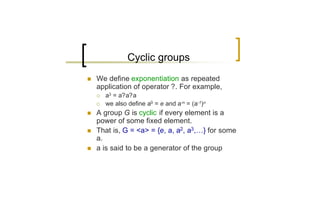
Cyclic groups
n   We define exponentiation as repeated
    application of operator ?. For example,
    ¡   a3 = a?a?a
    ¡   we also define a0 = e and a-n = (a-1)n
n   A group G is cyclic if every element is a
    power of some fixed element.
n   That is, G = <a> = {e, a, a2, a3,…} for some
    a.
n   a is said to be a generator of the group
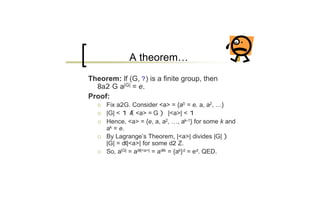
A theorem…
Theorem: If (G, ? ) is a finite group, then
  8a2 G a|G| = e.
Proof:
   ¡   Fix a2G. Consider <a> = {a0 = e, a, a2, …}
   ¡   |G| < 1 Æ <a> = G ) |<a>| < 1
   ¡   Hence, <a> = {e, a, a2, …, ak-1} for some k and
       ak = e.
   ¡   By Lagrange’s Theorem, |<a>| divides |G| )
       |G| = d¢|<a>| for some d2 Z.
   ¡   So, a|G| = ad¢|<a>| = ad¢k = {ak} d = ed. QED.
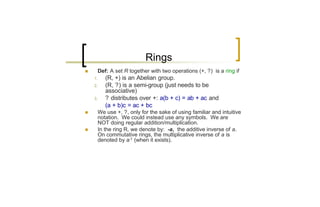
Rings
n        Def: A set R together with two operations (+, ?) is a ring if
    1.      (R, +) is an Abelian group.
    2.      (R, ?) is a semi-group (just needs to be
            associative)
    3.      ? distributes over +: a(b + c) = ab + ac and
            (a + b)c = ac + bc
n        We use +, ?, only for the sake of using familiar and intuitive
         notation. We could instead use any symbols. We are
         NOT doing regular addition/multiplication.
n        In the ring R, we denote by: -a, the additive inverse of a.
         On commutative rings, the multiplicative inverse of a is
         denoted by a-1 (when it exists).
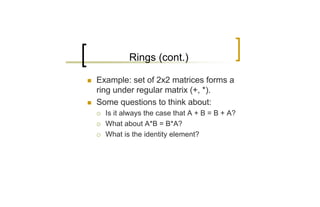
Rings (cont.)

n   Example: set of 2x2 matrices forms a
    ring under regular matrix (+, *).
n   Some questions to think about:
    ¡   Is it always the case that A + B = B + A?
    ¡   What about A*B = B*A?
    ¡   What is the identity element?
Fields

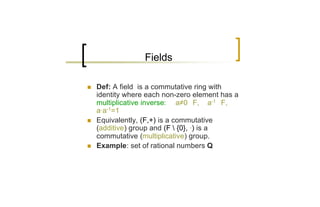
n   Def: A field is a commutative ring with
    identity where each non-zero element has a
    multiplicative inverse: ∀ a≠0∈F, ∃ a-1∈F,
    a·a-1=1
n   Equivalently, (F,+) is a commutative
    (additive) group and (F  {0}, ·) is a
    commutative (multiplicative) group.
n   Example: set of rational numbers Q
Modular arithmetic
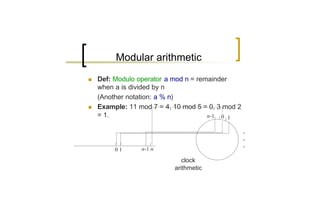
n   Def: Modulo operator a mod n = remainder
    when a is divided by n
    (Another notation: a % n)
n   Example: 11 mod 7 = 4, 10 mod 5 = 0, 3 mod 2
    = 1.                              n-1 0 1

                                                   .
                                                   .
                                                   .
         01      n-1 n

                              clock
                           arithmetic
Modular arithmetic (cont.)

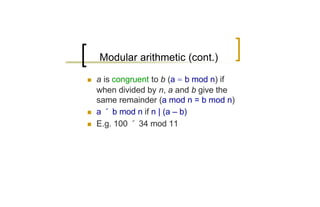
n   a is congruent to b (a = b mod n) if
    when divided by n, a and b give the
    same remainder (a mod n = b mod n)
n   a ´ b mod n if n | (a – b)
n   E.g. 100 ´ 34 mod 11
Zn

n   a´ b mod n defines an equivalence
    relation
n   set of residues Zn = {0, 1, …, n-1}
n   Each integer r2 Zn actually represents
    a residue class [r] = {a2 Z : a ´ r mod
    n}
Zn (cont.)
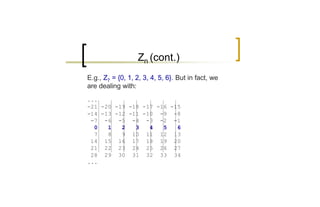
E.g., Z7 = {0, 1, 2, 3, 4, 5, 6}. But in fact, we
are dealing with:
...
-21 -20 -19 -18 -17 -16 -15
-14 -13 -12 -11 -10 -9 -8
 -7 -6 -5 -4 -3 -2 -1
  0   1   2   3   4   5   6
  7   8   9 10 11 12 13
 14 15 16 17 18 19 20
 21 22 23 24 25 26 27
 28 29 30 31 32 33 34
...
Zn (cont.)

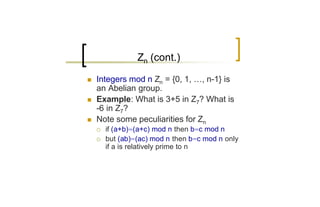
n   Integers mod n Zn = {0, 1, …, n-1} is
    an Abelian group.
n   Example: What is 3+5 in Z7? What is
    -6 in Z7?
n   Note some peculiarities for Zn
    ¡   if (a+b)=(a+c) mod n then b=c mod n
    ¡   but (ab)=(ac) mod n then b=c mod n only
        if a is relatively prime to n
Zn*


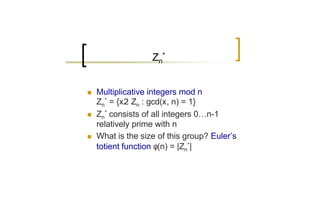
n   Multiplicative integers mod n
    Zn* = {x2 Zn : gcd(x, n) = 1}
n   Zn* consists of all integers 0…n-1
    relatively prime with n
n   What is the size of this group? Euler’s
    totient function φ(n) = |Zn*|
Zn* (cont.)

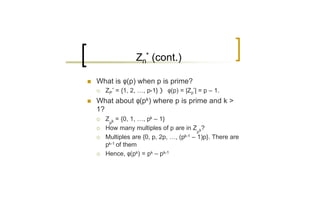
n   What is φ(p) when p is prime?
    ¡   ZP* = {1, 2, …, p-1} ) φ(p) = |Zp*| = p – 1.
n   What about φ(pk) where p is prime and k >
    1?
    ¡   Zpk = {0, 1, …, pk – 1}
    ¡   How many multiples of p are in Zpk?
    ¡   Multiples are {0, p, 2p, …, (pk-1 – 1)p}. There are
        pk-1 of them
    ¡   Hence, φ(pk) = pk – pk-1
Zn* (cont.)

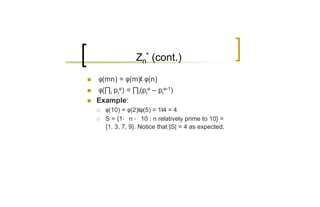
n   φ(mn) = φ(m)¢ φ(n)
n   φ(∏i pie) = ∏i(pie – pie-1)
n   Example:
    ¡   φ(10) = φ(2)¢φ(5) = 1¢4 = 4
    ¡   S = {1· n · 10 : n relatively prime to 10} =
        {1. 3, 7, 9}. Notice that |S| = 4 as expected.
To be continued next time…

Number theory lecture (part 1)

  • 1.
    Cryptography and Data Security Number Theory (1 of 2) (presented by Aleksandr Yampolskiy)
  • 2.
    Who is this? ÉvaristeGalois (1811-1832)
  • 3.
    Divisors n A non-zero number b divides a if 9m s.t. a=mb (a,b,m 2 Z) n That is, b divides into a with no remainder n We denote this b|a n Example: ¡ all of 1,2,3,4,6,8,12,24 divide 24 ¡ 6 | 24 (4*6 = 24), 1 | 24 (24*1 = 24), but 5 | 24 (no m2Z such that m*5 = 24)
  • 4.
    Divisors (cont.) n Some axioms: ¡ a|1 ) a = §1 ¡ a|b Æ b|a ) a = §b ¡ 8b?0 b|0 ¡ b|g Æ b|h ) b|(mg + nh) n A number p is prime , p ? 1 Æ 8m2 (1, p) m | p
  • 5.
    Groups n Def:A set G with a binary operation ?: G£ G ! G is called a group if: 1. (closure) ∀ a,b∈G, a?b∈G 2. (associativity) ∀ a,b,c∈G, (a?b)?c=a?(b?c) 4. (identity element) ∃ e∈G, ∀ a∈G, a?e=a 5. (inverse element) ∀ a∈G, ∃ a-1∈G, a?(a-1)=e n A group is commutative (Abelian) if ∀ a,b∈G, a?b=b?a
  • 6.
    Examples of groups nIntegers under addition, (Z, +) = {…, -2, -1, 0, +1, +2, …}. Identity: e = 0. Inverses: a-1 = -a n ({Britney, Dustin}, ? ), where ¡ Britney? Britney = Britney ¡ Britney? Dustin = Dustin ¡ Dustin ? Britney = Dustin ¡ Dustin ? Dustin = Britney Identity: e = Britney. Inverses: Britney -1 = Britney, Dustin-1 = Dustin.
  • 7.
    Subgroups n Let (G, ?) be a group. (H, ?) is a sub- group of (G, ?) if it is a group, and H⊆G. n Lagrange’s theorem: if G is finite and (H, ?) is a sub-group of (G, ?) then |H| divides |G|
  • 8.
    Cyclic groups n We define exponentiation as repeated application of operator ?. For example, ¡ a3 = a?a?a ¡ we also define a0 = e and a-n = (a-1)n n A group G is cyclic if every element is a power of some fixed element. n That is, G = <a> = {e, a, a2, a3,…} for some a. n a is said to be a generator of the group
  • 9.
    A theorem… Theorem: If(G, ? ) is a finite group, then 8a2 G a|G| = e. Proof: ¡ Fix a2G. Consider <a> = {a0 = e, a, a2, …} ¡ |G| < 1 Æ <a> = G ) |<a>| < 1 ¡ Hence, <a> = {e, a, a2, …, ak-1} for some k and ak = e. ¡ By Lagrange’s Theorem, |<a>| divides |G| ) |G| = d¢|<a>| for some d2 Z. ¡ So, a|G| = ad¢|<a>| = ad¢k = {ak} d = ed. QED.
  • 10.
    Rings n Def: A set R together with two operations (+, ?) is a ring if 1. (R, +) is an Abelian group. 2. (R, ?) is a semi-group (just needs to be associative) 3. ? distributes over +: a(b + c) = ab + ac and (a + b)c = ac + bc n We use +, ?, only for the sake of using familiar and intuitive notation. We could instead use any symbols. We are NOT doing regular addition/multiplication. n In the ring R, we denote by: -a, the additive inverse of a. On commutative rings, the multiplicative inverse of a is denoted by a-1 (when it exists).
  • 11.
    Rings (cont.) n Example: set of 2x2 matrices forms a ring under regular matrix (+, *). n Some questions to think about: ¡ Is it always the case that A + B = B + A? ¡ What about A*B = B*A? ¡ What is the identity element?
  • 12.
    Fields n Def: A field is a commutative ring with identity where each non-zero element has a multiplicative inverse: ∀ a≠0∈F, ∃ a-1∈F, a·a-1=1 n Equivalently, (F,+) is a commutative (additive) group and (F {0}, ·) is a commutative (multiplicative) group. n Example: set of rational numbers Q
  • 13.
    Modular arithmetic n Def: Modulo operator a mod n = remainder when a is divided by n (Another notation: a % n) n Example: 11 mod 7 = 4, 10 mod 5 = 0, 3 mod 2 = 1. n-1 0 1 . . . 01 n-1 n clock arithmetic
  • 14.
    Modular arithmetic (cont.) n a is congruent to b (a = b mod n) if when divided by n, a and b give the same remainder (a mod n = b mod n) n a ´ b mod n if n | (a – b) n E.g. 100 ´ 34 mod 11
  • 15.
    Zn n a´ b mod n defines an equivalence relation n set of residues Zn = {0, 1, …, n-1} n Each integer r2 Zn actually represents a residue class [r] = {a2 Z : a ´ r mod n}
  • 16.
    Zn (cont.) E.g., Z7= {0, 1, 2, 3, 4, 5, 6}. But in fact, we are dealing with: ... -21 -20 -19 -18 -17 -16 -15 -14 -13 -12 -11 -10 -9 -8 -7 -6 -5 -4 -3 -2 -1 0 1 2 3 4 5 6 7 8 9 10 11 12 13 14 15 16 17 18 19 20 21 22 23 24 25 26 27 28 29 30 31 32 33 34 ...
  • 17.
    Zn (cont.) n Integers mod n Zn = {0, 1, …, n-1} is an Abelian group. n Example: What is 3+5 in Z7? What is -6 in Z7? n Note some peculiarities for Zn ¡ if (a+b)=(a+c) mod n then b=c mod n ¡ but (ab)=(ac) mod n then b=c mod n only if a is relatively prime to n
  • 18.
    Zn* n Multiplicative integers mod n Zn* = {x2 Zn : gcd(x, n) = 1} n Zn* consists of all integers 0…n-1 relatively prime with n n What is the size of this group? Euler’s totient function φ(n) = |Zn*|
  • 19.
    Zn* (cont.) n What is φ(p) when p is prime? ¡ ZP* = {1, 2, …, p-1} ) φ(p) = |Zp*| = p – 1. n What about φ(pk) where p is prime and k > 1? ¡ Zpk = {0, 1, …, pk – 1} ¡ How many multiples of p are in Zpk? ¡ Multiples are {0, p, 2p, …, (pk-1 – 1)p}. There are pk-1 of them ¡ Hence, φ(pk) = pk – pk-1
  • 20.
    Zn* (cont.) n φ(mn) = φ(m)¢ φ(n) n φ(∏i pie) = ∏i(pie – pie-1) n Example: ¡ φ(10) = φ(2)¢φ(5) = 1¢4 = 4 ¡ S = {1· n · 10 : n relatively prime to 10} = {1. 3, 7, 9}. Notice that |S| = 4 as expected.
  • 21.
    To be continuednext time…