IIT-JEE2005-M-1 
FIIIITJEE Solutions to IITJEE––2005 Mains Paper 
Mathematics 
Time: 2 hours 
Note: Question number 1 to 8 carries 2 marks each, 9 to 16 carries 4 marks each and 17 to 18 carries 
6 marks each. 
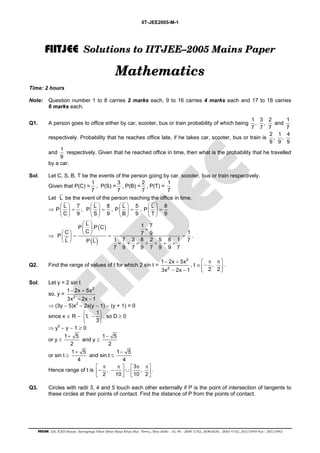
Q1. A person goes to office either by car, scooter, bus or train probability of which being 1, 3 , 2 
7 7 7 
and 1 
  
  = 
  
  
  = 
  
  
  = 
  
  
  = 
  
  
  × 
P L .P C 1 7 
  =   = =   
  × + × + × + × 
1 − 2x + 
5x 
3x 2x 1 
 π π −    
1 − 2x + 
5x 
3x 2x 1 
 −    
  
+ 
− 
+ 
− 
 π π   π π − −  ∪       
FIITJEE Ltd. ICES House, Sarvapriya Vihar (Near Hauz Khas Bus Term.), New Delhi - 16, Ph : 2686 5182, 26965626, 2685 4102, 26515949 Fax : 26513942 
7 
respectively. Probability that he reaches office late, if he takes car, scooter, bus or train is 2 , 1, 4 
9 9 9 
and 1 
9 
respectively. Given that he reached office in time, then what is the probability that he travelled 
by a car. 
Sol. Let C, S, B, T be the events of the person going by car, scooter, bus or train respectively. 
Given that P(C) = 1 
7 
, P(S) = 3 
7 
, P(B) = 2 
7 
, P(T) = 1 
7 
Let L be the event of the person reaching the office in time. 
⇒ P L 7 
C 9 
, P L 8 
S 9 
, P L 5 
B 9 
, P L 8 
T 9 
⇒ 
( ) 
( ) 
C C 7 9 1 P 
L P L 1 7 3 8 2 5 8 1 7 
7 9 7 9 7 9 9 7 
. 
Q2. Find the range of values of t for which 2 sin t = 
2 
2 
− − 
, t ∈ , 
2 2 
. 
Sol. Let y = 2 sin t 
so, y = 
2 
2 
− − 
⇒ (3y − 5)x2 − 2x(y − 1) − (y + 1) = 0 
since x ∈ R − 1, 1 
3 
, so D ≥ 0 
⇒ y2 − y − 1 ≥ 0 
or y ≥ 1 5 
2 
and y ≤ 1 5 
2 
or sin t ≥ 1 5 
4 
and sin t ≤ 1 5 
4 
Hence range of t is , 3 , 
2 10 10 2 
. 
Q3. Circles with radii 3, 4 and 5 touch each other externally if P is the point of intersection of tangents to 
these circles at their points of contact. Find the distance of P from the points of contact.
IIT-JEE2005-M-2 
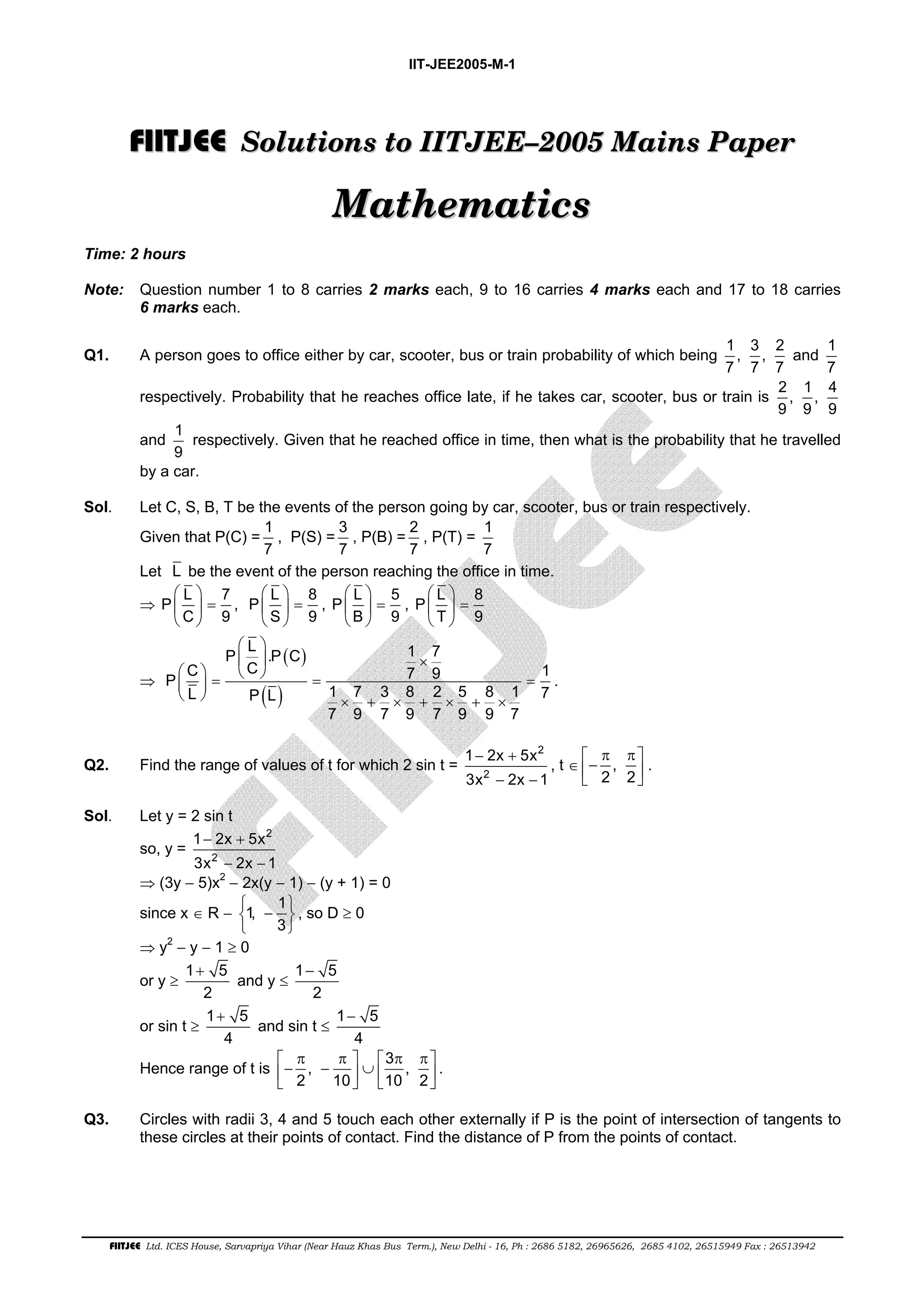
Sol. Let A, B, C be the centre of the three circles. 
Clearly the point P is the in–centre of the ΔABC, and 
hence 
Δ s (s − a)(s − b)(s − c) − − − 
r = 
= = 
(s a)(s b)(s c) 
s s s 
Now 2s = 7 + 8 + 9 = 24 ⇒ s = 12. 
Hence r = 5. 4.3 5 
12 
= . 
A 
3 
4 
C 
B 
3 
•P 
4 
5 
5 
Q4. Find the equation of the plane containing the line 2x – y + z – 3 = 0, 3x + y + z = 5 and at a distance of 
1 
6 
from the point (2, 1, – 1). 
Sol. Let the equation of plane be (3λ + 2)x + (λ − 1)y + (λ + 1)z − 5λ – 3 = 0 
⇒ 
6 λ + 4 + λ − 1 − λ − 1 − 5 λ − 
3 = 
1 
(3 λ + 2) 2 + ( λ − 1) 2 + ( λ + 
1) 2 
6 
⇒ 6(λ – 1)2 = 11λ2 + 12λ + 6 ⇒ λ = 0, − 24 
5 
. 
⇒ The planes are 2x – y + z – 3 = 0 and 62x + 29y + 19z − 105 = 0. 
Q5. If |f(x1) – f(x2)| < (x1 – x2)2, for all x1, x2 ∈R. Find the equation of tangent to the curve y = f(x) at the 
point (1, 2). 
Sol. |f (x1) – f (x2)| < (x1 – x2)2 
⇒ 
f(x ) − 
f(x ) 
1 2 
lim < lim | x − 
x | 
→ x x → 
x x 1 2 1 2 1 − 
2 
x 1 x 2 
⇒ |f′ (x)| < δ ⇒ f′ (x) = 0. 
Hence f (x) is a constant function and P (1, 2) lies on the curve. 
⇒ f (x) = 2 is the curve. 
Hence the equation of tangent is y – 2 = 0. 
Q6. If total number of runs scored in n matches is n 1 
 +  
  4 
 
 
(2n+1 – n – 2) where n > 1, and the runs scored 
in the kth match are given by k. 2n+1–k, where 1 ≤ k ≤ n. Find n. 
Sol. Let Sn = 
n 
n 1 k 
= Σ 
k 1 
k.2 + − 
= 
n 
= Σ 
n 1 k 
2 + k.2− 
k 1 
2 .2 1 1 n 
= n 1 
 − −   n n1 
 
2 2 
+ 
+ 
(sum of the A.G.P.) 
= 2[2n+1 – 2 – n] 
n + 
⇒ 1 2 
4 
= ⇒ n = 7. 
Q7. The area of the triangle formed by the intersection of a line parallel to x-axis and passing through 
P (h, k) with the lines y = x and x + y = 2 is 4h2. Find the locus of the point P. 
Sol. Area of triangle = 1 
2 
. AB. AC = 4h2 
and AB = 2 |k – 1| = AC 
⇒ 4h2 = 1 
2 
. 2. (k – 1)2 
⇒ k – 1 = ± 2h. 
⇒ locus is y = 2x + 1, y = – 2x + 1. 
y = x 
A(1,1) 
B(k,k) C(2−k,k) y =k 
P(h,k) 
X 
x+y=2 
O 
FIITJEE Ltd. ICES House, Sarvapriya Vihar (Near Hauz Khas Bus Term.), New Delhi - 16, Ph : 2686 5182, 26965626, 2685 4102, 26515949 Fax : 26513942
IIT-JEE2005-M-3 
π  e  1    2 sin  cos x  + 3 cos  1  cos x 
 
     ∫ sin x dx. 
Q8. Evaluate |cos x| 
0 
2 2 
π  e  1    2 sin  cos x  + 3 cos  1  cos x 
 
     ∫ sin x dx 
Sol. I = |cos x| 
0 
2 2 
= 6 
/ 2 
e sin x cos 1 cos x dx 
 
  0, if f(2a − x) = − f(x) 
 
 2a 
  =      − =      
∫ cos x 
  
  
( )   ( ) 
0 
2 
π 
∵ 
∫ a 
∫ 0 
2 f x dx, if f(2a x) f(x) 
0 
f x dx 
Let cos x = t 
1 
I = 6 
e cos t dt 
∫ 
t 
  
  
  0 
2 
         +   −  
      
= 24 ecos 1 e sin 1 1 
5 2 2 2 
. 
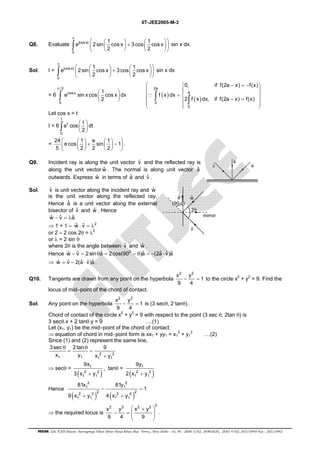
Q9. Incident ray is along the unit vector ˆv and the reflected ray is 
along the unit vector wˆ . The normal is along unit vector aˆ 
outwards. Express wˆ in terms of aˆ and vˆ . 
ˆv 
ˆa 
wˆ 
Sol. vˆ is unit vector along the incident ray and wˆ 
is the unit vector along the reflected ray. 
Hence ˆa is a unit vector along the external 
bisector of vˆ and wˆ . Hence 
wˆ − vˆ = λaˆ 
⇒ 1 + 1 – wˆ ⋅ vˆ = λ2 
or 2 – 2 cos 2θ = λ2 
or λ = 2 sin θ 
where 2θ is the angle between vˆ and wˆ . 
ˆa 
wˆ 
2θ 
ˆv 
(90-θ) 
mirror 
Hence wˆ − vˆ = 2sinθaˆ = 2cos(900 − θ)aˆ = −(2aˆ ⋅ vˆ )aˆ 
⇒ wˆ = vˆ − 2(aˆ ⋅ vˆ )aˆ . 
Q10. Tangents are drawn from any point on the hyperbola 
x2 y2 1 
9 4 
− = to the circle x2 + y2 = 9. Find the 
locus of mid–point of the chord of contact. 
Sol. Any point on the hyperbola 
x2 y2 1 
9 4 
− = is (3 secθ, 2 tanθ). 
Chord of contact of the circle x2 + y2 = 9 with respect to the point (3 sec θ, 2tan θ) is 
3 secθ.x + 2 tanθ.y = 9 ….(1) 
Let (x1, y1) be the mid–point of the chord of contact. 
⇒ equation of chord in mid−point form is xx1 + yy1 = x1 
2 + y1 
2 ….(2) 
Since (1) and (2) represent the same line, 
3sec 2 tan 9 
x y x y 
2 2 
θ θ 
= = 
+ 
1 1 1 1 
9x 
1 
⇒ secθ = 3 ( x 2 1 + y 
2 
) 
1 
9y 
1 
, tanθ = 2 ( x 2 1 + y 
2 
) 
1 
2 2 
1 1 
81x 81y 
− = 
Hence ( ) ( ) 
2 2 2 2 2 2 
1 1 1 1 
1 
9 x + y 4 x + 
y 
⇒ the required locus is 
x 2 y 2  2 2 x + − = y 
2  
9 4  9 
 
  
. 
FIITJEE Ltd. ICES House, Sarvapriya Vihar (Near Hauz Khas Bus Term.), New Delhi - 16, Ph : 2686 5182, 26965626, 2685 4102, 26515949 Fax : 26513942
IIT-JEE2005-M-4 
Q11. Find the equation of the common tangent in 1st quadrant to the circle x2 + y2 = 16 and the ellipse 
x2 y2 1 
25 4 
+ = . Also find the length of the intercept of the tangent between the coordinate axes. 
Sol. Let the equations of tangents to the given circle and the ellipse respectively be 
y = mx + 4 1+ m2 
and y = mx + 25m2 + 4 
Since both of these represent the same common tangent, 
4 1+ m2 = 25m2 + 4 
⇒ 16(1 + m2) = 25m2 + 4 
⇒ m = ± 2 
3 
The tangent is at a point in the first quadrant ⇒ m < 0. 
⇒ m = 2 
− , so that the equation of the common tangent is 
3 
y = 2 x 4 7 
− + . 
3 3 
  
  
  
It meets the coordinate axes at A (2 7, 0) and B 0, 4 7 
3 
⇒ AB = 14 
3 
. 
Q12. If length of tangent at any point on the curve y = f(x) intercepted between the point and the x–axis is of 
length 1. Find the equation of the curve. 
Sol. Length of tangent = 
2 y 1 dx 
  
+   dy 
 
 
⇒ 1 = 
   2 
  +    
    
y2 1 dx 
dy 
⇒ 
2 
dy = ± 
y 
dx 1 − 
y 
⇒ 
1 y2 
∫ − 
dy = ± x + c 
. 
y 
Writing y = sin θ, dy = cos θ dθ and integrating, we get the equation of the curve as 
2 
2 1 − 1 − 
y 
1 y ln x c 
− + = ± + . 
y 
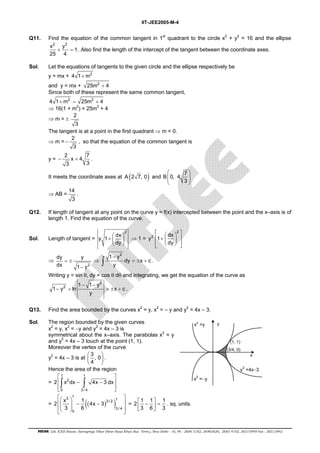
Q13. Find the area bounded by the curves x2 = y, x2 = – y and y2 = 4x – 3. 
Sol. The region bounded by the given curves 
x2 = y, x2 = −y and y2 = 4x – 3 is 
symmetrical about the x–axis. The parabolas x2 = y 
and y2 = 4x – 3 touch at the point (1, 1). 
Moreover the vertex of the curve 
y2 = 4x – 3 is at 3, 0 
  
  4 
 
 
. 
Hence the area of the region 
= 
 1 1 
 
 ∫ 2 
− ∫ 
−  
  
2 x dx 4x 3dx 
0 3/ 4 
x2 =y 
x2 =−y 
(1, 1) 
(3/4, 0) 
x 
y2 =4x−3 
y 
     − −        
= (( ) ) 3 1 3 / 2 1 
3 / 4 
2 x 1 4x 3 
3 6 
0 
= 2 1 1 1 
 −  =   
3 6 3 
. sq. units. 
FIITJEE Ltd. ICES House, Sarvapriya Vihar (Near Hauz Khas Bus Term.), New Delhi - 16, Ph : 2686 5182, 26965626, 2685 4102, 26515949 Fax : 26513942
IIT-JEE2005-M-5 
Q14. If one of the vertices of the square circumscribing the circle |z – 1| = 2 is 2 + 3 i. Find the other 
vertices of square. 
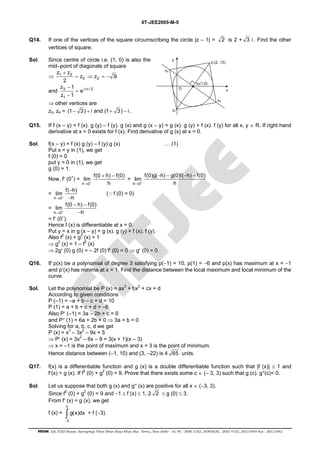
Sol. Since centre of circle i.e. (1, 0) is also the 
mid–point of diagonals of square 
⇒ 1 2 
z z 3i 
= ⇒ = − 
0 2 
z + 
z 
2 
z 1 
− ± π 
and 3 i / 2 
z 1 
1 
e 
= 
− 
⇒ other vertices are 
z3, z4 = (1− 3) + i and (1+ 3) − i . 
z0(1,0) 
z1(2, √3) 
z4 
y 
z2 
z3 
x 
O 
Q15. If f (x – y) = f (x). g (y) – f (y). g (x) and g (x – y) = g (x). g (y) + f (x). f (y) for all x, y ∈ R. If right hand 
derivative at x = 0 exists for f (x). Find derivative of g (x) at x = 0. 
Sol. f(x – y) = f (x) g (y) – f (y) g (x) … (1) 
Put x = y in (1), we get 
f (0) = 0 
put y = 0 in (1), we get 
g (0) = 1. 
Now, f′ (0+) = 
lim f(0 h) f(0) 
→ + h 
h 0 
+ − 
= 
lim f(0)g( h) g(0)f( h) f(0) 
→ + h 
h 0 
− − − − 
= 
lim f( h) 
→ + h 
h 0 
− 
− 
(∵f (0) = 0) 
= 
lim f(0 h) f(0) 
→ + h 
h 0 
− − 
− 
= f′ (0–). 
Hence f (x) is differentiable at x = 0. 
Put y = x in g (x – y) = g (x). g (y) + f (x). f (y). 
Also f2 (x) + g2 (x) = 1 
⇒ g2 (x) = 1 – f2 (x) 
⇒ 2g′ (0) g (0) = – 2f (0) f′ (0) = 0 ⇒ g′ (0) = 0. 
Q16. If p(x) be a polynomial of degree 3 satisfying p(−1) = 10, p(1) = −6 and p(x) has maximum at x = −1 
and p′(x) has minima at x = 1. Find the distance between the local maximum and local minimum of the 
curve. 
Sol. Let the polynomial be P (x) = ax3 + bx2 + cx + d 
According to given conditions 
P (–1) = –a + b – c + d = 10 
P (1) = a + b + c + d = –6 
Also P′ (–1) = 3a – 2b + c = 0 
and P″ (1) = 6a + 2b = 0 ⇒ 3a + b = 0 
Solving for a, b, c, d we get 
P (x) = x3 – 3x2 – 9x + 5 
⇒ P′ (x) = 3x2 – 6x – 9 = 3(x + 1)(x – 3) 
⇒ x = –1 is the point of maximum and x = 3 is the point of minimum. 
Hence distance between (–1, 10) and (3, –22) is 4 65 units. 
Q17. f(x) is a differentiable function and g (x) is a double differentiable function such that |f (x)| ≤ 1 and 
f′(x) = g (x). If f2 (0) + g2 (0) = 9. Prove that there exists some c ∈ (– 3, 3) such that g (c). g″(c)< 0. 
Sol. Let us suppose that both g (x) and g″ (x) are positive for all x ∈ (−3, 3). 
Since f2 (0) + g2 (0) = 9 and −1 ≤ f (x) ≤ 1, 2 2 ≤ g (0) ≤ 3. 
From f′ (x) = g (x), we get 
x 
f (x) = 
∫ + f (−3). 
3 
g(x)dx 
− 
FIITJEE Ltd. ICES House, Sarvapriya Vihar (Near Hauz Khas Bus Term.), New Delhi - 16, Ph : 2686 5182, 26965626, 2685 4102, 26515949 Fax : 26513942
IIT-JEE2005-M-6 
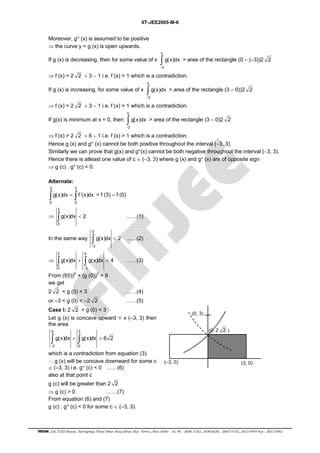
Moreover, g″ (x) is assumed to be positive 
⇒ the curve y = g (x) is open upwards. 
If g (x) is decreasing, then for some value of x 
x 
∫ > area of the rectangle (0 – (–3))2 2 
3 
g(x)dx 
− 
⇒ f (x) > 2 2 × 3 − 1 i.e. f (x) > 1 which is a contradiction. 
x 
If g (x) is increasing, for some value of x 
∫ > area of the rectangle (3 – 0))2 2 
3 
g(x)dx 
− 
⇒ f (x) > 2 2 × 3 − 1 i.e. f (x) > 1 which is a contradiction. 
x 
If g(x) is minimum at x = 0, then 
∫ > area of the rectangle (3 – 0)2 2 
3 
g(x)dx 
− 
⇒ f (x) > 2 2 × 6 − 1 i.e. f (x) > 1 which is a contradiction. 
Hence g (x) and g″ (x) cannot be both positive throughout the interval (−3, 3). 
Similarly we can prove that g(x) and g″(x) cannot be both negative throughout the interval (−3, 3). 
Hence there is atleast one value of c ∈ (−3, 3) where g (x) and g″ (x) are of opposite sign 
⇒ g (c) . g″ (c) < 0. 
Alternate: 
3 3 
∫ g(x)dx = ∫ f ′(x)dx = f (3) – f (0) 
0 0 
⇒ 
3 
∫g(x)dx < 2 ……(1) 
0 
In the same way 
0 
∫ < ……(2) 
− 
3 
g(x)dx 2 
⇒ 
3 0 
∫ g(x)dx + ∫ g(x)dx < 4 
……(3) 
− 
0 3 
From (f(0))2 + (g (0))2 = 9 
we get 
22 < g (0) < 3 ……(4) 
or –3 < g (0) < –2 2 ……(5) 
Case I: 2 2 < g (0) < 3 
Let g (x) is concave upward ∀ x (–3, 3) then 
the area 
0 3 
∫ g(x)dx + ∫ g(x)dx > 
6 2 
− 
3 0 
which is a contradiction from equation (3). 
∴ g (x) will be concave downward for some c 
∈ (–3, 3) i.e. g″ (c) < 0 ……(6) 
also at that point c 
(0, 2 2 ) 
(0, 3) 
(–3, 0) (3, 0) 
g (c) will be greater than 2 2 
⇒ g (c) > 0 ……(7) 
From equation (6) and (7) 
g (c) . g″ (c) < 0 for some c ∈ (–3, 3). 
FIITJEE Ltd. ICES House, Sarvapriya Vihar (Near Hauz Khas Bus Term.), New Delhi - 16, Ph : 2686 5182, 26965626, 2685 4102, 26515949 Fax : 26513942
IIT-JEE2005-M-7 
Case II: –3 < g (0) < –2 2 
Let g (x) is concave downward ∀ x (–3, 3) 
then the area 
0 3 
∫ g(x)dx + ∫ g(x)dx > 
6 2 
− 
3 0 
which is a contradiction from equation (3). 
∴ g (x) will be concave upward for some 
c ∈ (–3, 3) i.e. g″ (c) > 0 ……(8) 
also at that point c 
g (c) will be less than –2 2 
(–3, 0) (3, 0) 
(0, –2 2 ) 
(0, –3) 
⇒ g (c) < 0 ……(9) 
From equation (8) and (9) 
g (c) . g″ (c) < 0 for some c ∈ (–3, 3). 
Q18. If 
2 2 
2 2 
2 2 
 4a 4a 1   f( − 1)   3a + 3a 
      4b 4b 1    f(1)   =  3b + 3b 
      4c 4c 1   f(2)     3c + 3c 
 
, f(x) is a quadratic function and its maximum value occurs at a 
point V. A is a point of intersection of y = f (x) with x-axis and point B is such that chord AB subtends a 
right angle at V. Find the area enclosed by f (x) and chord AB. 
Sol. Let we have 
4a2 f (–1) + 4a f (1) + f (2) = 3a2 + 3a … (1) 
4b2 f (–1) + 4b f (1) + f (2) = 3b2 + 3b … (2) 
4c2 f (–1) + 4c f (1) + f (2) = 3c2 + 3c … (3) 
Consider a quadratic equation 
4x2 f (–1) + 4x f (1) + f (2) = 3x2 + 3x 
or [4f (–1) – 3] x2 + [4f (1) – 3] x + f (2) = 0 … (4) 
As equation (4) has three roots i.e. x = a, b, c. It is an identity. 
⇒ f (–1) = 3 
4 
, f (1) = 3 
4 
and f (2) = 0 
⇒ f (x) = 
(4 − 
x2 ) 
4 
… (5) 
Let point A be (–2, 0) and B be (2t, – t2 + 1) 
Now as AB subtends a right angle at the vertex 
V (0, 1) 
1 t2 1 
2 2t 
− 
× =− ⇒ t = 4 
⇒ B ≡ (8, – 15) 
8 2 
∴ Area = 
 − +  
 +  
  ∫ = 125 
4 x 3x 6 dx 
4 2 − 
2 
3 
sq. units. 
A(-2,0) 
V(0,1) 
(2,0) 
X 
B(8,-15) 
3x+2y+6=0 
FIITJEE Ltd. ICES House, Sarvapriya Vihar (Near Hauz Khas Bus Term.), New Delhi - 16, Ph : 2686 5182, 26965626, 2685 4102, 26515949 Fax : 26513942

Maths05

  • 1.
    IIT-JEE2005-M-1 FIIIITJEE Solutionsto IITJEE––2005 Mains Paper Mathematics Time: 2 hours Note: Question number 1 to 8 carries 2 marks each, 9 to 16 carries 4 marks each and 17 to 18 carries 6 marks each. Q1. A person goes to office either by car, scooter, bus or train probability of which being 1, 3 , 2 7 7 7 and 1     =       =       =       =       × P L .P C 1 7   =   = =     × + × + × + × 1 − 2x + 5x 3x 2x 1  π π −    1 − 2x + 5x 3x 2x 1  −      + − + −  π π   π π − −  ∪       FIITJEE Ltd. ICES House, Sarvapriya Vihar (Near Hauz Khas Bus Term.), New Delhi - 16, Ph : 2686 5182, 26965626, 2685 4102, 26515949 Fax : 26513942 7 respectively. Probability that he reaches office late, if he takes car, scooter, bus or train is 2 , 1, 4 9 9 9 and 1 9 respectively. Given that he reached office in time, then what is the probability that he travelled by a car. Sol. Let C, S, B, T be the events of the person going by car, scooter, bus or train respectively. Given that P(C) = 1 7 , P(S) = 3 7 , P(B) = 2 7 , P(T) = 1 7 Let L be the event of the person reaching the office in time. ⇒ P L 7 C 9 , P L 8 S 9 , P L 5 B 9 , P L 8 T 9 ⇒ ( ) ( ) C C 7 9 1 P L P L 1 7 3 8 2 5 8 1 7 7 9 7 9 7 9 9 7 . Q2. Find the range of values of t for which 2 sin t = 2 2 − − , t ∈ , 2 2 . Sol. Let y = 2 sin t so, y = 2 2 − − ⇒ (3y − 5)x2 − 2x(y − 1) − (y + 1) = 0 since x ∈ R − 1, 1 3 , so D ≥ 0 ⇒ y2 − y − 1 ≥ 0 or y ≥ 1 5 2 and y ≤ 1 5 2 or sin t ≥ 1 5 4 and sin t ≤ 1 5 4 Hence range of t is , 3 , 2 10 10 2 . Q3. Circles with radii 3, 4 and 5 touch each other externally if P is the point of intersection of tangents to these circles at their points of contact. Find the distance of P from the points of contact.
  • 2.
    IIT-JEE2005-M-2 Sol. LetA, B, C be the centre of the three circles. Clearly the point P is the in–centre of the ΔABC, and hence Δ s (s − a)(s − b)(s − c) − − − r = = = (s a)(s b)(s c) s s s Now 2s = 7 + 8 + 9 = 24 ⇒ s = 12. Hence r = 5. 4.3 5 12 = . A 3 4 C B 3 •P 4 5 5 Q4. Find the equation of the plane containing the line 2x – y + z – 3 = 0, 3x + y + z = 5 and at a distance of 1 6 from the point (2, 1, – 1). Sol. Let the equation of plane be (3λ + 2)x + (λ − 1)y + (λ + 1)z − 5λ – 3 = 0 ⇒ 6 λ + 4 + λ − 1 − λ − 1 − 5 λ − 3 = 1 (3 λ + 2) 2 + ( λ − 1) 2 + ( λ + 1) 2 6 ⇒ 6(λ – 1)2 = 11λ2 + 12λ + 6 ⇒ λ = 0, − 24 5 . ⇒ The planes are 2x – y + z – 3 = 0 and 62x + 29y + 19z − 105 = 0. Q5. If |f(x1) – f(x2)| < (x1 – x2)2, for all x1, x2 ∈R. Find the equation of tangent to the curve y = f(x) at the point (1, 2). Sol. |f (x1) – f (x2)| < (x1 – x2)2 ⇒ f(x ) − f(x ) 1 2 lim < lim | x − x | → x x → x x 1 2 1 2 1 − 2 x 1 x 2 ⇒ |f′ (x)| < δ ⇒ f′ (x) = 0. Hence f (x) is a constant function and P (1, 2) lies on the curve. ⇒ f (x) = 2 is the curve. Hence the equation of tangent is y – 2 = 0. Q6. If total number of runs scored in n matches is n 1  +    4   (2n+1 – n – 2) where n > 1, and the runs scored in the kth match are given by k. 2n+1–k, where 1 ≤ k ≤ n. Find n. Sol. Let Sn = n n 1 k = Σ k 1 k.2 + − = n = Σ n 1 k 2 + k.2− k 1 2 .2 1 1 n = n 1  − −   n n1  2 2 + + (sum of the A.G.P.) = 2[2n+1 – 2 – n] n + ⇒ 1 2 4 = ⇒ n = 7. Q7. The area of the triangle formed by the intersection of a line parallel to x-axis and passing through P (h, k) with the lines y = x and x + y = 2 is 4h2. Find the locus of the point P. Sol. Area of triangle = 1 2 . AB. AC = 4h2 and AB = 2 |k – 1| = AC ⇒ 4h2 = 1 2 . 2. (k – 1)2 ⇒ k – 1 = ± 2h. ⇒ locus is y = 2x + 1, y = – 2x + 1. y = x A(1,1) B(k,k) C(2−k,k) y =k P(h,k) X x+y=2 O FIITJEE Ltd. ICES House, Sarvapriya Vihar (Near Hauz Khas Bus Term.), New Delhi - 16, Ph : 2686 5182, 26965626, 2685 4102, 26515949 Fax : 26513942
  • 3.
    IIT-JEE2005-M-3 π e  1    2 sin  cos x  + 3 cos  1  cos x       ∫ sin x dx. Q8. Evaluate |cos x| 0 2 2 π  e  1    2 sin  cos x  + 3 cos  1  cos x       ∫ sin x dx Sol. I = |cos x| 0 2 2 = 6 / 2 e sin x cos 1 cos x dx    0, if f(2a − x) = − f(x)   2a   =      − =      ∫ cos x     ( )   ( ) 0 2 π ∵ ∫ a ∫ 0 2 f x dx, if f(2a x) f(x) 0 f x dx Let cos x = t 1 I = 6 e cos t dt ∫ t       0 2          +   −        = 24 ecos 1 e sin 1 1 5 2 2 2 . Q9. Incident ray is along the unit vector ˆv and the reflected ray is along the unit vector wˆ . The normal is along unit vector aˆ outwards. Express wˆ in terms of aˆ and vˆ . ˆv ˆa wˆ Sol. vˆ is unit vector along the incident ray and wˆ is the unit vector along the reflected ray. Hence ˆa is a unit vector along the external bisector of vˆ and wˆ . Hence wˆ − vˆ = λaˆ ⇒ 1 + 1 – wˆ ⋅ vˆ = λ2 or 2 – 2 cos 2θ = λ2 or λ = 2 sin θ where 2θ is the angle between vˆ and wˆ . ˆa wˆ 2θ ˆv (90-θ) mirror Hence wˆ − vˆ = 2sinθaˆ = 2cos(900 − θ)aˆ = −(2aˆ ⋅ vˆ )aˆ ⇒ wˆ = vˆ − 2(aˆ ⋅ vˆ )aˆ . Q10. Tangents are drawn from any point on the hyperbola x2 y2 1 9 4 − = to the circle x2 + y2 = 9. Find the locus of mid–point of the chord of contact. Sol. Any point on the hyperbola x2 y2 1 9 4 − = is (3 secθ, 2 tanθ). Chord of contact of the circle x2 + y2 = 9 with respect to the point (3 sec θ, 2tan θ) is 3 secθ.x + 2 tanθ.y = 9 ….(1) Let (x1, y1) be the mid–point of the chord of contact. ⇒ equation of chord in mid−point form is xx1 + yy1 = x1 2 + y1 2 ….(2) Since (1) and (2) represent the same line, 3sec 2 tan 9 x y x y 2 2 θ θ = = + 1 1 1 1 9x 1 ⇒ secθ = 3 ( x 2 1 + y 2 ) 1 9y 1 , tanθ = 2 ( x 2 1 + y 2 ) 1 2 2 1 1 81x 81y − = Hence ( ) ( ) 2 2 2 2 2 2 1 1 1 1 1 9 x + y 4 x + y ⇒ the required locus is x 2 y 2  2 2 x + − = y 2  9 4  9    . FIITJEE Ltd. ICES House, Sarvapriya Vihar (Near Hauz Khas Bus Term.), New Delhi - 16, Ph : 2686 5182, 26965626, 2685 4102, 26515949 Fax : 26513942
  • 4.
    IIT-JEE2005-M-4 Q11. Findthe equation of the common tangent in 1st quadrant to the circle x2 + y2 = 16 and the ellipse x2 y2 1 25 4 + = . Also find the length of the intercept of the tangent between the coordinate axes. Sol. Let the equations of tangents to the given circle and the ellipse respectively be y = mx + 4 1+ m2 and y = mx + 25m2 + 4 Since both of these represent the same common tangent, 4 1+ m2 = 25m2 + 4 ⇒ 16(1 + m2) = 25m2 + 4 ⇒ m = ± 2 3 The tangent is at a point in the first quadrant ⇒ m < 0. ⇒ m = 2 − , so that the equation of the common tangent is 3 y = 2 x 4 7 − + . 3 3       It meets the coordinate axes at A (2 7, 0) and B 0, 4 7 3 ⇒ AB = 14 3 . Q12. If length of tangent at any point on the curve y = f(x) intercepted between the point and the x–axis is of length 1. Find the equation of the curve. Sol. Length of tangent = 2 y 1 dx   +   dy   ⇒ 1 =    2   +        y2 1 dx dy ⇒ 2 dy = ± y dx 1 − y ⇒ 1 y2 ∫ − dy = ± x + c . y Writing y = sin θ, dy = cos θ dθ and integrating, we get the equation of the curve as 2 2 1 − 1 − y 1 y ln x c − + = ± + . y Q13. Find the area bounded by the curves x2 = y, x2 = – y and y2 = 4x – 3. Sol. The region bounded by the given curves x2 = y, x2 = −y and y2 = 4x – 3 is symmetrical about the x–axis. The parabolas x2 = y and y2 = 4x – 3 touch at the point (1, 1). Moreover the vertex of the curve y2 = 4x – 3 is at 3, 0     4   . Hence the area of the region =  1 1   ∫ 2 − ∫ −    2 x dx 4x 3dx 0 3/ 4 x2 =y x2 =−y (1, 1) (3/4, 0) x y2 =4x−3 y      − −        = (( ) ) 3 1 3 / 2 1 3 / 4 2 x 1 4x 3 3 6 0 = 2 1 1 1  −  =   3 6 3 . sq. units. FIITJEE Ltd. ICES House, Sarvapriya Vihar (Near Hauz Khas Bus Term.), New Delhi - 16, Ph : 2686 5182, 26965626, 2685 4102, 26515949 Fax : 26513942
  • 5.
    IIT-JEE2005-M-5 Q14. Ifone of the vertices of the square circumscribing the circle |z – 1| = 2 is 2 + 3 i. Find the other vertices of square. Sol. Since centre of circle i.e. (1, 0) is also the mid–point of diagonals of square ⇒ 1 2 z z 3i = ⇒ = − 0 2 z + z 2 z 1 − ± π and 3 i / 2 z 1 1 e = − ⇒ other vertices are z3, z4 = (1− 3) + i and (1+ 3) − i . z0(1,0) z1(2, √3) z4 y z2 z3 x O Q15. If f (x – y) = f (x). g (y) – f (y). g (x) and g (x – y) = g (x). g (y) + f (x). f (y) for all x, y ∈ R. If right hand derivative at x = 0 exists for f (x). Find derivative of g (x) at x = 0. Sol. f(x – y) = f (x) g (y) – f (y) g (x) … (1) Put x = y in (1), we get f (0) = 0 put y = 0 in (1), we get g (0) = 1. Now, f′ (0+) = lim f(0 h) f(0) → + h h 0 + − = lim f(0)g( h) g(0)f( h) f(0) → + h h 0 − − − − = lim f( h) → + h h 0 − − (∵f (0) = 0) = lim f(0 h) f(0) → + h h 0 − − − = f′ (0–). Hence f (x) is differentiable at x = 0. Put y = x in g (x – y) = g (x). g (y) + f (x). f (y). Also f2 (x) + g2 (x) = 1 ⇒ g2 (x) = 1 – f2 (x) ⇒ 2g′ (0) g (0) = – 2f (0) f′ (0) = 0 ⇒ g′ (0) = 0. Q16. If p(x) be a polynomial of degree 3 satisfying p(−1) = 10, p(1) = −6 and p(x) has maximum at x = −1 and p′(x) has minima at x = 1. Find the distance between the local maximum and local minimum of the curve. Sol. Let the polynomial be P (x) = ax3 + bx2 + cx + d According to given conditions P (–1) = –a + b – c + d = 10 P (1) = a + b + c + d = –6 Also P′ (–1) = 3a – 2b + c = 0 and P″ (1) = 6a + 2b = 0 ⇒ 3a + b = 0 Solving for a, b, c, d we get P (x) = x3 – 3x2 – 9x + 5 ⇒ P′ (x) = 3x2 – 6x – 9 = 3(x + 1)(x – 3) ⇒ x = –1 is the point of maximum and x = 3 is the point of minimum. Hence distance between (–1, 10) and (3, –22) is 4 65 units. Q17. f(x) is a differentiable function and g (x) is a double differentiable function such that |f (x)| ≤ 1 and f′(x) = g (x). If f2 (0) + g2 (0) = 9. Prove that there exists some c ∈ (– 3, 3) such that g (c). g″(c)< 0. Sol. Let us suppose that both g (x) and g″ (x) are positive for all x ∈ (−3, 3). Since f2 (0) + g2 (0) = 9 and −1 ≤ f (x) ≤ 1, 2 2 ≤ g (0) ≤ 3. From f′ (x) = g (x), we get x f (x) = ∫ + f (−3). 3 g(x)dx − FIITJEE Ltd. ICES House, Sarvapriya Vihar (Near Hauz Khas Bus Term.), New Delhi - 16, Ph : 2686 5182, 26965626, 2685 4102, 26515949 Fax : 26513942
  • 6.
    IIT-JEE2005-M-6 Moreover, g″(x) is assumed to be positive ⇒ the curve y = g (x) is open upwards. If g (x) is decreasing, then for some value of x x ∫ > area of the rectangle (0 – (–3))2 2 3 g(x)dx − ⇒ f (x) > 2 2 × 3 − 1 i.e. f (x) > 1 which is a contradiction. x If g (x) is increasing, for some value of x ∫ > area of the rectangle (3 – 0))2 2 3 g(x)dx − ⇒ f (x) > 2 2 × 3 − 1 i.e. f (x) > 1 which is a contradiction. x If g(x) is minimum at x = 0, then ∫ > area of the rectangle (3 – 0)2 2 3 g(x)dx − ⇒ f (x) > 2 2 × 6 − 1 i.e. f (x) > 1 which is a contradiction. Hence g (x) and g″ (x) cannot be both positive throughout the interval (−3, 3). Similarly we can prove that g(x) and g″(x) cannot be both negative throughout the interval (−3, 3). Hence there is atleast one value of c ∈ (−3, 3) where g (x) and g″ (x) are of opposite sign ⇒ g (c) . g″ (c) < 0. Alternate: 3 3 ∫ g(x)dx = ∫ f ′(x)dx = f (3) – f (0) 0 0 ⇒ 3 ∫g(x)dx < 2 ……(1) 0 In the same way 0 ∫ < ……(2) − 3 g(x)dx 2 ⇒ 3 0 ∫ g(x)dx + ∫ g(x)dx < 4 ……(3) − 0 3 From (f(0))2 + (g (0))2 = 9 we get 22 < g (0) < 3 ……(4) or –3 < g (0) < –2 2 ……(5) Case I: 2 2 < g (0) < 3 Let g (x) is concave upward ∀ x (–3, 3) then the area 0 3 ∫ g(x)dx + ∫ g(x)dx > 6 2 − 3 0 which is a contradiction from equation (3). ∴ g (x) will be concave downward for some c ∈ (–3, 3) i.e. g″ (c) < 0 ……(6) also at that point c (0, 2 2 ) (0, 3) (–3, 0) (3, 0) g (c) will be greater than 2 2 ⇒ g (c) > 0 ……(7) From equation (6) and (7) g (c) . g″ (c) < 0 for some c ∈ (–3, 3). FIITJEE Ltd. ICES House, Sarvapriya Vihar (Near Hauz Khas Bus Term.), New Delhi - 16, Ph : 2686 5182, 26965626, 2685 4102, 26515949 Fax : 26513942
  • 7.
    IIT-JEE2005-M-7 Case II:–3 < g (0) < –2 2 Let g (x) is concave downward ∀ x (–3, 3) then the area 0 3 ∫ g(x)dx + ∫ g(x)dx > 6 2 − 3 0 which is a contradiction from equation (3). ∴ g (x) will be concave upward for some c ∈ (–3, 3) i.e. g″ (c) > 0 ……(8) also at that point c g (c) will be less than –2 2 (–3, 0) (3, 0) (0, –2 2 ) (0, –3) ⇒ g (c) < 0 ……(9) From equation (8) and (9) g (c) . g″ (c) < 0 for some c ∈ (–3, 3). Q18. If 2 2 2 2 2 2  4a 4a 1   f( − 1)   3a + 3a       4b 4b 1    f(1)   =  3b + 3b       4c 4c 1   f(2)     3c + 3c  , f(x) is a quadratic function and its maximum value occurs at a point V. A is a point of intersection of y = f (x) with x-axis and point B is such that chord AB subtends a right angle at V. Find the area enclosed by f (x) and chord AB. Sol. Let we have 4a2 f (–1) + 4a f (1) + f (2) = 3a2 + 3a … (1) 4b2 f (–1) + 4b f (1) + f (2) = 3b2 + 3b … (2) 4c2 f (–1) + 4c f (1) + f (2) = 3c2 + 3c … (3) Consider a quadratic equation 4x2 f (–1) + 4x f (1) + f (2) = 3x2 + 3x or [4f (–1) – 3] x2 + [4f (1) – 3] x + f (2) = 0 … (4) As equation (4) has three roots i.e. x = a, b, c. It is an identity. ⇒ f (–1) = 3 4 , f (1) = 3 4 and f (2) = 0 ⇒ f (x) = (4 − x2 ) 4 … (5) Let point A be (–2, 0) and B be (2t, – t2 + 1) Now as AB subtends a right angle at the vertex V (0, 1) 1 t2 1 2 2t − × =− ⇒ t = 4 ⇒ B ≡ (8, – 15) 8 2 ∴ Area =  − +   +    ∫ = 125 4 x 3x 6 dx 4 2 − 2 3 sq. units. A(-2,0) V(0,1) (2,0) X B(8,-15) 3x+2y+6=0 FIITJEE Ltd. ICES House, Sarvapriya Vihar (Near Hauz Khas Bus Term.), New Delhi - 16, Ph : 2686 5182, 26965626, 2685 4102, 26515949 Fax : 26513942