UNIVERSITI PENDIDKAN SULTAN IDRIS


                    PREPARED BY : MOHAMAD AL FAIZ BIN
                                 SELAMAT
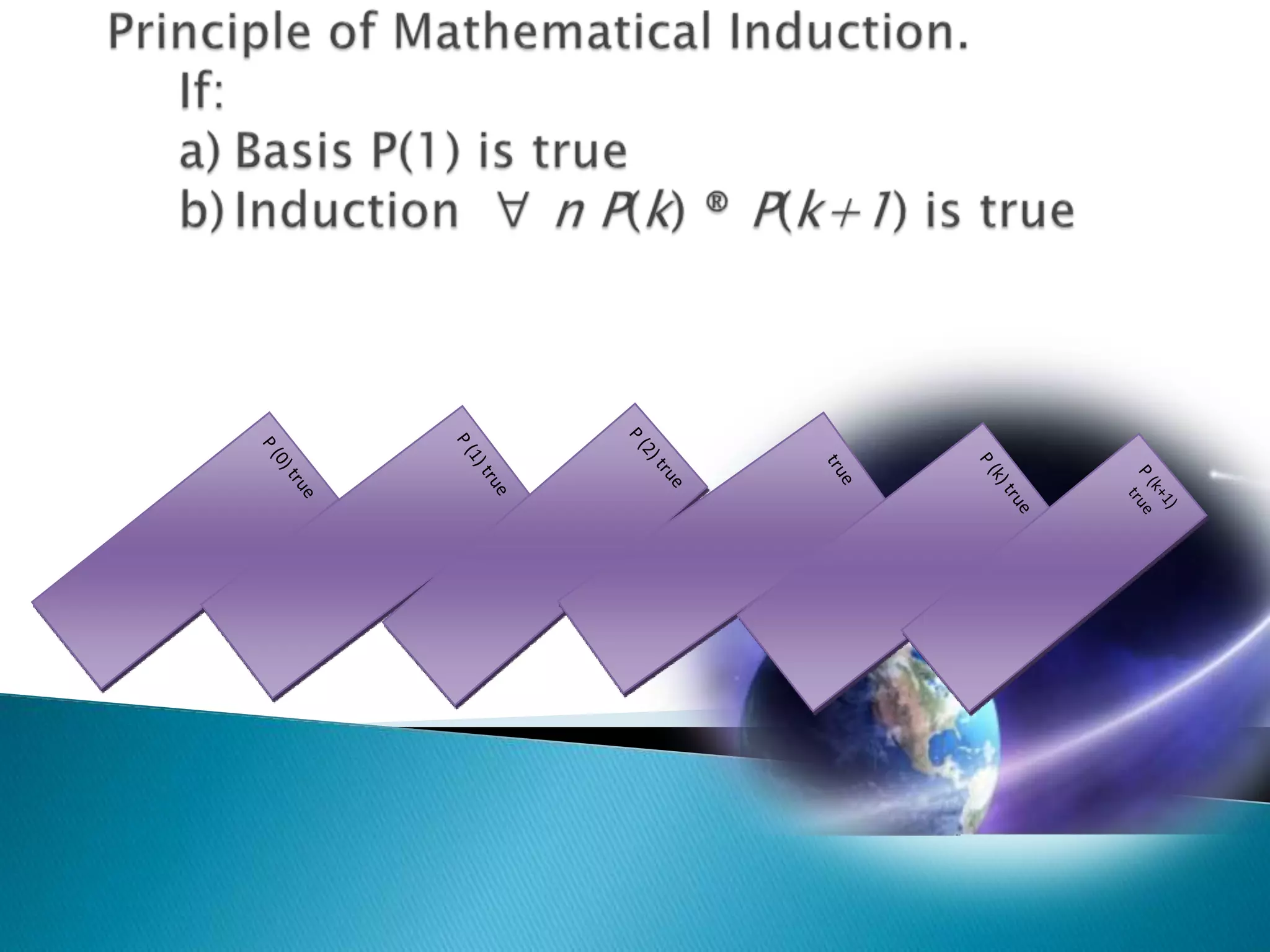
   Principle of Induction. To prove that P (n) is
    true for all positive integers n, where P (n) is a
    propositional function. A proof by
    mathematical induction has two parts:
   Basic step: We verify that P (1) is true.
   Inductive step: We show that the conditional
    proposition ∀ k ∈ , P (k) ⇒ P (k + 1) is true.
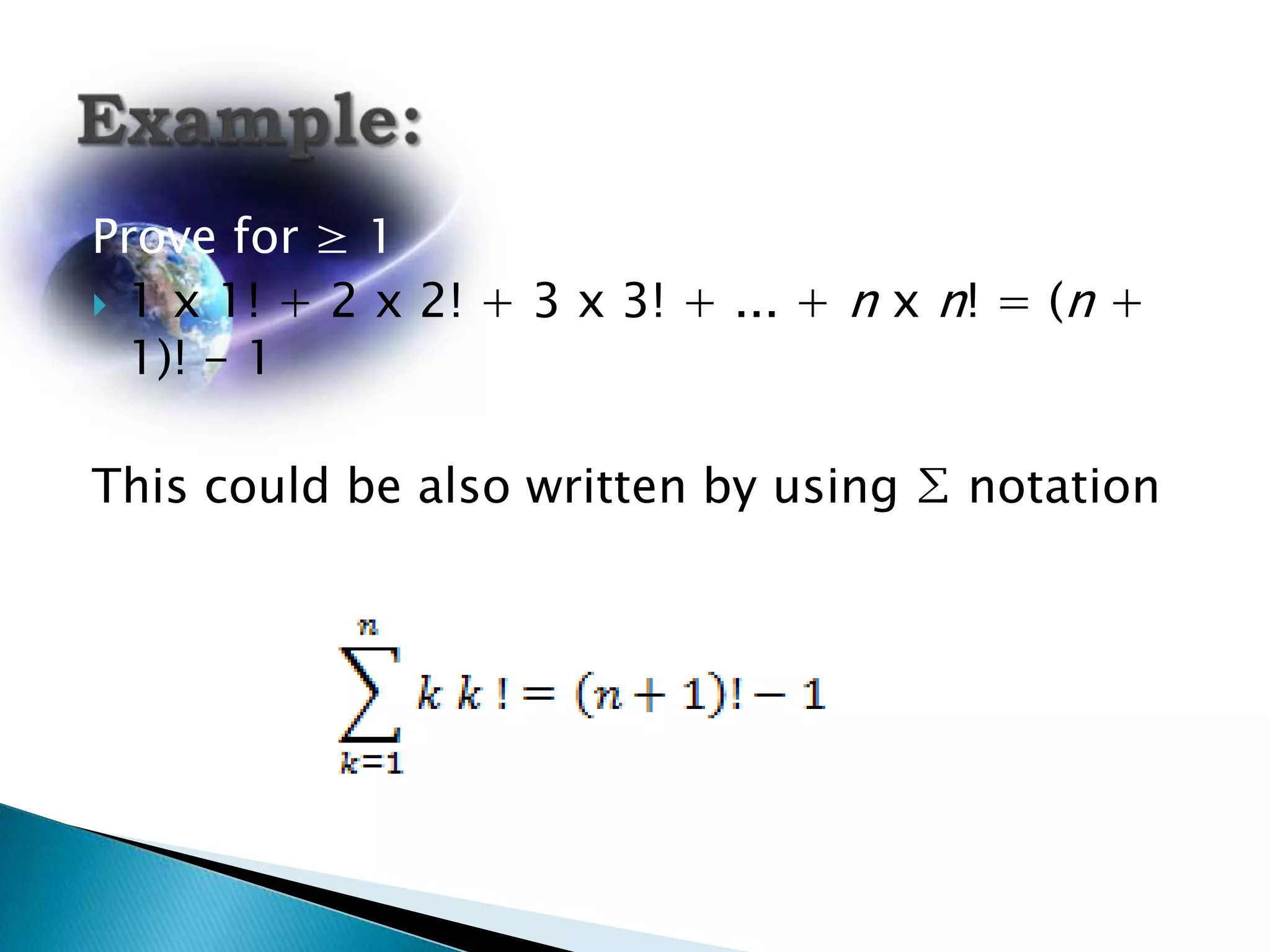
Prove for ≥ 1
 1 x 1! + 2 x 2! + 3 x 3! + ... + n x n! = (n +
  1)! - 1

This could be also written by using ∑ notation
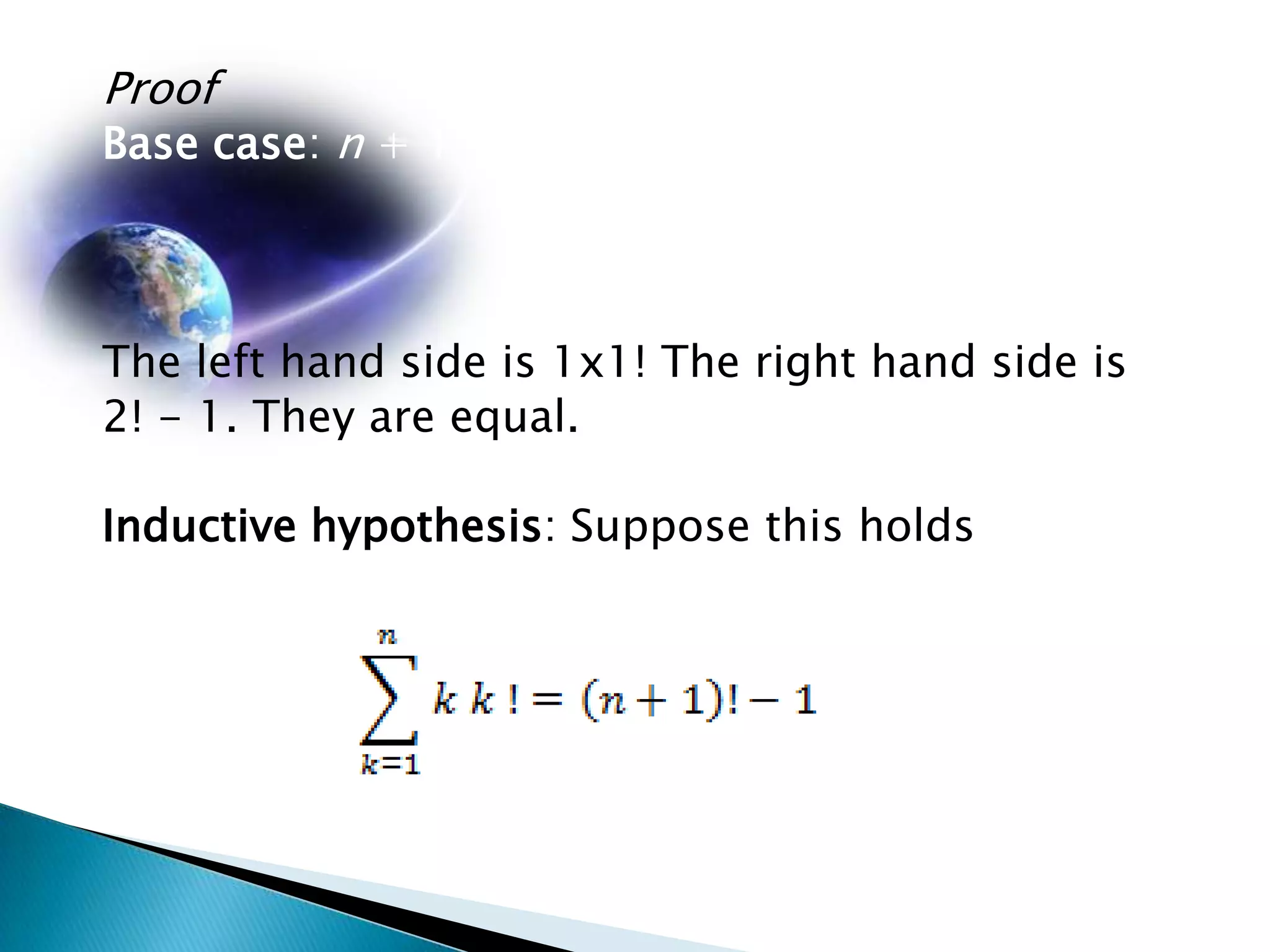
Proof
Base case: n + 1


The left hand side is 1x1! The right hand side is
2! - 1. They are equal.

Inductive hypothesis: Suppose this holds
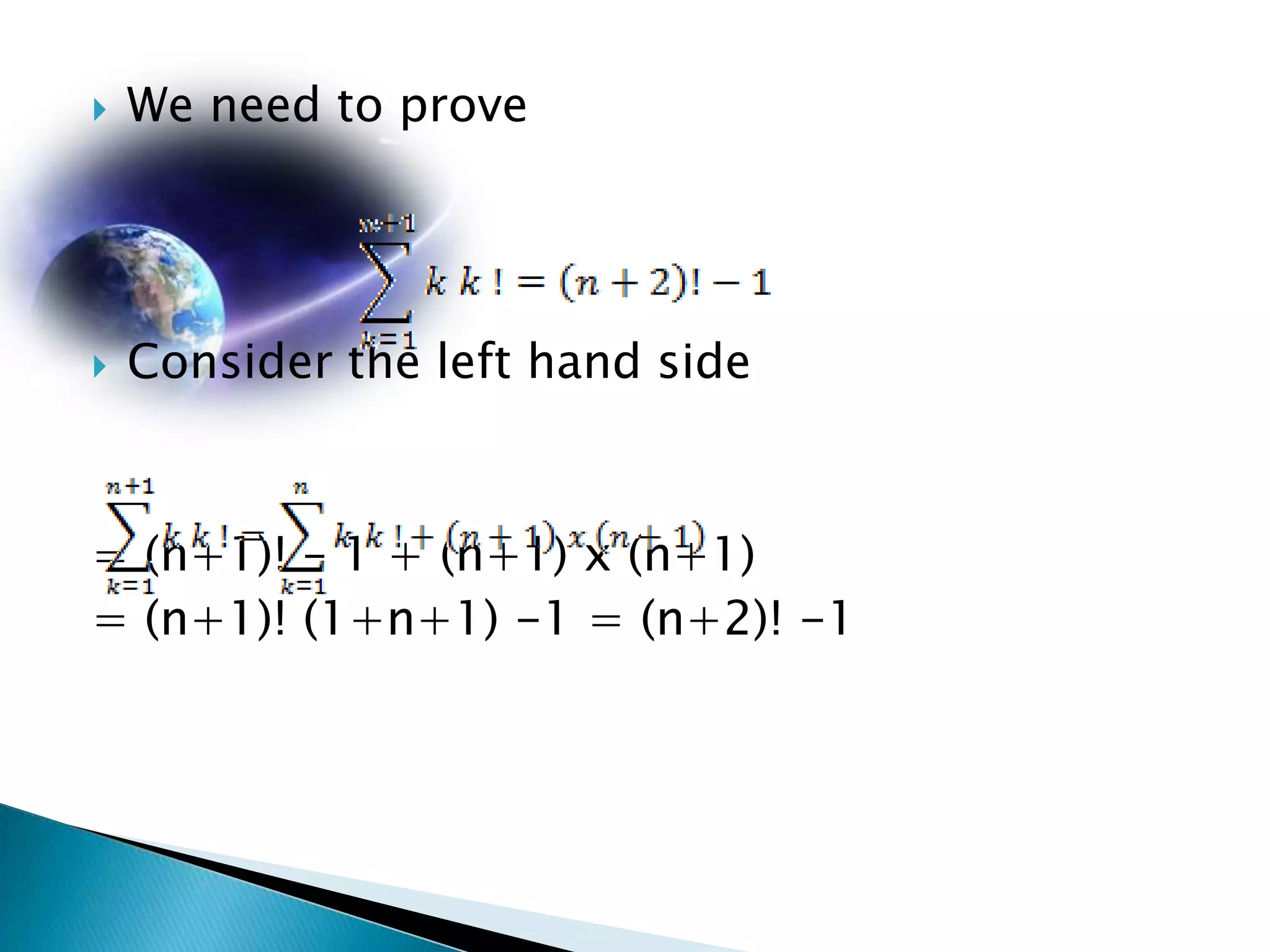
   We need to prove


   Consider the left hand side


= (n+1)! – 1 + (n+1) x (n+1)
= (n+1)! (1+n+1) -1 = (n+2)! -1
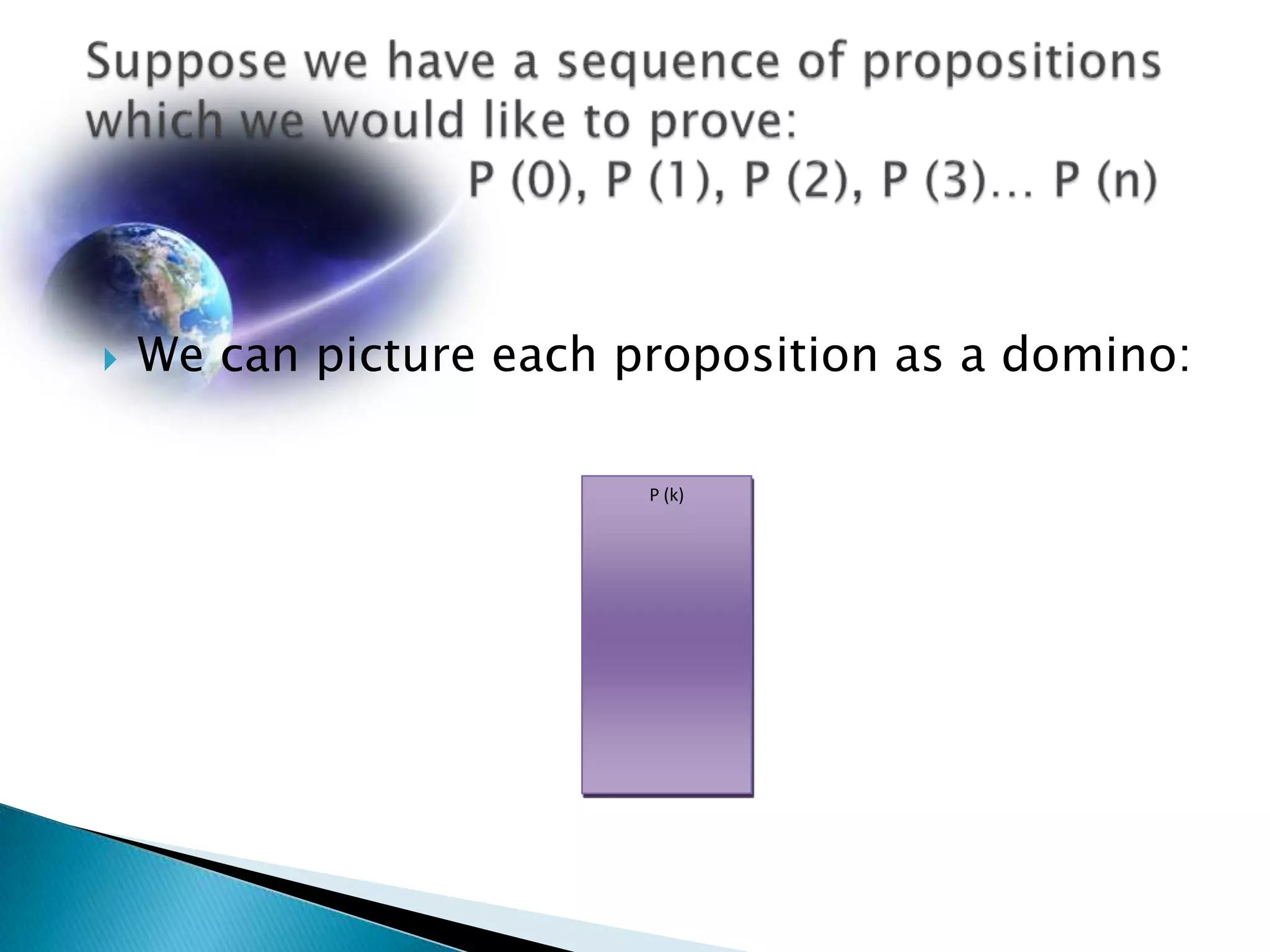
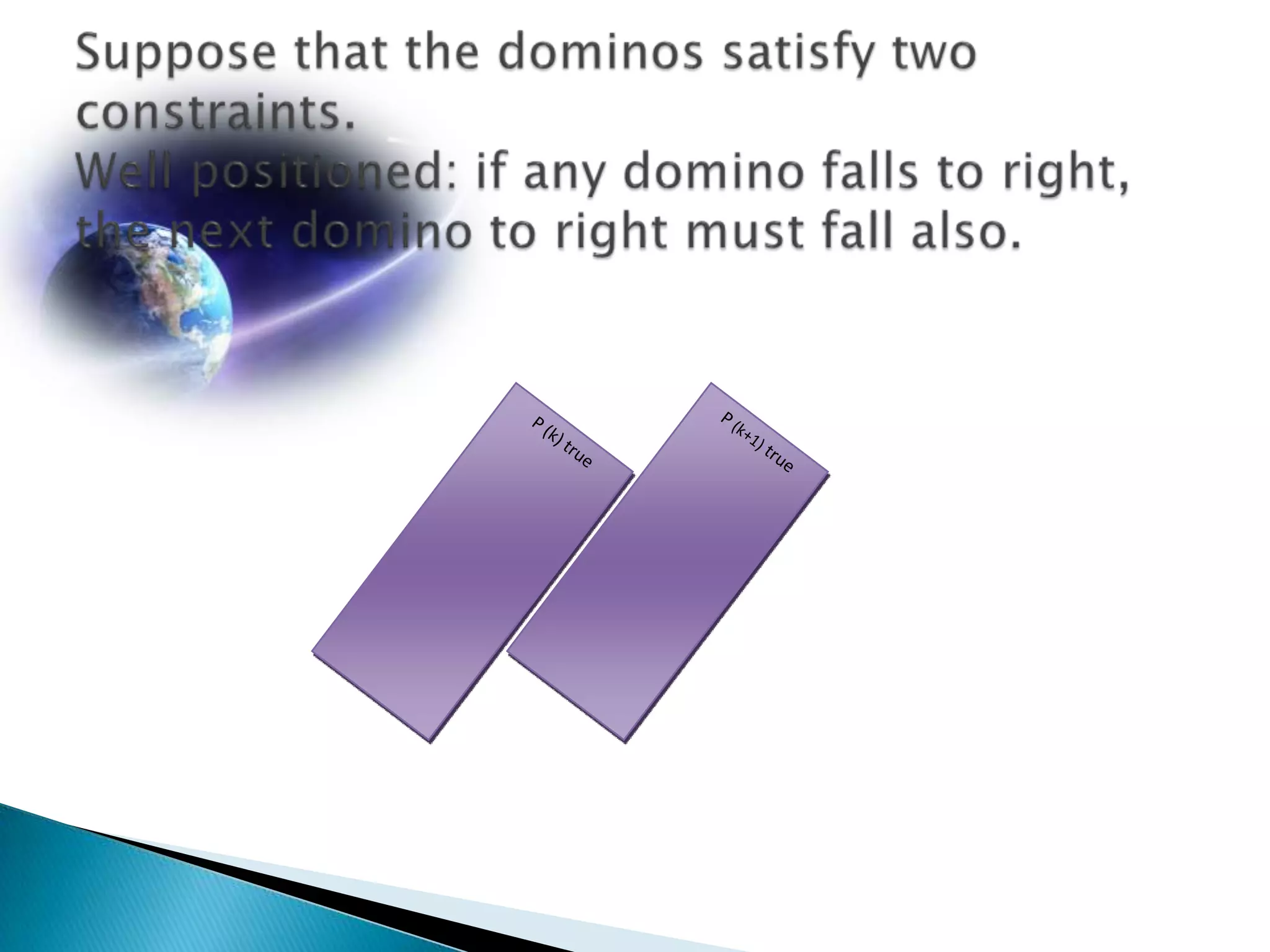
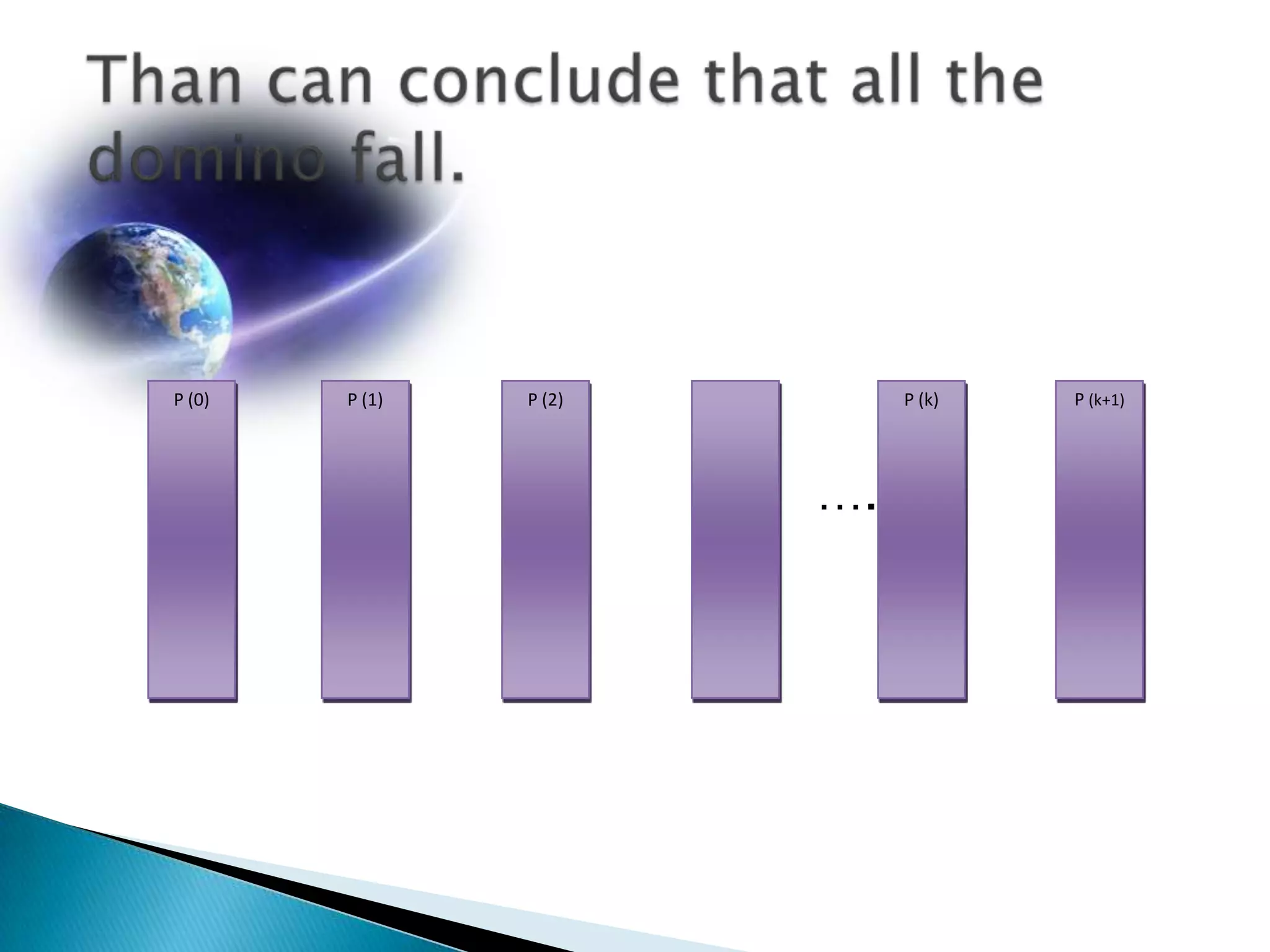
   We can picture each proposition as a domino:

                         P (k)
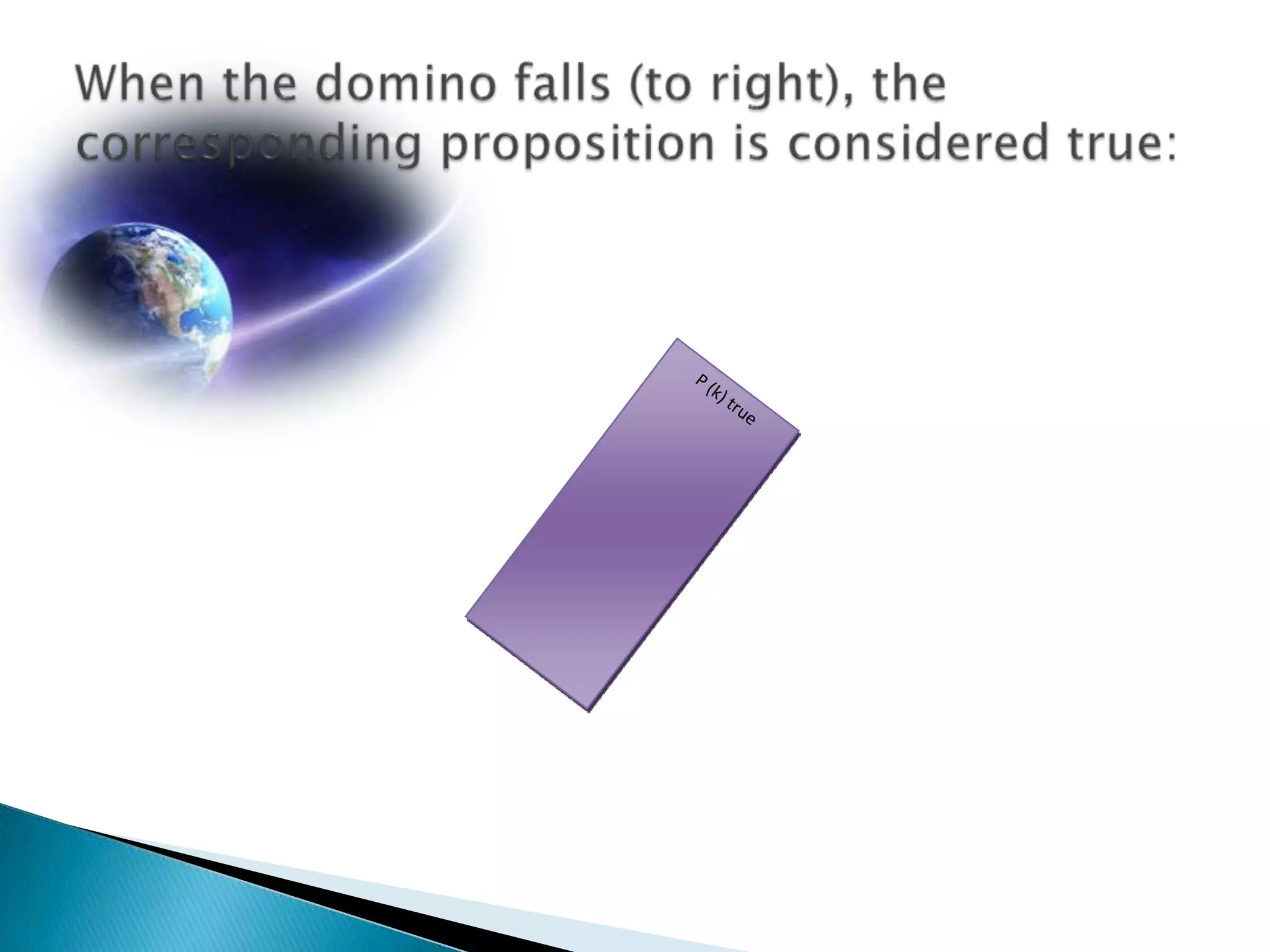
P (0)   P (1)   P (2)         P (k)   P (k+1)


                        …..
P (0)   P (1)   P (2)         P (k)   P (k+1)


                        …..
P (1)   P (2)         P (k)   P (k+1)


                …..
P (2)         P (k)   P (k+1)


        …..
P (k)   P (k+1)


…..
P (k)   P (k+1)


…..
P (k+1)


…..
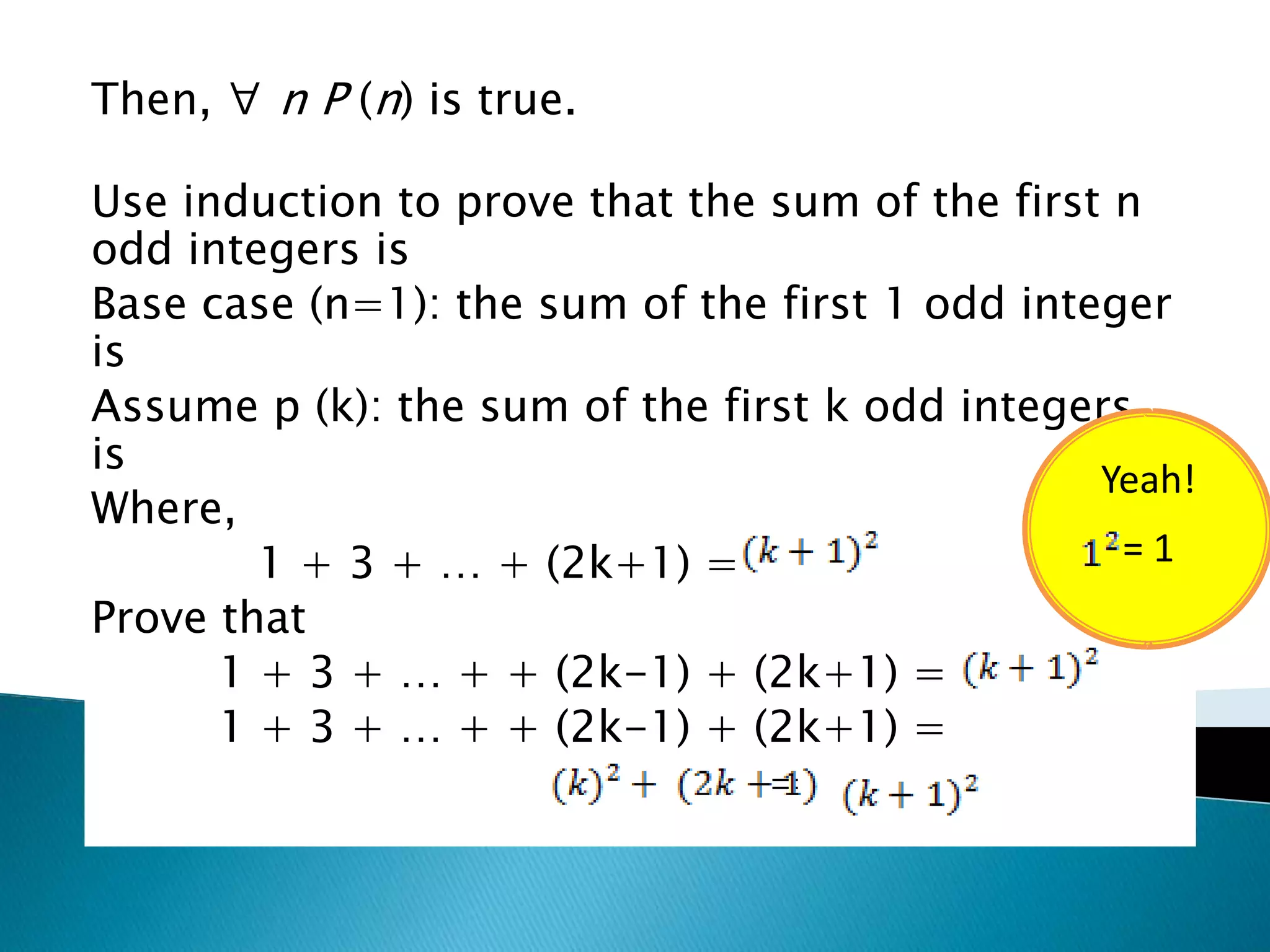
Then, ∀ n P (n) is true.

Use induction to prove that the sum of the first n
odd integers is
Base case (n=1): the sum of the first 1 odd integer
is
Assume p (k): the sum of the first k odd integers
is
                                                Yeah!
Where,
        1 + 3 + … + (2k+1) =                     =1
Prove that
      1 + 3 + … + + (2k-1) + (2k+1) =
      1 + 3 + … + + (2k-1) + (2k+1) =
                                =
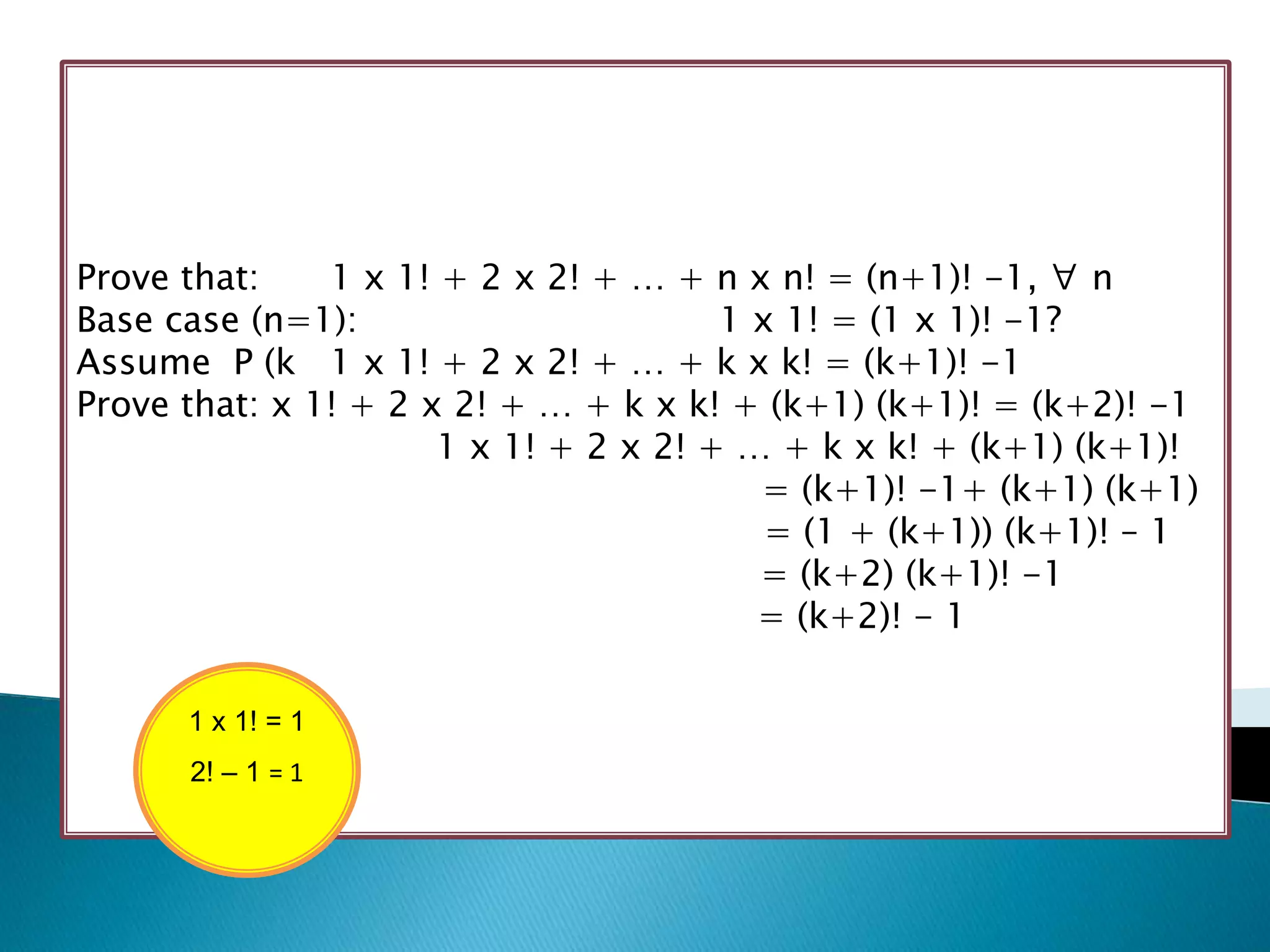
Prove that:    1 x 1! + 2 x 2! + … + n x n! = (n+1)! -1, ∀ n
Base case (n=1):                       1 x 1! = (1 x 1)! -1?
Assume P (k 1 x 1! + 2 x 2! + … + k x k! = (k+1)! -1
Prove that: x 1! + 2 x 2! + … + k x k! + (k+1) (k+1)! = (k+2)! -1
                      1 x 1! + 2 x 2! + … + k x k! + (k+1) (k+1)!
                                         = (k+1)! -1+ (k+1) (k+1)
                                          = (1 + (k+1)) (k+1)! – 1
                                         = (k+2) (k+1)! -1
                                         = (k+2)! - 1

      1 x 1! = 1
      2! – 1 = 1
Slide subtopic 5

Slide subtopic 5

  • 1.
    UNIVERSITI PENDIDKAN SULTANIDRIS PREPARED BY : MOHAMAD AL FAIZ BIN SELAMAT
  • 3.
    Principle of Induction. To prove that P (n) is true for all positive integers n, where P (n) is a propositional function. A proof by mathematical induction has two parts:  Basic step: We verify that P (1) is true.  Inductive step: We show that the conditional proposition ∀ k ∈ , P (k) ⇒ P (k + 1) is true.
  • 7.
    Prove for ≥1  1 x 1! + 2 x 2! + 3 x 3! + ... + n x n! = (n + 1)! - 1 This could be also written by using ∑ notation
  • 9.
    Proof Base case: n+ 1 The left hand side is 1x1! The right hand side is 2! - 1. They are equal. Inductive hypothesis: Suppose this holds
  • 11.
    We need to prove  Consider the left hand side = (n+1)! – 1 + (n+1) x (n+1) = (n+1)! (1+n+1) -1 = (n+2)! -1
  • 13.
    We can picture each proposition as a domino: P (k)
  • 15.
    P (0) P (1) P (2) P (k) P (k+1) …..
  • 23.
    P (0) P (1) P (2) P (k) P (k+1) …..
  • 25.
    P (1) P (2) P (k) P (k+1) …..
  • 27.
    P (2) P (k) P (k+1) …..
  • 29.
    P (k) P (k+1) …..
  • 31.
    P (k) P (k+1) …..
  • 33.
  • 39.
    Then, ∀ nP (n) is true. Use induction to prove that the sum of the first n odd integers is Base case (n=1): the sum of the first 1 odd integer is Assume p (k): the sum of the first k odd integers is Yeah! Where, 1 + 3 + … + (2k+1) = =1 Prove that 1 + 3 + … + + (2k-1) + (2k+1) = 1 + 3 + … + + (2k-1) + (2k+1) = =
  • 41.
    Prove that: 1 x 1! + 2 x 2! + … + n x n! = (n+1)! -1, ∀ n Base case (n=1): 1 x 1! = (1 x 1)! -1? Assume P (k 1 x 1! + 2 x 2! + … + k x k! = (k+1)! -1 Prove that: x 1! + 2 x 2! + … + k x k! + (k+1) (k+1)! = (k+2)! -1 1 x 1! + 2 x 2! + … + k x k! + (k+1) (k+1)! = (k+1)! -1+ (k+1) (k+1) = (1 + (k+1)) (k+1)! – 1 = (k+2) (k+1)! -1 = (k+2)! - 1 1 x 1! = 1 2! – 1 = 1