UNIVERSALIZATION OF
ELEMENTARY EDUCATION
PREPARED BY VIPIN KUMAR SHUKLA
INTRODUCTION OF
ELEMENTARY EDUCATION
• Universalization of elementary education
means education for all, and not for few and
recognizing child birth right without any
discrimination.
• Elementary education is compulsory and free
education which is provided by the Indian
constitution to all children up to age of 14.
FACTORS AFFECTING ELEMENTARY
EDUCATION
• Universalization of provision:
• It mean provision of a school to every child
within walking distance from his home i.e. A
primary school within (1km) and Middle school
within (3km).
• Universalization of Enrolment:
• It means all children between the age group of (6-
14yr) of age must be enrolled by primary school.
• Universalization of Retension:
• It means that a child once enrolled in class 1 must
continue his schooling up to class 8th.
SIGNIFICANCE AND IMPORTANCE OF
UNIVERSALIZATION OF ELEMENTARY
EDUCATION
• Acc to Nelson Mandella:
• Education is important not only for full development of
one's personality but also for sustained growth of the
nation.
• Education development political ideology.
• Preservation and promotion of culture.
• Improvement in the quality of fellowship and leadership.
• Development of upgraded and basic skills.
• Education is important for personal, social and economic
development.
• Education is
• Important to live with happiness and prosperity.
• Education empowers mind that will be able to conceive
good thoughts.
PROBLEMS IN U.E.E
• Problem in finance or Inadequacy of financial
provision.
• Provision of population explosion.
• Problem of priority.
• Problem of ill-literate parents.
• Problem of girl education.
• Problem of poverty.
• Wastage and stagnation in primary education.
• Problem of defective curriculum.
• Absence of suitable and qualified teacher.
• Low enrolment of physically handicapped and
backward classes.
MEASURES FOR U.E.E
• Educating the illiterate parent.
• Increased the allocation of fund.
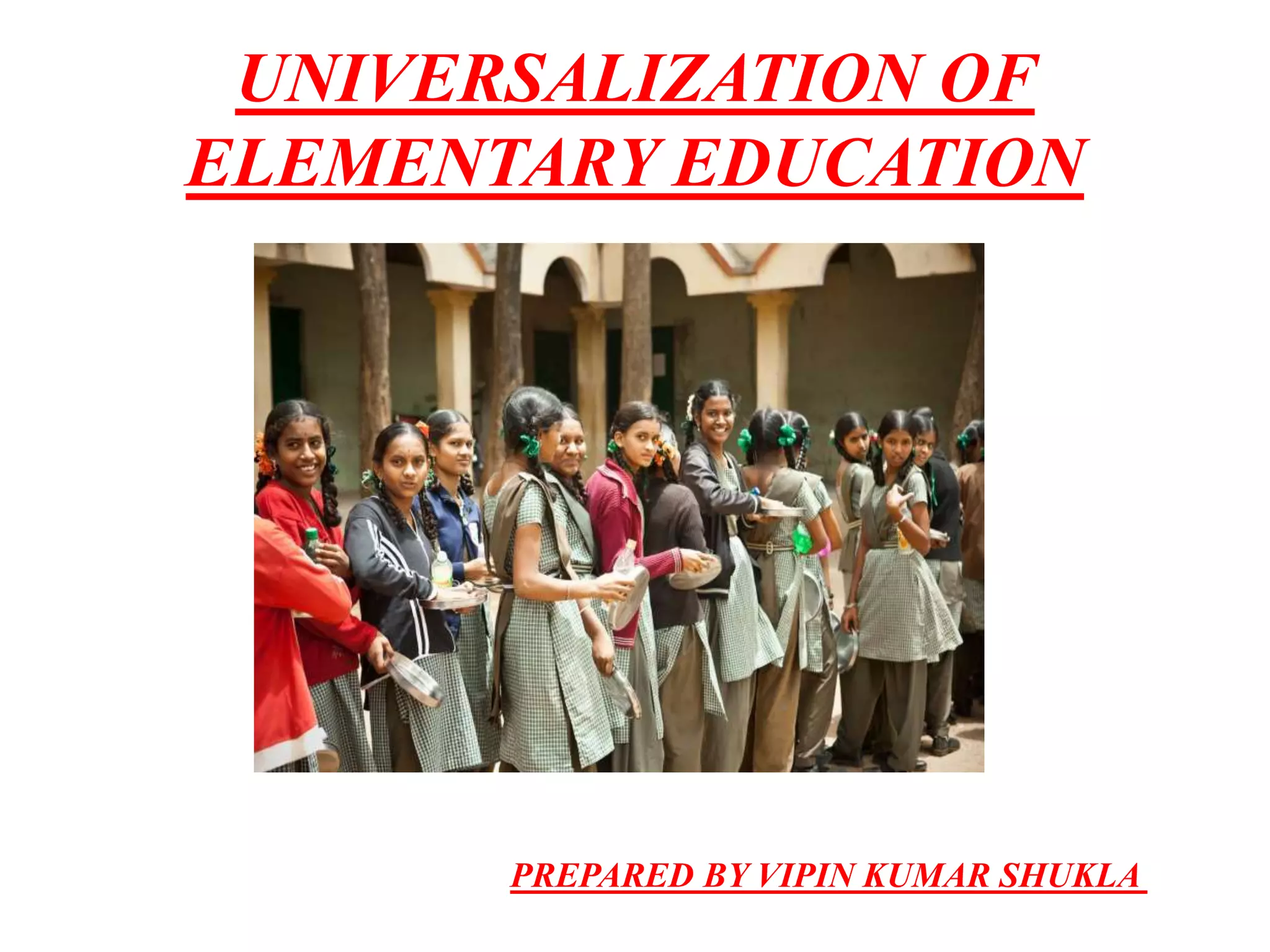
• Provision of Mid day meal.
• Main Motto- Protecting the children from
hunger increased, School enrolment and
attendance.
• Provision for free supply of school dress,
Reading and writing material.
Contd…….
• Priority of elementary education.
• Reduce the gap between boys and girls
education.
• Renewal of curriculum ( Related to real life).
• Provision for qualified and experienced
teaching staff.
• New and innovative methods of teaching.
• Quality education to all rural children.
WASTAGE AND STAGNATION
• WASTAGE:
• The premature withdrawal of children at any
stage before completion of the primary
education called “ wastage”.
• STAGNATION:
• The retention of a child in the class for a
period of more than 1yr called “ stagnation”.
CAUSES OF WASTAGE AND
STAGNATION
• Absence of school facilities and infra:
• Inadequacy or absence of school building, water,
sanitation, transport and playground etc.
• Unwilling Teacher:
• Teachers are not well qualified or well trained
teacher from urban areas, refuse to move to rural
institutions.
• Socio Economic:
• Poverty Inequality of sexes, ill-Literacy,
Conservative attitudes.
Educational:
• Poor quality of teaching, inexperience teacher,
lack of vocational teacher and faulty
evaluation styles.
• Mismatch of school timing:
• Miscellaneous:
• Under nourishment and malnutrition of
children health problems, no medical facilities.
• Irr-regular attendance, dull curriculum,
Atmosphere at home not good.
SUGGESTIONS OF WASTAGE AND
STAGNATION
• Changing admission policy.
• Adjust school timings.
• Providing facilities to needy students.
• Educating parents.
• Reforming examinations.
• Reforming curriculum.
• Establishment of upgraded schools.
• Reforming curriculum.
• Making school attractive.
• Provision for non formal education.
• Removal social evils.
• Providing part time examinations.
• Separate school for girls.
Universalization of elementary education

Universalization of elementary education

  • 1.
  • 2.
    INTRODUCTION OF ELEMENTARY EDUCATION •Universalization of elementary education means education for all, and not for few and recognizing child birth right without any discrimination. • Elementary education is compulsory and free education which is provided by the Indian constitution to all children up to age of 14.
  • 3.
    FACTORS AFFECTING ELEMENTARY EDUCATION •Universalization of provision: • It mean provision of a school to every child within walking distance from his home i.e. A primary school within (1km) and Middle school within (3km). • Universalization of Enrolment: • It means all children between the age group of (6- 14yr) of age must be enrolled by primary school. • Universalization of Retension: • It means that a child once enrolled in class 1 must continue his schooling up to class 8th.
  • 4.
    SIGNIFICANCE AND IMPORTANCEOF UNIVERSALIZATION OF ELEMENTARY EDUCATION • Acc to Nelson Mandella: • Education is important not only for full development of one's personality but also for sustained growth of the nation. • Education development political ideology. • Preservation and promotion of culture. • Improvement in the quality of fellowship and leadership. • Development of upgraded and basic skills. • Education is important for personal, social and economic development. • Education is • Important to live with happiness and prosperity. • Education empowers mind that will be able to conceive good thoughts.
  • 5.
    PROBLEMS IN U.E.E •Problem in finance or Inadequacy of financial provision. • Provision of population explosion. • Problem of priority. • Problem of ill-literate parents. • Problem of girl education. • Problem of poverty. • Wastage and stagnation in primary education. • Problem of defective curriculum. • Absence of suitable and qualified teacher. • Low enrolment of physically handicapped and backward classes.
  • 6.
    MEASURES FOR U.E.E •Educating the illiterate parent. • Increased the allocation of fund. • Provision of Mid day meal. • Main Motto- Protecting the children from hunger increased, School enrolment and attendance. • Provision for free supply of school dress, Reading and writing material.
  • 7.
    Contd……. • Priority ofelementary education. • Reduce the gap between boys and girls education. • Renewal of curriculum ( Related to real life). • Provision for qualified and experienced teaching staff. • New and innovative methods of teaching. • Quality education to all rural children.
  • 8.
    WASTAGE AND STAGNATION •WASTAGE: • The premature withdrawal of children at any stage before completion of the primary education called “ wastage”. • STAGNATION: • The retention of a child in the class for a period of more than 1yr called “ stagnation”.
  • 9.
    CAUSES OF WASTAGEAND STAGNATION • Absence of school facilities and infra: • Inadequacy or absence of school building, water, sanitation, transport and playground etc. • Unwilling Teacher: • Teachers are not well qualified or well trained teacher from urban areas, refuse to move to rural institutions. • Socio Economic: • Poverty Inequality of sexes, ill-Literacy, Conservative attitudes.
  • 10.
    Educational: • Poor qualityof teaching, inexperience teacher, lack of vocational teacher and faulty evaluation styles. • Mismatch of school timing: • Miscellaneous: • Under nourishment and malnutrition of children health problems, no medical facilities. • Irr-regular attendance, dull curriculum, Atmosphere at home not good.
  • 11.
    SUGGESTIONS OF WASTAGEAND STAGNATION • Changing admission policy. • Adjust school timings. • Providing facilities to needy students. • Educating parents. • Reforming examinations. • Reforming curriculum. • Establishment of upgraded schools. • Reforming curriculum. • Making school attractive. • Provision for non formal education. • Removal social evils. • Providing part time examinations. • Separate school for girls.