PHILOSOPHY
The teacher can help dumb, slow, less confident and
unmotivated students to learn like smart, fast and
motivated students.
Any teacher can help all students to learn excellently,
quickly and self confidently.
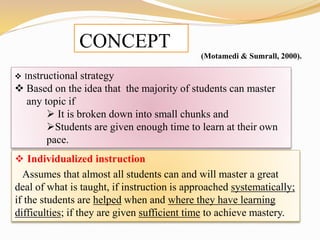
CONCEPT
 Individualized instruction
Assumes that almost all students can and will master a great
deal of what is taught, if instruction is approached systematically;
if the students are helped when and where they have learning
difficulties; if they are given sufficient time to achieve mastery.
 Instructional strategy
 Based on the idea that the majority of students can master
any topic if
 It is broken down into small chunks and
Students are given enough time to learn at their own
pace.
(Motamedi & Sumrall, 2000).
Two genotypes
Bloom’s learning for mastery Keller’s personalised system of
instruction
Group based and teacher paced
 Students learn cooperatively
 Teacher controls the
delivery and flow of
instruction
Impact on elementary and
secondary levels of learning
Individual based and learner
paced
 Students learn independently
 Each student controls the
delivery and flow of
instruction.
Major impact at the college and
university level
Teacher works as manager and
observer
(L. W. Anderson and J.H. Block 2003)
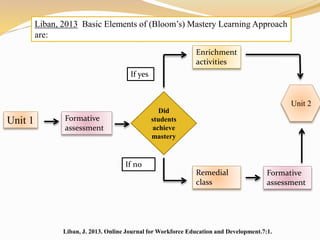
Unit 1 Formative
assessment
Enrichment
activities
Did
students
achieve
mastery
Remedial
class
Formative
assessment
Unit 2
Liban, 2013 Basic Elements of (Bloom’s) Mastery Learning Approach
are:
Liban, J. 2013. Online Journal for Workforce Education and Development.7:1.
If no
If yes
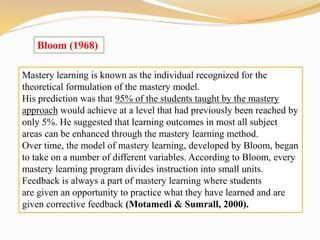
Mastery learning is known as the individual recognized for the
theoretical formulation of the mastery model.
His prediction was that 95% of the students taught by the mastery
approach would achieve at a level that had previously been reached by
only 5%. He suggested that learning outcomes in most all subject
areas can be enhanced through the mastery learning method.
Over time, the model of mastery learning, developed by Bloom, began
to take on a number of different variables. According to Bloom, every
mastery learning program divides instruction into small units.
Feedback is always a part of mastery learning where students
are given an opportunity to practice what they have learned and are
given corrective feedback (Motamedi & Sumrall, 2000).
Bloom (1968)
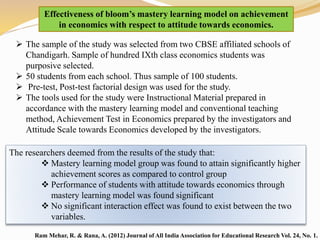
 The sample of the study was selected from two CBSE affiliated schools of
Chandigarh. Sample of hundred IXth class economics students was
purposive selected.
 50 students from each school. Thus sample of 100 students.
 Pre-test, Post-test factorial design was used for the study.
 The tools used for the study were Instructional Material prepared in
accordance with the mastery learning model and conventional teaching
method, Achievement Test in Economics prepared by the investigators and
Attitude Scale towards Economics developed by the investigators.
Ram Mehar, R. & Rana, A. (2012) Journal of All India Association for Educational Research Vol. 24, No. 1.
Effectiveness of bloom’s mastery learning model on achievement
in economics with respect to attitude towards economics.
The researchers deemed from the results of the study that:
 Mastery learning model group was found to attain significantly higher
achievement scores as compared to control group
 Performance of students with attitude towards economics through
mastery learning model was found significant
 No significant interaction effect was found to exist between the two
variables.
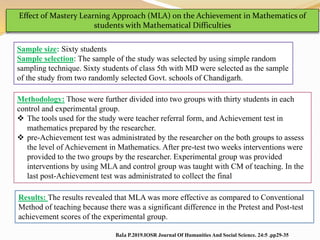
Effect of Mastery Learning Approach (MLA) on the Achievement in Mathematics of
students with Mathematical Difficulties
Results: The results revealed that MLA was more effective as compared to Conventional
Method of teaching because there was a significant difference in the Pretest and Post-test
achievement scores of the experimental group.
Sample size: Sixty students
Sample selection: The sample of the study was selected by using simple random
sampling technique. Sixty students of class 5th with MD were selected as the sample
of the study from two randomly selected Govt. schools of Chandigarh.
Methodology: Those were further divided into two groups with thirty students in each
control and experimental group.
 The tools used for the study were teacher referral form, and Achievement test in
mathematics prepared by the researcher.
 pre-Achievement test was administrated by the researcher on the both groups to assess
the level of Achievement in Mathematics. After pre-test two weeks interventions were
provided to the two groups by the researcher. Experimental group was provided
interventions by using MLA and control group was taught with CM of teaching. In the
last post-Achievement test was administrated to collect the final
Bala P.2019.IOSR Journal Of Humanities And Social Science. 24:5 .pp29-35
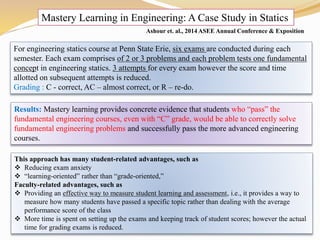
For engineering statics course at Penn State Erie, six exams are conducted during each
semester. Each exam comprises of 2 or 3 problems and each problem tests one fundamental
concept in engineering statics. 3 attempts for every exam however the score and time
allotted on subsequent attempts is reduced.
Grading : C - correct, AC – almost correct, or R – re-do.
Results: Mastery learning provides concrete evidence that students who “pass” the
fundamental engineering courses, even with “C” grade, would be able to correctly solve
fundamental engineering problems and successfully pass the more advanced engineering
courses.
Mastery Learning in Engineering: A Case Study in Statics
Ashour et. al., 2014 ASEE Annual Conference & Exposition
This approach has many student-related advantages, such as
 Reducing exam anxiety
 “learning-oriented” rather than “grade-oriented,”
Faculty-related advantages, such as
 Providing an effective way to measure student learning and assessment, i.e., it provides a way to
measure how many students have passed a specific topic rather than dealing with the average
performance score of the class
 More time is spent on setting up the exams and keeping track of student scores; however the actual
time for grading exams is reduced.
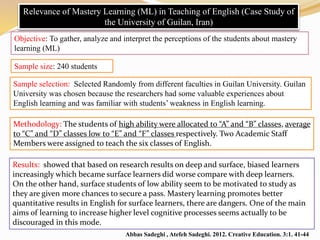
Relevance of Mastery Learning (ML) in Teaching of English (Case Study of
the University of Guilan, Iran)
Results: showed that based on research results on deep and surface, biased learners
increasingly which became surface learners did worse compare with deep learners.
On the other hand, surface students of low ability seem to be motivated to study as
they are given more chances to secure a pass. Mastery learning promotes better
quantitative results in English for surface learners, there are dangers. One of the main
aims of learning to increase higher level cognitive processes seems actually to be
discouraged in this mode.
Objective: To gather, analyze and interpret the perceptions of the students about mastery
learning (ML)
Sample size: 240 students
Sample selection: Selected Randomly from different faculties in Guilan University. Guilan
University was chosen because the researchers had some valuable experiences about
English learning and was familiar with students’ weakness in English learning.
Methodology: The students of high ability were allocated to “A” and “B” classes, average
to “C” and “D” classes low to “E” and “F” classes respectively. Two Academic Staff
Members were assigned to teach the six classes of English.
Abbas Sadeghi , Atefeh Sadeghi. 2012. Creative Education. 3:1. 41-44
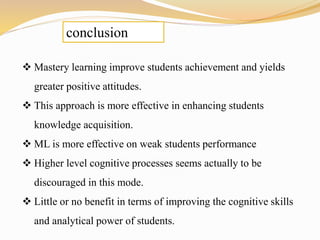
conclusion
 Mastery learning improve students achievement and yields
greater positive attitudes.
 This approach is more effective in enhancing students
knowledge acquisition.
 ML is more effective on weak students performance
 Higher level cognitive processes seems actually to be
discouraged in this mode.
 Little or no benefit in terms of improving the cognitive skills
and analytical power of students.
Mastery learning models ppt

Mastery learning models ppt

  • 2.
    PHILOSOPHY The teacher canhelp dumb, slow, less confident and unmotivated students to learn like smart, fast and motivated students. Any teacher can help all students to learn excellently, quickly and self confidently.
  • 3.
    CONCEPT  Individualized instruction Assumesthat almost all students can and will master a great deal of what is taught, if instruction is approached systematically; if the students are helped when and where they have learning difficulties; if they are given sufficient time to achieve mastery.  Instructional strategy  Based on the idea that the majority of students can master any topic if  It is broken down into small chunks and Students are given enough time to learn at their own pace. (Motamedi & Sumrall, 2000).
  • 4.
    Two genotypes Bloom’s learningfor mastery Keller’s personalised system of instruction Group based and teacher paced  Students learn cooperatively  Teacher controls the delivery and flow of instruction Impact on elementary and secondary levels of learning Individual based and learner paced  Students learn independently  Each student controls the delivery and flow of instruction. Major impact at the college and university level Teacher works as manager and observer (L. W. Anderson and J.H. Block 2003)
  • 5.
    Unit 1 Formative assessment Enrichment activities Did students achieve mastery Remedial class Formative assessment Unit2 Liban, 2013 Basic Elements of (Bloom’s) Mastery Learning Approach are: Liban, J. 2013. Online Journal for Workforce Education and Development.7:1. If no If yes
  • 6.
    Mastery learning isknown as the individual recognized for the theoretical formulation of the mastery model. His prediction was that 95% of the students taught by the mastery approach would achieve at a level that had previously been reached by only 5%. He suggested that learning outcomes in most all subject areas can be enhanced through the mastery learning method. Over time, the model of mastery learning, developed by Bloom, began to take on a number of different variables. According to Bloom, every mastery learning program divides instruction into small units. Feedback is always a part of mastery learning where students are given an opportunity to practice what they have learned and are given corrective feedback (Motamedi & Sumrall, 2000). Bloom (1968)
  • 7.
     The sampleof the study was selected from two CBSE affiliated schools of Chandigarh. Sample of hundred IXth class economics students was purposive selected.  50 students from each school. Thus sample of 100 students.  Pre-test, Post-test factorial design was used for the study.  The tools used for the study were Instructional Material prepared in accordance with the mastery learning model and conventional teaching method, Achievement Test in Economics prepared by the investigators and Attitude Scale towards Economics developed by the investigators. Ram Mehar, R. & Rana, A. (2012) Journal of All India Association for Educational Research Vol. 24, No. 1. Effectiveness of bloom’s mastery learning model on achievement in economics with respect to attitude towards economics. The researchers deemed from the results of the study that:  Mastery learning model group was found to attain significantly higher achievement scores as compared to control group  Performance of students with attitude towards economics through mastery learning model was found significant  No significant interaction effect was found to exist between the two variables.
  • 8.
    Effect of MasteryLearning Approach (MLA) on the Achievement in Mathematics of students with Mathematical Difficulties Results: The results revealed that MLA was more effective as compared to Conventional Method of teaching because there was a significant difference in the Pretest and Post-test achievement scores of the experimental group. Sample size: Sixty students Sample selection: The sample of the study was selected by using simple random sampling technique. Sixty students of class 5th with MD were selected as the sample of the study from two randomly selected Govt. schools of Chandigarh. Methodology: Those were further divided into two groups with thirty students in each control and experimental group.  The tools used for the study were teacher referral form, and Achievement test in mathematics prepared by the researcher.  pre-Achievement test was administrated by the researcher on the both groups to assess the level of Achievement in Mathematics. After pre-test two weeks interventions were provided to the two groups by the researcher. Experimental group was provided interventions by using MLA and control group was taught with CM of teaching. In the last post-Achievement test was administrated to collect the final Bala P.2019.IOSR Journal Of Humanities And Social Science. 24:5 .pp29-35
  • 9.
    For engineering staticscourse at Penn State Erie, six exams are conducted during each semester. Each exam comprises of 2 or 3 problems and each problem tests one fundamental concept in engineering statics. 3 attempts for every exam however the score and time allotted on subsequent attempts is reduced. Grading : C - correct, AC – almost correct, or R – re-do. Results: Mastery learning provides concrete evidence that students who “pass” the fundamental engineering courses, even with “C” grade, would be able to correctly solve fundamental engineering problems and successfully pass the more advanced engineering courses. Mastery Learning in Engineering: A Case Study in Statics Ashour et. al., 2014 ASEE Annual Conference & Exposition This approach has many student-related advantages, such as  Reducing exam anxiety  “learning-oriented” rather than “grade-oriented,” Faculty-related advantages, such as  Providing an effective way to measure student learning and assessment, i.e., it provides a way to measure how many students have passed a specific topic rather than dealing with the average performance score of the class  More time is spent on setting up the exams and keeping track of student scores; however the actual time for grading exams is reduced.
  • 10.
    Relevance of MasteryLearning (ML) in Teaching of English (Case Study of the University of Guilan, Iran) Results: showed that based on research results on deep and surface, biased learners increasingly which became surface learners did worse compare with deep learners. On the other hand, surface students of low ability seem to be motivated to study as they are given more chances to secure a pass. Mastery learning promotes better quantitative results in English for surface learners, there are dangers. One of the main aims of learning to increase higher level cognitive processes seems actually to be discouraged in this mode. Objective: To gather, analyze and interpret the perceptions of the students about mastery learning (ML) Sample size: 240 students Sample selection: Selected Randomly from different faculties in Guilan University. Guilan University was chosen because the researchers had some valuable experiences about English learning and was familiar with students’ weakness in English learning. Methodology: The students of high ability were allocated to “A” and “B” classes, average to “C” and “D” classes low to “E” and “F” classes respectively. Two Academic Staff Members were assigned to teach the six classes of English. Abbas Sadeghi , Atefeh Sadeghi. 2012. Creative Education. 3:1. 41-44
  • 11.
    conclusion  Mastery learningimprove students achievement and yields greater positive attitudes.  This approach is more effective in enhancing students knowledge acquisition.  ML is more effective on weak students performance  Higher level cognitive processes seems actually to be discouraged in this mode.  Little or no benefit in terms of improving the cognitive skills and analytical power of students.