Production/Operations PlanningAn Overview
Operations Planning
IntroductionMeaning: Organization of an overall manufacturing/operating system to produce a productObjective: to provide a physical system together with a set of operating guidelines for efficient conversion of raw materials, human skills & other inputs into finished products
Factors Determining Production Planning ProcessMain difference between two companies’ planning processes is the differences in  the economic & technological conditions of the company’s operations.Volume of productionNature of production processesNature of operations
Variants in Manufacturing ApproachManufacturing to orderManufacturing for stock & sell under repetitive batchManufacturing for stock & sell under continuous process
Production Planning LevelsHierarchical levelsStrategic planningTactical planningOperational PlanningTime spanLong rangeIntermediate rangeShort range
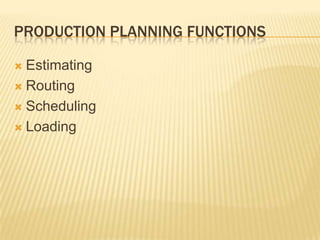
Production Planning FunctionsEstimatingRoutingSchedulingLoading
Master production schedule (MPS)
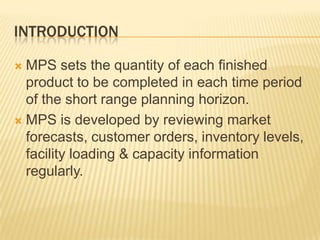
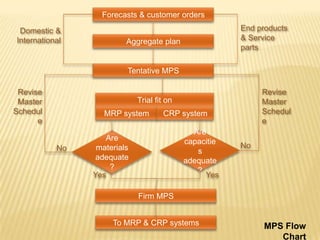
IntroductionMPS sets the quantity of each finished product to be completed in each time period of the short range planning horizon.MPS is developed by reviewing market forecasts, customer orders, inventory levels, facility loading & capacity information regularly.
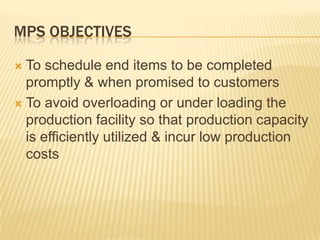
MPS ObjectivesTo schedule end items to be completed promptly & when promised to customersTo avoid overloading or under loading the production facility so that production capacity is efficiently utilized & incur low production costs
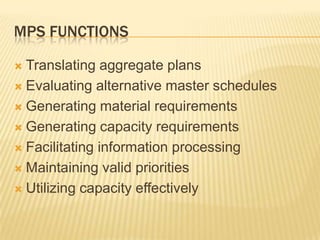
MPS FunctionsTranslating aggregate plansEvaluating alternative master schedulesGenerating material requirementsGenerating capacity requirementsFacilitating information processingMaintaining valid prioritiesUtilizing capacity effectively
Forecasts & customer ordersEnd products & Service partsDomestic & InternationalAggregate planTentative MPSRevise Master ScheduleRevise Master ScheduleTrial fit onMRP systemCRP systemAre materials adequate?Are capacities adequate?NoNoYesYesFirm MPSTo MRP & CRP systemsMPS Flow Chart
Capacity requirement planning  (crp)
CRPMeaning: CRP is a technique to determine the  labor & equipment capacities needed to meet the objectives.
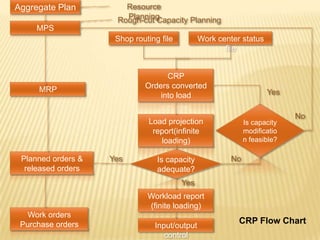
Aggregate PlanResourcePlanningRough-cut Capacity PlanningMPSWork center status fileShop routing fileCRPOrders converted into loadMRPYesIs capacity modification feasible?NoLoad projection report(infinite loading)Is capacity  adequate?Planned orders & released ordersYesNoYesWorkload report (finite loading)Work orders Purchase ordersCRP Flow ChartInput/output control
Planning ActivityInfinite Loading: Process of loading work centers with all the loads when they are required without regard to the actual capacity of work centers.Finite Loading: Done automatically with computerized loading system limiting the load assigned to work centers in each period as per the available capacity at each work center.
Material requirement planning (mrp)
Material Requirement Planning(MRP)MRP  is a computer based information system for ordering & scheduling of dependent demand inventories.The technique to plan for procurement or manufacture of the specific components that will be required to produce the required quantities of end products as per the production schedule indicated by MPS is called MRP technique.
Objectives of MRPImprove customer service by meeting delivery schedules promised & shortening delivery lead timesReduce inventory costs by reducing inventory levelsImprove plant operating efficiency by better use of productive resources
Purpose of MRPControl inventory levelsAssign operating prioritiesAssign capacity to load production systems
MRP AdvantagesReduced inventoryReduced idle timeReduced setup timeAbility to change MPSAbility to price more competitivelyBetter customer serviceBetter response to market demandReduced sales price
MRP System also enables…Aids capacity planningHelps mangers to use the planned schedule before actual release ordersTells when to expedite or de-expediteDelays or cancels ordersChanges order quantitiesAdvances or delays order due dates
MRP DisadvantagesLack of top management commitment for MRP as a closed-loop, integrated strategic planning toolPresented & perceived as a complete stand-alone system to run a firm, rather than as part of the total systemThe issue of how MRP can be made to function with just-in-time production system

Operations Planning

  • 1.
  • 2.
  • 3.
    IntroductionMeaning: Organization ofan overall manufacturing/operating system to produce a productObjective: to provide a physical system together with a set of operating guidelines for efficient conversion of raw materials, human skills & other inputs into finished products
  • 4.
    Factors Determining ProductionPlanning ProcessMain difference between two companies’ planning processes is the differences in the economic & technological conditions of the company’s operations.Volume of productionNature of production processesNature of operations
  • 5.
    Variants in ManufacturingApproachManufacturing to orderManufacturing for stock & sell under repetitive batchManufacturing for stock & sell under continuous process
  • 6.
    Production Planning LevelsHierarchicallevelsStrategic planningTactical planningOperational PlanningTime spanLong rangeIntermediate rangeShort range
  • 7.
  • 8.
  • 9.
    IntroductionMPS sets thequantity of each finished product to be completed in each time period of the short range planning horizon.MPS is developed by reviewing market forecasts, customer orders, inventory levels, facility loading & capacity information regularly.
  • 10.
    MPS ObjectivesTo scheduleend items to be completed promptly & when promised to customersTo avoid overloading or under loading the production facility so that production capacity is efficiently utilized & incur low production costs
  • 11.
    MPS FunctionsTranslating aggregateplansEvaluating alternative master schedulesGenerating material requirementsGenerating capacity requirementsFacilitating information processingMaintaining valid prioritiesUtilizing capacity effectively
  • 12.
    Forecasts & customerordersEnd products & Service partsDomestic & InternationalAggregate planTentative MPSRevise Master ScheduleRevise Master ScheduleTrial fit onMRP systemCRP systemAre materials adequate?Are capacities adequate?NoNoYesYesFirm MPSTo MRP & CRP systemsMPS Flow Chart
  • 13.
  • 14.
    CRPMeaning: CRP isa technique to determine the labor & equipment capacities needed to meet the objectives.
  • 15.
    Aggregate PlanResourcePlanningRough-cut CapacityPlanningMPSWork center status fileShop routing fileCRPOrders converted into loadMRPYesIs capacity modification feasible?NoLoad projection report(infinite loading)Is capacity adequate?Planned orders & released ordersYesNoYesWorkload report (finite loading)Work orders Purchase ordersCRP Flow ChartInput/output control
  • 16.
    Planning ActivityInfinite Loading:Process of loading work centers with all the loads when they are required without regard to the actual capacity of work centers.Finite Loading: Done automatically with computerized loading system limiting the load assigned to work centers in each period as per the available capacity at each work center.
  • 17.
  • 18.
    Material Requirement Planning(MRP)MRP is a computer based information system for ordering & scheduling of dependent demand inventories.The technique to plan for procurement or manufacture of the specific components that will be required to produce the required quantities of end products as per the production schedule indicated by MPS is called MRP technique.
  • 19.
    Objectives of MRPImprovecustomer service by meeting delivery schedules promised & shortening delivery lead timesReduce inventory costs by reducing inventory levelsImprove plant operating efficiency by better use of productive resources
  • 20.
    Purpose of MRPControlinventory levelsAssign operating prioritiesAssign capacity to load production systems
  • 21.
    MRP AdvantagesReduced inventoryReducedidle timeReduced setup timeAbility to change MPSAbility to price more competitivelyBetter customer serviceBetter response to market demandReduced sales price
  • 22.
    MRP System alsoenables…Aids capacity planningHelps mangers to use the planned schedule before actual release ordersTells when to expedite or de-expediteDelays or cancels ordersChanges order quantitiesAdvances or delays order due dates
  • 23.
    MRP DisadvantagesLack oftop management commitment for MRP as a closed-loop, integrated strategic planning toolPresented & perceived as a complete stand-alone system to run a firm, rather than as part of the total systemThe issue of how MRP can be made to function with just-in-time production system