By
                      A.Venu
                     M.Pharm
                 Pharmaceutics
Sri Krupa Institute of Pharmaceutical Sciences
            Under the Guidance of
             Dr. S. Y. MANJUNATH
MASS SPECTROMETRY

 Introduction
 Principle
 Instrumentation
 applications
INTRODUCTION

 Mass spectrometry is one of the most
  generally applicable tools providing both
  qualitative and quantitative information
  about the atomic and molecular materials.
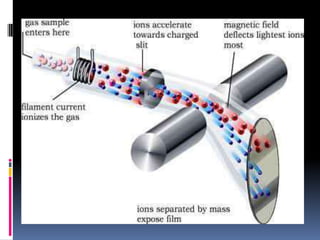
 Here the compound under the investigation is
  bombarded with a beam of electrons which
  produce an ionic molecule or ionic fragments
  of the original species. The resulting charging
  particle is then seperated according their
  masses.
Mass Spectrometry
 Analytical method to measure the
 molecular or atomic weight of samples
PRINCIPLE

 Organic molecules are bombarded with
  electron and are converted to high energetic
  positively charged ions(molecular ions or
  parent ions).
 Which will break up in to smaller ions
  (fragment ions or daughter ions).
 The loss of electron from a molecule leads to
  a radical cation.
      M+e-                M++2e-
 This molecular commonly M+ decomposes to a pair
    of fragments which may be either radical +anion or
    a small molecule + radical cation.
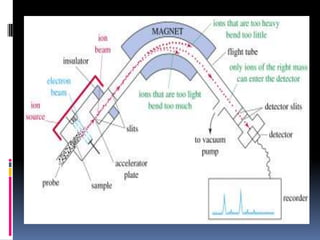
   These molecular ions, are isolated in the electric
    field at an voltage V, these charging particles which
    are isolated then made to enter into an magnetic
    field H. Here the field attracts the particles and
    move in a circle around it.
   Here the radius of the ionised molecule depends on
    m, its mass. This forms the basis of separation of
    particles according to their masses.
   These ions are made to impinge upon the collector
    inturn thus giving rise to a spectrum.
   The ion source, ion path and collector of the mass
    spectrometer must be under high vacuum(107 mm
    Hg) for optimum operation.
INSTRUMENTATION


   SAMPLE INLET SYSTEM
   ION SOURCE(OR IONISATION CHAMBER)
   THE ELECTROSTATIC ACCELERATING SYSTEM
   THE MAGNETIC FIELD
   THE ION SEPERATOR
   THE ION COLLECTOR
   THE VACUUM SYSTEM
SAMPLE INLET SYSTEM

1.   Handling gas samples:
       It involves transfer of samples from small containers of
     known volume coupled to a mercury manometer. The
     sample is then expanded into a reservoir immediately a
     head of the sample inlet
2.Introduction of liquids:
      The sample is converted into gaseous state then injected
     by using a
     a. micropipet to a sintered glass disk under a layer of
     molten gallium,or
      b. by hypodermic needle injection through a silicone
     rubber septum.
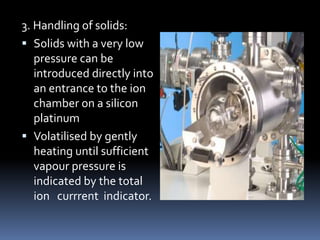
3. Handling of solids:
 Solids with a very low
   pressure can be
   introduced directly into
   an entrance to the ion
   chamber on a silicon
   platinum
 Volatilised by gently
   heating until sufficient
   vapour pressure is
   indicated by the total
   ion currrent indicator.
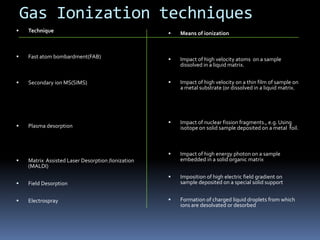
Gas Ionization techniques
   Technique                                         Means of ionization


   Fast atom bombardment(FAB)                        Impact of high velocity atoms on a sample
                                                       dissolved in a liquid matrix.


   Secondary ion MS(SIMS)                            Impact of high velocity on a thin film of sample on
                                                       a metal substrate (or dissolved in a liquid matrix.


                                                      Impact of nuclear fission fragments., e.g. Using
   Plasma desorption                                  isotope on solid sample deposited on a metal foil.


                                                      Impact of high energy photon on a sample
   Matrix Assisted Laser Desorption /Ionization       embedded in a solid organic matrix
    (MALDI)
                                                      Imposition of high electric field gradient on
   Field Desorption                                   sample deposited on a special solid support


   Electrospray                                      Formation of charged liquid droplets from which
                                                       ions are desolvated or desorbed
Electrostatic Acceleration
System
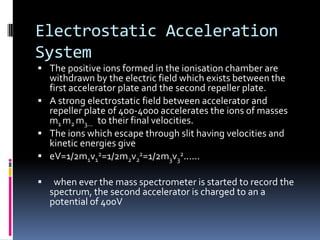
 The positive ions formed in the ionisation chamber are
  withdrawn by the electric field which exists between the
  first accelerator plate and the second repeller plate.
 A strong electrostatic field between accelerator and
  repeller plate of 400-4000 accelerates the ions of masses
  m1 m2 m3... to their final velocities.
 The ions which escape through slit having velocities and
  kinetic energies give
 eV=1/2m1v12=1/2m2v22=1/2m3v32......

    when ever the mass spectrometer is started to record the
    spectrum, the second accelerator is charged to an a
    potential of 400V
Magnetic field

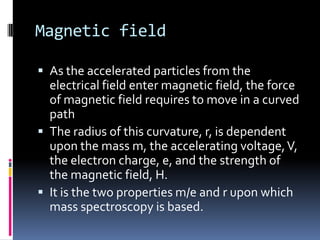
 As the accelerated particles from the
  electrical field enter magnetic field, the force
  of magnetic field requires to move in a curved
  path
 The radius of this curvature, r, is dependent
  upon the mass m, the accelerating voltage, V,
  the electron charge, e, and the strength of
  the magnetic field, H.
 It is the two properties m/e and r upon which
  mass spectroscopy is based.
Ion seperators or analysers

 Double focussing analyser
 Cycloidal focussing analyser
 Quadrupole mass spectrometer
 Time of flight
 Radio frequency analysers
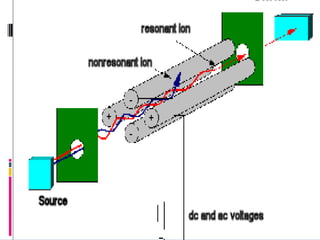
Quadrupole Mass Analyser

 Quadrupole Mass spectrometer, initially
  devised to separate uranium isotopes.
 Focusing of ions after accelerating from the
  ion source is affected by a quadrupole mass
  filter where they are separated according to
  mass and detected by an electron multiplier.
 The mass filter consists of a quadrant of four
  parallel circular tungsten rods which foce ions
  by means of an oscillating and variable
  radiofrequency filed.
Ion collector

 The ion beam currents are of the order of
  10-15 to 10-19 ampere.
 The generally employed ion collectors are
  photographic plates, Faraday cylinders,
  electron multipliers and electrometers.
Vacuum system

 A high vacuum is to be maintained.
 The inlet system is generally maintained at
  0.015 torr, the ion source at 10-15 torr and
  analyzer tube at 10-7 torr or as low as
  possible.
 Oil diffusion and mercury diffusion pumps are
  commonly used in different types of
  combination
Applications

 Structure elucidation
 Detection of impurities
 Quantitative analysis
 Drug metabolism studies
 Clinical, toxicological and forensic
  applications
 GC MS
Reference

1. Instrumental methods of chemical analysis by
   Gurdeep R. Chatwal, Sham k. Anand, first
   edition page no 2.273-2.285
2. Organic spectroscopy by William Kemp, Third
   edition page no 285-290.
3. Spectrometric identification of organic
   compounds by Silverstein. Sixth edition page no
   2-5
4. Instrumental methods of analysis by Willard,
   seventh edition page no -466
Mass spectrometer

Mass spectrometer

  • 1.
    By A.Venu M.Pharm Pharmaceutics Sri Krupa Institute of Pharmaceutical Sciences Under the Guidance of Dr. S. Y. MANJUNATH
  • 2.
    MASS SPECTROMETRY  Introduction Principle  Instrumentation  applications
  • 3.
    INTRODUCTION  Mass spectrometryis one of the most generally applicable tools providing both qualitative and quantitative information about the atomic and molecular materials.  Here the compound under the investigation is bombarded with a beam of electrons which produce an ionic molecule or ionic fragments of the original species. The resulting charging particle is then seperated according their masses.
  • 4.
    Mass Spectrometry  Analyticalmethod to measure the molecular or atomic weight of samples
  • 5.
    PRINCIPLE  Organic moleculesare bombarded with electron and are converted to high energetic positively charged ions(molecular ions or parent ions).  Which will break up in to smaller ions (fragment ions or daughter ions).  The loss of electron from a molecule leads to a radical cation. M+e- M++2e-
  • 6.
     This molecularcommonly M+ decomposes to a pair of fragments which may be either radical +anion or a small molecule + radical cation.  These molecular ions, are isolated in the electric field at an voltage V, these charging particles which are isolated then made to enter into an magnetic field H. Here the field attracts the particles and move in a circle around it.  Here the radius of the ionised molecule depends on m, its mass. This forms the basis of separation of particles according to their masses.  These ions are made to impinge upon the collector inturn thus giving rise to a spectrum.  The ion source, ion path and collector of the mass spectrometer must be under high vacuum(107 mm Hg) for optimum operation.
  • 7.
    INSTRUMENTATION  SAMPLE INLET SYSTEM  ION SOURCE(OR IONISATION CHAMBER)  THE ELECTROSTATIC ACCELERATING SYSTEM  THE MAGNETIC FIELD  THE ION SEPERATOR  THE ION COLLECTOR  THE VACUUM SYSTEM
  • 9.
    SAMPLE INLET SYSTEM 1. Handling gas samples: It involves transfer of samples from small containers of known volume coupled to a mercury manometer. The sample is then expanded into a reservoir immediately a head of the sample inlet 2.Introduction of liquids: The sample is converted into gaseous state then injected by using a a. micropipet to a sintered glass disk under a layer of molten gallium,or b. by hypodermic needle injection through a silicone rubber septum.
  • 10.
    3. Handling ofsolids:  Solids with a very low pressure can be introduced directly into an entrance to the ion chamber on a silicon platinum  Volatilised by gently heating until sufficient vapour pressure is indicated by the total ion currrent indicator.
  • 11.
    Gas Ionization techniques  Technique  Means of ionization  Fast atom bombardment(FAB)  Impact of high velocity atoms on a sample dissolved in a liquid matrix.  Secondary ion MS(SIMS)  Impact of high velocity on a thin film of sample on a metal substrate (or dissolved in a liquid matrix.  Impact of nuclear fission fragments., e.g. Using  Plasma desorption isotope on solid sample deposited on a metal foil.  Impact of high energy photon on a sample  Matrix Assisted Laser Desorption /Ionization embedded in a solid organic matrix (MALDI)  Imposition of high electric field gradient on  Field Desorption sample deposited on a special solid support  Electrospray  Formation of charged liquid droplets from which ions are desolvated or desorbed
  • 12.
    Electrostatic Acceleration System  Thepositive ions formed in the ionisation chamber are withdrawn by the electric field which exists between the first accelerator plate and the second repeller plate.  A strong electrostatic field between accelerator and repeller plate of 400-4000 accelerates the ions of masses m1 m2 m3... to their final velocities.  The ions which escape through slit having velocities and kinetic energies give  eV=1/2m1v12=1/2m2v22=1/2m3v32......  when ever the mass spectrometer is started to record the spectrum, the second accelerator is charged to an a potential of 400V
  • 13.
    Magnetic field  Asthe accelerated particles from the electrical field enter magnetic field, the force of magnetic field requires to move in a curved path  The radius of this curvature, r, is dependent upon the mass m, the accelerating voltage, V, the electron charge, e, and the strength of the magnetic field, H.  It is the two properties m/e and r upon which mass spectroscopy is based.
  • 15.
    Ion seperators oranalysers  Double focussing analyser  Cycloidal focussing analyser  Quadrupole mass spectrometer  Time of flight  Radio frequency analysers
  • 16.
    Quadrupole Mass Analyser Quadrupole Mass spectrometer, initially devised to separate uranium isotopes.  Focusing of ions after accelerating from the ion source is affected by a quadrupole mass filter where they are separated according to mass and detected by an electron multiplier.  The mass filter consists of a quadrant of four parallel circular tungsten rods which foce ions by means of an oscillating and variable radiofrequency filed.
  • 18.
    Ion collector  Theion beam currents are of the order of 10-15 to 10-19 ampere.  The generally employed ion collectors are photographic plates, Faraday cylinders, electron multipliers and electrometers.
  • 19.
    Vacuum system  Ahigh vacuum is to be maintained.  The inlet system is generally maintained at 0.015 torr, the ion source at 10-15 torr and analyzer tube at 10-7 torr or as low as possible.  Oil diffusion and mercury diffusion pumps are commonly used in different types of combination
  • 20.
    Applications  Structure elucidation Detection of impurities  Quantitative analysis  Drug metabolism studies  Clinical, toxicological and forensic applications  GC MS
  • 21.
    Reference 1. Instrumental methodsof chemical analysis by Gurdeep R. Chatwal, Sham k. Anand, first edition page no 2.273-2.285 2. Organic spectroscopy by William Kemp, Third edition page no 285-290. 3. Spectrometric identification of organic compounds by Silverstein. Sixth edition page no 2-5 4. Instrumental methods of analysis by Willard, seventh edition page no -466