1
Market Led Extension
2
Outline
 Introduction
 Concepts
 Challenges
 Role of agricultural Extension personnel
 Case studies
3
Introduction
4
Concept of Market Led Extension
 Market-A congregation of prospective buyers & sellers
with a common motive of trading a particular
commodity.
 Extension- It is the spreading/reaching out to the mass
 Market led Extension- Agriculture & economics coupled
with extension is the perfect blend for reaching at the
door steps of common man
5
Challenges in Agricultural
Marketing System
 Market size is large and continuously
expanding, but marketing system not kept pace
 7161 market yards/sub yards is inadequate, ill
equipped and mismanaged
 Due to lack of proper handling at farm gate
lead to 30 % F&V, 7% grains, 10% spices loss
before reaching market
 Rs 50,000 crores /year lost due to poor
marketing chain
6
continues….
 Risk bearing
 Storage of farm produce
 The absence of grades and standards restricts
the development of effective and efficient
marketing systems.
7
 An efficient marketing system is essential for the
development of the agricultural sector. In as much as it
provides outlets and incentives for increased production,
the marketing system contributes greatly to the
commercialization of subsistence farmers. Failure to
develop the agricultural marketing system is likely to
negate most, if not all, efforts to increase agricultural
production (FAO, 2000).
8
 It is expected that future agricultural growth would
largely accrue from improvements in productivity of
diversified farming systems with regional and sustainable
management of natural resources, especially land and
water. Effective linkages of production systems with
marketing, agro-processing and other Value added
activities would play an increasingly important role in the
diversification of agriculture (MoA,GoI 2001).
9
Present Scenario
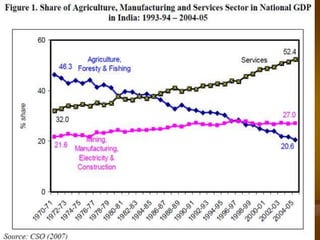
 Agriculture-18.5% GDP & 58%
Employment
• Production- Food grains-219 mt
• Fruits & Veg- 134 mt
• Oil seeds- 26 mt
10
11
Changing Paradigm of
Indian Agriculture
 Transformation from Subsistence to market
driven – LPG
 Technology, institutions, and markets
 Linking producers to markets is a major
challenge
 Access to information, capital and effective
transfer of technology is crucial
 Farmers quite often loose due to lack of
market information and access to market
12
Access to Extension Information
 Needs of farmers are diverse and complex
 NSSO 2005 –Over 50% of farmers do not have
access to extension information.
 44% have some access. Of this, 22% has access
through media (radio 13%and TV 9%)
 Lack of information hinders transfer of technology
13
Questions confronting the
farmers
 Globalization of market- How to adjust?
 Farmers need to know answers to questions
like:
- what to produce?
- when to produce?
- how much to produce?
- when and where to sell?
- Where to sell?
- what firm to sell his produce (value
addition etc.)
 Key answer to the above: Empower farmers in
both Production Market oriented knowledge
14
Crises in the present
Extension system
 Knowledge-skill Input Crisis
 Efficacy Crisis
 Credibility Crisis
 Reorganization Structure Crisis
15
Challenges to Market-Led
Extension
 Gigantic Size of Extension System
 Adoption of Information Technology
 Market Intelligence
 Extension Cadre Development
 Reorganization of Extension System
16
Gigantic Size of Public Extension
System
 Heavily burdened with multi-farious activities
 Liaison between researcher and farmer
 New dimension of ‘marketing’ may further burden
and become an agenda beyond their
comprehension and capability
 Already under severe criticism for delivery of
services
 How to motivate them to learn the new knowledge
and skills of marketing before assigning them
marketing extension jobs
17
Information Technology
 Sporadic success stories of farmers using IT
 Urgent need to strategically frame
information policy to make the farmers info-
rich
 Present websites furnish general
information. No ready information available
on agri-markets
 Need for collection of relevant information
and creation and maintenance of websites
18
Market Intelligence
 Generation of data on the market
intelligence is a huge task by itself.
 Linkages between line departments
and Marketing agencies strengthens
the market-led extension.
19
Extension cadre development
 The present extension system suffers
from several limitations. There is a dire
need to upgrade the basic facilities.
 Enthuse them to look forward for
motivating factors like achievement, job
satisfaction and recognition etc.
20
Reorganization of the
extension system
• Restructuring the extension system
of line departments
• Promotion of Participatory Extension
Management System
21
Extension Policy Framework :
Reforms In Public Extension
 Public Extension shall have to be leaner, better qualified,

more professional
 Farmer-to-Farmer extension: Subject Matter Specialists
up to Block level, below that operate through para-
professionals linked to ‘Farmers’ Groups
 Role of Village Level Extension Functionaries / Para Tech
as Farm Advisor / Mitra Kissan (Service provider)
 Public Extension Functionaries to be organized in
innovative, restructured institutional arrangements
22
Institutional Reforms in Public Sector
Making the technology dissemination farmer-driven
and farmer-accountable
(ATMA model – pilot tested in 7 states & 28 districts)
Adopting bottom-up planning procedures for setting
the research-extension agenda
(District SREP & Block Action Plans)
Moving towards integrated, broad-based extension
delivery
(District Technology Team & BTT)
23
Strategic Research and Extension
Plan (SREP) for District
 Prepared by District Technology Team
 Identification of Representative Agro-eco
Situations
 Intensive PRAs & Participatory Data Collection
 Defining Strategies, Activities & Operational
Modalities
 Approval by ATMA Governing Board
 Ownership by the Stakeholders
24
Required Information to
Extension System and Farmers
 Present agricultural scenario and
land use pattern
 Suitability of land holding to various
crops/enterprises
 Market prices of crops in demand
 Availability of inputs
 Credit facilities
 Desired qualities of the products by
consumers
25
The role of Agril. Extension
personnel in MLE
1. Doing the SWOT analysis
2. Organization of FIG (Farmer interest
Group)
3. Local established Group
4. Direct market
5. Providing Advise on Product planning
6. Educating the Farming community
7. Capacity building of FIG
8. Expose the Farmer
26
Dimension of market led
Extension
 Marketing mix
 Marketing plan
 Competitive success
 Customer satisfaction
27
Required Information
 Market network of the local area and the price differences in various
markets
 Network of storage and warehouse facilities available
 Transport facilities
 Production technologies like improved varieties, organic farming,
usage of bio-fertilizers and bio-pesticides, IPM, INM, and right
methods of harvesting etc.
 Post-harvest management like processing, grading, standardization
of produce, value addition, packaging, storage, certification, etc.
with reference to food grains, fruits and vegetables, eggs, poultry,
fish, etc.
28
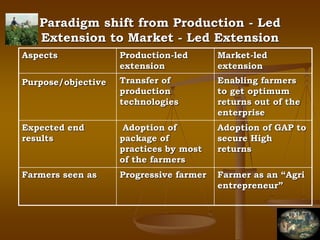
Paradigm shift from Production - Led
Extension to Market - Led Extension
Aspects Production-led
extension
Market-led
extension
Purpose/objective Transfer of
production
technologies
Enabling farmers
to get optimum
returns out of the
enterprise
Expected end
results
Adoption of
package of
practices by most
of the farmers
Adoption of GAP to
secure High
returns
Farmers seen as Progressive farmer Farmer as an “Agri
entrepreneur”
29
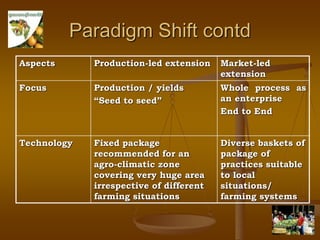
Paradigm Shift contd
Aspects Production-led extension Market-led
extension
Focus Production / yields
“Seed to seed”
Whole process as
an enterprise
End to End
Technology Fixed package
recommended for an
agro-climatic zone
covering very huge area
irrespective of different
farming situations
Diverse baskets of
package of
practices suitable
to local
situations/
farming systems
30
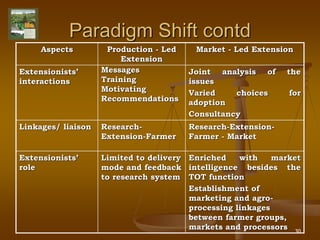
Paradigm Shift contd
Aspects Production - Led
Extension
Market - Led Extension
Extensionists’
interactions
Messages
Training
Motivating
Recommendations
Joint analysis of the
issues
Varied choices for
adoption
Consultancy
Linkages/ liaison Research-
Extension-Farmer
Research-Extension-
Farmer - Market
Extensionists’
role
Limited to delivery
mode and feedback
to research system
Enriched with market
intelligence besides the
TOT function
Establishment of
marketing and agro-
processing linkages
between farmer groups,
markets and processors
31
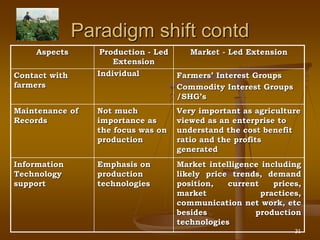
Paradigm shift contd
Aspects Production - Led
Extension
Market - Led Extension
Contact with
farmers
Individual Farmers’ Interest Groups
Commodity Interest Groups
/SHG’s
Maintenance of
Records
Not much
importance as
the focus was on
production
Very important as agriculture
viewed as an enterprise to
understand the cost benefit
ratio and the profits
generated
Information
Technology
support
Emphasis on
production
technologies
Market intelligence including
likely price trends, demand
position, current prices,
market practices,
communication net work, etc
besides production
technologies
32
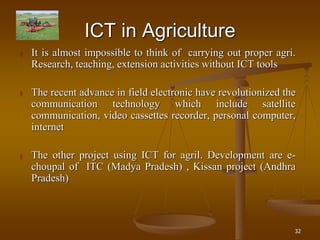
ICT in Agriculture
 It is almost impossible to think of carrying out proper agri.
Research, teaching, extension activities without ICT tools
 The recent advance in field electronic have revolutionized the
communication technology which include satellite
communication, video cassettes recorder, personal computer,
internet
 The other project using ICT for agril. Development are e-
choupal of ITC (Madya Pradesh) , Kissan project (Andhra
Pradesh)
33
STUDIES RELATED TO MARKET - LED EXTENSION
Case 1:
Market- led Extension Strategies for
promoting vegetable cultivation in
UTTARAKHAND
Shailesh kumar &
G.Sharma
34
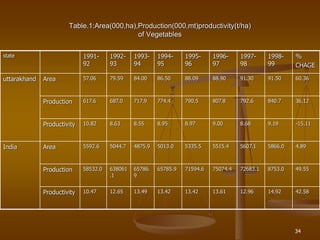
Table.1:Area(000,ha),Production(000,mt)productivity(t/ha)
of Vegetables
state 1991-
92
1992-
93
1993-
94
1994-
95
1995-
96
1996-
97
1997-
98
1998-
99
%
CHAGE
uttarakhand Area 57.06 79.59 84.00 86.50 88.09 88.90 91.30 91.50 60.36
Production 617.6 687.0 717.9 774.4 790.5 807.8 792.6 840.7 36.12
Productivity 10.82 8.63 8.55 8.95 8.97 9.00 8.68 9.19 -15.11
India Area 5592.6 5044.7 4875.9 5013.0 5335.5 5515.4 5607.1 5866.0 4.89
Production 58532.0 638061
.1
65786.
9
65785.9 71594.6 75074.4 72683.1 8753.0 49.55
Productivity 10.47 12.65 13.49 13.42 13.42 13.61 12.96 14.92 42.58
35
MARKET LED AGRICULTURAL
PRODUCTION
M.C.AHIRE &
P.B.KHARDE
2…..
36
Diversified agriculture by Shri
Bhagwat
 Progressive farmer Shri Arun Bhagwat
follow the main activity of Diversified and
intensified agriculture and market oriented
Agriculture
 He has been a practical advocate of
organic farming and low cost agriculture
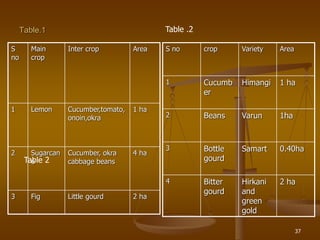
 Back ground-who has joint family, own
12.0ha of land, adopted the following
inter-cropping system.
37
Table.1
S
no
Main
crop
Inter crop Area
1 Lemon Cucumber,tomato,
onoin,okra
1 ha
2 Sugarcan
e
Cucumber, okra
cabbage beans
4 ha
3 Fig Little gourd 2 ha
S no crop Variety Area
1 Cucumb
er
Himangi 1 ha
2 Beans Varun 1ha
3 Bottle
gourd
Samart 0.40ha
4 Bitter
gourd
Hirkani
and
green
gold
2 ha
Table 2
Table .2
38
Conclusion
39

Market Led Extension

  • 1.
  • 2.
    2 Outline  Introduction  Concepts Challenges  Role of agricultural Extension personnel  Case studies
  • 3.
  • 4.
    4 Concept of MarketLed Extension  Market-A congregation of prospective buyers & sellers with a common motive of trading a particular commodity.  Extension- It is the spreading/reaching out to the mass  Market led Extension- Agriculture & economics coupled with extension is the perfect blend for reaching at the door steps of common man
  • 5.
    5 Challenges in Agricultural MarketingSystem  Market size is large and continuously expanding, but marketing system not kept pace  7161 market yards/sub yards is inadequate, ill equipped and mismanaged  Due to lack of proper handling at farm gate lead to 30 % F&V, 7% grains, 10% spices loss before reaching market  Rs 50,000 crores /year lost due to poor marketing chain
  • 6.
    6 continues….  Risk bearing Storage of farm produce  The absence of grades and standards restricts the development of effective and efficient marketing systems.
  • 7.
    7  An efficientmarketing system is essential for the development of the agricultural sector. In as much as it provides outlets and incentives for increased production, the marketing system contributes greatly to the commercialization of subsistence farmers. Failure to develop the agricultural marketing system is likely to negate most, if not all, efforts to increase agricultural production (FAO, 2000).
  • 8.
    8  It isexpected that future agricultural growth would largely accrue from improvements in productivity of diversified farming systems with regional and sustainable management of natural resources, especially land and water. Effective linkages of production systems with marketing, agro-processing and other Value added activities would play an increasingly important role in the diversification of agriculture (MoA,GoI 2001).
  • 9.
    9 Present Scenario  Agriculture-18.5%GDP & 58% Employment • Production- Food grains-219 mt • Fruits & Veg- 134 mt • Oil seeds- 26 mt
  • 10.
  • 11.
    11 Changing Paradigm of IndianAgriculture  Transformation from Subsistence to market driven – LPG  Technology, institutions, and markets  Linking producers to markets is a major challenge  Access to information, capital and effective transfer of technology is crucial  Farmers quite often loose due to lack of market information and access to market
  • 12.
    12 Access to ExtensionInformation  Needs of farmers are diverse and complex  NSSO 2005 –Over 50% of farmers do not have access to extension information.  44% have some access. Of this, 22% has access through media (radio 13%and TV 9%)  Lack of information hinders transfer of technology
  • 13.
    13 Questions confronting the farmers Globalization of market- How to adjust?  Farmers need to know answers to questions like: - what to produce? - when to produce? - how much to produce? - when and where to sell? - Where to sell? - what firm to sell his produce (value addition etc.)  Key answer to the above: Empower farmers in both Production Market oriented knowledge
  • 14.
    14 Crises in thepresent Extension system  Knowledge-skill Input Crisis  Efficacy Crisis  Credibility Crisis  Reorganization Structure Crisis
  • 15.
    15 Challenges to Market-Led Extension Gigantic Size of Extension System  Adoption of Information Technology  Market Intelligence  Extension Cadre Development  Reorganization of Extension System
  • 16.
    16 Gigantic Size ofPublic Extension System  Heavily burdened with multi-farious activities  Liaison between researcher and farmer  New dimension of ‘marketing’ may further burden and become an agenda beyond their comprehension and capability  Already under severe criticism for delivery of services  How to motivate them to learn the new knowledge and skills of marketing before assigning them marketing extension jobs
  • 17.
    17 Information Technology  Sporadicsuccess stories of farmers using IT  Urgent need to strategically frame information policy to make the farmers info- rich  Present websites furnish general information. No ready information available on agri-markets  Need for collection of relevant information and creation and maintenance of websites
  • 18.
    18 Market Intelligence  Generationof data on the market intelligence is a huge task by itself.  Linkages between line departments and Marketing agencies strengthens the market-led extension.
  • 19.
    19 Extension cadre development The present extension system suffers from several limitations. There is a dire need to upgrade the basic facilities.  Enthuse them to look forward for motivating factors like achievement, job satisfaction and recognition etc.
  • 20.
    20 Reorganization of the extensionsystem • Restructuring the extension system of line departments • Promotion of Participatory Extension Management System
  • 21.
    21 Extension Policy Framework: Reforms In Public Extension  Public Extension shall have to be leaner, better qualified, more professional  Farmer-to-Farmer extension: Subject Matter Specialists up to Block level, below that operate through para- professionals linked to ‘Farmers’ Groups  Role of Village Level Extension Functionaries / Para Tech as Farm Advisor / Mitra Kissan (Service provider)  Public Extension Functionaries to be organized in innovative, restructured institutional arrangements
  • 22.
    22 Institutional Reforms inPublic Sector Making the technology dissemination farmer-driven and farmer-accountable (ATMA model – pilot tested in 7 states & 28 districts) Adopting bottom-up planning procedures for setting the research-extension agenda (District SREP & Block Action Plans) Moving towards integrated, broad-based extension delivery (District Technology Team & BTT)
  • 23.
    23 Strategic Research andExtension Plan (SREP) for District  Prepared by District Technology Team  Identification of Representative Agro-eco Situations  Intensive PRAs & Participatory Data Collection  Defining Strategies, Activities & Operational Modalities  Approval by ATMA Governing Board  Ownership by the Stakeholders
  • 24.
    24 Required Information to ExtensionSystem and Farmers  Present agricultural scenario and land use pattern  Suitability of land holding to various crops/enterprises  Market prices of crops in demand  Availability of inputs  Credit facilities  Desired qualities of the products by consumers
  • 25.
    25 The role ofAgril. Extension personnel in MLE 1. Doing the SWOT analysis 2. Organization of FIG (Farmer interest Group) 3. Local established Group 4. Direct market 5. Providing Advise on Product planning 6. Educating the Farming community 7. Capacity building of FIG 8. Expose the Farmer
  • 26.
    26 Dimension of marketled Extension  Marketing mix  Marketing plan  Competitive success  Customer satisfaction
  • 27.
    27 Required Information  Marketnetwork of the local area and the price differences in various markets  Network of storage and warehouse facilities available  Transport facilities  Production technologies like improved varieties, organic farming, usage of bio-fertilizers and bio-pesticides, IPM, INM, and right methods of harvesting etc.  Post-harvest management like processing, grading, standardization of produce, value addition, packaging, storage, certification, etc. with reference to food grains, fruits and vegetables, eggs, poultry, fish, etc.
  • 28.
    28 Paradigm shift fromProduction - Led Extension to Market - Led Extension Aspects Production-led extension Market-led extension Purpose/objective Transfer of production technologies Enabling farmers to get optimum returns out of the enterprise Expected end results Adoption of package of practices by most of the farmers Adoption of GAP to secure High returns Farmers seen as Progressive farmer Farmer as an “Agri entrepreneur”
  • 29.
    29 Paradigm Shift contd AspectsProduction-led extension Market-led extension Focus Production / yields “Seed to seed” Whole process as an enterprise End to End Technology Fixed package recommended for an agro-climatic zone covering very huge area irrespective of different farming situations Diverse baskets of package of practices suitable to local situations/ farming systems
  • 30.
    30 Paradigm Shift contd AspectsProduction - Led Extension Market - Led Extension Extensionists’ interactions Messages Training Motivating Recommendations Joint analysis of the issues Varied choices for adoption Consultancy Linkages/ liaison Research- Extension-Farmer Research-Extension- Farmer - Market Extensionists’ role Limited to delivery mode and feedback to research system Enriched with market intelligence besides the TOT function Establishment of marketing and agro- processing linkages between farmer groups, markets and processors
  • 31.
    31 Paradigm shift contd AspectsProduction - Led Extension Market - Led Extension Contact with farmers Individual Farmers’ Interest Groups Commodity Interest Groups /SHG’s Maintenance of Records Not much importance as the focus was on production Very important as agriculture viewed as an enterprise to understand the cost benefit ratio and the profits generated Information Technology support Emphasis on production technologies Market intelligence including likely price trends, demand position, current prices, market practices, communication net work, etc besides production technologies
  • 32.
    32 ICT in Agriculture It is almost impossible to think of carrying out proper agri. Research, teaching, extension activities without ICT tools  The recent advance in field electronic have revolutionized the communication technology which include satellite communication, video cassettes recorder, personal computer, internet  The other project using ICT for agril. Development are e- choupal of ITC (Madya Pradesh) , Kissan project (Andhra Pradesh)
  • 33.
    33 STUDIES RELATED TOMARKET - LED EXTENSION Case 1: Market- led Extension Strategies for promoting vegetable cultivation in UTTARAKHAND Shailesh kumar & G.Sharma
  • 34.
    34 Table.1:Area(000,ha),Production(000,mt)productivity(t/ha) of Vegetables state 1991- 92 1992- 93 1993- 94 1994- 95 1995- 96 1996- 97 1997- 98 1998- 99 % CHAGE uttarakhandArea 57.06 79.59 84.00 86.50 88.09 88.90 91.30 91.50 60.36 Production 617.6 687.0 717.9 774.4 790.5 807.8 792.6 840.7 36.12 Productivity 10.82 8.63 8.55 8.95 8.97 9.00 8.68 9.19 -15.11 India Area 5592.6 5044.7 4875.9 5013.0 5335.5 5515.4 5607.1 5866.0 4.89 Production 58532.0 638061 .1 65786. 9 65785.9 71594.6 75074.4 72683.1 8753.0 49.55 Productivity 10.47 12.65 13.49 13.42 13.42 13.61 12.96 14.92 42.58
  • 35.
  • 36.
    36 Diversified agriculture byShri Bhagwat  Progressive farmer Shri Arun Bhagwat follow the main activity of Diversified and intensified agriculture and market oriented Agriculture  He has been a practical advocate of organic farming and low cost agriculture  Back ground-who has joint family, own 12.0ha of land, adopted the following inter-cropping system.
  • 37.
    37 Table.1 S no Main crop Inter crop Area 1Lemon Cucumber,tomato, onoin,okra 1 ha 2 Sugarcan e Cucumber, okra cabbage beans 4 ha 3 Fig Little gourd 2 ha S no crop Variety Area 1 Cucumb er Himangi 1 ha 2 Beans Varun 1ha 3 Bottle gourd Samart 0.40ha 4 Bitter gourd Hirkani and green gold 2 ha Table 2 Table .2
  • 38.
  • 39.