
Financing Agri-value Chain Development in
India – Constraints and Opportunities

P K Joshi

International Food Policy Research Institute
South Asia Regional Office, Pusa, New Delhi 110 012
India
E-mail: p.joshi@cgiar.org
Coverage
1.
2.
3.
4.
5.
6.

Problems of agricultural marketing in India
Evolution of agri-value chain development
and its financing in India
Illustration of few value chains
Benefits of modern value chains to producers
Constraints in financing agriculture and value
chains
Opportunities and way forward
I
Problems of Agricultural Marketing
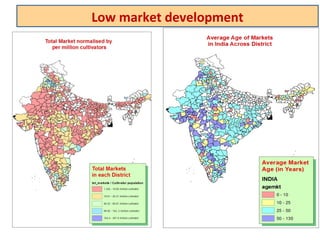
Low market development
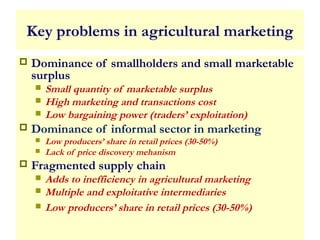
Key problems in agricultural marketing


Dominance of smallholders and small marketable
surplus






Dominance of informal sector in marketing





Small quantity of marketable surplus
High marketing and transactions cost
Low bargaining power (traders’ exploitation)
Low producers’ share in retail prices (30-50%)
Lack of price discovery mehanism

Fragmented supply chain




Adds to inefficiency in agricultural marketing
Multiple and exploitative intermediaries
Low producers’ share in retail prices (30-50%)
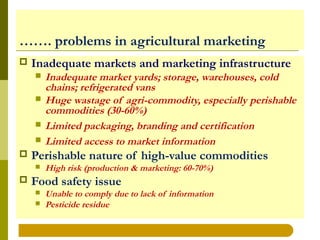
……. problems in agricultural marketing


Inadequate markets and marketing infrastructure







Perishable nature of high-value commodities




Inadequate market yards; storage, warehouses, cold
chains; refrigerated vans
Huge wastage of agri-commodity, especially perishable
commodities (30-60%)
Limited packaging, branding and certification
Limited access to market information
High risk (production & marketing: 60-70%)

Food safety issue



Unable to comply due to lack of information
Pesticide residue
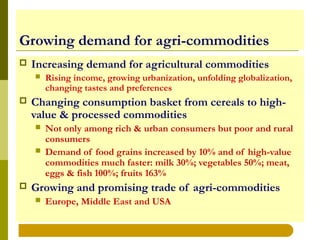
Growing demand for agri-commodities


Increasing demand for agricultural commodities




Changing consumption basket from cereals to highvalue & processed commodities





Rising income, growing urbanization, unfolding globalization,
changing tastes and preferences

Not only among rich & urban consumers but poor and rural
consumers
Demand of food grains increased by 10% and of high-value
commodities much faster: milk 30%; vegetables 50%; meat,
eggs & fish 100%; fruits 163%

Growing and promising trade of agri-commodities


Europe, Middle East and USA
II
Evolution of Value Chains and Financing
in India
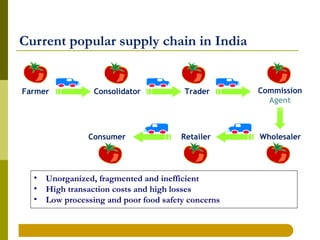
Current popular supply chain in India

Farmer

Consolidator

Consumer

Trader

Commission
Agent

Retailer

Wholesaler

• Unorganized, fragmented and inefficient
• High transaction costs and high losses
• Low processing and poor food safety concerns
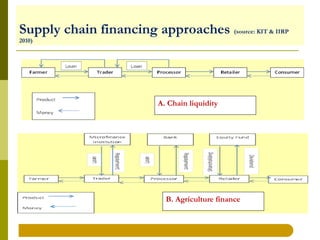
Supply chain financing approaches (source: KIT & IIRP
2010)

A. Chain liquidity

B. Agriculture finance
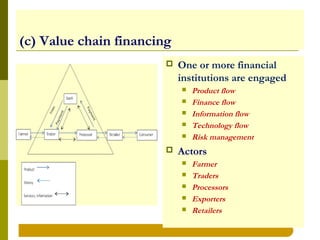
(c) Value chain financing


One or more financial
institutions are engaged








Product flow
Finance flow
Information flow
Technology flow
Risk management

Actors






Farmer
Traders
Processors
Exporters
Retailers
Key instruments of value chain financing


Financing for buying inputs




Financing for creating assets










Land development, polyhouse development, machine, irrigation
management (drip, sprinkler, micro-irrigation)
Cold storage, warehouse, chilling plants, processing plant, animals

Financing for risk mitigation




Planting material, Chemicals, feed, chicks, packaging material

Insurance for production and transportation
Agricultural commodity futures

Warehouse receipts
Commodity futures market


Price discovery and price risk management
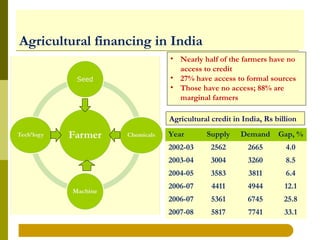
Agricultural financing in India
• Nearly half of the farmers have no
access to credit
• 27% have access to formal sources
• Those have no access; 88% are
marginal farmers
Agricultural credit in India, Rs billion
Year

Supply

Demand

Gap, %

2002-03

2562

2665

4.0

2003-04

3004

3260

8.5

2004-05

3583

3811

6.4

2006-07

4411

4944

12.1

2006-07

5361

6745

25.8

2007-08

5817

7741

33.1
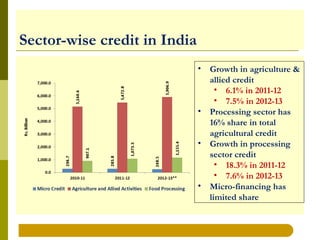
Sector-wise credit in India
•

•
•

•

Growth in agriculture &
allied credit
• 6.1% in 2011-12
• 7.5% in 2012-13
Processing sector has
16% share in total
agricultural credit
Growth in processing
sector credit
• 18.3% in 2011-12
• 7.6% in 2012-13
Micro-financing has
limited share
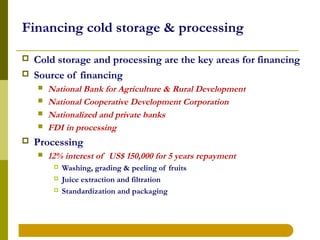
Financing cold storage & processing



Cold storage and processing are the key areas for financing
Source of financing







National Bank for Agriculture & Rural Development
National Cooperative Development Corporation
Nationalized and private banks
FDI in processing

Processing


12% interest of US$ 150,000 for 5 years repayment




Washing, grading & peeling of fruits
Juice extraction and filtration
Standardization and packaging
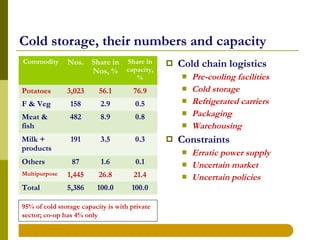
Cold storage, their numbers and capacity
Commodity

Nos. Share in Share in
Nos, % capacity,



Cold chain logistics

%



Potatoes

3,023

56.1

76.9



F & Veg

158

2.9

0.5



Meat &
fish

482

8.9

0.8



Milk +
products

191

Others

87

1.6

0.1



Multipurpose

1,445

26.8

21.4



Total

5,386

100.0

100.0



3.5

0.3



Constraints


95% of cold storage capacity is with private
sector; co-op has 4% only

Pre-cooling facilities
Cold storage
Refrigerated carriers
Packaging
Warehousing
Erratic power supply
Uncertain market
Uncertain policies
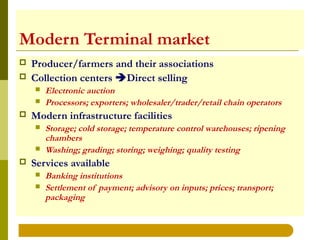
Modern Terminal market



Producer/farmers and their associations
Collection centers Direct selling





Modern infrastructure facilities





Electronic auction
Processors; exporters; wholesaler/trader/retail chain operators
Storage; cold storage; temperature control warehouses; ripening
chambers
Washing; grading; storing; weighing; quality testing

Services available



Banking institutions
Settlement of payment; advisory on inputs; prices; transport;
packaging
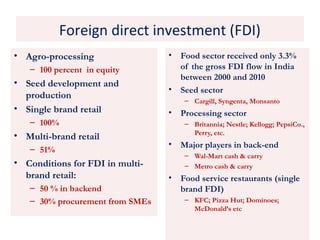
Foreign direct investment (FDI)
• Agro-processing

•

– 100 percent in equity

• Seed development and
production
• Single brand retail
– 100%

• Multi-brand retail
– 51%

• Conditions for FDI in multibrand retail:
– 50 % in backend
– 30% procurement from SMEs

•

Food sector received only 3.3%
of the gross FDI flow in India
between 2000 and 2010
Seed sector
– Cargill, Syngenta, Monsanto

•

Processing sector
– Britannia; Nestle; Kellogg; PepsiCo.,
Perry, etc.

•

Major players in back-end
– Wal-Mart cash & carry
– Metro cash & carry

•

Food service restaurants (single
brand FDI)
– KFC; Pizza Hut; Dominoes;
McDonald’s etc
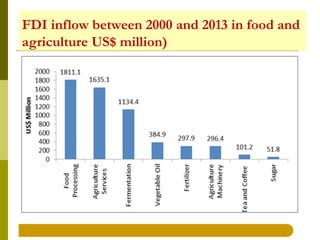
FDI inflow between 2000 and 2013 in food and
agriculture US$ million)
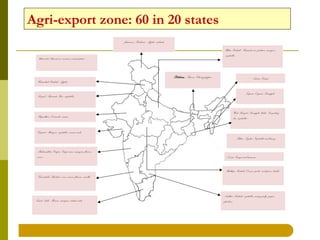
Agri-export zone: 60 in 20 states
Jammu & Kashmir: Apples, walnuts
Uttar Pradesh: Basmati rice, potatoes, mangoes,
vegetables

Uttaranchal: Basmati rice, aromatic & medicinal plants

Sikkim: Flowers, Cherry pepper
Himachal Pradesh: Apples
Punjab: Basmati Rice, vegetables

Rajasthan: Coriander, cumin

Assam: Ginger
Tripura: Organic Pineapple

West Bengal: Pineapple, litchi, Darjeeling
tea, vegetables

Gujarat: Mangoes, vegetables, sesame seeds
Bihar: Lychee, Vegetables and honey
Maharashtra: Grapes, Grape wine, mangoes, flowers,
onion

Orissa: Ginger and turmeric
Madhya Pradesh: Onions, garlic, seed spices, lentils

Karnataka: Gherkins, rose, onions, flowers, vanilla

Tamil Nadu: Flowers, mangoes, cashew nuts

Andhra Pradesh: vegetables, mango pulp, grapes,
gherkins
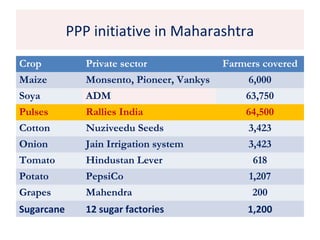
PPP initiative in Maharashtra
Crop

Private sector

Farmers covered

Maize

Monsento, Pioneer, Vankys

6,000

Soya

ADM

63,750

Pulses

Rallies India

64,500

Cotton

Nuziveedu Seeds

3,423

Onion

Jain Irrigation system

3,423

Tomato

Hindustan Lever

Potato

PepsiCo

Grapes

Mahendra

Sugarcane

12 sugar factories

618
1,207
200
1,200
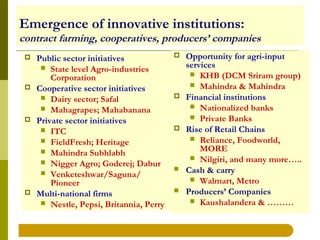
Emergence of innovative institutions:
contract farming, cooperatives, producers’ companies








Public sector initiatives
 State level Agro-industries
Corporation
Cooperative sector initiatives
 Dairy sector; Safal
 Mahagrapes; Mahabanana
Private sector initiatives
 ITC
 FieldFresh; Heritage
 Mahindra Subhlabh
 Nigger Agro; Goderej; Dabur
 Venketeshwar/Saguna/
Pioneer
Multi-national firms
 Nestle, Pepsi, Britannia, Perry










Opportunity for agri-input
services
 KHB (DCM Sriram group)
 Mahindra & Mahindra
Financial institutions
 Nationalized banks
 Private Banks
Rise of Retail Chains
 Reliance, Foodworld,
MORE
 Nilgiri, and many more…..
Cash & carry
 Walmart, Metro
Producers’ Companies
 Kaushalandera & ………
III
Some Illustrations of Improved Value Chains
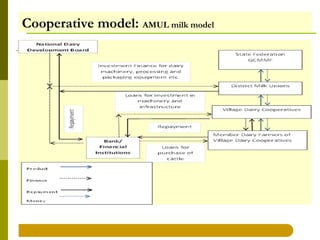
Cooperative model: AMUL milk model
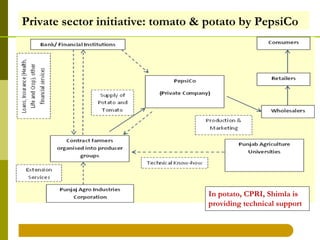
Private sector initiative: tomato & potato by PepsiCo

In potato, CPRI, Shimla is
providing technical support
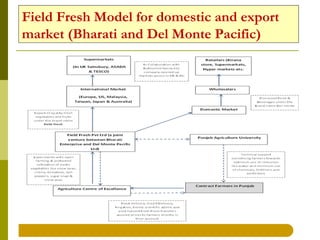
Field Fresh Model for domestic and export
market (Bharati and Del Monte Pacific)
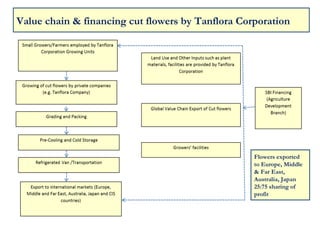
Value chain & financing cut flowers by Tanflora Corporation

Flowers exported
to Europe, Middle
& Far East,
Australia, Japan
25:75 sharing of
profit
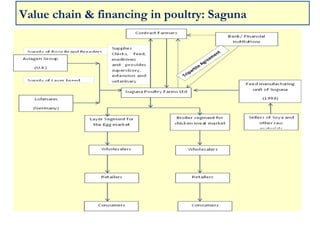
Value chain & financing in poultry: Saguna
IV
Benefits of Modern Value Chain to
Farmers: Some Case Studies
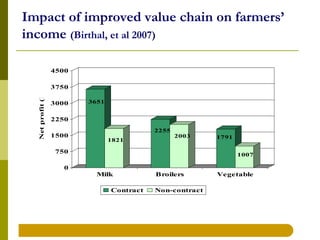
Impact of improved value chain on farmers’
income (Birthal, et al 2007)

Net profit (Rs/t)

4500
3750
3000

3651

2250
1500

2255
1821

2003

750
0

1791
1007

Milk
Contract

Broilers
Non-contract

Vegetable
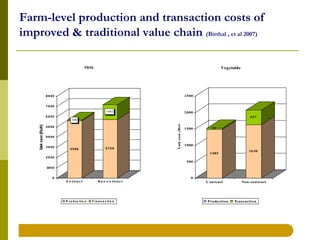
Farm-level production and transaction costs of
improved & traditional value chain (Birthal , et al 2007)
Milk

Vegetable

2500

80 00
70 00

1442

437

100

50 00
40 00
30 00

2000

5586

5728

Unit cost (Rs/t)

60 00

1500

35

1000
1485

1630

20 00

500
10 0 0

0

0
C o n tra c t

P ro d u c tio n

N o n - c o n tra c t

T ra n s a c tio n

Contract

Producti on

Non -contract

Transacti on
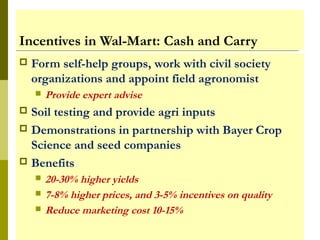
Incentives in Wal-Mart: Cash and Carry


Form self-help groups, work with civil society
organizations and appoint field agronomist


Provide expert advise

Soil testing and provide agri inputs
 Demonstrations in partnership with Bayer Crop
Science and seed companies
 Benefits






20-30% higher yields
7-8% higher prices, and 3-5% incentives on quality
Reduce marketing cost 10-15%
V
Constraints in Financing Farmers and
Value Chains
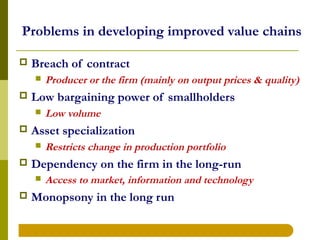
Problems in developing improved value chains


Breach of contract




Low bargaining power of smallholders




Restricts change in production portfolio

Dependency on the firm in the long-run




Low volume

Asset specialization




Producer or the firm (mainly on output prices & quality)

Access to market, information and technology

Monopsony in the long run
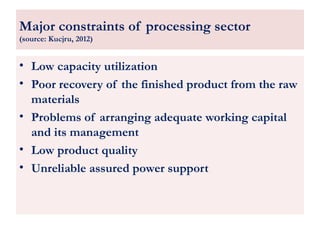
Major constraints of processing sector
(source: Kucjru, 2012)

• Low capacity utilization
• Poor recovery of the finished product from the raw
materials
• Problems of arranging adequate working capital
and its management
• Low product quality
• Unreliable assured power support
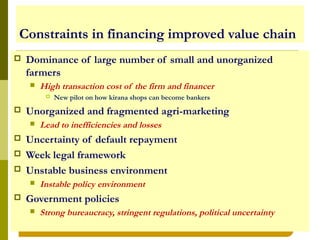
Constraints in financing improved value chain


Dominance of large number of small and unorganized
farmers


High transaction cost of the firm and financer




Unorganized and fragmented agri-marketing






Lead to inefficiencies and losses

Uncertainty of default repayment
Week legal framework
Unstable business environment




New pilot on how kirana shops can become bankers

Instable policy environment

Government policies


Strong bureaucracy, stringent regulations, political uncertainty
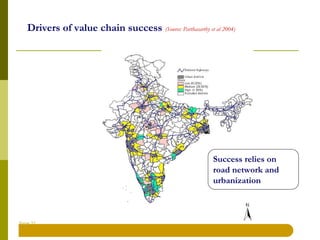
Drivers of value chain success (Source: Parthasarthy et al 2004)

Success relies on
road network and
urbanization

Page 37
VI
Way Forward
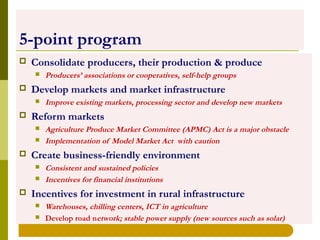
5-point program


Consolidate producers, their production & produce




Develop markets and market infrastructure






Agriculture Produce Market Committee (APMC) Act is a major obstacle
Implementation of Model Market Act with caution

Create business-friendly environment





Improve existing markets, processing sector and develop new markets

Reform markets




Producers’ associations or cooperatives, self-help groups

Consistent and sustained policies
Incentives for financial institutions

Incentives for investment in rural infrastructure



Warehouses, chilling centers, ICT in agriculture
Develop road network; stable power supply (new sources such as solar)
Thank you

Thank you

Page 40