Social Groups
1. Meaning
2. Definition
3. Classification
4. Factors considered in
formation of groups
SOCIAL GROUPS
 The words “group” and social group”
are used synonymously in sociology
 The word group in day-to-day life
connotes / refers to an assemblage /
collection of people at certain places
with common purpose.
 people at traffic signal waiting for the
light to change for walk.
 People waiting for a bus in a bus stand.
 People in a cricket stadium-witnessing
match.
 The examples of social category are
women pilots, teenagers Negroes etc.
The aggregates and social categories”
are non-groups for sociologists
 Sociologists use the term “group” or
“social group” to designate a number of
people (collection of people) interacting
with each other under a “recognizable
structure”. By recognizable structure
we mean the “organization” be the
system of procedures, leadership and
functional interdependence.
 Eg: family, college, trade union, political
party, village, city etc.
 Bogardus: A social group may be
thought of as a number of persons
two or more, who have some
common objects of attention, who
are stimulating to each other, who
have common loyalty and
participate in similar activities.
 Maciver: A collection of two or
more people, who are brought into
a social relationship with one
another.
Characteristics / features of social
group
1. A collection of people
 No single individual could gives birth to a group / social group, the
group comes into being only when there are two or more people.
2. Social interaction
 Reciprocal / mutual actions among people.
 This in turn leads to emergence of relationships.
 A group comes into being only because of interaction among people
and also of the consequent relationships.
 If the interaction ceases among people, social group causes to exists
or comes to an end.
 Therefore, interaction is responsible for emergence and continuation
of social group.
3. A system of functional inter dependence
 In every social group the different functions that are to be performed
to achieve the goal are allocated or assigned to different members
either formally or informally this system is known as functional inter
dependence.
4. A system of leadership
 In all social groups some kind of leadership (elected, appointed,
nominated) which defines and regulates activities of the members
towards common goal and also ensures orderliness and harmony
within the groups essential for their effective functioning.
5. We feeling
 In every social group there is some degree of we feeling which knits
the members together and enables them to share each others joys and
sorrows and have sympathy sacrifice and trust towards one another.
6. Common interest / purpose
 The common purpose of the people has brought them together into a
group.
 They are more or less similar behavior and participate in similar
activities.
 The common activities have paved the way for unity and fellow feeling
among the members of the groups.
7. Group norms
 Refers to the rules or standards of behavior.
 Eg: customs, moral, folkways, mores which are unwritten (informal)
 The laws and other codes are written form (formal).
 These norms are found in every group / social group which define and
regulate actions of the members.
 This helps the group in maintaining order and harmony essential for its
effective functioning.
8. An idea of size – small / big
 The size of the group decided / judged based on the number of
members involved init.
 If the group is smaller consisting of limited members there exists a
intimate personal direct contacts.
 If the group is larger in size consisting of unlimited members there
exists a impersonal, indirect and non intimate contacts.
Types of social groups
 Based on the nature of relationships between members / groups.
1. Primary Group
 Used by C H Cooley to refer to those groups which have face to face,
personal and intimate contact / relationship.
 According to Cooley these groups are primary because they are
fundamental in training the social or human nature and ideas of an
individual ie., they exert a first hand, basic influence on the formation
of an individual ideas, his standards of behaviors, his ideas of right or
wrong in the early part of his life.
 One begins his life as a rule in a family group and as a child becomes
a member of play groups or neighborhood, enters into circle of close
friends (peer group).
 All these groups have a formative influence on the individual in
moulding human nature and personality.
 Thus, Cooley called them as “nurseries of human nature and
personality”. Eg: Family, peer group, village, tribe and other smaller
neighborhood.
2. Secondary Group
 These groups involve impersonal, non-intimate, indirect and formal
relationships.
 Eg: Urban community, political party, city, trade union etc.
Difference between Primary and Secondary
Groups (Characteristics / features)
Primary groups Secondary groups
Close physical proximity
The members of primary group live
physically close with one another
and they interact face to face
more frequently, which facilitates
the exchange of ideas, opinions
and sentiments resulting in
intimate feeling and mutual
understanding
Lack of physical proximity
The members of secondary
group spread over in a larger
area and thus, they generally
lack physical proximity,
consequently they are unable
to have a direct interaction
rather they use different
medias for their interaction.
Thus their relationships are not
very much intimate.
Primary groups Secondary groups
Smaller in size
The primary groups are
always small in size as
there are limited
members. Thus, they
know each other
personally and develop
intimacy rather quickly.
The smaller the group
the more intense
interaction tends to be
developed and each
member is able to know
each other member
intimately.
Bigger in Size
Secondary groups consists
of unlimited members and
are scattered over the length
and breadth of a country /
world. Therefore, the
member of channels of
interaction increases and
consequently the possibility
of having direct interaction
are less. The relationships
are tending to be more
superficial and impersonal.
Primary groups Secondary groups
Relationships of personal,
intimate and direct
The primary relationship is said
to be personal therefore
they are more congenial
and warmth ie., involve
grater degree of love and
affection. Further, the
members know each other
by name. The primary exist
as long as the concerned
person exist, once the
person disappear the
primary also disappear. The
relationship are also said to
be direct therefore frequent
face-to-face interaction. In
view of these qualities the
relationship tend to be
intimate.
Relationships of
impersonal, non intimate
and direct
In secondary groups, the
relationship is impersonal
mainly because these
persons will not be
knowing each other by
name. In other words
“anonymity” prevails to a
greater extent.
Primary groups Secondary groups
Relationship are informal
In primary groups
relationships are
expressive rather than
instrumental, they are
established for the
feelings of
companionship, love
affection and security
that emanates from the
relationship. The
members of the primary
groups are not living
together as delegates
whose goal is pre
determined because the
primary are said to be
informal.
Relationship are formal
In secondary groups, the
relationship are said to be
formal, because they
establish the relationships to
achieve a specific goal, they
are rather instrumental in
achieving specific goal. The
members live together/
function together on rational
agreement of interest. The
members live function
together as delegates as
their goals are
predetermined
Primary groups Secondary groups
Primary relationships
are inclusive
In primary groups every
person is known to every
other person in all his
completeness or in all
the dimensions or details
of his life. Therefore he
is regarded as a unique
personality rather than a
unit.
Secondary
relationships are
exclusive
Relationships are said to be
non inclusive as the persons
are not knowing one another
in their whole of the life /
totality of life therefore each
person strive for his self
personal interest than the
interest of other members.
Primary groups Secondary groups
Relationships are governed
by informal social
control
In primary groups relationship
are defined and regulated
by unwritten norms in the
form of customs, moral,
values, folkways, and more.
In view of personal and
intimate relationship any
violation of these norms will
be known to every other
member who reacts
negatively in the form of
ridicule, gossip, mockery,
avoidance of contacts or
excommunication from the
group. This helps to
maintain required order and
harmony for effective
functioning of group.
Relationships are
governed by formal social
control
In secondary groups, the
relationship are defined and
regulated by written rules
and regulations in the form
of laws and other courts. The
violation will be seriously
dealt with as stipulated in
the laws. This helps to
maintain the order and
harmony essential for
effective functioning of
group.
Primary groups Secondary groups
Primary groups are
relatively durable
The primary groups involve
personnel intimate and
direct contacts and also
the limited size of
members. Further, they
serve general purpose of
the member
consequently their
durability is longer.
Secondary groups are
may or may not be
durable
Secondary groups have
impersonal, non intimate and
direct relationships and also
unlimited members. Further,
they serve a specific purpose
once that purpose is fulfilled
the secondary groups may
come to an end and if they
have large number of
common interest they also
continue to exist for a longer
time
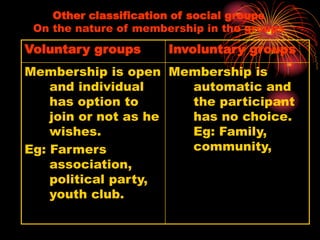
Voluntary groups Involuntary groups
Membership is open
and individual
has option to
join or not as he
wishes.
Eg: Farmers
association,
political party,
youth club.
Membership is
automatic and
the participant
has no choice.
Eg: Family,
community,
Other classification of social groups
On the nature of membership in the groups
Formal groups Informal groups
Thee groups are
formed for
satisfying a
specific
purpose.
Are spontaneous
and serve general
purpose of the
members. Eg:
family, peer group
On the basis of degree of formality or informality
that exist in the group
In-group Out-group
The groups to which
a individual feels
he belongs and
with which he
strongly
identifies are
called in groups.
Eg: family, tribe,
college, nation.
The groups to which
an individual
feels that he does
not belong and
never identifies
himself with
them are called
out groups. Eg:
Naxalisam, LTTE,
ULFA.
On personal feeling of belonging to the group,
(W G Summer)
Ethnocentrism
 WG Summer while explaining the nature
of “in group” finds a tendency among
members of “in group” of evaluating the
culture of other group as inferior in
terms of their own culture, which he
calls the ethnocentrism leads to
prejudice towards the members of other
group and ultimately leading to
discrimination. Ethnocentrism promotes
unity with in a group and becomes a
great barrier in the way of inter group
relationship and co-operation. Thus it is
a menace to society at large.

Social groups

  • 1.
    Social Groups 1. Meaning 2.Definition 3. Classification 4. Factors considered in formation of groups
  • 2.
    SOCIAL GROUPS  Thewords “group” and social group” are used synonymously in sociology  The word group in day-to-day life connotes / refers to an assemblage / collection of people at certain places with common purpose.  people at traffic signal waiting for the light to change for walk.  People waiting for a bus in a bus stand.  People in a cricket stadium-witnessing match.
  • 3.
     The examplesof social category are women pilots, teenagers Negroes etc. The aggregates and social categories” are non-groups for sociologists  Sociologists use the term “group” or “social group” to designate a number of people (collection of people) interacting with each other under a “recognizable structure”. By recognizable structure we mean the “organization” be the system of procedures, leadership and functional interdependence.  Eg: family, college, trade union, political party, village, city etc.
  • 4.
     Bogardus: Asocial group may be thought of as a number of persons two or more, who have some common objects of attention, who are stimulating to each other, who have common loyalty and participate in similar activities.  Maciver: A collection of two or more people, who are brought into a social relationship with one another.
  • 5.
    Characteristics / featuresof social group 1. A collection of people  No single individual could gives birth to a group / social group, the group comes into being only when there are two or more people. 2. Social interaction  Reciprocal / mutual actions among people.  This in turn leads to emergence of relationships.  A group comes into being only because of interaction among people and also of the consequent relationships.  If the interaction ceases among people, social group causes to exists or comes to an end.  Therefore, interaction is responsible for emergence and continuation of social group. 3. A system of functional inter dependence  In every social group the different functions that are to be performed to achieve the goal are allocated or assigned to different members either formally or informally this system is known as functional inter dependence. 4. A system of leadership  In all social groups some kind of leadership (elected, appointed, nominated) which defines and regulates activities of the members towards common goal and also ensures orderliness and harmony within the groups essential for their effective functioning.
  • 6.
    5. We feeling In every social group there is some degree of we feeling which knits the members together and enables them to share each others joys and sorrows and have sympathy sacrifice and trust towards one another. 6. Common interest / purpose  The common purpose of the people has brought them together into a group.  They are more or less similar behavior and participate in similar activities.  The common activities have paved the way for unity and fellow feeling among the members of the groups. 7. Group norms  Refers to the rules or standards of behavior.  Eg: customs, moral, folkways, mores which are unwritten (informal)  The laws and other codes are written form (formal).  These norms are found in every group / social group which define and regulate actions of the members.  This helps the group in maintaining order and harmony essential for its effective functioning. 8. An idea of size – small / big  The size of the group decided / judged based on the number of members involved init.  If the group is smaller consisting of limited members there exists a intimate personal direct contacts.  If the group is larger in size consisting of unlimited members there exists a impersonal, indirect and non intimate contacts.
  • 7.
    Types of socialgroups  Based on the nature of relationships between members / groups. 1. Primary Group  Used by C H Cooley to refer to those groups which have face to face, personal and intimate contact / relationship.  According to Cooley these groups are primary because they are fundamental in training the social or human nature and ideas of an individual ie., they exert a first hand, basic influence on the formation of an individual ideas, his standards of behaviors, his ideas of right or wrong in the early part of his life.  One begins his life as a rule in a family group and as a child becomes a member of play groups or neighborhood, enters into circle of close friends (peer group).  All these groups have a formative influence on the individual in moulding human nature and personality.  Thus, Cooley called them as “nurseries of human nature and personality”. Eg: Family, peer group, village, tribe and other smaller neighborhood. 2. Secondary Group  These groups involve impersonal, non-intimate, indirect and formal relationships.  Eg: Urban community, political party, city, trade union etc.
  • 8.
    Difference between Primaryand Secondary Groups (Characteristics / features) Primary groups Secondary groups Close physical proximity The members of primary group live physically close with one another and they interact face to face more frequently, which facilitates the exchange of ideas, opinions and sentiments resulting in intimate feeling and mutual understanding Lack of physical proximity The members of secondary group spread over in a larger area and thus, they generally lack physical proximity, consequently they are unable to have a direct interaction rather they use different medias for their interaction. Thus their relationships are not very much intimate.
  • 9.
    Primary groups Secondarygroups Smaller in size The primary groups are always small in size as there are limited members. Thus, they know each other personally and develop intimacy rather quickly. The smaller the group the more intense interaction tends to be developed and each member is able to know each other member intimately. Bigger in Size Secondary groups consists of unlimited members and are scattered over the length and breadth of a country / world. Therefore, the member of channels of interaction increases and consequently the possibility of having direct interaction are less. The relationships are tending to be more superficial and impersonal.
  • 10.
    Primary groups Secondarygroups Relationships of personal, intimate and direct The primary relationship is said to be personal therefore they are more congenial and warmth ie., involve grater degree of love and affection. Further, the members know each other by name. The primary exist as long as the concerned person exist, once the person disappear the primary also disappear. The relationship are also said to be direct therefore frequent face-to-face interaction. In view of these qualities the relationship tend to be intimate. Relationships of impersonal, non intimate and direct In secondary groups, the relationship is impersonal mainly because these persons will not be knowing each other by name. In other words “anonymity” prevails to a greater extent.
  • 11.
    Primary groups Secondarygroups Relationship are informal In primary groups relationships are expressive rather than instrumental, they are established for the feelings of companionship, love affection and security that emanates from the relationship. The members of the primary groups are not living together as delegates whose goal is pre determined because the primary are said to be informal. Relationship are formal In secondary groups, the relationship are said to be formal, because they establish the relationships to achieve a specific goal, they are rather instrumental in achieving specific goal. The members live together/ function together on rational agreement of interest. The members live function together as delegates as their goals are predetermined
  • 12.
    Primary groups Secondarygroups Primary relationships are inclusive In primary groups every person is known to every other person in all his completeness or in all the dimensions or details of his life. Therefore he is regarded as a unique personality rather than a unit. Secondary relationships are exclusive Relationships are said to be non inclusive as the persons are not knowing one another in their whole of the life / totality of life therefore each person strive for his self personal interest than the interest of other members.
  • 13.
    Primary groups Secondarygroups Relationships are governed by informal social control In primary groups relationship are defined and regulated by unwritten norms in the form of customs, moral, values, folkways, and more. In view of personal and intimate relationship any violation of these norms will be known to every other member who reacts negatively in the form of ridicule, gossip, mockery, avoidance of contacts or excommunication from the group. This helps to maintain required order and harmony for effective functioning of group. Relationships are governed by formal social control In secondary groups, the relationship are defined and regulated by written rules and regulations in the form of laws and other courts. The violation will be seriously dealt with as stipulated in the laws. This helps to maintain the order and harmony essential for effective functioning of group.
  • 14.
    Primary groups Secondarygroups Primary groups are relatively durable The primary groups involve personnel intimate and direct contacts and also the limited size of members. Further, they serve general purpose of the member consequently their durability is longer. Secondary groups are may or may not be durable Secondary groups have impersonal, non intimate and direct relationships and also unlimited members. Further, they serve a specific purpose once that purpose is fulfilled the secondary groups may come to an end and if they have large number of common interest they also continue to exist for a longer time
  • 15.
    Voluntary groups Involuntarygroups Membership is open and individual has option to join or not as he wishes. Eg: Farmers association, political party, youth club. Membership is automatic and the participant has no choice. Eg: Family, community, Other classification of social groups On the nature of membership in the groups
  • 16.
    Formal groups Informalgroups Thee groups are formed for satisfying a specific purpose. Are spontaneous and serve general purpose of the members. Eg: family, peer group On the basis of degree of formality or informality that exist in the group
  • 17.
    In-group Out-group The groupsto which a individual feels he belongs and with which he strongly identifies are called in groups. Eg: family, tribe, college, nation. The groups to which an individual feels that he does not belong and never identifies himself with them are called out groups. Eg: Naxalisam, LTTE, ULFA. On personal feeling of belonging to the group, (W G Summer)
  • 18.
    Ethnocentrism  WG Summerwhile explaining the nature of “in group” finds a tendency among members of “in group” of evaluating the culture of other group as inferior in terms of their own culture, which he calls the ethnocentrism leads to prejudice towards the members of other group and ultimately leading to discrimination. Ethnocentrism promotes unity with in a group and becomes a great barrier in the way of inter group relationship and co-operation. Thus it is a menace to society at large.