Mr.C.THATCHINAMOORTHY
Ph.D., Research Scholar
Department of Agricultural Extension
Faculty of Agriculture
Annamalai University
tmthatchupeaceful@gmail.com
ICT in Agriculture
 Agriculture is most important sector with the majority of the
rural population in developing countries depending on it.
 In Indian scenario, it said that the country lives in villages
which means that farming and agriculture sector contributes
in GDP of the country to great extent.
 The traditional approaches of agriculture being adopted since
long back in the history, has numerous challenges in terms of
production, marketing, profit etc.
Cont…..
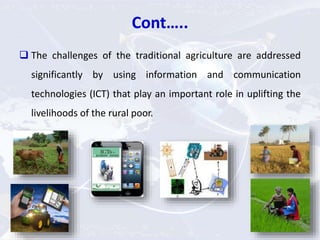
 The challenges of the traditional agriculture are addressed
significantly by using information and communication
technologies (ICT) that play an important role in uplifting the
livelihoods of the rural poor.
Objectives
 ICT in agriculture sector meets several objectives and
thereby achieving agricultural growth, rural employment,
enhanced productivity and happy livelihood.
 To ensure ownership and develop entrepreneurship in farmers
of Indian villages.
 To develop local content and create awareness.
 To spread knowledge of technologies, crop cycle, suitable use
of fertilizers etc.
 To ensure language and cultural pertinence and active
participation of farmers.
 To help the villagers augment the growth of agriculture and
contribute in GDP growth.
Cont…..
 To implement a framework for agricultural development
strategies, investments and programs.
 To provide concrete guidance on agriculture through several
motivational real time examples; telling them the success
stories of farmers who have been successful using ICT.
 To increase public investment in agriculture.
 To provide local as well as global markets.
 To improve access to financial and banking services.
 To improve performance of producer organizations.
 To use innovative practices through science and technology,
and many more….
Reasons of Agricultural
Information delay in rural India:
Media, Information Management and ICT are not
properly used
Lack of sufficient extension workers
Lack of Agricultural information literacy in India
Lack of updated agriculture information with the farmers
and most of the extension workers
Cont…..
 Poor technological knowledge of farmers and village level
extension personnel
 Economic problems of rural people
 The top-down approach is adapted for extension activity.
So the linkages between research- extension and farmer
remained weak etc.
Need of ICT in Indian Agriculture
 The advancements in ICT can be utilized for providing
accurate, timely, relevant information and services to
the farmers.
 To address the needs of the farmers through ICT, their
actual usage and their ability to bring significant impact
on the farm productivity and socio-economic
development of the intended beneficiaries.
 To understand as to how far the ICT initiatives are able
to address the farmers need so that better solutions
can be developed to address those unmet needs.
Role of ICT in Indian Agriculture
Enhancing Agricultural Production
Improving Market Access
Capacity-building and empowerment
Enhancing Agricultural Production
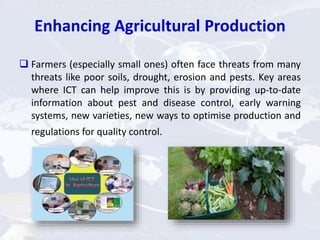
 Farmers (especially small ones) often face threats from many
threats like poor soils, drought, erosion and pests. Key areas
where ICT can help improve this is by providing up-to-date
information about pest and disease control, early warning
systems, new varieties, new ways to optimise production and
regulations for quality control.
Improving Market Access
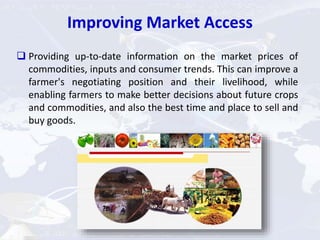
 Providing up-to-date information on the market prices of
commodities, inputs and consumer trends. This can improve a
farmer's negotiating position and their livelihood, while
enabling farmers to make better decisions about future crops
and commodities, and also the best time and place to sell and
buy goods.
Capacity-building and empowerment
 ICT technologies can be used to strengthen communities and
farmer organizations strengthen their own capacities and
better represent their constituencies when negotiating input
and output prices, land claims, resource rights and
infrastructure projects.
 Rural communities are able to interact with others via the use
of ICT which reduces social isolation that they would
otherwise be facing. Besides that, ICT technologies are able to
make processes like law-making and land-title approvals more
transparent.
Scope of ICT
 ICTs at the different levels of agricultural processes result in
improvements of agricultural competitiveness.
 Management of technological information which includes
price and market information; weather conditions; economic
variables; communication with peers and business
transactions etc.,
 The money is directly transferred to bank account of farmers
that reduces the possibility of malpractices by agents and also
addresses the corruption menace to large extent.
Cont…..
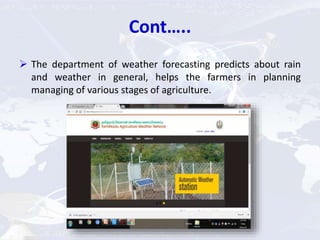
 The department of weather forecasting predicts about rain
and weather in general, helps the farmers in planning
managing of various stages of agriculture.
Some of the important efforts by public sector, NGOs
and private sector in ICT for rural India are :
Information:
• Cyber extension program of MANAGE
(http://www.manage.gov.in/)
• National Informatics Centre (NIC) (http://home.nic.in)
• Community Information Centre (CIC) (http://www.cic.nic.in/)
• http://ruralinformatics.nic.in/
• http://www.agriwatch.com
Marketing Information
 DACNET (http://dacnet.nic.in)
 http://www.agmarketnet.nic.in
 http://www.itcportal.com/sets/agreeex_frameset.htm
 http://www.oddanchatrammaket.com/
 http://www.tenet.res.in/cordect/cordect.html
 e-Seva (http://www.esevaonline.com)
ICT Project
• Warna Wired Village Project
(http://www.mah.nic.in/warana)
• http://www.gyandoot.net/
• Bhoomi (http://www.bhoomi.kar.nic.in/
• http://www.lokmitra.gov.in
• http://raitumitra.kar.nic.in/
• http://www.mssrf.org/
others
• http://himachal.nic.in/lokmitra/lokmitra_hdr.htm
• http://setu.maharashtra.gov.in/
• http://indiagriline.com/
• http://www.ikisan.com
• http://www.indiagriline.com/
• http://www.tatatkk.com/kisan_kendra.htm
• http://www.nddb.org/
• http://www.isapindia.org/
Cont….
• http://www.sristi.org/
• http://www.icar.org.in
• http://gauanand.com/
• N-Logue- http://www.n logue.co.in/home.htm
• http://edevelopment.media.mit.edu/SARI/mai
nsari.html
• http://www.drishtee.com/
• http://www.simputer.org/
ICT INITIATIVES FOR AGRICULTURE
AND RURAL DEVELOPMENT
 ASHA (www.assamagribusiness.nic.in) initiative of Assam SFAC
(Government of Assam) with its networking with large ICT
infrastructure (CICs) spread all over the state.
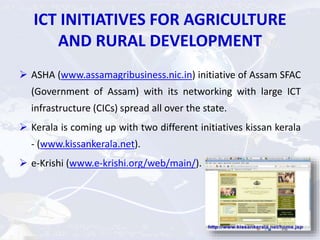
 Kerala is coming up with two different initiatives kissan kerala
- (www.kissankerala.net).
 e-Krishi (www.e-krishi.org/web/main/).
e-Sagu
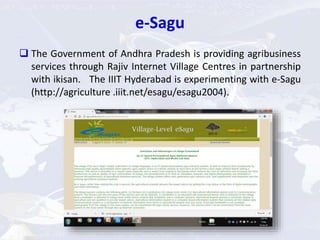
 The Government of Andhra Pradesh is providing agribusiness
services through Rajiv Internet Village Centres in partnership
with ikisan. The IIIT Hyderabad is experimenting with e-Sagu
(http://agriculture .iiit.net/esagu/esagu2004).
Kisan Soochna Kendras
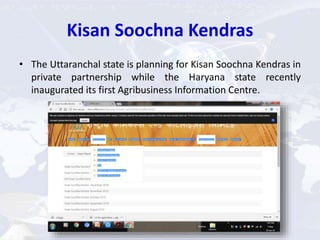
• The Uttaranchal state is planning for Kisan Soochna Kendras in
private partnership while the Haryana state recently
inaugurated its first Agribusiness Information Centre.
Agrisnet
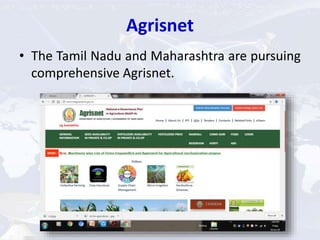
• The Tamil Nadu and Maharashtra are pursuing
comprehensive Agrisnet.
Bhoomi Project of Karnataka state
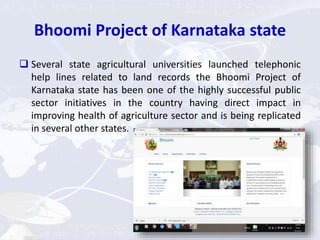
 Several state agricultural universities launched telephonic
help lines related to land records the Bhoomi Project of
Karnataka state has been one of the highly successful public
sector initiatives in the country having direct impact in
improving health of agriculture sector and is being replicated
in several other states.
ITC e-chaupal
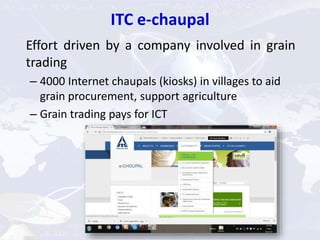
Effort driven by a company involved in grain
trading
– 4000 Internet chaupals (kiosks) in villages to aid
grain procurement, support agriculture
– Grain trading pays for ICT
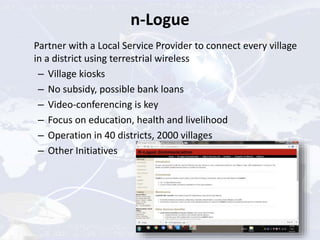
n-Logue
Partner with a Local Service Provider to connect every village
in a district using terrestrial wireless
– Village kiosks
– No subsidy, possible bank loans
– Video-conferencing is key
– Focus on education, health and livelihood
– Operation in 40 districts, 2000 villages
– Other Initiatives
Grant / aid driven
• MS Swaminathan Center (in Pondicherry focussed on agri
and fishery applications)
• Tara-haat (focus on rural enterprises)
• Akshaya (in Kerala with Government support)
• Gyaandoot* (in MP with focus on e-governance)
• Rural E-seva* (in east Godavari in AP with focus on e-
governance)
• Warana* Wired village (in Maharashtra by NIC)
• * these projects are now operated by n-Logue
For profit initiatives
• Drishtee (uses existing telecom infrastructure)
• There are several models of ICTs in Indian
agriculture, which have made a significant
difference in the delivery of services in Indian
agriculture like, the establishments of Kisan
call centers, Gyandoot project, Bhoomi
project, Village knowledge centers,
AGMARKNET etc,..
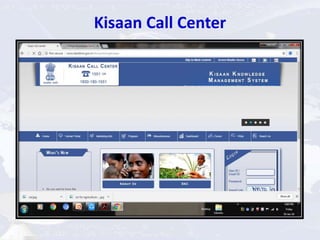
Kisan Call Centers (KCCs)
• KCCs were launched on January 21, 2004 by the
Department of Agricultural and Co-operation. The main
technologies involved in Kisan call centers are:
• Desktop computer system with Internet connectivity.
• High bandwidth telephone line (preferably 128 kbps ISDN
line).
• Telephones with headphones and teleconferencing
facility (if required).
Kisaan Call Center
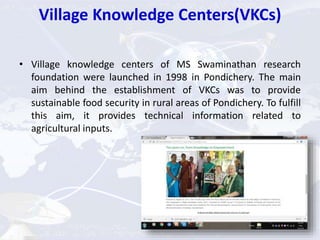
Village Knowledge Centers(VKCs)
• Village knowledge centers of MS Swaminathan research
foundation were launched in 1998 in Pondichery. The main
aim behind the establishment of VKCs was to provide
sustainable food security in rural areas of Pondichery. To fulfill
this aim, it provides technical information related to
agricultural inputs.
VKC
• It helps in procuring quality seeds, in providing
information about the daily marked priced from
the government as well as private bodies, and
advices farmers on rotation of crops as well as
about the use of fertilizers and pesticides.VKCs
receive information by voice mail, and
disseminate it through any public address system.
• It has also identified 13 districts in Pondichery,
where there is a huge potential for agriculture
business , and where the government will invest
Rs. 170 cr.
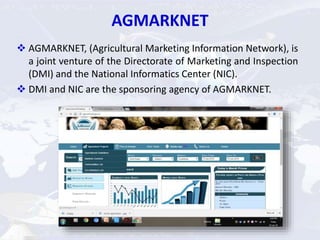
AGMARKNET
 AGMARKNET, (Agricultural Marketing Information Network), is
a joint venture of the Directorate of Marketing and Inspection
(DMI) and the National Informatics Center (NIC).
 DMI and NIC are the sponsoring agency of AGMARKNET.
Cont…..
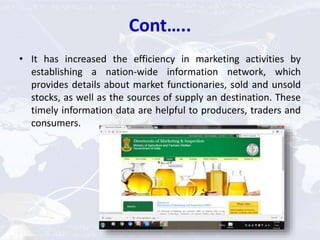
• It has increased the efficiency in marketing activities by
establishing a nation-wide information network, which
provides details about market functionaries, sold and unsold
stocks, as well as the sources of supply an destination. These
timely information data are helpful to producers, traders and
consumers.
How does AGMARKNET get the
Information?
• AGMARKNET has been connected to 670 agricultural
produce markets and 40 State Agricultural Marketing
Boards & Directorates. Each AGMARK portal of wholesale
market provides daily information to AGMARK portals of
its respective states, and then each state’s AGMARK
portal sends the information to the AGMARKNET portal.
• All of these software's are maintained by the National
Information System .
Cont…..
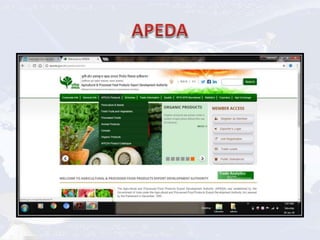
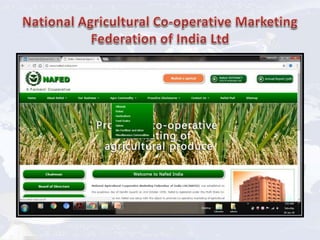
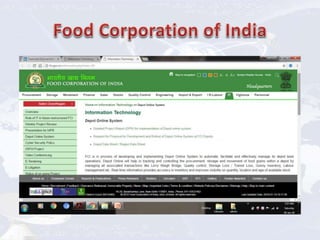
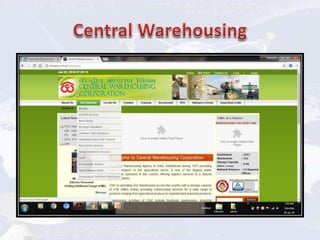
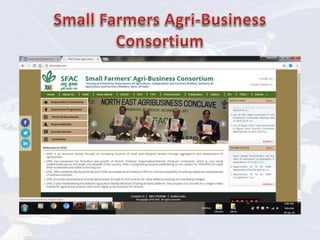
APEDA (Agricultural and Processed Food Products Export
Development Authority),NAFED (National Agricultural
Co-operative Marketing Federation of India Ltd), Food
Corporation of India, Central Warehousing, SFAC (Small
Farmers Agri-Business Consortium) are the main users of
the AGMARKNET portal.
 The food processing units, traders and different village
kiosks, to help the farmers in taking the right decisions,
mainly use these portals.
Factors affected - ICT implementation
• ICT plays crucial role in agriculture production, crop
management and others, however, the implementation
is affected by several factors such as:
• required infrastructure for access and affordability of
ICT tools and facilities;
• internet connectivity in production and commercial
areas;
• outreach of awareness programmes, the quality and
availability of suitable information content; limitation
of the media;
• choices and appropriation of individuals towards ICT
based approaches etc.
Outcome
 ICT has helped agriculture sector to great extent that further
making livelihood of rural people better; finally the services
are of big importance for the nation since GDP of the country
is controlled by agriculture. Following are some major
outcomes of ICT enabled agriculture:
 Increased productivity due to growth and penetration of
mobile ICTs in rural areas.
 Innovations in agriculture through electronic media that
supports education and training.
 Creation of new opportunities increasing the development of
human and social capital.
Cont…..
 Achieving improved process control, transparency in market
information.
 Reduction of transaction costs in tracking of consumer needs.
 Enhanced food security and support rural to livelihoods.
 Poverty alleviation through modern agriculture.
 Expansion of perspective of local communities in terms of
national or global developments.
 Creation of new business opportunities.
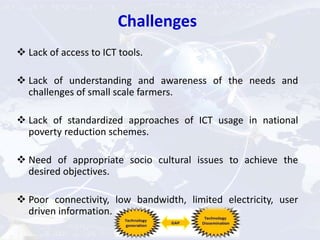
Challenges
 Lack of access to ICT tools.
 Lack of understanding and awareness of the needs and
challenges of small scale farmers.
 Lack of standardized approaches of ICT usage in national
poverty reduction schemes.
 Need of appropriate socio cultural issues to achieve the
desired objectives.
 Poor connectivity, low bandwidth, limited electricity, user
driven information.