Lecture 17: Farm Budgeting
1
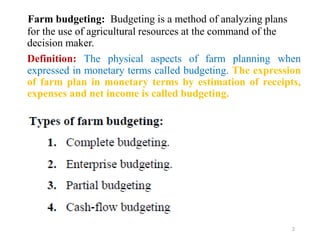
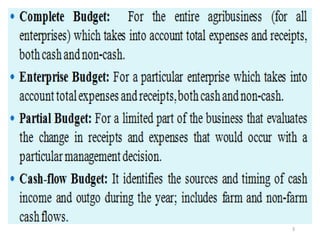
Farm budgeting: Budgeting is a method of analyzing plans
for the use of agricultural resources at the command of the
decision maker.
Definition: The physical aspects of farm planning when
expressed in monetary terms called budgeting. The expression
of farm plan in monetary terms by estimation of receipts,
expenses and net income is called budgeting.
2
3
4
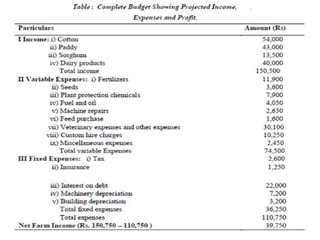
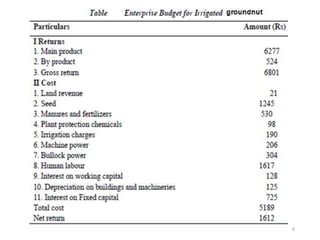
Enterprise budgeting:
• An enterprise is defined as a single crop or livestock
commodity being produced on the farm.
• An enterprise budget is an estimate of all income and expenses
associated with a specific enterprise and estimate of its
profitability.
• It consists of three elements viz., income, costs (variable and
fixed) and profitability.
• Note: The cost component of an enterprise budget would
include both variable costs and fixed costs.
5
6
Partial budgeting:
• Partial budgeting is a statement of anticipated changes in costs,
returns and profitability for a minor modification on the farm.
• It is used to calculate the expected change in profit for a proposed
change in the farm business.
• Partial budget is best adapted for analyzing relatively small
change in the whole farm plan.
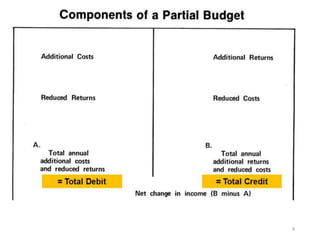
• It consists of four important elements viz. added costs, added
returns, reduced returns and reduced costs.
• Partial budgeting technique is generally used to evaluate the
profitability of input substitution, enterprise substitution and
scale of operation.
7
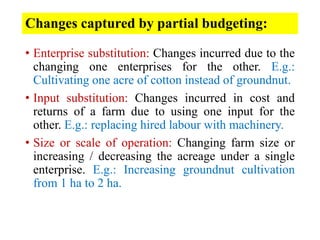
Changes captured by partial budgeting:
• Enterprise substitution: Changes incurred due to the
changing one enterprises for the other. E.g.:
Cultivating one acre of cotton instead of groundnut.
• Input substitution: Changes incurred in cost and
returns of a farm due to using one input for the
other. E.g.: replacing hired labour with machinery.
• Size or scale of operation: Changing farm size or
increasing / decreasing the acreage under a single
enterprise. E.g.: Increasing groundnut cultivation
from 1 ha to 2 ha.
9
10
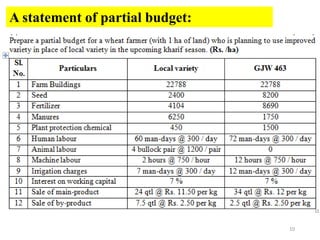
A statement of partial budget:
11
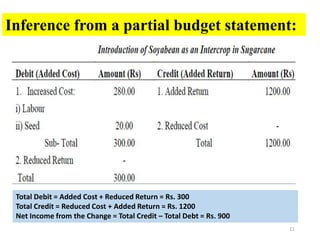
Inference from a partial budget statement:
Total Debit = Added Cost + Reduced Return = Rs. 300
Total Credit = Reduced Cost + Added Return = Rs. 1200
Net Income from the Change = Total Credit – Total Debt = Rs. 900
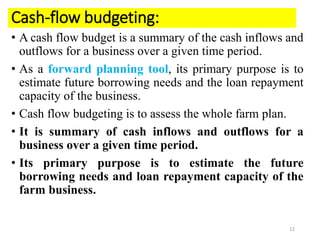
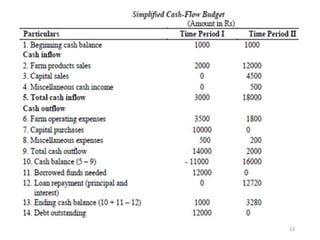
Cash-flow budgeting:
• A cash flow budget is a summary of the cash inflows and
outflows for a business over a given time period.
• As a forward planning tool, its primary purpose is to
estimate future borrowing needs and the loan repayment
capacity of the business.
• Cash flow budgeting is to assess the whole farm plan.
• It is summary of cash inflows and outflows for a
business over a given time period.
• Its primary purpose is to estimate the future
borrowing needs and loan repayment capacity of the
farm business.
12
13
14
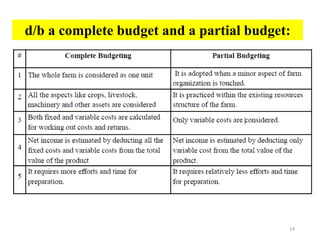
d/b a complete budget and a partial budget:

Lecture 17 farm budgeting

  • 1.
    Lecture 17: FarmBudgeting 1
  • 2.
    Farm budgeting: Budgetingis a method of analyzing plans for the use of agricultural resources at the command of the decision maker. Definition: The physical aspects of farm planning when expressed in monetary terms called budgeting. The expression of farm plan in monetary terms by estimation of receipts, expenses and net income is called budgeting. 2
  • 3.
  • 4.
  • 5.
    Enterprise budgeting: • Anenterprise is defined as a single crop or livestock commodity being produced on the farm. • An enterprise budget is an estimate of all income and expenses associated with a specific enterprise and estimate of its profitability. • It consists of three elements viz., income, costs (variable and fixed) and profitability. • Note: The cost component of an enterprise budget would include both variable costs and fixed costs. 5
  • 6.
  • 7.
    Partial budgeting: • Partialbudgeting is a statement of anticipated changes in costs, returns and profitability for a minor modification on the farm. • It is used to calculate the expected change in profit for a proposed change in the farm business. • Partial budget is best adapted for analyzing relatively small change in the whole farm plan. • It consists of four important elements viz. added costs, added returns, reduced returns and reduced costs. • Partial budgeting technique is generally used to evaluate the profitability of input substitution, enterprise substitution and scale of operation. 7
  • 8.
    Changes captured bypartial budgeting: • Enterprise substitution: Changes incurred due to the changing one enterprises for the other. E.g.: Cultivating one acre of cotton instead of groundnut. • Input substitution: Changes incurred in cost and returns of a farm due to using one input for the other. E.g.: replacing hired labour with machinery. • Size or scale of operation: Changing farm size or increasing / decreasing the acreage under a single enterprise. E.g.: Increasing groundnut cultivation from 1 ha to 2 ha.
  • 9.
  • 10.
    10 A statement ofpartial budget:
  • 11.
    11 Inference from apartial budget statement: Total Debit = Added Cost + Reduced Return = Rs. 300 Total Credit = Reduced Cost + Added Return = Rs. 1200 Net Income from the Change = Total Credit – Total Debt = Rs. 900
  • 12.
    Cash-flow budgeting: • Acash flow budget is a summary of the cash inflows and outflows for a business over a given time period. • As a forward planning tool, its primary purpose is to estimate future borrowing needs and the loan repayment capacity of the business. • Cash flow budgeting is to assess the whole farm plan. • It is summary of cash inflows and outflows for a business over a given time period. • Its primary purpose is to estimate the future borrowing needs and loan repayment capacity of the farm business. 12
  • 13.
  • 14.
    14 d/b a completebudget and a partial budget: