Externalities
in agriculture
Hello!
I am SUMIT ACHARYA
My roll no is 180804130073
2
What is
externalities?
• It refers to the consequence of
an industrial or commercial
activity which affects other
parties. This concept is given by
Arthur C.Pigou.
• Externalities occur when
producing or consuming a good
cause an impact on third parties
not directly related to the
transaction.
4
“
➜ Externalities can either be
positive or negative. They can
also occur from production or
consumption.
➜ In other words, they are
unforeseen consequences to
economic activities.
5
Thus, externality means the
economic effect which arises from
the production or consumption
which having positive or a negative
impact on a third party.
Examples are pollution,
pollination, soil loss, biodiversity
loss,
damage to health etc.
Types of externalities
7
1. Positive externalities in
agriculture
When the production or consumption of a
good/service proves beneficial to a third
party, then it is a positive externality.
For example, a farmer that cultivates
oranges is a positive externality because
he provides society with healthy products.
8
positive externalities
can be divided in to two
types as below:
1.Positive Production
Externality
2.Positive Consumption
Externality
9
Positive Production Externality
When a firm’s production
increases the well-being of
others but the firm is not
compensated by those others.
Example: Honey producers have
a positive impact on pollination
and agricultural output.
10
Positive Consumption
Externality
When an individual’s consumption
increases the well being of others
but the individual is not
compensated by those others.
Example: Beautiful private garden
that passers-by enjoy seeing and
increased the value of nearby
properties of other individuals.
11
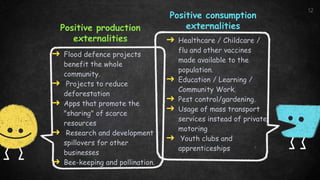
➜ Flood defence projects
benefit the whole
community.
➜ Projects to reduce
deforestation
➜ Apps that promote the
"sharing" of scarce
resources
➜ Research and development -
spillovers for other
businesses
➜ Bee-keeping and pollination.
➜ Healthcare / Childcare /
flu and other vaccines
made available to the
population.
➜ Education / Learning /
Community Work.
➜ Pest control/gardening.
➜ Usage of mass transport
services instead of private
motoring
➜ Youth clubs and
apprenticeships
12
Positive production
externalities
Positive consumption
externalities
2. Negative externalities in
agriculture
➜ When the production or consumption of
a good or a service is detrimental to a
third party, then it is a negative
externality.
➜ For example, someone who is smoking in
a closed area is a negative externality
because he may cause cancer to other
people.
13
Negative externalities
can be divided in to two
types as below:
1.Negative Production
Externality
2. Negative Consumption
Externality
14
Negative production
externality
When a firm’s
production reduces the
well-being of others
who are not
compensated by the firm.
Example: Steel plant
pollutes a river
15
Negative consumption
externality
When an individual’s
consumption reduces the
well-being of others who
are not compensated by the
individual. Example: Using a
car and emitting carbon
contributing to global
warming
16
17
OVERCOMING EXTERNALITIES
➜ Organic agriculture and environmental construction
practices should be adopted.
➜ FriendlyTo reduce consumption of negative externalities,
we can place a tax on goods with negative externalities
➜ To increase consumption of positive externalities, we can
place a subsidy on these goods.
➜ The government may place regulations which limit the
amount of pollution.
➜ The government could place incentives and make it easier
to choose less costly environmental choices.
Thank you
18

Externalities in agriculture

  • 1.
  • 2.
    Hello! I am SUMITACHARYA My roll no is 180804130073 2
  • 3.
  • 4.
    • It refersto the consequence of an industrial or commercial activity which affects other parties. This concept is given by Arthur C.Pigou. • Externalities occur when producing or consuming a good cause an impact on third parties not directly related to the transaction. 4
  • 5.
    “ ➜ Externalities caneither be positive or negative. They can also occur from production or consumption. ➜ In other words, they are unforeseen consequences to economic activities. 5
  • 6.
    Thus, externality meansthe economic effect which arises from the production or consumption which having positive or a negative impact on a third party. Examples are pollution, pollination, soil loss, biodiversity loss, damage to health etc.
  • 7.
  • 8.
    1. Positive externalitiesin agriculture When the production or consumption of a good/service proves beneficial to a third party, then it is a positive externality. For example, a farmer that cultivates oranges is a positive externality because he provides society with healthy products. 8
  • 9.
    positive externalities can bedivided in to two types as below: 1.Positive Production Externality 2.Positive Consumption Externality 9
  • 10.
    Positive Production Externality Whena firm’s production increases the well-being of others but the firm is not compensated by those others. Example: Honey producers have a positive impact on pollination and agricultural output. 10
  • 11.
    Positive Consumption Externality When anindividual’s consumption increases the well being of others but the individual is not compensated by those others. Example: Beautiful private garden that passers-by enjoy seeing and increased the value of nearby properties of other individuals. 11
  • 12.
    ➜ Flood defenceprojects benefit the whole community. ➜ Projects to reduce deforestation ➜ Apps that promote the "sharing" of scarce resources ➜ Research and development - spillovers for other businesses ➜ Bee-keeping and pollination. ➜ Healthcare / Childcare / flu and other vaccines made available to the population. ➜ Education / Learning / Community Work. ➜ Pest control/gardening. ➜ Usage of mass transport services instead of private motoring ➜ Youth clubs and apprenticeships 12 Positive production externalities Positive consumption externalities
  • 13.
    2. Negative externalitiesin agriculture ➜ When the production or consumption of a good or a service is detrimental to a third party, then it is a negative externality. ➜ For example, someone who is smoking in a closed area is a negative externality because he may cause cancer to other people. 13
  • 14.
    Negative externalities can bedivided in to two types as below: 1.Negative Production Externality 2. Negative Consumption Externality 14
  • 15.
    Negative production externality When afirm’s production reduces the well-being of others who are not compensated by the firm. Example: Steel plant pollutes a river 15
  • 16.
    Negative consumption externality When anindividual’s consumption reduces the well-being of others who are not compensated by the individual. Example: Using a car and emitting carbon contributing to global warming 16
  • 17.
    17 OVERCOMING EXTERNALITIES ➜ Organicagriculture and environmental construction practices should be adopted. ➜ FriendlyTo reduce consumption of negative externalities, we can place a tax on goods with negative externalities ➜ To increase consumption of positive externalities, we can place a subsidy on these goods. ➜ The government may place regulations which limit the amount of pollution. ➜ The government could place incentives and make it easier to choose less costly environmental choices.
  • 18.