MARKET–LED EXTENSION Presented By: Sunil Kumar SEMINAR NOV - 2009 By: Sunil Kumar (Research Scholar) Dept. of Extension Education Inst. of Agricultural Sciences B.H.U.
CONTENTS Introduction Need Paradigm Shift from Production-led Extension to Market Led Extension Objectives Required information to extension system and farmers Markets Roles of Agricultural Extension in Light of Market Led Extension Problems MLE – Its Challenges Suggestions A final thought...
INTRODUCTION With globalization of the market, farmers need to transform themselves from mere producers-sellers in the domestic market to producers cum sellers in a wider market sense to best realize the returns on their investments, risks and efforts. Keeping this in view, MANAGE started working on the concept of ‘Market-Led Extension’ and a beginning was made through a three day national workshop on Market-Led Extension at MANAGE during 18 th -20 th  December, 2001.
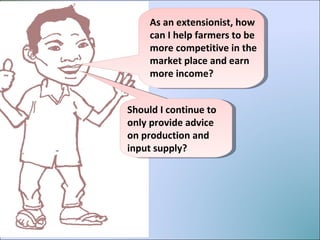
As an extensionist, how can I help farmers to be more competitive in the market place and earn more income?  Should I continue to only provide advice on production and input supply?
Why? Even after 60 years of independence, the quality, timely and cost effective delivery of adequate inputs remains a dream Farmers are not able to sell their surplus produce remuneratively Plenty of distress sales among farmers We produce enough to feed the nation.  -Dr M. S. Swaminathan
NEED Conversion of P-L-E into M-L-E Orientation of extension system with knowledge and skills related to the market. Minimization of production cost. Introduction of export oriented product. Modernization of wholesale markets or new markets with new Agricultural policy.
Paradigm Shift from Production-led Extension to  Market Led Extension Aspects Production-led extension Market-led extension Purpose/objective Transfer of production technologies Enabling farmers to get optimum returns out of the enterprise Expected end results Delivery of messages Adoption of package of practices by most of the farmers High returns Farmers seen as Progressive farmer High producer Farmer as an entrepreneur “Agripreneur” Focus Production / yields”Seed to seed” Whole process as an enterprise / High Returns ”Rupee to Rupee” Technology Fixed package recommended for an agro-climatic zone covering very huge area irrespective of different farming situations Diverse baskets of package of practices suitable to local situations/ farming systems
Continued… Extensionists’ interactions Messages Training \ Motivating Recommendations Joint analysis of the issues Varied choices for adoption Consultancy Linkages/ liaison Research-Extension-Farmer Research-Extension-Farmer extended by market linkages Extensionists’ role Limited to delivery mode and feedback to research system Establishment of marketing and agro processing linkages between farmer groups, markets and processors Maintenance of Records Not much importance as the focus was on production Very important as agriculture viewed as an enterprise to understand the cost benefit ratio and the profits generated Information Technology support Emphasis on production technologies MI including likely price  trends, demand position, current prices,  market practices, communication net  work,
OBJECTIVE Conversion of Agriculture sector into profit oriented business . Strengthening R-E-F linkages – between various department at various levels. Strengthening market linkages to farmers – IT application in Agricultural marketing. Wider use of electronic mass media for Agricultural Extension.
Required information to extension system and farmers •   Present agricultural scenario and land use pattern •  Suitability of land holding to various crops/enterprises •  Crops in demand in near future •  Market prices of crops •  Availability of inputs •  Usage of inputs •  Credit facilities •  Desired qualities of the products by consumers •  Market network of the local area and the price differences in various markets •  Network of storage and warehouse facilities available
•  Transport facilities •  Regular updating of market intelligence •  Production technologies like improved varieties, organic farming, usage of bio-fertilizers and bio-pesticides, IPM, INM, and right methods of harvesting etc. •  Post-harvest management like processing, grading, standardization of produce, value addition, packaging, storage, certification, etc. with reference to food grains, fruits and vegetables, eggs, poultry, fish, etc. •  Contract farming •  Private modern terminal markets •  Food retail chains •  Food safety and quality standard •  Certification •  WTO regulations Continued…
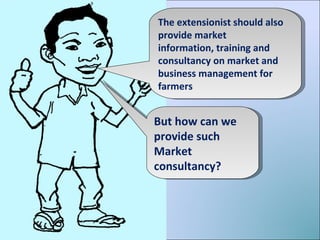
The extensionist should also provide market information, training and consultancy on market and business management for farmers But how can we provide such Market consultancy?
Markets Markets must be available  and profitable Potential risks include: –  rapid price fluctuations; –  highly competitive markets; –  limited number of buyers. not only the market but also the marketing chain must be fully understood
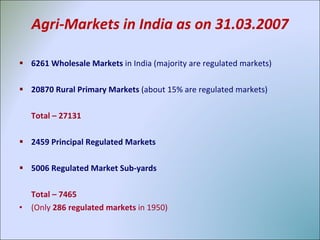
Agri-Markets in India as on 31.03.2007 6261   Wholesale Markets  in India (majority are regulated markets) 20870   Rural Primary Markets  (about 15% are regulated markets) Total – 27131 2459   Principal Regulated Markets 5006   Regulated Market Sub-yards   Total – 7465 (Only  286 regulated markets  in 1950)
Roles of Agricultural Extension in Light of Market Led Extension SWOT analysis of the market: Organization of Farmers’ Interest Groups (FIGs) Supporting and enhancing the capacities of locally established groups under various schemes /programmers Enhancing the interactive and communication skills of the farmers Establishing marketing and agro-processing linkages between farmers’ groups, markets and private processors. Advice on product planning:
Educating the farming community: Direct marketing: farmers need to be informed about the benefits of direct marketing. Capacity building of FIGs in terms of improved production, post harvest operations, storage, transport and marketing. Regular usage of internet facility and Production of video films of success stories of commodity specific farmers. Continued…
PROBLEMS 1. Production related Seasonality of production: Supply not uniform throughout the year. Perishability of produce: Problem of storage. Bulkiness of production: Transportation problem. 2. Market related Non – availability of MI: Lack of information about the market. Existence of many middleman Inferior quality of produce. 3. Extension related Lack of communication skills.  Lack of credibility. Insufficient information related with market and many more….
MLE – ITS CHALLENGES 1. Rapid changes in the information tech and need for collection of relevant information. 2. Generation of data on Market intelligence – interlinking of marketing and Agricultural line departments. 3. Reorganization of extension system –  ADE  ADEM 4. Strong communication skills with credibility.
Suggestions Training programme for extension worker Module 1 Basic concepts and issues in agriculture markets and marketing (and links w/ agricultural extension) Collection, processing and dissemination of market information
Continued… Module 2 Reflection on application of module 1 Helping farmers access markets: collective action, business linkages and other (based on needs assessment during mentoring phases) 2. To introduce market-oriented approach into extension  subjects .
3. Development of local market and promoting local consumption. 4. Entrepreneurial training to farmers. 5. Linking farmers to markets. 6. Market reforms 7. Formation of Market-Led Extension Policies and its implementation. 8 .  Workshop on Market-Led Extension at regional level Continued…
Last, but certainly not least! Work closely with the private sector Public – Private Partnership The concept of linkage implies the communication and working relationship established between two or more organizations pursuing commonly shared objectives in order to have regular contact and improved productivity. Actors within a MLE system Service providers Service users Public Private NGO’s
A final thought... The focus of the extension functionaries need to be extended beyond production. Farmers should be sensitized on various aspects on quality, consumer’s preference, market intelligence, processing and value addition and other marketing information. This will help the farming community to realize high returns for the produce, minimize the production costs, and improve the product value and marketability.
THANK YOU THANK YOU FOR YOUR ATTENTION….
OPEN DISCUSSION!

Market Led Extension

  • 1.
    MARKET–LED EXTENSION PresentedBy: Sunil Kumar SEMINAR NOV - 2009 By: Sunil Kumar (Research Scholar) Dept. of Extension Education Inst. of Agricultural Sciences B.H.U.
  • 2.
    CONTENTS Introduction NeedParadigm Shift from Production-led Extension to Market Led Extension Objectives Required information to extension system and farmers Markets Roles of Agricultural Extension in Light of Market Led Extension Problems MLE – Its Challenges Suggestions A final thought...
  • 3.
    INTRODUCTION With globalizationof the market, farmers need to transform themselves from mere producers-sellers in the domestic market to producers cum sellers in a wider market sense to best realize the returns on their investments, risks and efforts. Keeping this in view, MANAGE started working on the concept of ‘Market-Led Extension’ and a beginning was made through a three day national workshop on Market-Led Extension at MANAGE during 18 th -20 th December, 2001.
  • 4.
    As an extensionist,how can I help farmers to be more competitive in the market place and earn more income? Should I continue to only provide advice on production and input supply?
  • 5.
    Why? Even after60 years of independence, the quality, timely and cost effective delivery of adequate inputs remains a dream Farmers are not able to sell their surplus produce remuneratively Plenty of distress sales among farmers We produce enough to feed the nation. -Dr M. S. Swaminathan
  • 6.
    NEED Conversion ofP-L-E into M-L-E Orientation of extension system with knowledge and skills related to the market. Minimization of production cost. Introduction of export oriented product. Modernization of wholesale markets or new markets with new Agricultural policy.
  • 7.
    Paradigm Shift fromProduction-led Extension to Market Led Extension Aspects Production-led extension Market-led extension Purpose/objective Transfer of production technologies Enabling farmers to get optimum returns out of the enterprise Expected end results Delivery of messages Adoption of package of practices by most of the farmers High returns Farmers seen as Progressive farmer High producer Farmer as an entrepreneur “Agripreneur” Focus Production / yields”Seed to seed” Whole process as an enterprise / High Returns ”Rupee to Rupee” Technology Fixed package recommended for an agro-climatic zone covering very huge area irrespective of different farming situations Diverse baskets of package of practices suitable to local situations/ farming systems
  • 8.
    Continued… Extensionists’ interactionsMessages Training \ Motivating Recommendations Joint analysis of the issues Varied choices for adoption Consultancy Linkages/ liaison Research-Extension-Farmer Research-Extension-Farmer extended by market linkages Extensionists’ role Limited to delivery mode and feedback to research system Establishment of marketing and agro processing linkages between farmer groups, markets and processors Maintenance of Records Not much importance as the focus was on production Very important as agriculture viewed as an enterprise to understand the cost benefit ratio and the profits generated Information Technology support Emphasis on production technologies MI including likely price trends, demand position, current prices, market practices, communication net work,
  • 9.
    OBJECTIVE Conversion ofAgriculture sector into profit oriented business . Strengthening R-E-F linkages – between various department at various levels. Strengthening market linkages to farmers – IT application in Agricultural marketing. Wider use of electronic mass media for Agricultural Extension.
  • 10.
    Required information toextension system and farmers • Present agricultural scenario and land use pattern • Suitability of land holding to various crops/enterprises • Crops in demand in near future • Market prices of crops • Availability of inputs • Usage of inputs • Credit facilities • Desired qualities of the products by consumers • Market network of the local area and the price differences in various markets • Network of storage and warehouse facilities available
  • 11.
    • Transportfacilities • Regular updating of market intelligence • Production technologies like improved varieties, organic farming, usage of bio-fertilizers and bio-pesticides, IPM, INM, and right methods of harvesting etc. • Post-harvest management like processing, grading, standardization of produce, value addition, packaging, storage, certification, etc. with reference to food grains, fruits and vegetables, eggs, poultry, fish, etc. • Contract farming • Private modern terminal markets • Food retail chains • Food safety and quality standard • Certification • WTO regulations Continued…
  • 12.
    The extensionist shouldalso provide market information, training and consultancy on market and business management for farmers But how can we provide such Market consultancy?
  • 13.
    Markets Markets mustbe available and profitable Potential risks include: – rapid price fluctuations; – highly competitive markets; – limited number of buyers. not only the market but also the marketing chain must be fully understood
  • 14.
    Agri-Markets in Indiaas on 31.03.2007 6261 Wholesale Markets in India (majority are regulated markets) 20870 Rural Primary Markets (about 15% are regulated markets) Total – 27131 2459 Principal Regulated Markets 5006 Regulated Market Sub-yards Total – 7465 (Only 286 regulated markets in 1950)
  • 15.
    Roles of AgriculturalExtension in Light of Market Led Extension SWOT analysis of the market: Organization of Farmers’ Interest Groups (FIGs) Supporting and enhancing the capacities of locally established groups under various schemes /programmers Enhancing the interactive and communication skills of the farmers Establishing marketing and agro-processing linkages between farmers’ groups, markets and private processors. Advice on product planning:
  • 16.
    Educating the farmingcommunity: Direct marketing: farmers need to be informed about the benefits of direct marketing. Capacity building of FIGs in terms of improved production, post harvest operations, storage, transport and marketing. Regular usage of internet facility and Production of video films of success stories of commodity specific farmers. Continued…
  • 17.
    PROBLEMS 1. Productionrelated Seasonality of production: Supply not uniform throughout the year. Perishability of produce: Problem of storage. Bulkiness of production: Transportation problem. 2. Market related Non – availability of MI: Lack of information about the market. Existence of many middleman Inferior quality of produce. 3. Extension related Lack of communication skills. Lack of credibility. Insufficient information related with market and many more….
  • 18.
    MLE – ITSCHALLENGES 1. Rapid changes in the information tech and need for collection of relevant information. 2. Generation of data on Market intelligence – interlinking of marketing and Agricultural line departments. 3. Reorganization of extension system – ADE ADEM 4. Strong communication skills with credibility.
  • 19.
    Suggestions Training programmefor extension worker Module 1 Basic concepts and issues in agriculture markets and marketing (and links w/ agricultural extension) Collection, processing and dissemination of market information
  • 20.
    Continued… Module 2Reflection on application of module 1 Helping farmers access markets: collective action, business linkages and other (based on needs assessment during mentoring phases) 2. To introduce market-oriented approach into extension subjects .
  • 21.
    3. Development oflocal market and promoting local consumption. 4. Entrepreneurial training to farmers. 5. Linking farmers to markets. 6. Market reforms 7. Formation of Market-Led Extension Policies and its implementation. 8 . Workshop on Market-Led Extension at regional level Continued…
  • 22.
    Last, but certainlynot least! Work closely with the private sector Public – Private Partnership The concept of linkage implies the communication and working relationship established between two or more organizations pursuing commonly shared objectives in order to have regular contact and improved productivity. Actors within a MLE system Service providers Service users Public Private NGO’s
  • 23.
    A final thought...The focus of the extension functionaries need to be extended beyond production. Farmers should be sensitized on various aspects on quality, consumer’s preference, market intelligence, processing and value addition and other marketing information. This will help the farming community to realize high returns for the produce, minimize the production costs, and improve the product value and marketability.
  • 24.
    THANK YOU THANKYOU FOR YOUR ATTENTION….
  • 25.