WEL COME
Studies on livestock and
fodder development
programmes in India
FLOW OF SEMINAR
Introduction
Need for development programmes
Different livestock and fodder
development programmes
Research studies
Conclusion
What i will
learn
today?
Introduction
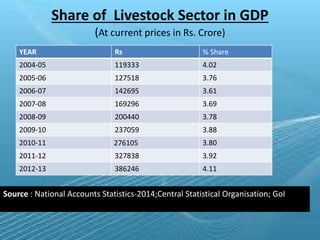
Share of Livestock Sector in GDP
(At current prices in Rs. Crore)
YEAR Rs % Share
2004-05 119333 4.02
2005-06 127518 3.76
2006-07 142695 3.61
2007-08 169296 3.69
2008-09 200440 3.78
2009-10 237059 3.88
2010-11 276105 3.80
2011-12 327838 3.92
2012-13 386246 4.11
Source : National Accounts Statistics-2014;Central Statistical Organisation; GoI
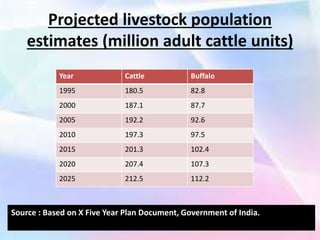
Projected livestock population
estimates (million adult cattle units)
Year Cattle Buffalo
1995 180.5 82.8
2000 187.1 87.7
2005 192.2 92.6
2010 197.3 97.5
2015 201.3 102.4
2020 207.4 107.3
2025 212.5 112.2
Source : Based on X Five Year Plan Document, Government of India.
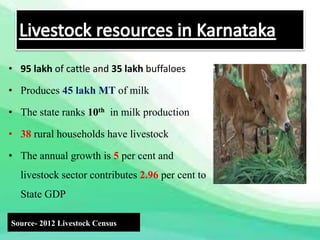
• 95 lakh of cattle and 35 lakh buffaloes
• Produces 45 lakh MT of milk
• The state ranks 10th in milk production
• 38 rural households have livestock
• The annual growth is 5 per cent and
livestock sector contributes 2.96 per cent to
State GDP
Source- 2012 Livestock Census
History of industrial-scale production of
animal feeds
• It was started in 19th century .
• Corn gluten feed was first manufactured in 1882
• Leading world feed producer Purina Feeds was established in
1894 by William Hollington Danforth
• The feed industry expanded rapidly in the first quarter of the
20th century, with Purina expanding its operations into Canada,
and opened its first feed mill in 1927
• 8.47 m ha of land under cultivated fodder
• 25-30% of quality fodder seeds availability
• Maize, sorghum, bajra, oats, berseem, lucerne, cowpea and guar
• Out of the total 326.82 mha geographical area only 4 per cent area
under pastures thereby leading to severe shortage of fodder to the tune
of 36% green fodder, 40% dry fodder and 57% of concentrates
State-wise area under fodder crops and permanent
pastures and other grazing lands (provisional)
• STATEWISE.pdf
The Planning Commission’s Working Group on Animal Husbandry and
Dairying looking into the demand and supply of fodder resources in India
arrived at the following estimated fodder status
Demand and Supply
Status of Fodder
Resources in India
(in Million Ton)
Supply Demand Shortfall
Green Dry Green Dry Green Dry
2000 384.5 428 988 549 604 121
2005 389.9 443 1025 569 635 126
2010 395.2 451 1061 589 666 138
2015 400.6 466 1097 609 696 143
2020 405.9 473 1134 630 728 157
[Source: Draft Report of the WG on Animal Husbandry and Dairying for 5-year Plan
(2002-2007). Planning Commission of India. August 2001.]
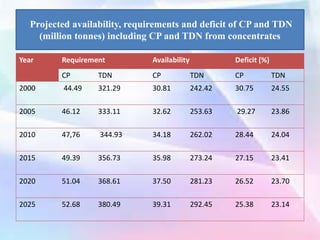
Projected availability, requirements and deficit of CP and TDN
(million tonnes) including CP and TDN from concentrates
Year Requirement Availability Deficit (%)
CP TDN CP TDN CP TDN
2000 44.49 321.29 30.81 242.42 30.75 24.55
2005 46.12 333.11 32.62 253.63 29.27 23.86
2010 47,76 344.93 34.18 262.02 28.44 24.04
2015 49.39 356.73 35.98 273.24 27.15 23.41
2020 51.04 368.61 37.50 281.23 26.52 23.70
2025 52.68 380.49 39.31 292.45 25.38 23.14
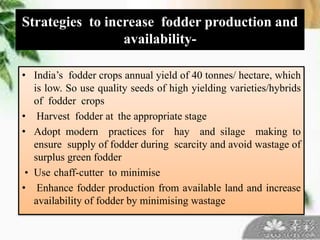
Strategies to increase fodder production and
availability-
• India’s fodder crops annual yield of 40 tonnes/ hectare, which
is low. So use quality seeds of high yielding varieties/hybrids
of fodder crops
• Harvest fodder at the appropriate stage
• Adopt modern practices for hay and silage making to
ensure supply of fodder during scarcity and avoid wastage of
surplus green fodder
• Use chaff-cutter to minimise
• Enhance fodder production from available land and increase
availability of fodder by minimising wastage
Livestock and fodder programmes
1]Fodder Minikits under Integrated Fodder Development Programme
2]Subsidy for Hand operated Chaffcutter under Integrated Fodder
Development Programme
3] Cattle Shed subsidy scheme under Integrated Fodder
Development Programme
4]Fodder Minikits under Tribal Area Sub Plan(TASP) Scheme
5]Subsidy for Hand operated Chaffcutter under Tribal Area Sub Plan
(TASP) Programme
6]Fodder Minikits under Health Package Programme
7]Subsidy for Hand operated Chaffcutter under Schedule Caste Sub
Plan(SCSP)
• Implemented – 2002- 2005
• Objective- Popularize the latest improved fodder varieties
amongst the farmers
• African tall Maize, Lucerne, Bersem, Sorghum, Oats,
M. P. Chari, Red Chari, Sudan Chari, Chinese Cabbage &
Congosignal.
1] Central Minikit Testing Programme on Fodder
Crops
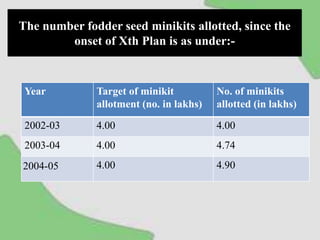
The number fodder seed minikits allotted, since the
onset of Xth Plan is as under:-
Year Target of minikit
allotment (no. in lakhs)
No. of minikits
allotted (in lakhs)
2002-03 4.00 4.00
2003-04 4.00 4.74
2004-05 4.00 4.90
The Scheme ‘Integrated Dairy Development Project (IDDP) in
Non-Operation Flood, Hilly and Backward Areas’ was
launched in 1993-94 on 100% grant-in-aid basis.
2] Integrated dairy development programme
(1993-94)
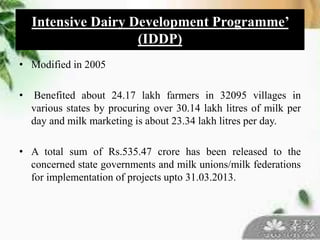
• Modified in 2005
• Benefited about 24.17 lakh farmers in 32095 villages in
various states by procuring over 30.14 lakh litres of milk per
day and milk marketing is about 23.34 lakh litres per day.
• A total sum of Rs.535.47 crore has been released to the
concerned state governments and milk unions/milk federations
for implementation of projects upto 31.03.2013.
Intensive Dairy Development Programme’
(IDDP)
Sl.
No
Scheme Year Implementing
agency
Amount
sanctioned
1 Grassland development
including grass reserves
(100% GOI share)
2005-06 Karnataka Milk
Federation Bangalore
BIRDS Belgaum
100:0
2 Fodder seed production
& distribution programme
2006-07 Karnataka Milk
Federation Bangalore
75:25
3] Enrichment of straws & cellulosic waste scheme:
(100% GOI)
• Launched in 2014-15
• Quantitative and qualitative improvement in livestock
production systems and capacity building of all stakeholders.
• Reduce the demand –supply gap
4. National Livestock Mission
NLM has 4 submissions as follows:
1] The Sub-Mission on Fodder and Feed Development
2] Under Sub-Mission on Livestock Development
3] Sub-Mission on Pig Development in North-Eastern Region
4] Sub-Mission on Skill Development, Technology Transfer and
Extension
SUB-MISSION ON FODDER AND FEED DEVELOPMENT
UNDER NATIONAL LIVESTOCK MISSION
 Distribution of hand driven chaffcutters
 Distribution of power driven chaffcutters
 Establishment of Silage making units/Azolla
cultivation
 Fodder seed production, procurement and distribution
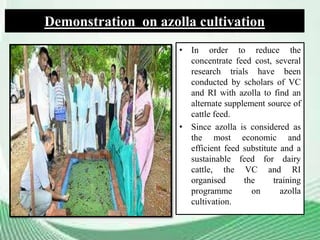
Demonstration on azolla cultivation
• In order to reduce the
concentrate feed cost, several
research trials have been
conducted by scholars of VC
and RI with azolla to find an
alternate supplement source of
cattle feed.
• Since azolla is considered as
the most economic and
efficient feed substitute and a
sustainable feed for dairy
cattle, the VC and RI
organised the training
programme on azolla
cultivation.
• Central Sector Scheme for a period of 2011-12 to 2018-19
Objectives
• To help increase productivity of milch animals
• To help provide rural milk producers with greater access to
the organised milk-processing sector.
Fodder Development-
Extension initiatives/interventions for fodder
development, including support for improved fodder seed
production, fodder production on contract, demonstrations for
silage making, and reducing wastage of dry fodder through
enrichment & densification
5] National Dairy Plan
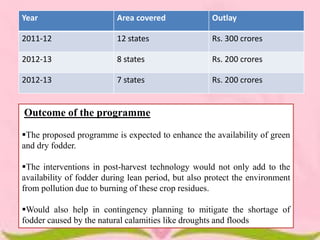
Year Area covered Outlay
2011-12 12 states Rs. 300 crores
2012-13 8 states Rs. 200 crores
2012-13 7 states Rs. 200 crores
Outcome of the programme
The proposed programme is expected to enhance the availability of green
and dry fodder.
The interventions in post-harvest technology would not only add to the
availability of fodder during lean period, but also protect the environment
from pollution due to burning of these crop residues.
Would also help in contingency planning to mitigate the shortage of
fodder caused by the natural calamities like droughts and floods
• Implemented in -2010
• Objective- Production of fodder through promotion of
integrated technologies and processes for enhancing the
availability of fodder throughout the year.
Strategies of this programme
1]Production of Quality Seeds: Strengthening SAU’s
2]Production of Fodder
3]Adoption of appropriate technologies for Post Harvest
Management
6] ACCELERATED FODDER DEVELOPMENT PROGRAMME (AFDP)
• Year of Commencement – 1987 ( modified in 2005 & 2010)
Objectives
• Demonstration of Azolla cultivation and production units
• Introduction of hand driven chaff-cutter
• Introduction of power driven chaff-cutter
• Establishment of silage making Units
7] Centrally Sponsored Fodder and Feed
Development Scheme
• Implemented in -October 7, 2014
• Procurement of vaccine
• Inspection of cold chain in transit and during storage
• Ensure timely supply of vaccines to the respective
states as per demand
8] FMD-CP: Foot and Mouth Disease Control
Programme
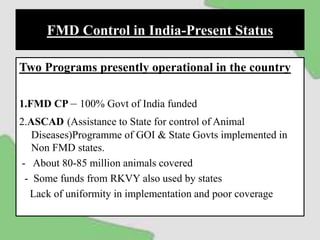
FMD Control in India-Present Status
Two Programs presently operational in the country
1.FMD CP – 100% Govt of India funded
2.ASCAD (Assistance to State for control of Animal
Diseases)Programme of GOI & State Govts implemented in
Non FMD states.
- About 80-85 million animals covered
- Some funds from RKVY also used by states
Lack of uniformity in implementation and poor coverage
Objective-
Protection mechanism to the farmers against any eventual loss
of their animals due to death
Claim Procedure
In the event of death of an animal, immediate intimation should
be sent to the insurers and the require steps should be follow.
9] Livestock Insurance Scheme
Progress of National Insurance Scheme-
• progressreport.pdf
• RKVY.docx
Under this scheme
• Milking Machines- 50% subsidy basis
• Chaff Cutters: 33% subsidy basis
• Supply of calf feed: female calves of 3 to 4 months age
borne out of Artificial Insemination will be enrolled and
260 Kg of calf feed will be supplied for a period of 12
months along with health care
• Feed & Fodder Development
10] Under RKVY
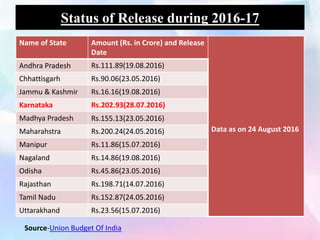
Status of Release during 2016-17
Name of State Amount (Rs. in Crore) and Release
Date
Data as on 24 August 2016
Andhra Pradesh Rs.111.89(19.08.2016)
Chhattisgarh Rs.90.06(23.05.2016)
Jammu & Kashmir Rs.16.16(19.08.2016)
Karnataka Rs.202.93(28.07.2016)
Madhya Pradesh Rs.155.13(23.05.2016)
Maharahstra Rs.200.24(24.05.2016)
Manipur Rs.11.86(15.07.2016)
Nagaland Rs.14.86(19.08.2016)
Odisha Rs.45.86(23.05.2016)
Rajasthan Rs.198.71(14.07.2016)
Tamil Nadu Rs.152.87(24.05.2016)
Uttarakhand Rs.23.56(15.07.2016)
Source-Union Budget Of India
• Implemented in 2015-16
• Backended subsidy of 33% to farmers belonging to Scheduled
Caste and Scheduled Tribes and 25% to other small and
marginal farmers will be provided to establish cattle, sheep,
goat, pig, poultry units in availing maximum loan of Rs.1.20
lakh from commercial banks (The subsidy to SC/ST has been
revised from 33% to 50% )
1] Pashu Bhagya
2] Karnataka Livestock Development Policy -
2010 (Draft) -Fodder resource development
I. Qualitative and quantitative improvement in fodder production through
utilizing waste land/Goumalas
II. Popularizing ,enrichment of crop residues, area specific mineral mixture and
ensilaging of fodder.
III. Popularizing silvipasture development through incentives.
IV. Fodder densification units /fodder banks to be established through PPP
models
V. Local bodies/gram panchayats to be supported for establishing fodder tree
nurseries and for silvipasture development
RESEARCH STUDIES
Impact Evaluation of Training
Programmes on Dairy Farming in
Punjab State
Sharma et al.(2014)
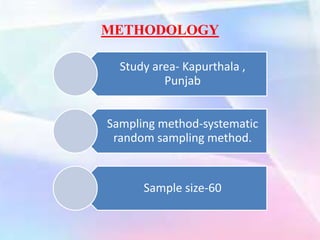
Study area- Kapurthala ,
Punjab
Sampling method-systematic
random sampling method.
Sample size-60
METHODOLOGY
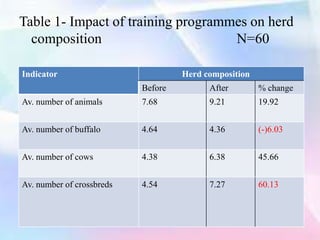
Table 1- Impact of training programmes on herd
composition N=60
Indicator Herd composition
Before After % change
Av. number of animals 7.68 9.21 19.92
Av. number of buffalo 4.64 4.36 (-)6.03
Av. number of cows 4.38 6.38 45.66
Av. number of crossbreds 4.54 7.27 60.13
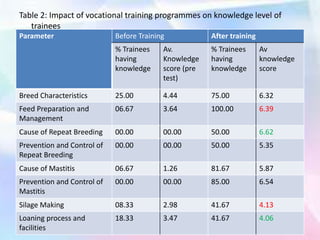
Table 2: Impact of vocational training programmes on knowledge level of
trainees
Parameter Before Training After training
% Trainees
having
knowledge
Av.
Knowledge
score (pre
test)
% Trainees
having
knowledge
Av
knowledge
score
Breed Characteristics 25.00 4.44 75.00 6.32
Feed Preparation and
Management
06.67 3.64 100.00 6.39
Cause of Repeat Breeding 00.00 00.00 50.00 6.62
Prevention and Control of
Repeat Breeding
00.00 00.00 50.00 5.35
Cause of Mastitis 06.67 1.26 81.67 5.87
Prevention and Control of
Mastitis
00.00 00.00 85.00 6.54
Silage Making 08.33 2.98 41.67 4.13
Loaning process and
facilities
18.33 3.47 41.67 4.06
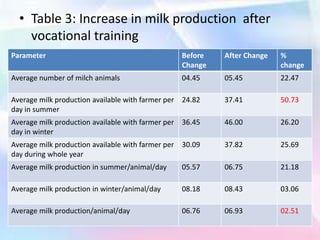
• Table 3: Increase in milk production after
vocational training
Parameter Before
Change
After Change %
change
Average number of milch animals 04.45 05.45 22.47
Average milk production available with farmer per
day in summer
24.82 37.41 50.73
Average milk production available with farmer per
day in winter
36.45 46.00 26.20
Average milk production available with farmer per
day during whole year
30.09 37.82 25.69
Average milk production in summer/animal/day 05.57 06.75 21.18
Average milk production in winter/animal/day 08.18 08.43 03.06
Average milk production/animal/day 06.76 06.93 02.51
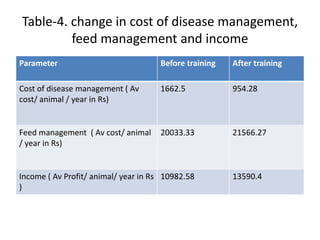
Table-4. change in cost of disease management,
feed management and income
Parameter Before training After training
Cost of disease management ( Av
cost/ animal / year in Rs)
1662.5 954.28
Feed management ( Av cost/ animal
/ year in Rs)
20033.33 21566.27
Income ( Av Profit/ animal/ year in Rs
)
10982.58 13590.4
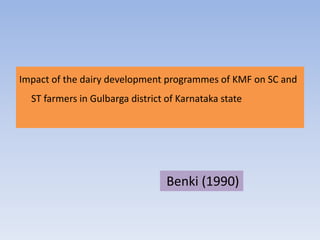
Impact of the dairy development programmes of KMF on SC and
ST farmers in Gulbarga district of Karnataka state
Benki (1990)
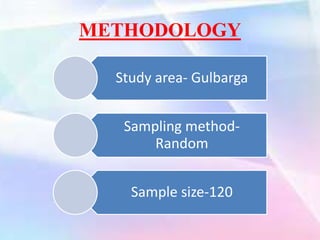
METHODOLOGY
Study area- Gulbarga
Sampling method-
Random
Sample size-120
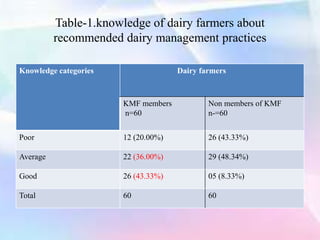
Table-1.knowledge of dairy farmers about
recommended dairy management practices
Knowledge categories Dairy farmers
KMF members
n=60
Non members of KMF
n-=60
Poor 12 (20.00%) 26 (43.33%)
Average 22 (36.00%) 29 (48.34%)
Good 26 (43.33%) 05 (8.33%)
Total 60 60
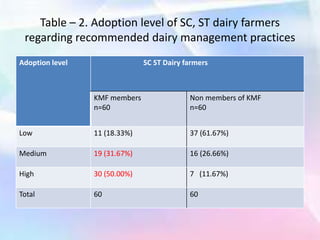
Table – 2. Adoption level of SC, ST dairy farmers
regarding recommended dairy management practices
Adoption level SC ST Dairy farmers
KMF members
n=60
Non members of KMF
n=60
Low 11 (18.33%) 37 (61.67%)
Medium 19 (31.67%) 16 (26.66%)
High 30 (50.00%) 7 (11.67%)
Total 60 60
Adoption of azolla cultivation technology in the
farmers’ field: an analysis
Senthilkumar and Manivannan (2015)
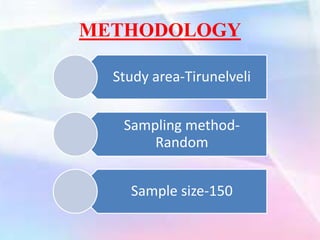
Study area-Tirunelveli
Sampling method-
Random
Sample size-150
METHODOLOGY
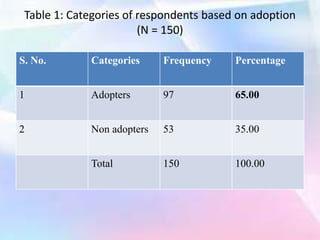
S. No. Categories Frequency Percentage
1 Adopters 97 65.00
2 Non adopters 53 35.00
Total 150 100.00
Table 1: Categories of respondents based on adoption
(N = 150)
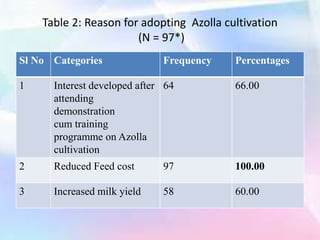
Sl No Categories Frequency Percentages
1 Interest developed after
attending
demonstration
cum training
programme on Azolla
cultivation
64 66.00
2 Reduced Feed cost 97 100.00
3 Increased milk yield 58 60.00
Table 2: Reason for adopting Azolla cultivation
(N = 97*)
Sl No Categories Frequency Percentages
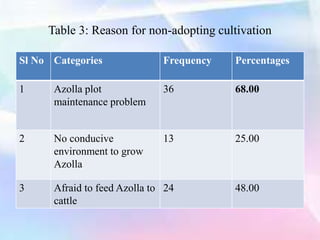
1 Azolla plot
maintenance problem
36 68.00
2 No conducive
environment to grow
Azolla
13 25.00
3 Afraid to feed Azolla to
cattle
24 48.00
Table 3: Reason for non-adopting cultivation
On-farm preparation of low cost feed blocks using
mulberry fruit wastes: impact analysis and adoption
by farmers
• This technology initiated by Faculty of Animal Husbandry
and Veterinary Sciences, KP Agricultural University,
Peshawar, Pakistan
• Training of farmers in preparation of mulberry-fruit-based
blocks
Source- Successes and failures with animal nutrition practices and
technologies in developing countries, 2010 ., FAO Electronic
Conference
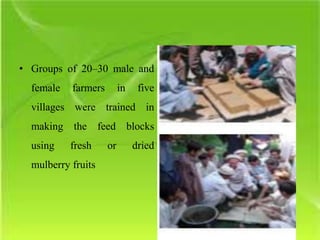
• Groups of 20–30 male and
female farmers in five
villages were trained in
making the feed blocks
using fresh or dried
mulberry fruits
Impact of this technology
• All the farmers in the five villages consistently reported that the
animals readily accepted and licked the blocks and in all cases and
that milk production increased by 30 to 50 per cent
• It helped to generate income (The sale price of a 3 kg block was
fixed by the farmers as PKR 35 with a profit of PKR 14 (almost 67
percent). This price of a 3 kg block was much lower than the market
price of over PKR 100)
Straw-based densified complete feed block
technology
Initiated by Dairy Cattle Nutrition Division, National
Dairy Research Institute, Karnal.
• The two major components of straw-based DCFB are
roughage and concentrates
Benefits obtained by farmers by applying this technology
• A balanced ration for ruminants
• An efficient nutrient-delivery system
• Time and labour saving
• Cheaper and easier transportation
• Can check environmental pollution
• Improved productive and reproductive efficiency.
Impact of this technology
• Increase growth rate of calves by 25 to 30 per cent and milk yield by
10 to15 per cent
• Also the milk yield persists longer, causing an increase in total lactation
yield
• The absence of dietary fluctuations results in a relatively stable
microbial-ecology in the rumen which increases its efficiency
• Feeding CFB results in earlier maturing of animals
• This not only lowers the cost of rearing, but also reduces age at first
calving
• Also provides regularity to subsequent calvings and increases life-
time production
• The optimum supply of nutrients, including micronutrients has a
positive effect on health which keeps the animal free from many
reproductive problems
• Block feeding provides immuno-protection against infectious diseases
resulting in significant savings in costs of medicating animals.
Urea-molasses-multinutrient blocks/licks: a
blend of nutrients for ruminants
Was initiated by the Department of Animal Nutrition,
Punjab Agricultural University, Ludhiana.
Impact of UMMB on performance of animals
• Pica was effectively reduced by UMMB supplementation.
• Animals suffering from haemoglobin urea due to phosphorus
deficiency recovered when supplemented with UMMB
• Farmers reported animals to be better general body condition,
with glossy coats and healthier appearance
• Increases in milk production due to UMMB supplementation have
generated additional income whilst improving reproductive
performance, leading to more calves
These improvements have undoubtedly improved the socio-
economic status of farmers.
Adoption of the technology
During the last three years the sale of the UMMBs has increased
from 2660 to 6530/annum
Agencies responsible for transfering this technology
• State Animal Husbandry Department.
• SAU’s
• ICAR
• KVK
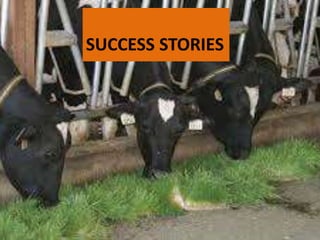
SUCCESS STORIES
Success of Umesh through Integrated Farming
 Kalya village of Magadi taluk of Ramangara
District
 Traditional farming included only arecanut
with a small dairy unit
 Technical support from Krishi Vigyan
Kendra (KVK), Ramangara
 Upgrading dairy unit, azolla as cattle feed,
vermicompost, poultry, fodder bank and
drudgery reduction through farm
mechanisation at his level
• The average production
from his farming per year
is
85 q green arecanuts
1.0 ton of vermicompost,
15 tonnes of cow dung
40 tonnes of fodder grass and
vegetables worth
Rs.2,40,000/-.
Success story of Sri Bhabakrishna Muduli
• Bhabakrishna Muduli from Angul district, Alekhpur
• In 2008 Started Buhuban Dairy with one cow with a daily
production of 8 litres of milk
• He got his primary knowledge on dairying from different
sources by discussing with different block level and district
level Animal Husbandry staffs, attending different
training programs at various level, visiting different
successful farmers and gaining knowledge by virtue of
studying success stories in dairying as well as from
internet.
• Now Dairy Farming (BHUBAN DAIRY) with 65 Cows with
fodder production facilities.
• Getting a profit of about Rs 5000/- to Rs 5500/- daily
• Oat and Berseem seeds and cultivated Hybrid Napier
in order to decrease his production cost
• Adopted Azolla cultivation
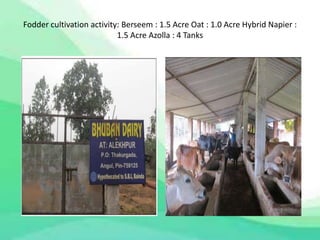
Fodder cultivation activity: Berseem : 1.5 Acre Oat : 1.0 Acre Hybrid Napier :
1.5 Acre Azolla : 4 Tanks
Studies on livestock and fodder development programmes in india

Studies on livestock and fodder development programmes in india

  • 1.
  • 2.
    Studies on livestockand fodder development programmes in India
  • 3.
    FLOW OF SEMINAR Introduction Needfor development programmes Different livestock and fodder development programmes Research studies Conclusion What i will learn today?
  • 4.
  • 5.
    Share of LivestockSector in GDP (At current prices in Rs. Crore) YEAR Rs % Share 2004-05 119333 4.02 2005-06 127518 3.76 2006-07 142695 3.61 2007-08 169296 3.69 2008-09 200440 3.78 2009-10 237059 3.88 2010-11 276105 3.80 2011-12 327838 3.92 2012-13 386246 4.11 Source : National Accounts Statistics-2014;Central Statistical Organisation; GoI
  • 6.
    Projected livestock population estimates(million adult cattle units) Year Cattle Buffalo 1995 180.5 82.8 2000 187.1 87.7 2005 192.2 92.6 2010 197.3 97.5 2015 201.3 102.4 2020 207.4 107.3 2025 212.5 112.2 Source : Based on X Five Year Plan Document, Government of India.
  • 7.
    • 95 lakhof cattle and 35 lakh buffaloes • Produces 45 lakh MT of milk • The state ranks 10th in milk production • 38 rural households have livestock • The annual growth is 5 per cent and livestock sector contributes 2.96 per cent to State GDP Source- 2012 Livestock Census
  • 8.
    History of industrial-scaleproduction of animal feeds • It was started in 19th century . • Corn gluten feed was first manufactured in 1882 • Leading world feed producer Purina Feeds was established in 1894 by William Hollington Danforth • The feed industry expanded rapidly in the first quarter of the 20th century, with Purina expanding its operations into Canada, and opened its first feed mill in 1927
  • 9.
    • 8.47 mha of land under cultivated fodder • 25-30% of quality fodder seeds availability • Maize, sorghum, bajra, oats, berseem, lucerne, cowpea and guar • Out of the total 326.82 mha geographical area only 4 per cent area under pastures thereby leading to severe shortage of fodder to the tune of 36% green fodder, 40% dry fodder and 57% of concentrates
  • 10.
    State-wise area underfodder crops and permanent pastures and other grazing lands (provisional) • STATEWISE.pdf
  • 11.
    The Planning Commission’sWorking Group on Animal Husbandry and Dairying looking into the demand and supply of fodder resources in India arrived at the following estimated fodder status Demand and Supply Status of Fodder Resources in India (in Million Ton) Supply Demand Shortfall Green Dry Green Dry Green Dry 2000 384.5 428 988 549 604 121 2005 389.9 443 1025 569 635 126 2010 395.2 451 1061 589 666 138 2015 400.6 466 1097 609 696 143 2020 405.9 473 1134 630 728 157 [Source: Draft Report of the WG on Animal Husbandry and Dairying for 5-year Plan (2002-2007). Planning Commission of India. August 2001.]
  • 12.
    Projected availability, requirementsand deficit of CP and TDN (million tonnes) including CP and TDN from concentrates Year Requirement Availability Deficit (%) CP TDN CP TDN CP TDN 2000 44.49 321.29 30.81 242.42 30.75 24.55 2005 46.12 333.11 32.62 253.63 29.27 23.86 2010 47,76 344.93 34.18 262.02 28.44 24.04 2015 49.39 356.73 35.98 273.24 27.15 23.41 2020 51.04 368.61 37.50 281.23 26.52 23.70 2025 52.68 380.49 39.31 292.45 25.38 23.14
  • 13.
    Strategies to increasefodder production and availability- • India’s fodder crops annual yield of 40 tonnes/ hectare, which is low. So use quality seeds of high yielding varieties/hybrids of fodder crops • Harvest fodder at the appropriate stage • Adopt modern practices for hay and silage making to ensure supply of fodder during scarcity and avoid wastage of surplus green fodder • Use chaff-cutter to minimise • Enhance fodder production from available land and increase availability of fodder by minimising wastage
  • 14.
    Livestock and fodderprogrammes 1]Fodder Minikits under Integrated Fodder Development Programme 2]Subsidy for Hand operated Chaffcutter under Integrated Fodder Development Programme 3] Cattle Shed subsidy scheme under Integrated Fodder Development Programme 4]Fodder Minikits under Tribal Area Sub Plan(TASP) Scheme 5]Subsidy for Hand operated Chaffcutter under Tribal Area Sub Plan (TASP) Programme 6]Fodder Minikits under Health Package Programme 7]Subsidy for Hand operated Chaffcutter under Schedule Caste Sub Plan(SCSP)
  • 15.
    • Implemented –2002- 2005 • Objective- Popularize the latest improved fodder varieties amongst the farmers • African tall Maize, Lucerne, Bersem, Sorghum, Oats, M. P. Chari, Red Chari, Sudan Chari, Chinese Cabbage & Congosignal. 1] Central Minikit Testing Programme on Fodder Crops
  • 16.
    The number fodderseed minikits allotted, since the onset of Xth Plan is as under:- Year Target of minikit allotment (no. in lakhs) No. of minikits allotted (in lakhs) 2002-03 4.00 4.00 2003-04 4.00 4.74 2004-05 4.00 4.90
  • 17.
    The Scheme ‘IntegratedDairy Development Project (IDDP) in Non-Operation Flood, Hilly and Backward Areas’ was launched in 1993-94 on 100% grant-in-aid basis. 2] Integrated dairy development programme (1993-94)
  • 18.
    • Modified in2005 • Benefited about 24.17 lakh farmers in 32095 villages in various states by procuring over 30.14 lakh litres of milk per day and milk marketing is about 23.34 lakh litres per day. • A total sum of Rs.535.47 crore has been released to the concerned state governments and milk unions/milk federations for implementation of projects upto 31.03.2013. Intensive Dairy Development Programme’ (IDDP)
  • 19.
    Sl. No Scheme Year Implementing agency Amount sanctioned 1Grassland development including grass reserves (100% GOI share) 2005-06 Karnataka Milk Federation Bangalore BIRDS Belgaum 100:0 2 Fodder seed production & distribution programme 2006-07 Karnataka Milk Federation Bangalore 75:25 3] Enrichment of straws & cellulosic waste scheme: (100% GOI)
  • 20.
    • Launched in2014-15 • Quantitative and qualitative improvement in livestock production systems and capacity building of all stakeholders. • Reduce the demand –supply gap 4. National Livestock Mission NLM has 4 submissions as follows: 1] The Sub-Mission on Fodder and Feed Development 2] Under Sub-Mission on Livestock Development 3] Sub-Mission on Pig Development in North-Eastern Region 4] Sub-Mission on Skill Development, Technology Transfer and Extension
  • 21.
    SUB-MISSION ON FODDERAND FEED DEVELOPMENT UNDER NATIONAL LIVESTOCK MISSION  Distribution of hand driven chaffcutters  Distribution of power driven chaffcutters  Establishment of Silage making units/Azolla cultivation  Fodder seed production, procurement and distribution
  • 22.
    Demonstration on azollacultivation • In order to reduce the concentrate feed cost, several research trials have been conducted by scholars of VC and RI with azolla to find an alternate supplement source of cattle feed. • Since azolla is considered as the most economic and efficient feed substitute and a sustainable feed for dairy cattle, the VC and RI organised the training programme on azolla cultivation.
  • 23.
    • Central SectorScheme for a period of 2011-12 to 2018-19 Objectives • To help increase productivity of milch animals • To help provide rural milk producers with greater access to the organised milk-processing sector. Fodder Development- Extension initiatives/interventions for fodder development, including support for improved fodder seed production, fodder production on contract, demonstrations for silage making, and reducing wastage of dry fodder through enrichment & densification 5] National Dairy Plan
  • 24.
    Year Area coveredOutlay 2011-12 12 states Rs. 300 crores 2012-13 8 states Rs. 200 crores 2012-13 7 states Rs. 200 crores Outcome of the programme The proposed programme is expected to enhance the availability of green and dry fodder. The interventions in post-harvest technology would not only add to the availability of fodder during lean period, but also protect the environment from pollution due to burning of these crop residues. Would also help in contingency planning to mitigate the shortage of fodder caused by the natural calamities like droughts and floods
  • 25.
    • Implemented in-2010 • Objective- Production of fodder through promotion of integrated technologies and processes for enhancing the availability of fodder throughout the year. Strategies of this programme 1]Production of Quality Seeds: Strengthening SAU’s 2]Production of Fodder 3]Adoption of appropriate technologies for Post Harvest Management 6] ACCELERATED FODDER DEVELOPMENT PROGRAMME (AFDP)
  • 26.
    • Year ofCommencement – 1987 ( modified in 2005 & 2010) Objectives • Demonstration of Azolla cultivation and production units • Introduction of hand driven chaff-cutter • Introduction of power driven chaff-cutter • Establishment of silage making Units 7] Centrally Sponsored Fodder and Feed Development Scheme
  • 27.
    • Implemented in-October 7, 2014 • Procurement of vaccine • Inspection of cold chain in transit and during storage • Ensure timely supply of vaccines to the respective states as per demand 8] FMD-CP: Foot and Mouth Disease Control Programme
  • 28.
    FMD Control inIndia-Present Status Two Programs presently operational in the country 1.FMD CP – 100% Govt of India funded 2.ASCAD (Assistance to State for control of Animal Diseases)Programme of GOI & State Govts implemented in Non FMD states. - About 80-85 million animals covered - Some funds from RKVY also used by states Lack of uniformity in implementation and poor coverage
  • 29.
    Objective- Protection mechanism tothe farmers against any eventual loss of their animals due to death Claim Procedure In the event of death of an animal, immediate intimation should be sent to the insurers and the require steps should be follow. 9] Livestock Insurance Scheme
  • 30.
    Progress of NationalInsurance Scheme- • progressreport.pdf
  • 31.
    • RKVY.docx Under thisscheme • Milking Machines- 50% subsidy basis • Chaff Cutters: 33% subsidy basis • Supply of calf feed: female calves of 3 to 4 months age borne out of Artificial Insemination will be enrolled and 260 Kg of calf feed will be supplied for a period of 12 months along with health care • Feed & Fodder Development 10] Under RKVY
  • 32.
    Status of Releaseduring 2016-17 Name of State Amount (Rs. in Crore) and Release Date Data as on 24 August 2016 Andhra Pradesh Rs.111.89(19.08.2016) Chhattisgarh Rs.90.06(23.05.2016) Jammu & Kashmir Rs.16.16(19.08.2016) Karnataka Rs.202.93(28.07.2016) Madhya Pradesh Rs.155.13(23.05.2016) Maharahstra Rs.200.24(24.05.2016) Manipur Rs.11.86(15.07.2016) Nagaland Rs.14.86(19.08.2016) Odisha Rs.45.86(23.05.2016) Rajasthan Rs.198.71(14.07.2016) Tamil Nadu Rs.152.87(24.05.2016) Uttarakhand Rs.23.56(15.07.2016) Source-Union Budget Of India
  • 33.
    • Implemented in2015-16 • Backended subsidy of 33% to farmers belonging to Scheduled Caste and Scheduled Tribes and 25% to other small and marginal farmers will be provided to establish cattle, sheep, goat, pig, poultry units in availing maximum loan of Rs.1.20 lakh from commercial banks (The subsidy to SC/ST has been revised from 33% to 50% ) 1] Pashu Bhagya
  • 34.
    2] Karnataka LivestockDevelopment Policy - 2010 (Draft) -Fodder resource development I. Qualitative and quantitative improvement in fodder production through utilizing waste land/Goumalas II. Popularizing ,enrichment of crop residues, area specific mineral mixture and ensilaging of fodder. III. Popularizing silvipasture development through incentives. IV. Fodder densification units /fodder banks to be established through PPP models V. Local bodies/gram panchayats to be supported for establishing fodder tree nurseries and for silvipasture development
  • 35.
  • 36.
    Impact Evaluation ofTraining Programmes on Dairy Farming in Punjab State Sharma et al.(2014)
  • 37.
    Study area- Kapurthala, Punjab Sampling method-systematic random sampling method. Sample size-60 METHODOLOGY
  • 38.
    Table 1- Impactof training programmes on herd composition N=60 Indicator Herd composition Before After % change Av. number of animals 7.68 9.21 19.92 Av. number of buffalo 4.64 4.36 (-)6.03 Av. number of cows 4.38 6.38 45.66 Av. number of crossbreds 4.54 7.27 60.13
  • 39.
    Table 2: Impactof vocational training programmes on knowledge level of trainees Parameter Before Training After training % Trainees having knowledge Av. Knowledge score (pre test) % Trainees having knowledge Av knowledge score Breed Characteristics 25.00 4.44 75.00 6.32 Feed Preparation and Management 06.67 3.64 100.00 6.39 Cause of Repeat Breeding 00.00 00.00 50.00 6.62 Prevention and Control of Repeat Breeding 00.00 00.00 50.00 5.35 Cause of Mastitis 06.67 1.26 81.67 5.87 Prevention and Control of Mastitis 00.00 00.00 85.00 6.54 Silage Making 08.33 2.98 41.67 4.13 Loaning process and facilities 18.33 3.47 41.67 4.06
  • 40.
    • Table 3:Increase in milk production after vocational training Parameter Before Change After Change % change Average number of milch animals 04.45 05.45 22.47 Average milk production available with farmer per day in summer 24.82 37.41 50.73 Average milk production available with farmer per day in winter 36.45 46.00 26.20 Average milk production available with farmer per day during whole year 30.09 37.82 25.69 Average milk production in summer/animal/day 05.57 06.75 21.18 Average milk production in winter/animal/day 08.18 08.43 03.06 Average milk production/animal/day 06.76 06.93 02.51
  • 41.
    Table-4. change incost of disease management, feed management and income Parameter Before training After training Cost of disease management ( Av cost/ animal / year in Rs) 1662.5 954.28 Feed management ( Av cost/ animal / year in Rs) 20033.33 21566.27 Income ( Av Profit/ animal/ year in Rs ) 10982.58 13590.4
  • 42.
    Impact of thedairy development programmes of KMF on SC and ST farmers in Gulbarga district of Karnataka state Benki (1990)
  • 43.
    METHODOLOGY Study area- Gulbarga Samplingmethod- Random Sample size-120
  • 44.
    Table-1.knowledge of dairyfarmers about recommended dairy management practices Knowledge categories Dairy farmers KMF members n=60 Non members of KMF n-=60 Poor 12 (20.00%) 26 (43.33%) Average 22 (36.00%) 29 (48.34%) Good 26 (43.33%) 05 (8.33%) Total 60 60
  • 45.
    Table – 2.Adoption level of SC, ST dairy farmers regarding recommended dairy management practices Adoption level SC ST Dairy farmers KMF members n=60 Non members of KMF n=60 Low 11 (18.33%) 37 (61.67%) Medium 19 (31.67%) 16 (26.66%) High 30 (50.00%) 7 (11.67%) Total 60 60
  • 46.
    Adoption of azollacultivation technology in the farmers’ field: an analysis Senthilkumar and Manivannan (2015)
  • 47.
  • 48.
    S. No. CategoriesFrequency Percentage 1 Adopters 97 65.00 2 Non adopters 53 35.00 Total 150 100.00 Table 1: Categories of respondents based on adoption (N = 150)
  • 49.
    Sl No CategoriesFrequency Percentages 1 Interest developed after attending demonstration cum training programme on Azolla cultivation 64 66.00 2 Reduced Feed cost 97 100.00 3 Increased milk yield 58 60.00 Table 2: Reason for adopting Azolla cultivation (N = 97*)
  • 50.
    Sl No CategoriesFrequency Percentages 1 Azolla plot maintenance problem 36 68.00 2 No conducive environment to grow Azolla 13 25.00 3 Afraid to feed Azolla to cattle 24 48.00 Table 3: Reason for non-adopting cultivation
  • 51.
    On-farm preparation oflow cost feed blocks using mulberry fruit wastes: impact analysis and adoption by farmers • This technology initiated by Faculty of Animal Husbandry and Veterinary Sciences, KP Agricultural University, Peshawar, Pakistan • Training of farmers in preparation of mulberry-fruit-based blocks Source- Successes and failures with animal nutrition practices and technologies in developing countries, 2010 ., FAO Electronic Conference
  • 52.
    • Groups of20–30 male and female farmers in five villages were trained in making the feed blocks using fresh or dried mulberry fruits
  • 53.
    Impact of thistechnology • All the farmers in the five villages consistently reported that the animals readily accepted and licked the blocks and in all cases and that milk production increased by 30 to 50 per cent • It helped to generate income (The sale price of a 3 kg block was fixed by the farmers as PKR 35 with a profit of PKR 14 (almost 67 percent). This price of a 3 kg block was much lower than the market price of over PKR 100)
  • 54.
    Straw-based densified completefeed block technology Initiated by Dairy Cattle Nutrition Division, National Dairy Research Institute, Karnal. • The two major components of straw-based DCFB are roughage and concentrates Benefits obtained by farmers by applying this technology • A balanced ration for ruminants • An efficient nutrient-delivery system • Time and labour saving • Cheaper and easier transportation • Can check environmental pollution • Improved productive and reproductive efficiency.
  • 55.
    Impact of thistechnology • Increase growth rate of calves by 25 to 30 per cent and milk yield by 10 to15 per cent • Also the milk yield persists longer, causing an increase in total lactation yield • The absence of dietary fluctuations results in a relatively stable microbial-ecology in the rumen which increases its efficiency • Feeding CFB results in earlier maturing of animals • This not only lowers the cost of rearing, but also reduces age at first calving • Also provides regularity to subsequent calvings and increases life- time production • The optimum supply of nutrients, including micronutrients has a positive effect on health which keeps the animal free from many reproductive problems • Block feeding provides immuno-protection against infectious diseases resulting in significant savings in costs of medicating animals.
  • 56.
    Urea-molasses-multinutrient blocks/licks: a blendof nutrients for ruminants Was initiated by the Department of Animal Nutrition, Punjab Agricultural University, Ludhiana. Impact of UMMB on performance of animals • Pica was effectively reduced by UMMB supplementation. • Animals suffering from haemoglobin urea due to phosphorus deficiency recovered when supplemented with UMMB • Farmers reported animals to be better general body condition, with glossy coats and healthier appearance • Increases in milk production due to UMMB supplementation have generated additional income whilst improving reproductive performance, leading to more calves These improvements have undoubtedly improved the socio- economic status of farmers.
  • 57.
    Adoption of thetechnology During the last three years the sale of the UMMBs has increased from 2660 to 6530/annum Agencies responsible for transfering this technology • State Animal Husbandry Department. • SAU’s • ICAR • KVK
  • 58.
  • 59.
    Success of Umeshthrough Integrated Farming  Kalya village of Magadi taluk of Ramangara District  Traditional farming included only arecanut with a small dairy unit  Technical support from Krishi Vigyan Kendra (KVK), Ramangara  Upgrading dairy unit, azolla as cattle feed, vermicompost, poultry, fodder bank and drudgery reduction through farm mechanisation at his level
  • 60.
    • The averageproduction from his farming per year is 85 q green arecanuts 1.0 ton of vermicompost, 15 tonnes of cow dung 40 tonnes of fodder grass and vegetables worth Rs.2,40,000/-.
  • 61.
    Success story ofSri Bhabakrishna Muduli • Bhabakrishna Muduli from Angul district, Alekhpur • In 2008 Started Buhuban Dairy with one cow with a daily production of 8 litres of milk • He got his primary knowledge on dairying from different sources by discussing with different block level and district level Animal Husbandry staffs, attending different training programs at various level, visiting different successful farmers and gaining knowledge by virtue of studying success stories in dairying as well as from internet. • Now Dairy Farming (BHUBAN DAIRY) with 65 Cows with fodder production facilities.
  • 62.
    • Getting aprofit of about Rs 5000/- to Rs 5500/- daily • Oat and Berseem seeds and cultivated Hybrid Napier in order to decrease his production cost • Adopted Azolla cultivation
  • 63.
    Fodder cultivation activity:Berseem : 1.5 Acre Oat : 1.0 Acre Hybrid Napier : 1.5 Acre Azolla : 4 Tanks