 During the last 50 years emphasis was given on Production-led
extension(PLE) in our country which resulted in raise in agricultural
production.
 India became self-reliant on food production, but the farmers at the
individual level are not realizing renumerative prices for their produce.
 Even after 67 years of independence, the quality , timely and cost effective
delivery of adequate inputs remain a dream.
 With the Globalisation of the market, farmers need to
transform themselves from mere producer-sellers in the
domestic market to producer cum seller in a wider market
sense to best realize the returns on their investments, risks and
efforts.
 The extension systems now needs to be oriented with
knowledge and skills related to the market.
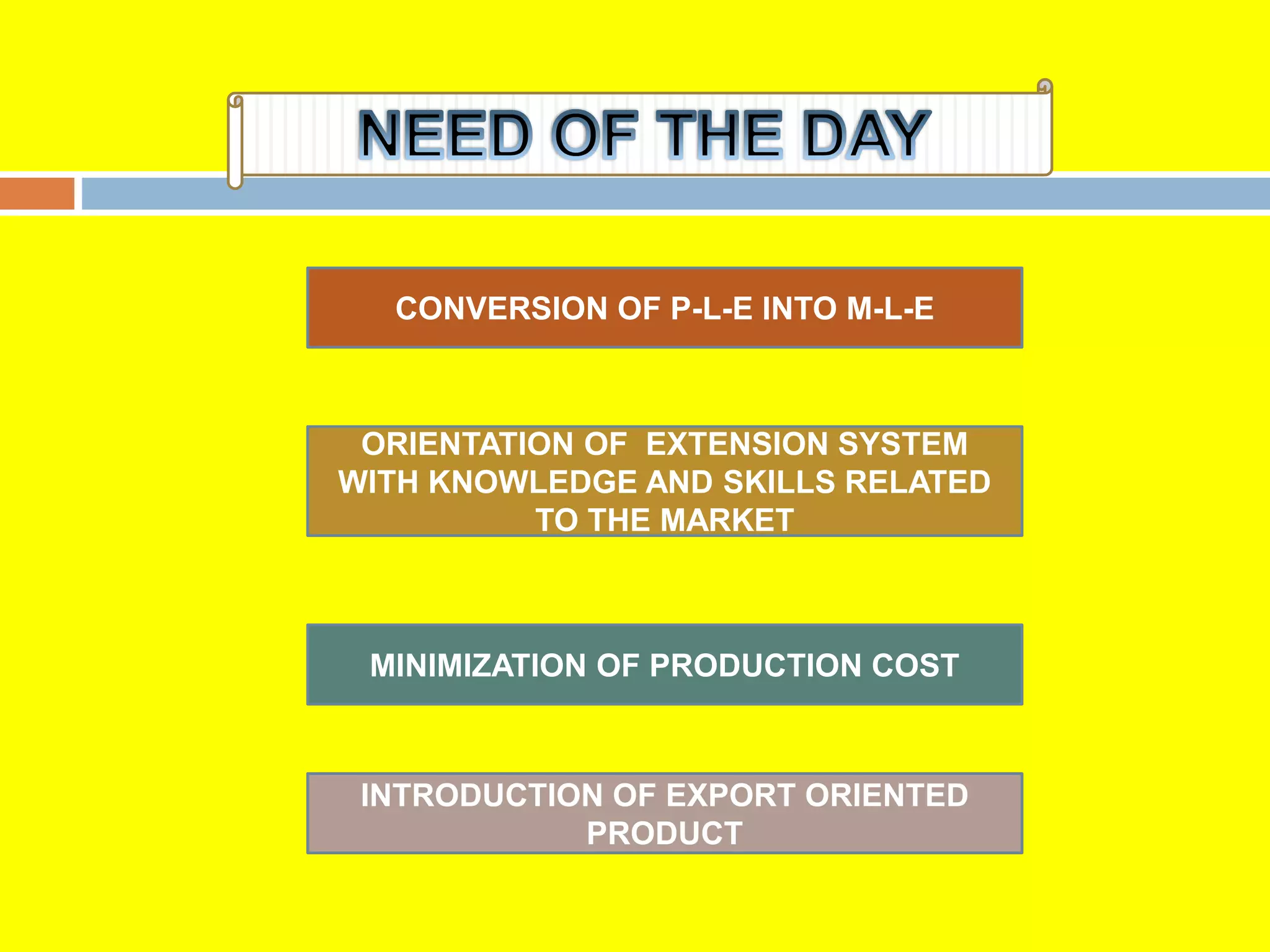
CONVERSION OF P-L-E INTO M-L-E
ORIENTATION OF EXTENSION SYSTEM
WITH KNOWLEDGE AND SKILLS RELATED
TO THE MARKET
MINIMIZATION OF PRODUCTION COST
INTRODUCTION OF EXPORT ORIENTED
PRODUCT
MARKET-LED EXTENSION is the market ward orientation
of agriculture through extension includes agriculture and
economics is the perfect blend for reaching at the door steps
of farming community with the help of appropriate
technology.
(Kaleel , 2007)
 Strengthening R-E-F linkages- between
various departments at various levels.
 Strengthening market linkages to the
farmers-IT applications in Agricultural
marketing.
 Wider use of electronic mass media for
agricultural extension.
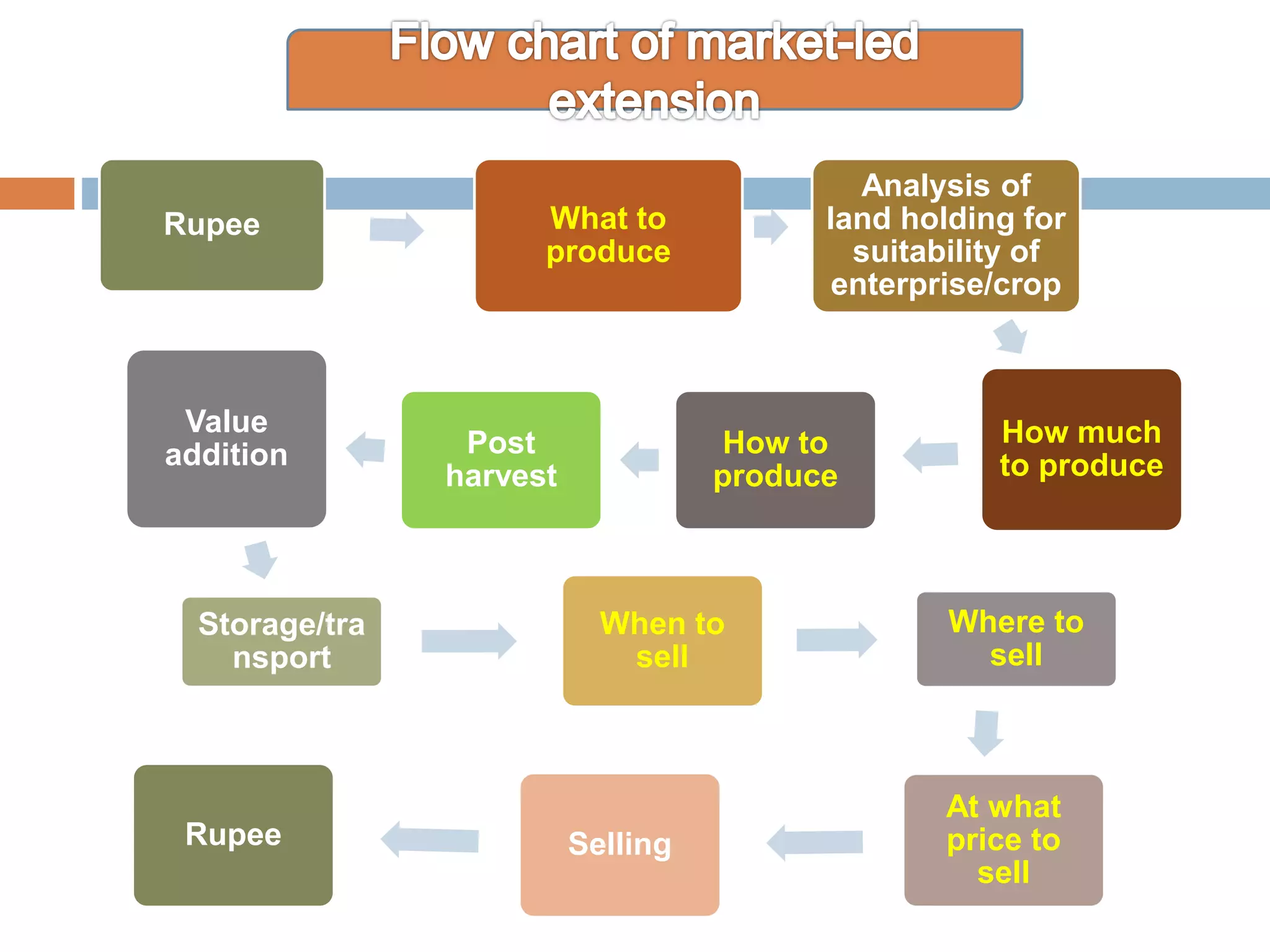
Rupee What to
produce
Analysis of
land holding for
suitability of
enterprise/crop
How much
to produce
How to
produce
Post
harvest
Value
addition
Storage/tra
nsport
When to
sell
Where to
sell
At what
price to
sell
SellingRupee
Production Related
Seasonality of Production
Perishability of the Produce
Smaller size of production
Irregularity of production
Variability in quality of production.
Bulkiness of Production
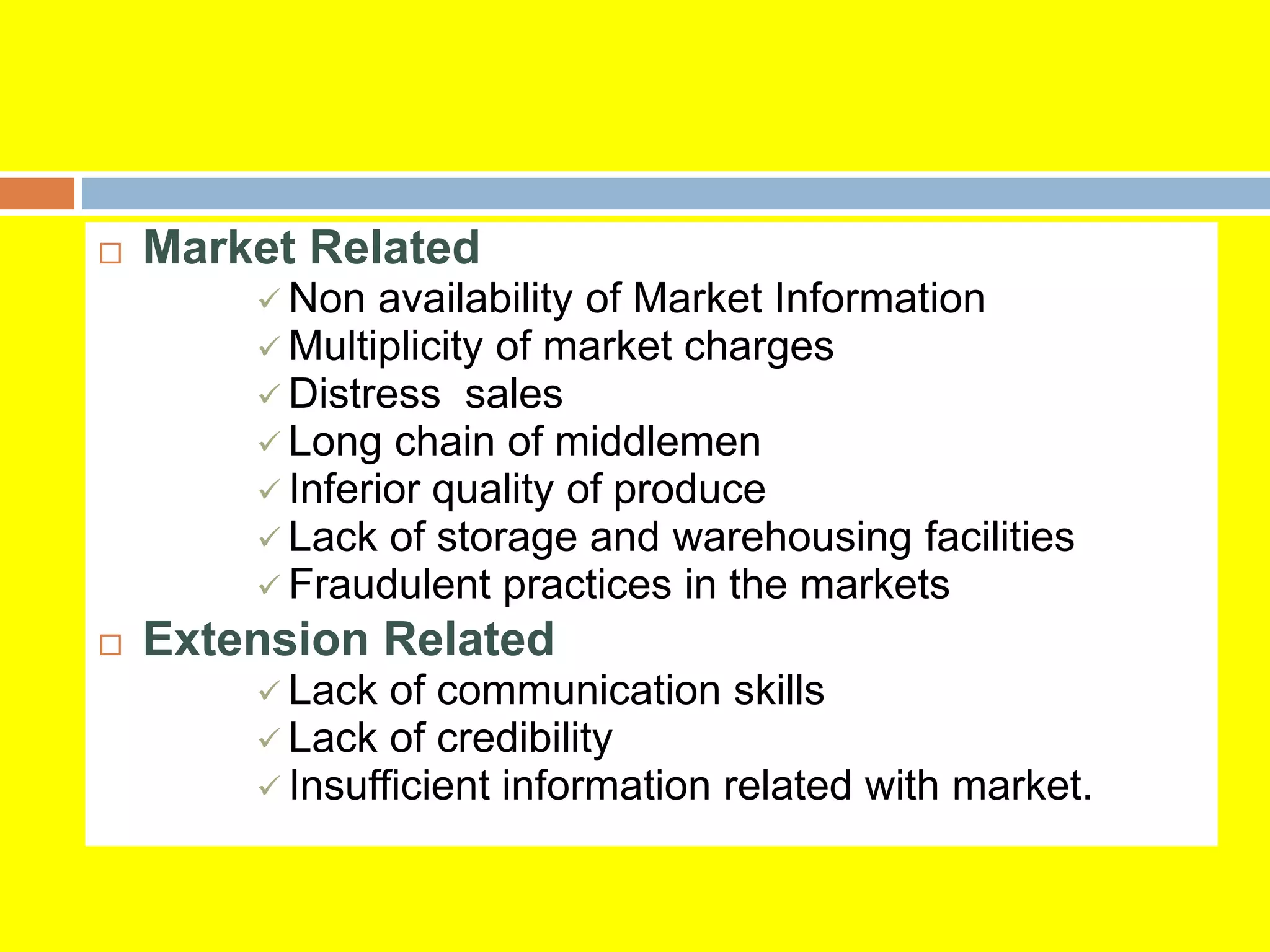
 Market Related
 Non availability of Market Information
 Multiplicity of market charges
 Distress sales
 Long chain of middlemen
 Inferior quality of produce
 Lack of storage and warehousing facilities
 Fraudulent practices in the markets
 Extension Related
 Lack of communication skills
 Lack of credibility
 Insufficient information related with market.
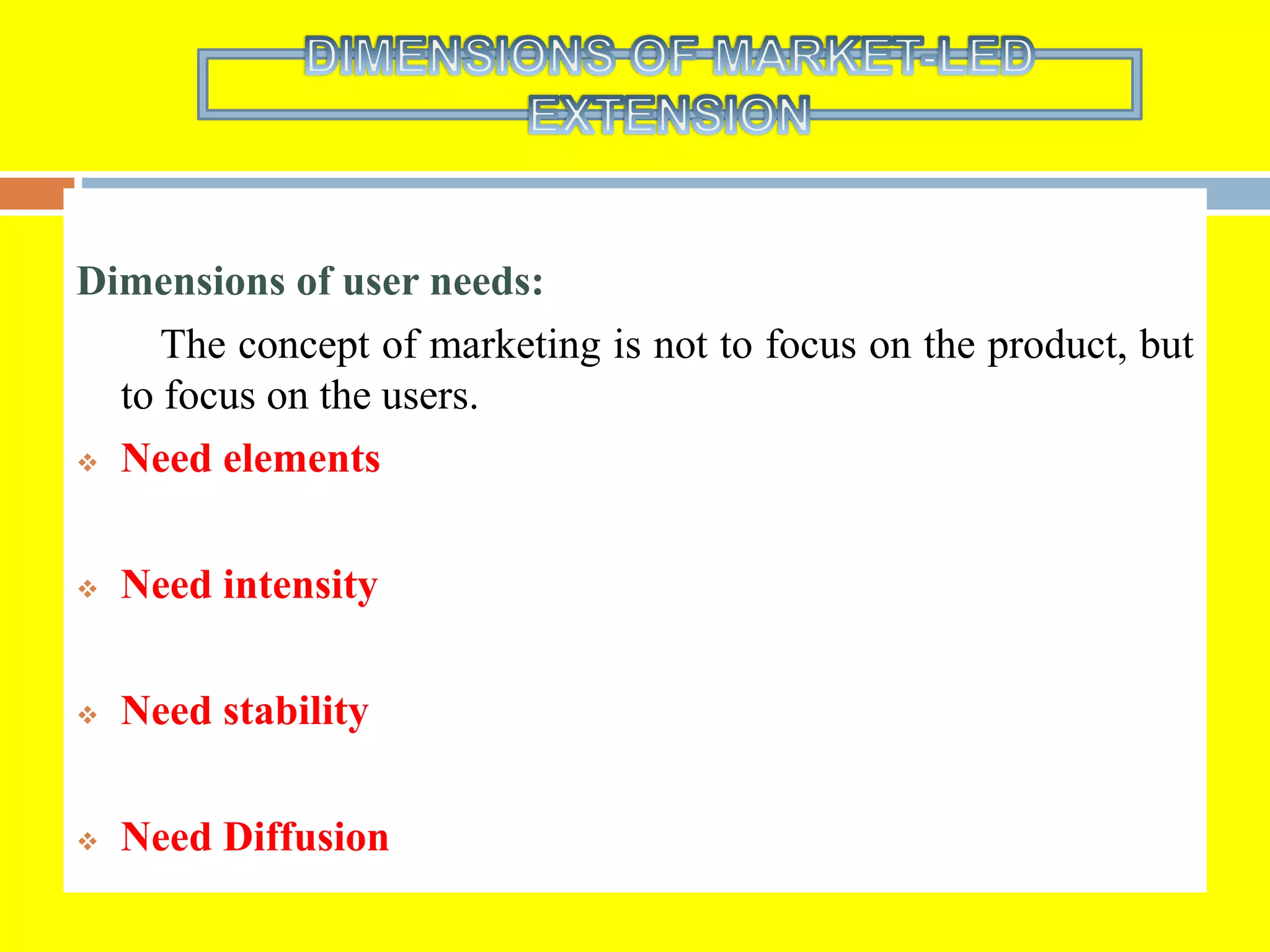
Dimensions of user needs:
The concept of marketing is not to focus on the product, but
to focus on the users.
 Need elements
 Need intensity
 Need stability
 Need Diffusion
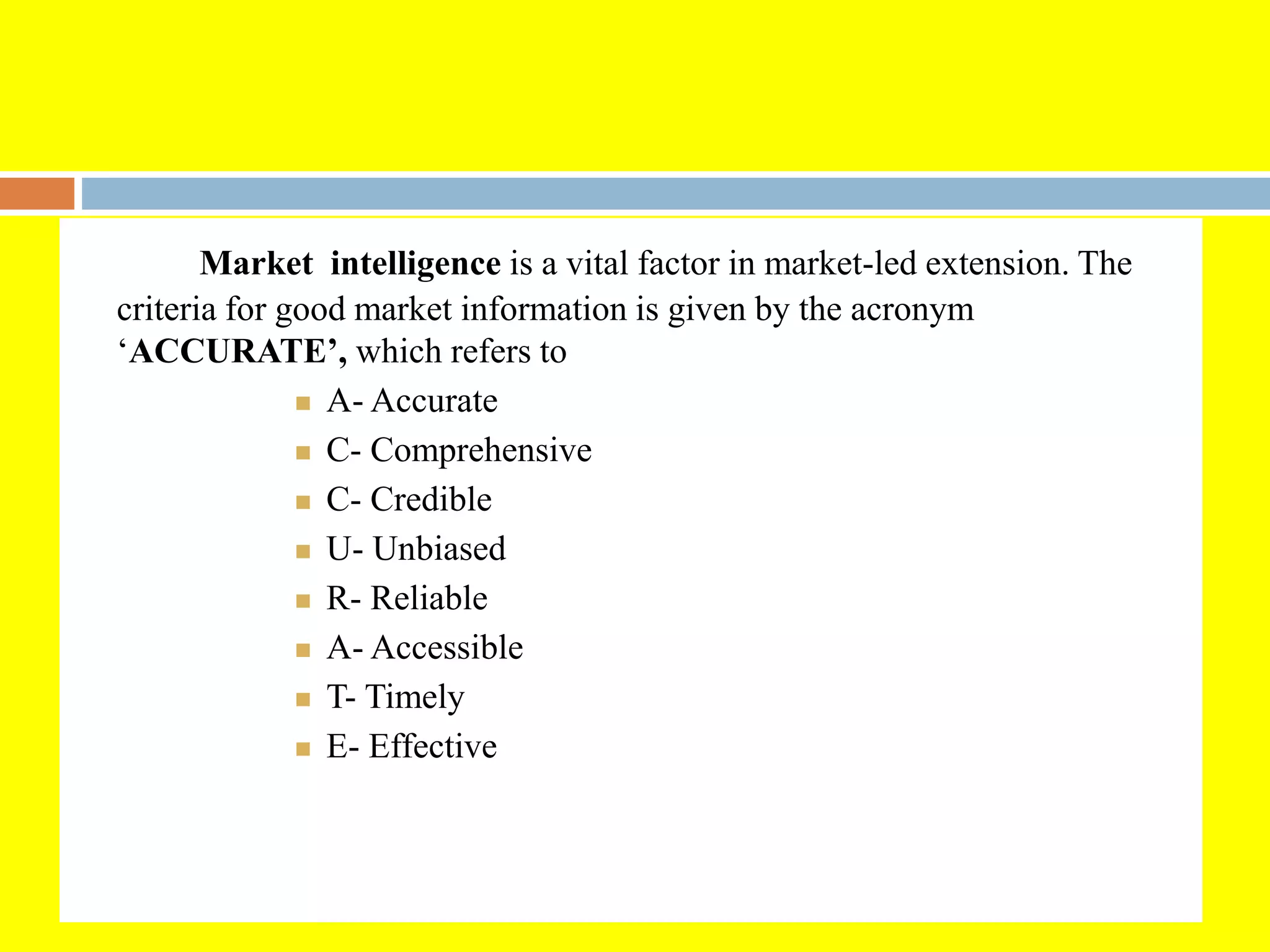
Market intelligence is a vital factor in market-led extension. The
criteria for good market information is given by the acronym
‘ACCURATE’, which refers to
 A- Accurate
 C- Comprehensive
 C- Credible
 U- Unbiased
 R- Reliable
 A- Accessible
 T- Timely
 E- Effective
 Marketing Mix
 Marketing Plan
 Competitive Success
 Customer Satisfaction
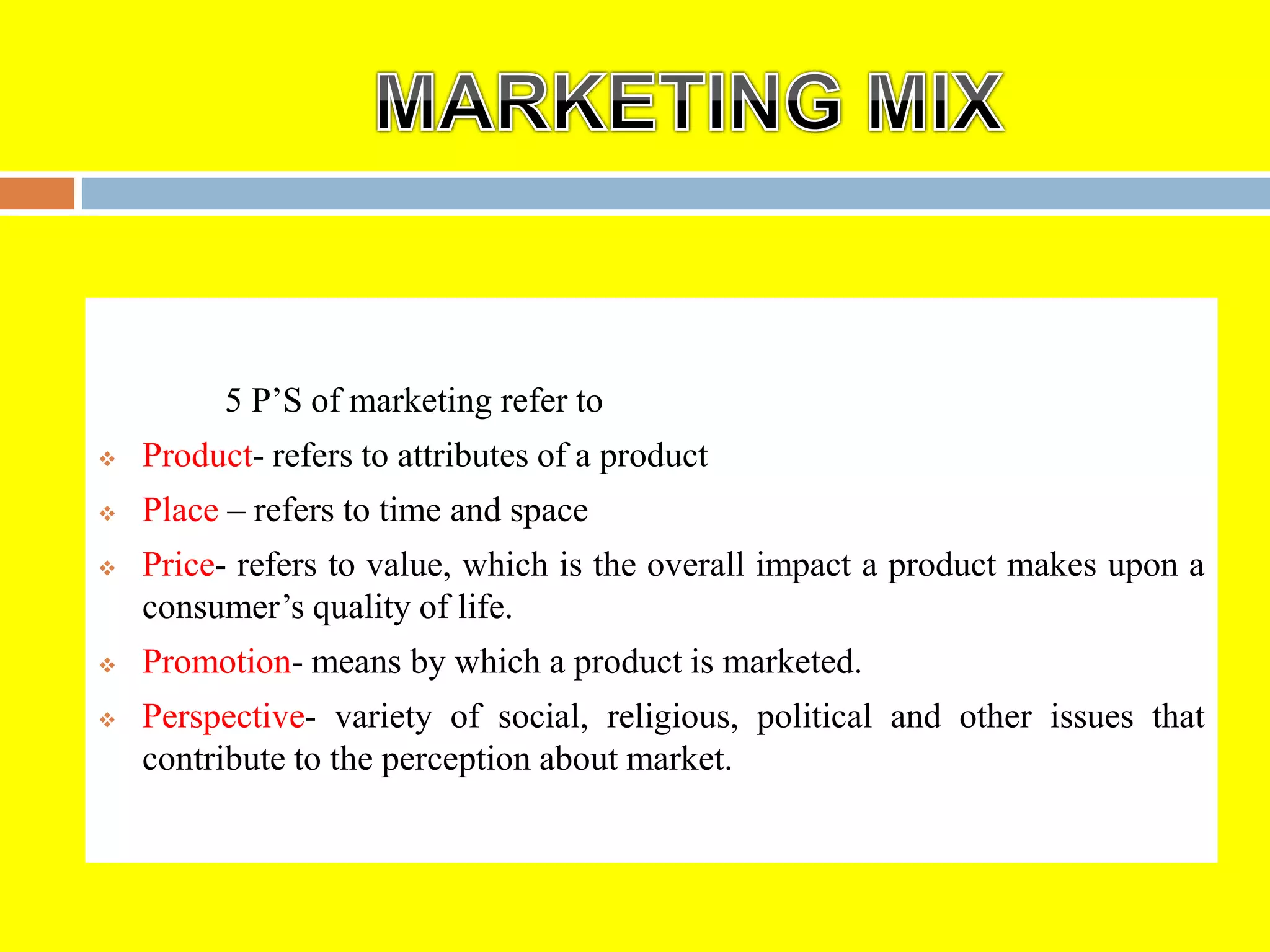
5 P’S of marketing refer to
 Product- refers to attributes of a product
 Place – refers to time and space
 Price- refers to value, which is the overall impact a product makes upon a
consumer’s quality of life.
 Promotion- means by which a product is marketed.
 Perspective- variety of social, religious, political and other issues that
contribute to the perception about market.
 Production planning
 Setting the sales and profit targets
 Market prices
 Environmental factors
 Organisation factors
 Marketing factors
 Managerial factors
 Market penetration- More aggressive market,
promotion efforts .
 Market development-present product, but new
roles.
 Product development- improved product for the
present role.
 Diversification : new product for new market.
 SWOT analysis of the market
 Organization of Farmers’ Interest Groups (FIGs) on commodity basis and
building their capabilities with regard to management of their farm
enterprise.
 Enhancing the interactive and communication skills of the farmers to
exchange their views with customers and other market forces
 Establishing marketing and agro-processing linkages between farmers’
groups, markets and private processors
 Advice on product planning
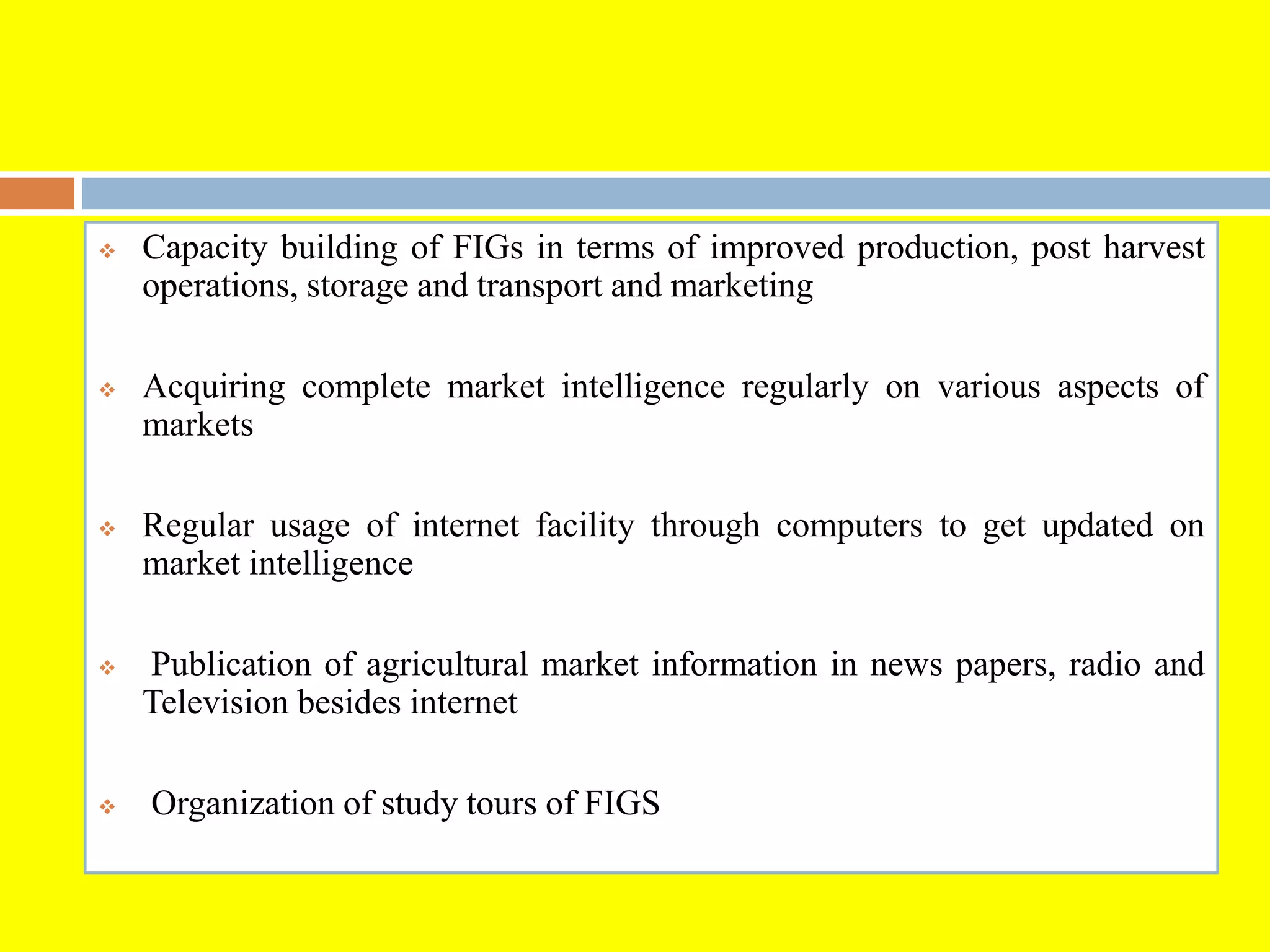
 Capacity building of FIGs in terms of improved production, post harvest
operations, storage and transport and marketing
 Acquiring complete market intelligence regularly on various aspects of
markets
 Regular usage of internet facility through computers to get updated on
market intelligence
 Publication of agricultural market information in news papers, radio and
Television besides internet
 Organization of study tours of FIGS
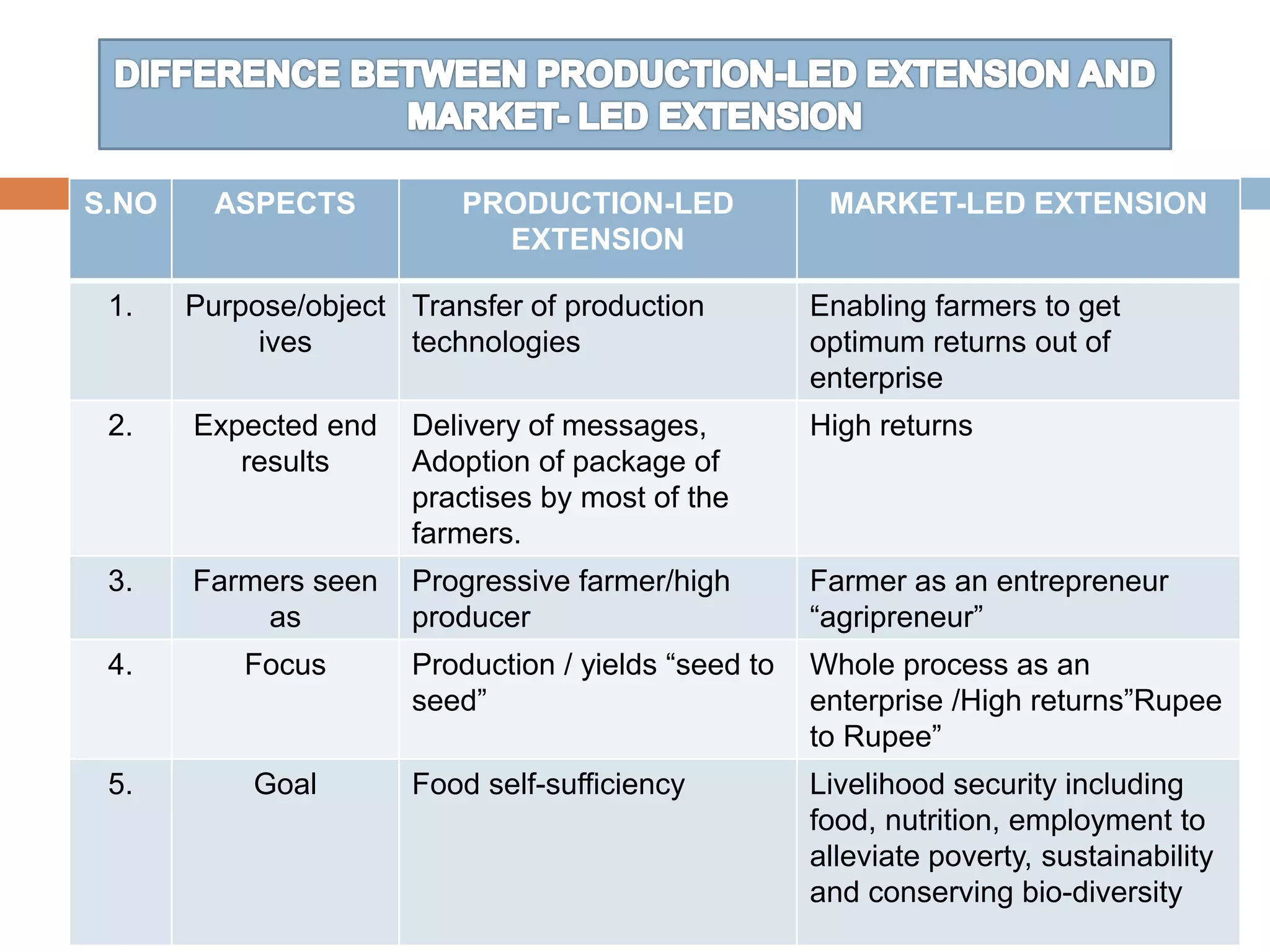
S.NO ASPECTS PRODUCTION-LED
EXTENSION
MARKET-LED EXTENSION
1. Purpose/object
ives
Transfer of production
technologies
Enabling farmers to get
optimum returns out of
enterprise
2. Expected end
results
Delivery of messages,
Adoption of package of
practises by most of the
farmers.
High returns
3. Farmers seen
as
Progressive farmer/high
producer
Farmer as an entrepreneur
“agripreneur”
4. Focus Production / yields “seed to
seed”
Whole process as an
enterprise /High returns”Rupee
to Rupee”
5. Goal Food self-sufficiency Livelihood security including
food, nutrition, employment to
alleviate poverty, sustainability
and conserving bio-diversity
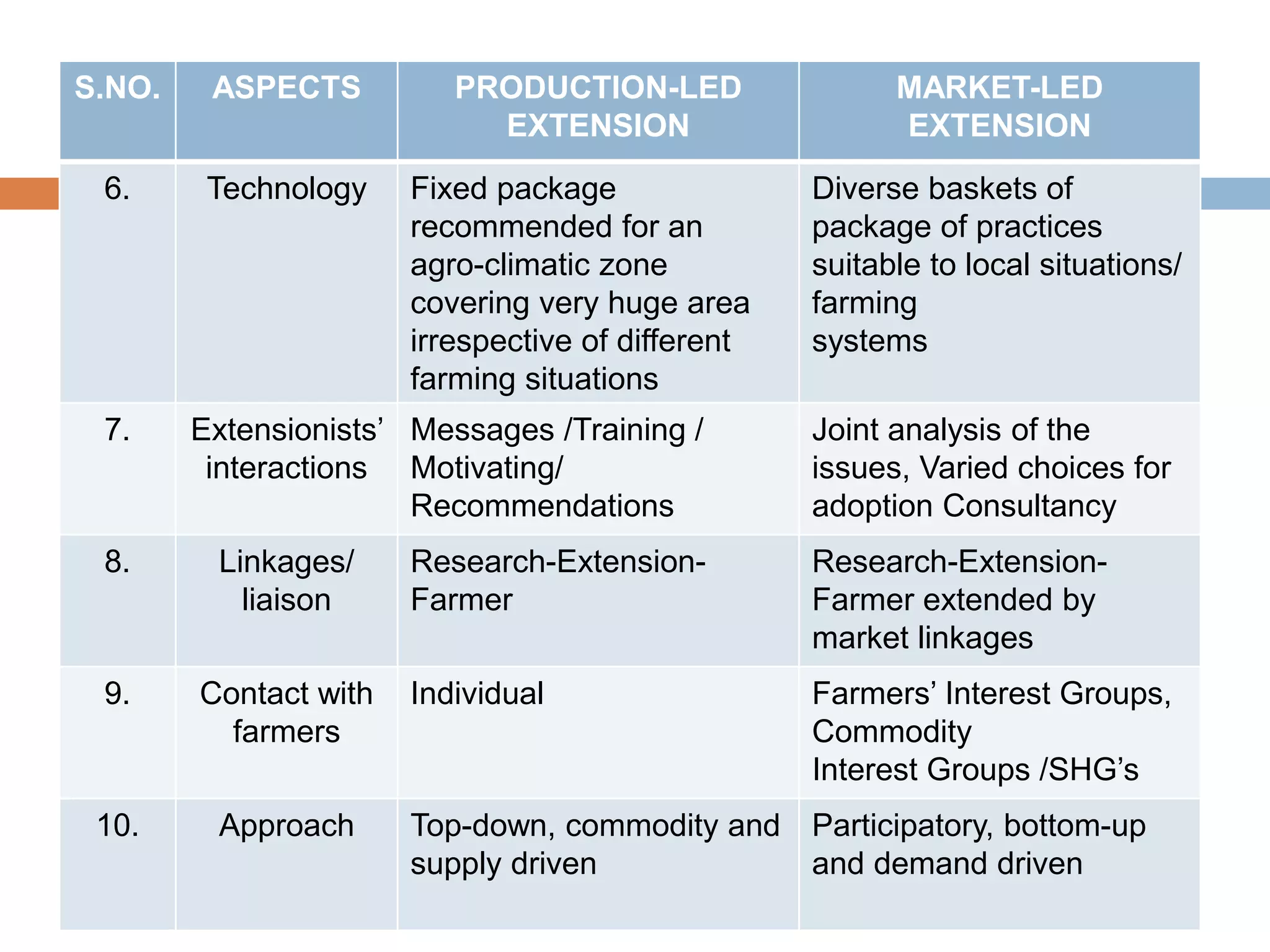
S.NO. ASPECTS PRODUCTION-LED
EXTENSION
MARKET-LED
EXTENSION
6. Technology Fixed package
recommended for an
agro-climatic zone
covering very huge area
irrespective of different
farming situations
Diverse baskets of
package of practices
suitable to local situations/
farming
systems
7. Extensionists’
interactions
Messages /Training /
Motivating/
Recommendations
Joint analysis of the
issues, Varied choices for
adoption Consultancy
8. Linkages/
liaison
Research-Extension-
Farmer
Research-Extension-
Farmer extended by
market linkages
9. Contact with
farmers
Individual Farmers’ Interest Groups,
Commodity
Interest Groups /SHG’s
10. Approach Top-down, commodity and
supply driven
Participatory, bottom-up
and demand driven
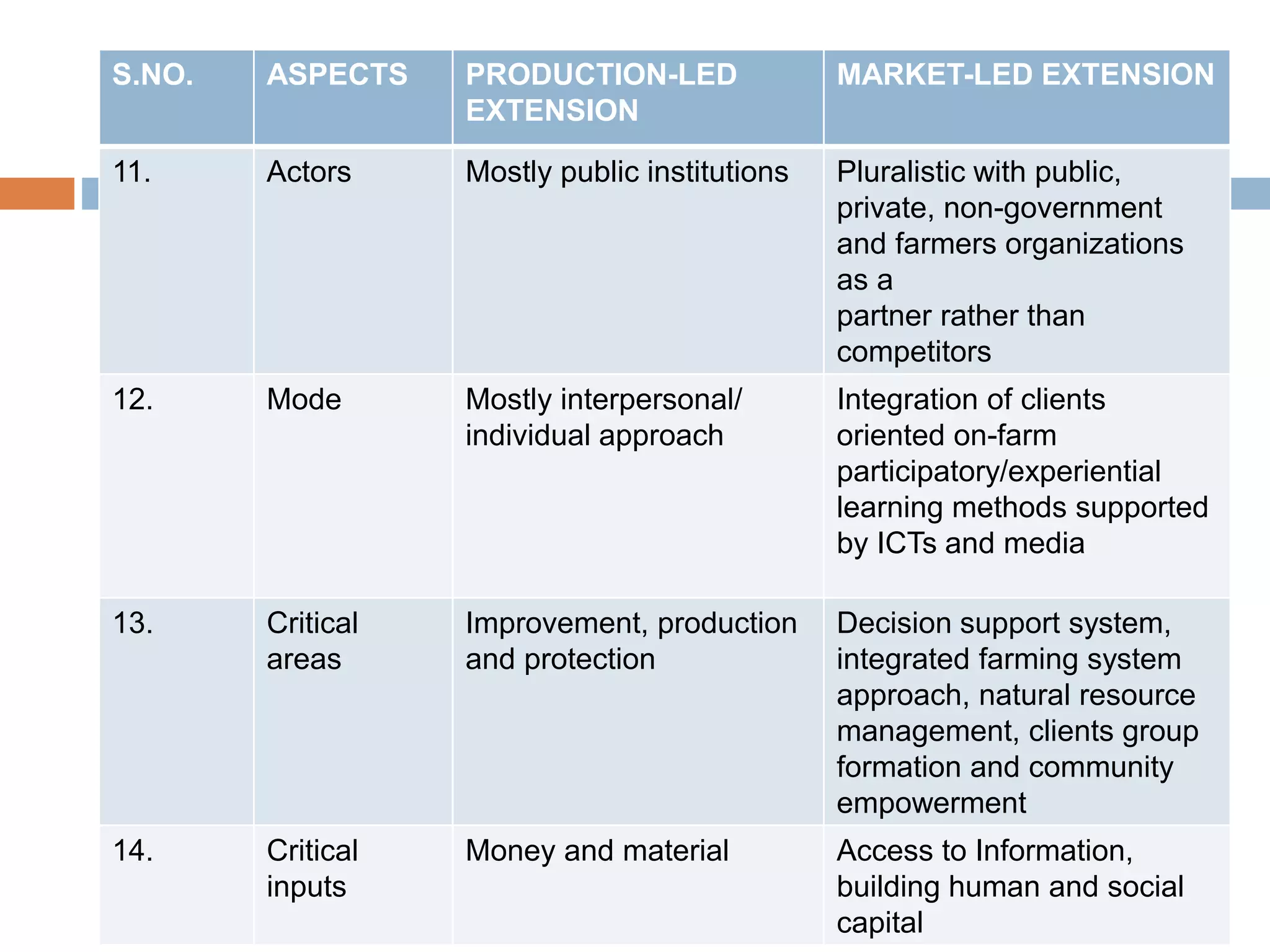
S.NO. ASPECTS PRODUCTION-LED
EXTENSION
MARKET-LED EXTENSION
11. Actors Mostly public institutions Pluralistic with public,
private, non-government
and farmers organizations
as a
partner rather than
competitors
12. Mode Mostly interpersonal/
individual approach
Integration of clients
oriented on-farm
participatory/experiential
learning methods supported
by ICTs and media
13. Critical
areas
Improvement, production
and protection
Decision support system,
integrated farming system
approach, natural resource
management, clients group
formation and community
empowerment
14. Critical
inputs
Money and material Access to Information,
building human and social
capital
S.NO ASPECTS PRODUCTION-
LED EXTENSION
MARKET-LED EXTENSION
15. Extensionists’
role
Limited to delivery
mode and
feedback to
research system
Enriched with market intelligence
besides the TOT function
Establishment of marketing and
agroprocessing linkages between
farmer groups, markets and
processors
16. Maintenance of
Records
Not much
importance as the
focus was on
production
Very important as agriculture
viewed as an enterprise to
understand the cost benefit ratio
and the profits generated
17. Information
Technology
support
Emphasis on
production
technologies
Market intelligence including likely
price trends, demand position,
current prices, market practices,
communication network, etc
besides production technologies
 Market-Led Extension establishes its
position by helping farmers to realize high
returns for their produce; minimize the
production costs; improve the product
value and marketability.
 Information technology, electronic and
print media need to be harnessed to
disseminate the Production and market
information .
 Indian farmers have moved from
subsistence to self sufficiency due to
advent of production technologies.
 In order to be successful in the liberalized
market scenario they have to shift their
focus from ‘supply driven’ to market
driven’ and produce according to the
market needs and earn high returns.
References
Kaleel . F. M. H. et al,2007, Market-Led Extension Dimensions And
Tools, Agrotech Publishing Academy, Udaipur.
Rajesh Kumar, B. P. Singh and Sandeep Kaswan, 2012, Production
Driven To Market Driven Extension Approach, Indian Research
Journal of Extension Education, Special Issue (Volume II),
Pp:125-129.
Kokate K. D. et al,2009, Farmers’- Led Extension: Experiences and
Road Ahead, Indian Res. J Ext. Edu. 9 (2 ),Pp: 18-21.
Dimensions of market led extension

Dimensions of market led extension

  • 2.
     During thelast 50 years emphasis was given on Production-led extension(PLE) in our country which resulted in raise in agricultural production.  India became self-reliant on food production, but the farmers at the individual level are not realizing renumerative prices for their produce.  Even after 67 years of independence, the quality , timely and cost effective delivery of adequate inputs remain a dream.
  • 3.
     With theGlobalisation of the market, farmers need to transform themselves from mere producer-sellers in the domestic market to producer cum seller in a wider market sense to best realize the returns on their investments, risks and efforts.  The extension systems now needs to be oriented with knowledge and skills related to the market.
  • 4.
    CONVERSION OF P-L-EINTO M-L-E ORIENTATION OF EXTENSION SYSTEM WITH KNOWLEDGE AND SKILLS RELATED TO THE MARKET MINIMIZATION OF PRODUCTION COST INTRODUCTION OF EXPORT ORIENTED PRODUCT
  • 5.
    MARKET-LED EXTENSION isthe market ward orientation of agriculture through extension includes agriculture and economics is the perfect blend for reaching at the door steps of farming community with the help of appropriate technology. (Kaleel , 2007)
  • 6.
     Strengthening R-E-Flinkages- between various departments at various levels.  Strengthening market linkages to the farmers-IT applications in Agricultural marketing.  Wider use of electronic mass media for agricultural extension.
  • 7.
    Rupee What to produce Analysisof land holding for suitability of enterprise/crop How much to produce How to produce Post harvest Value addition Storage/tra nsport When to sell Where to sell At what price to sell SellingRupee
  • 8.
    Production Related Seasonality ofProduction Perishability of the Produce Smaller size of production Irregularity of production Variability in quality of production. Bulkiness of Production
  • 9.
     Market Related Non availability of Market Information  Multiplicity of market charges  Distress sales  Long chain of middlemen  Inferior quality of produce  Lack of storage and warehousing facilities  Fraudulent practices in the markets  Extension Related  Lack of communication skills  Lack of credibility  Insufficient information related with market.
  • 10.
    Dimensions of userneeds: The concept of marketing is not to focus on the product, but to focus on the users.  Need elements  Need intensity  Need stability  Need Diffusion
  • 11.
    Market intelligence isa vital factor in market-led extension. The criteria for good market information is given by the acronym ‘ACCURATE’, which refers to  A- Accurate  C- Comprehensive  C- Credible  U- Unbiased  R- Reliable  A- Accessible  T- Timely  E- Effective
  • 12.
     Marketing Mix Marketing Plan  Competitive Success  Customer Satisfaction
  • 13.
    5 P’S ofmarketing refer to  Product- refers to attributes of a product  Place – refers to time and space  Price- refers to value, which is the overall impact a product makes upon a consumer’s quality of life.  Promotion- means by which a product is marketed.  Perspective- variety of social, religious, political and other issues that contribute to the perception about market.
  • 14.
     Production planning Setting the sales and profit targets  Market prices
  • 15.
     Environmental factors Organisation factors  Marketing factors  Managerial factors
  • 16.
     Market penetration-More aggressive market, promotion efforts .  Market development-present product, but new roles.  Product development- improved product for the present role.  Diversification : new product for new market.
  • 18.
     SWOT analysisof the market  Organization of Farmers’ Interest Groups (FIGs) on commodity basis and building their capabilities with regard to management of their farm enterprise.  Enhancing the interactive and communication skills of the farmers to exchange their views with customers and other market forces  Establishing marketing and agro-processing linkages between farmers’ groups, markets and private processors  Advice on product planning
  • 19.
     Capacity buildingof FIGs in terms of improved production, post harvest operations, storage and transport and marketing  Acquiring complete market intelligence regularly on various aspects of markets  Regular usage of internet facility through computers to get updated on market intelligence  Publication of agricultural market information in news papers, radio and Television besides internet  Organization of study tours of FIGS
  • 20.
    S.NO ASPECTS PRODUCTION-LED EXTENSION MARKET-LEDEXTENSION 1. Purpose/object ives Transfer of production technologies Enabling farmers to get optimum returns out of enterprise 2. Expected end results Delivery of messages, Adoption of package of practises by most of the farmers. High returns 3. Farmers seen as Progressive farmer/high producer Farmer as an entrepreneur “agripreneur” 4. Focus Production / yields “seed to seed” Whole process as an enterprise /High returns”Rupee to Rupee” 5. Goal Food self-sufficiency Livelihood security including food, nutrition, employment to alleviate poverty, sustainability and conserving bio-diversity
  • 21.
    S.NO. ASPECTS PRODUCTION-LED EXTENSION MARKET-LED EXTENSION 6.Technology Fixed package recommended for an agro-climatic zone covering very huge area irrespective of different farming situations Diverse baskets of package of practices suitable to local situations/ farming systems 7. Extensionists’ interactions Messages /Training / Motivating/ Recommendations Joint analysis of the issues, Varied choices for adoption Consultancy 8. Linkages/ liaison Research-Extension- Farmer Research-Extension- Farmer extended by market linkages 9. Contact with farmers Individual Farmers’ Interest Groups, Commodity Interest Groups /SHG’s 10. Approach Top-down, commodity and supply driven Participatory, bottom-up and demand driven
  • 22.
    S.NO. ASPECTS PRODUCTION-LED EXTENSION MARKET-LEDEXTENSION 11. Actors Mostly public institutions Pluralistic with public, private, non-government and farmers organizations as a partner rather than competitors 12. Mode Mostly interpersonal/ individual approach Integration of clients oriented on-farm participatory/experiential learning methods supported by ICTs and media 13. Critical areas Improvement, production and protection Decision support system, integrated farming system approach, natural resource management, clients group formation and community empowerment 14. Critical inputs Money and material Access to Information, building human and social capital
  • 23.
    S.NO ASPECTS PRODUCTION- LEDEXTENSION MARKET-LED EXTENSION 15. Extensionists’ role Limited to delivery mode and feedback to research system Enriched with market intelligence besides the TOT function Establishment of marketing and agroprocessing linkages between farmer groups, markets and processors 16. Maintenance of Records Not much importance as the focus was on production Very important as agriculture viewed as an enterprise to understand the cost benefit ratio and the profits generated 17. Information Technology support Emphasis on production technologies Market intelligence including likely price trends, demand position, current prices, market practices, communication network, etc besides production technologies
  • 24.
     Market-Led Extensionestablishes its position by helping farmers to realize high returns for their produce; minimize the production costs; improve the product value and marketability.  Information technology, electronic and print media need to be harnessed to disseminate the Production and market information .  Indian farmers have moved from subsistence to self sufficiency due to advent of production technologies.  In order to be successful in the liberalized market scenario they have to shift their focus from ‘supply driven’ to market driven’ and produce according to the market needs and earn high returns.
  • 25.
    References Kaleel . F.M. H. et al,2007, Market-Led Extension Dimensions And Tools, Agrotech Publishing Academy, Udaipur. Rajesh Kumar, B. P. Singh and Sandeep Kaswan, 2012, Production Driven To Market Driven Extension Approach, Indian Research Journal of Extension Education, Special Issue (Volume II), Pp:125-129. Kokate K. D. et al,2009, Farmers’- Led Extension: Experiences and Road Ahead, Indian Res. J Ext. Edu. 9 (2 ),Pp: 18-21.

Editor's Notes

  • #3 But the farmers at the individual level are not realizing renumerative prices for their produce. Plenty of distress sales among farmers.
  • #11 The extension system has to realize that agricultural marketing is part of the production process and hence has to give due importance to this vital function.the process of production ends only with marketing and final consumption.
  • #14 This is commonly reffered to as 5p’s of marketing, to be tailored to the needs of each market and user.
  • #15 It relates to marketing practises and marketing functions.
  • #16 Relates to the advantages of a product in competition with others in the market.the factors influencing competitive success are
  • #17 This is very important from angle of marketing.what people really desire are not products, but satisfying experiences.based on product and mission, four marketing orientations are possible, as below:
  • #19 like watershed committees, users groups, SHGs, water users’ associations, thrift and credit groups. These groups need to be educated on the importance, utility and benefit of self-help action. • Enhancing the interactive