Characters of Marker Gene
• Represent genetic differences between
individual organisms or species.
• Do not represent the target gene
themselves but act as signs or flag.
• Do not affect the phenotype of the desired
genes.
• Occupy specific genomic positions
within chromosomes.
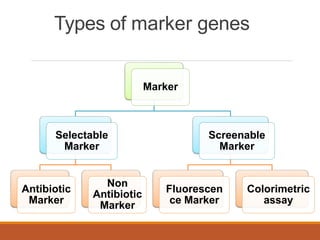
Types of marker genes
Marker
Selectable
Marker
Antibiotic
Marker
Non
Antibiotic
Marker
Screenable
Marker
Fluorescen
ce Marker
Colorimetric
assay
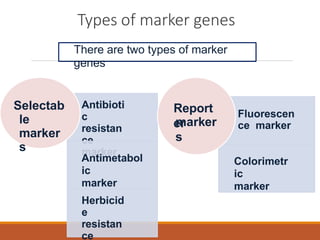
Types of marker genes
There are two types of marker
genes
Antibioti
c
resistan
ce
marker
Antimetabol
ic
marker
Herbicid
e
resistan
ce
Selectab
le
marker
s
Fluorescen
ce marker
Colorimetr
ic
marker
Report
er
marker
s
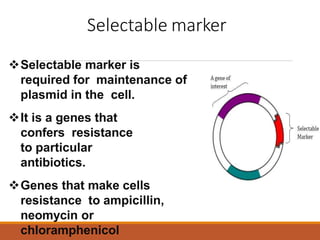
Selectable marker
Selectable marker is
required for maintenance of
plasmid in the cell.
It is a genes that
confers resistance
to particular
antibiotics.
Genes that make cells
resistance to ampicillin,
neomycin or
chloramphenicol
Characters of Selectable Marker
• Protect the organism from a selective
agent that would normally kill it or
prevent its growth.
• Used for killing all cells that donot
contain the foreign DNA.
• Antibiotics are most common selective
marker.
• Non Antibiotics Marker can be 2 types
• Endogenous marker
• Nutritional marker
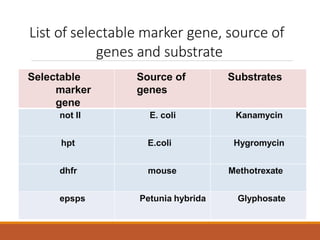
List of selectable marker gene, source of
genes and substrate
Selectable
marker
gene
Source of
genes
Substrates
not II E. coli Kanamycin
hpt E.coli Hygromycin
dhfr mouse Methotrexate
epsps Petunia hybrida Glyphosate
Reporter marker
• Also known as screenable marker.
• A gene used to ‘tag’ another gene or
DNA sequence, such as promoter.
• Encode gene products whose enzyme
activity can easily be assayed.
• It is used as marker to confirm
stable transformation.
Commonly Used Reporter marker
• Three types of Screening marker commonly
used:
• Green Fluorescent Protein (GFP)
– Make cells glow green under UV light.
– A specialized microscope is required to see individual
• cells.
– Commonly used to measure gene expression.
• GUS Assay
– Use of beta-glucourinidase.
Commonly Used Reporter marker
– AN excellent method for detecting a single cell
by
staining it blue.
3. Blue White Screening
– Used in bacteria.
– The lacZ gene makes cells turn blue in special
media, e.g. X-gal
– A colony of cells with the gene can be seen with
the
naked eye.
List of reporter marker gene, source of
genes and detection assay
Reporter marker
gene
Source of
genes
Detection
assay
ocs Agrobacteriu
m
tumefacien
s
Electrophoresis
nos Agrobacteriu
m
tumefacien
s
Electrophoresis
gus E.coli Colorimetric
cat E.coli
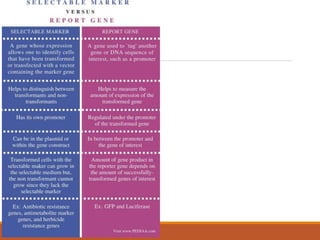
Selectable marker vs Reporter marker
Selectable marker Reporter marker
• A gene whose expression
allows one to identify
cells that have been
transformed or
transfected with a vector
containing the marker
gene
•A gene used to tag
another gene or DNA
sequence
• Helps to distinguish
between transformants
and non- transformants
•Helps to measure the
amount of expression of
transformed gene
• Has its own promoter •Regulated under the
promoter of the transformed
gene
• Ex:Antibiotic resistance
gene,herbicide
•Ex:GFP and Luciferase
1. Constitutive promoters are commonly used type of promoter.
They are capable of expressing linked DNA sequences in all tissues of a
plant throughout normal development.
Monocot promoters- Plant ubiquitin promoter (Ubi), Rice actin 1 promoter
(Act-1), Maize alcoh dehydrogenase 1 promoter (Adh-1).
In addition to promoters obtained from plant genes, there are also promoters
of bacterial and viral origin which have been used to constitutively express
novel sequences in plant tissues.
Examples of such promoters from bacteria include the octopine synthase
(ocs) promoter, the nopaline synthase (nos) promoter and others derived
from native Ti plasmids.
The 35S and 19S promoters of cauliflower mosaic virus are commonly used
examples of viral promoters. Plant pathogen/Dicot promoters- Opine
promoters, CaMV 35S promoter.
Constitutive promoters
Promoters from the nopaline synthase (nos), octopine synthase (ocs) and
mannopine synthase (mas) genes have been isolated and inserted into
transformation vectors upstream of foreign genes to control the expression of
those genes.
Used mainly for transformation of dicotyledonous (dicot) plants. Nos,
ocs, mas are compact promoters less than 400bp long.
Nos is the weakest promoter in this group while ocs and mas are stronger in the
order given.
The nos promoter is highest in older leaves, stem and flowers of
tobacco and is inducible by wound, auxin (Kim et al., 1994).
The CaMV 35S promoter (most widely used)
The 35S promoter is a very strong constitutive promoter, causing high levels of
gene expression in dicot plants.
 it is less effective in monocots, especially in cereals.
the differences in behavior are due to differences in quality
and/or quantity of regulatory factors.
Part of the domain A of the CaMV 35S promoter, which contains the TATA box
and extends from the -90 position to the transcription start site +1, is used as a
"minimal promoter."
Apart from the TATA box, which is the binding site for RNA polymerase II, the
region contains a least three CAAT-like boxes. These sequences potentiate the
activity of upstream sequences and influence the efficiency of the promoter activity.
Minimal promoter does not drive the expression of a gene by itself.
2.Tissue-specific promoters are those promoters that are capable of selectively
expressing heterologous DNA sequences in certain plant tissues. Eg., anther
specific promoter for induction of male sterility, LEA protein promoters for gene
expression during embryonic development.
Fruit-specific promoter –
promoter region from the ethylene regulated genes E4 and E8 and from the
fruit-specific polygalacturonase gene have been used to direct fruit specific
expression of a heterologous DNA sequence in transgenic tomato plants.
It is preferable to use promoters from homologous or closely related plant
species to achieve efficient and reliable expression of transgenes in particular
tissues.
Root specific promoters-
have been of particular use in engineering resistance to nematodes and
improving plant tolerance to environmently stressfull conditions such as water,
salt and heavy metals.
In an attempt to engineer resistance to the parasite in transgenic tomato plants,
the root specific promoters (tob) was used to direct the expression of the
sarcotoxin IA (Radi et al.,2006).
Result: sarcotoxin IA gene was selectively toxic to the parasite and
non-toxic to the plant.
Seed Specific Promoters-
The majority of available seed specific promoters originate from seed storage
proteins (SSPs) such as rice glutelin & globulin, soybean lectin & β-
phaseolin, Brassica napin, Maize zein.
The genes that encode for the prolamin storage proteins are an ideal source for
the isolation of seed specific promoters as these proteins are exclusively
synthesized in the endosperm & are expressed at high levels during seed
development in most cereals.
A very popular way to regulate the amount and the timing of protein expression is
to use an inducible promoter.
An inducible promoter is not always active the way constitutive promoters
are (e.g. viral promoters).
Their performance is not conditioned to endogenous factors but to environmental
conditions and external stimuli that can be artificially controlled.
Some inducible promoters are activated by physical means such as the heat shock
promoter. Others are activated by chemical such as Tetracycline (Tet).
Chemically-regulated promoters-
Promoters whose transcriptional activity is regulated by the presence or absence of
alcohol, tetracycline, steroids, metal and other compounds.
INDUCIBLE PROMOTER
4. Synthetic promoters-
Among the elements of promoter are the TATA box, the transcription start site and
the CCAAT consensus sequence, which are required for accurate transcription.
From the sequences of these elements in diverse organisms, it is possible to
synthesize consensus sequences that may work across different organisms and
are not necessarily derived from a particular organism.
For example: the synthetic promoters from Pioneer Hi-Bred's inventions
contain: a TATA motif; a GC-rich region (at least 64% GC); and a transcription start
site.
The GC-rich region located between the TATA motif and the transcription start site
in plant promoters acts as a very strong inducer of constitutive expression. It
increases transcriptional activation efficiency.
Plant-expressible promoters contain a region of about 40% GC, while a 64% or
greater GC content is characteristic of animal promoters. The maize ubiquitin 1
gene (Ubi-1) promoter, which produces high levels of activity in monocots, has a
GC content of 64%.
Examples of Promoters
Promoter origin expression Induced/upre
-gulated by
Heterologo
us system
reference
Glutelin
(Gt3)
Oryza Endosperm Flowering Nicotiana Russell and
sativa tabacum Fromm
(1997)
Chalcone Phaseolus Root epical Stress Nicotiana Schmid et al.
synthase vulgaris meristem, petal tabacum (1990)
(CHS8) epidermis,
cotyledons,
primary leaves
Patatin Solanum Tuber Sucrose Not Grierson et
tuberosum determined al. (1994)
Heat shock Helianthus Vegetative Heat shock Not Coca et al.
protein 17.7 annus tissues determined (1996)
G4
Sc Sugarcane Constitutive Not Several Schenk et al.
bacilliform determined monocot and (2001)
badnaviru
s
dicot
species
Markers - Transgenics.pptx

Markers - Transgenics.pptx

  • 1.
    Characters of MarkerGene • Represent genetic differences between individual organisms or species. • Do not represent the target gene themselves but act as signs or flag. • Do not affect the phenotype of the desired genes. • Occupy specific genomic positions within chromosomes.
  • 2.
    Types of markergenes Marker Selectable Marker Antibiotic Marker Non Antibiotic Marker Screenable Marker Fluorescen ce Marker Colorimetric assay
  • 3.
    Types of markergenes There are two types of marker genes Antibioti c resistan ce marker Antimetabol ic marker Herbicid e resistan ce Selectab le marker s Fluorescen ce marker Colorimetr ic marker Report er marker s
  • 4.
    Selectable marker Selectable markeris required for maintenance of plasmid in the cell. It is a genes that confers resistance to particular antibiotics. Genes that make cells resistance to ampicillin, neomycin or chloramphenicol
  • 5.
    Characters of SelectableMarker • Protect the organism from a selective agent that would normally kill it or prevent its growth. • Used for killing all cells that donot contain the foreign DNA. • Antibiotics are most common selective marker. • Non Antibiotics Marker can be 2 types • Endogenous marker • Nutritional marker
  • 6.
    List of selectablemarker gene, source of genes and substrate Selectable marker gene Source of genes Substrates not II E. coli Kanamycin hpt E.coli Hygromycin dhfr mouse Methotrexate epsps Petunia hybrida Glyphosate
  • 7.
    Reporter marker • Alsoknown as screenable marker. • A gene used to ‘tag’ another gene or DNA sequence, such as promoter. • Encode gene products whose enzyme activity can easily be assayed. • It is used as marker to confirm stable transformation.
  • 8.
    Commonly Used Reportermarker • Three types of Screening marker commonly used: • Green Fluorescent Protein (GFP) – Make cells glow green under UV light. – A specialized microscope is required to see individual • cells. – Commonly used to measure gene expression. • GUS Assay – Use of beta-glucourinidase.
  • 9.
    Commonly Used Reportermarker – AN excellent method for detecting a single cell by staining it blue. 3. Blue White Screening – Used in bacteria. – The lacZ gene makes cells turn blue in special media, e.g. X-gal – A colony of cells with the gene can be seen with the naked eye.
  • 10.
    List of reportermarker gene, source of genes and detection assay Reporter marker gene Source of genes Detection assay ocs Agrobacteriu m tumefacien s Electrophoresis nos Agrobacteriu m tumefacien s Electrophoresis gus E.coli Colorimetric cat E.coli
  • 11.
    Selectable marker vsReporter marker Selectable marker Reporter marker • A gene whose expression allows one to identify cells that have been transformed or transfected with a vector containing the marker gene •A gene used to tag another gene or DNA sequence • Helps to distinguish between transformants and non- transformants •Helps to measure the amount of expression of transformed gene • Has its own promoter •Regulated under the promoter of the transformed gene • Ex:Antibiotic resistance gene,herbicide •Ex:GFP and Luciferase
  • 15.
    1. Constitutive promotersare commonly used type of promoter. They are capable of expressing linked DNA sequences in all tissues of a plant throughout normal development. Monocot promoters- Plant ubiquitin promoter (Ubi), Rice actin 1 promoter (Act-1), Maize alcoh dehydrogenase 1 promoter (Adh-1). In addition to promoters obtained from plant genes, there are also promoters of bacterial and viral origin which have been used to constitutively express novel sequences in plant tissues. Examples of such promoters from bacteria include the octopine synthase (ocs) promoter, the nopaline synthase (nos) promoter and others derived from native Ti plasmids. The 35S and 19S promoters of cauliflower mosaic virus are commonly used examples of viral promoters. Plant pathogen/Dicot promoters- Opine promoters, CaMV 35S promoter. Constitutive promoters
  • 16.
    Promoters from thenopaline synthase (nos), octopine synthase (ocs) and mannopine synthase (mas) genes have been isolated and inserted into transformation vectors upstream of foreign genes to control the expression of those genes. Used mainly for transformation of dicotyledonous (dicot) plants. Nos, ocs, mas are compact promoters less than 400bp long. Nos is the weakest promoter in this group while ocs and mas are stronger in the order given. The nos promoter is highest in older leaves, stem and flowers of tobacco and is inducible by wound, auxin (Kim et al., 1994).
  • 17.
    The CaMV 35Spromoter (most widely used) The 35S promoter is a very strong constitutive promoter, causing high levels of gene expression in dicot plants.  it is less effective in monocots, especially in cereals. the differences in behavior are due to differences in quality and/or quantity of regulatory factors. Part of the domain A of the CaMV 35S promoter, which contains the TATA box and extends from the -90 position to the transcription start site +1, is used as a "minimal promoter." Apart from the TATA box, which is the binding site for RNA polymerase II, the region contains a least three CAAT-like boxes. These sequences potentiate the activity of upstream sequences and influence the efficiency of the promoter activity. Minimal promoter does not drive the expression of a gene by itself.
  • 18.
    2.Tissue-specific promoters arethose promoters that are capable of selectively expressing heterologous DNA sequences in certain plant tissues. Eg., anther specific promoter for induction of male sterility, LEA protein promoters for gene expression during embryonic development. Fruit-specific promoter – promoter region from the ethylene regulated genes E4 and E8 and from the fruit-specific polygalacturonase gene have been used to direct fruit specific expression of a heterologous DNA sequence in transgenic tomato plants. It is preferable to use promoters from homologous or closely related plant species to achieve efficient and reliable expression of transgenes in particular tissues. Root specific promoters- have been of particular use in engineering resistance to nematodes and improving plant tolerance to environmently stressfull conditions such as water, salt and heavy metals.
  • 19.
    In an attemptto engineer resistance to the parasite in transgenic tomato plants, the root specific promoters (tob) was used to direct the expression of the sarcotoxin IA (Radi et al.,2006). Result: sarcotoxin IA gene was selectively toxic to the parasite and non-toxic to the plant. Seed Specific Promoters- The majority of available seed specific promoters originate from seed storage proteins (SSPs) such as rice glutelin & globulin, soybean lectin & β- phaseolin, Brassica napin, Maize zein. The genes that encode for the prolamin storage proteins are an ideal source for the isolation of seed specific promoters as these proteins are exclusively synthesized in the endosperm & are expressed at high levels during seed development in most cereals.
  • 20.
    A very popularway to regulate the amount and the timing of protein expression is to use an inducible promoter. An inducible promoter is not always active the way constitutive promoters are (e.g. viral promoters). Their performance is not conditioned to endogenous factors but to environmental conditions and external stimuli that can be artificially controlled. Some inducible promoters are activated by physical means such as the heat shock promoter. Others are activated by chemical such as Tetracycline (Tet). Chemically-regulated promoters- Promoters whose transcriptional activity is regulated by the presence or absence of alcohol, tetracycline, steroids, metal and other compounds. INDUCIBLE PROMOTER
  • 21.
    4. Synthetic promoters- Amongthe elements of promoter are the TATA box, the transcription start site and the CCAAT consensus sequence, which are required for accurate transcription. From the sequences of these elements in diverse organisms, it is possible to synthesize consensus sequences that may work across different organisms and are not necessarily derived from a particular organism. For example: the synthetic promoters from Pioneer Hi-Bred's inventions contain: a TATA motif; a GC-rich region (at least 64% GC); and a transcription start site. The GC-rich region located between the TATA motif and the transcription start site in plant promoters acts as a very strong inducer of constitutive expression. It increases transcriptional activation efficiency. Plant-expressible promoters contain a region of about 40% GC, while a 64% or greater GC content is characteristic of animal promoters. The maize ubiquitin 1 gene (Ubi-1) promoter, which produces high levels of activity in monocots, has a GC content of 64%.
  • 22.
    Examples of Promoters Promoterorigin expression Induced/upre -gulated by Heterologo us system reference Glutelin (Gt3) Oryza Endosperm Flowering Nicotiana Russell and sativa tabacum Fromm (1997) Chalcone Phaseolus Root epical Stress Nicotiana Schmid et al. synthase vulgaris meristem, petal tabacum (1990) (CHS8) epidermis, cotyledons, primary leaves Patatin Solanum Tuber Sucrose Not Grierson et tuberosum determined al. (1994) Heat shock Helianthus Vegetative Heat shock Not Coca et al. protein 17.7 annus tissues determined (1996) G4 Sc Sugarcane Constitutive Not Several Schenk et al. bacilliform determined monocot and (2001) badnaviru s dicot species