TRANSPOSONS IN
DROSOPHILA
Jaserah Syed
MSc II
INTRODUCTION
 Transposable elements (TEs), also known as "jumping genes" or transposons, are sequences of DNA
that move (or jump) from one location in the genome to another.
 Maize geneticist Barbara McClintock discovered TEs in the 1940s, and for decades thereafter, most
scientists dismissed transposons as useless or "junk" DNA. McClintock, however, was among the first
researchers to suggest that these mysterious mobile elements of the genome might play some kind of
regulatory role, determining which genes are turned on and when this activation takes place
(McClintock, 1965).
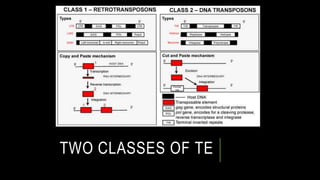
 Class 1 elements, also known as Retrotransposons, mobilize through a ‘copy-and-paste’ mechanism
whereby a RNA intermediate is reverse-transcribed into a cDNA copy that is integrated elsewhere in
the genome. For long terminal repeat (LTR) retrotransposons, integration occurs by means of a
cleavage and strand-transfer reaction catalyzed by an integrase much like retroviruses. For non-LTR
retrotransposons, which include both long and short interspersed nuclear elements (LINEs and SINEs),
chromosomal integration is coupled to the reverse transcription through a process referred to as
target-primed reverse transcription.
 Class 2 elements, also known as DNA transposons, are mobilized via a DNA intermediate, either
directly through a ‘cut-and-paste’ mechanism or, in the case of Helitrons, a ‘peel-and-paste’
replicative mechanism involving a circular DNA intermediate
TWO CLASSES OF TE
P ELEMENTS IN DROSOPHILA
 P transposable elements are one of the best-studied eukaryotic mobile DNA elements in
metazoans. These elements were initially discovered in the late 1960's because they cause
a syndrome of genetic traits termed hybrid dysgenesis.
 P elements belong to Class II transposable elements. They are DNA transposons.
 P elements have a characteristic 31bp inverted repeat at both ends of the element.
 P elements can be either full length or short length. The full length P elements are about
2.9kb long and have four open reading frames. The shorter P elements have fewer open
reading frames and are unable to transpose on their own.
 A Drosophila P strain contains 30-50 copies of the P element. A Drosophila M strain
does not contain any copies of the P element.
 Activation of the transposase is only possible in germline cells but transcription
occurs in germline and somatic cells.
STRUCTURE OF P
ELEMENT
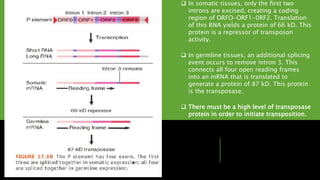
 In somatic tissues, only the first two
introns are excised, creating a coding
region of ORFO-ORF1-0RF2. Translation
of this RNA yields a protein of 66 kD. This
protein is a repressor of transposon
activity.
 In germline tissues, an additional splicing
event occurs to remove intron 3. This
connects all four open reading frames
into an mRNA that is translated to
generate a protein of 87 kD. This protein
is the transposase.
 There must be a high level of transposase
protein in order to initiate transposition.
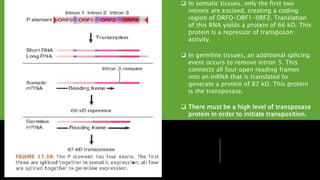
 In somatic tissues, only the first two
introns are excised, creating a coding
region of ORFO-ORF1-0RF2. Translation
of this RNA yields a protein of 66 kD. This
protein is a repressor of transposon
activity.
 In germline tissues, an additional splicing
event occurs to remove intron 3. This
connects all four open reading frames
into an mRNA that is translated to
generate a protein of 87 kD. This protein
is the transposase.
 There must be a high level of transposase
protein in order to initiate transposition.
WHY SPLICING OF INTRON 3 IS
NEEDED?
Two types of experiments have demonstrated that splicing of the third intron is
needed
for transposition -
 First, if the splicing junctions are mutated in vitro and the P element is reintroduced
into flies, its transposition activity is abolished.
 Second, if the third intron is deleted, so that ORF3 is constitutively included in the
mRNA in all tissues, transposition occurs in somatic tissues as well as the germline.
Thus, whenever ORF3 is spliced to the preceding reading frame, the P element
becomes active.
 Somatic cells contain a protein that binds to sequences in Exon 3 to prevent
splicing of last Intron.
 The splicing of intron 3 occurs in germline cells as they lack the protein.
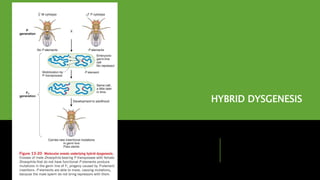
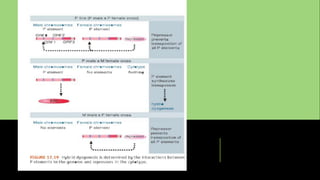
HYBRID DYSGENESIS
 Hybrid Dysgenesis- a phenomenon that occurs when a M strain female is mated with a P
strain male.
 Certain strains of D. melanogaster encounter difficulties in interbreeding. When flies from
two of these strains are crossed, the progeny display "dysgenic traits"-a series of defects
including mutations, chromosomal aberrations, distorted segregation at meiosis, and
reduced fertility. The appearance of these correlated defects is called hybrid dysgenesis.
 Dysgenesis is principally a phenomenon of the germ cells.
 Any one of the chromosomes of a P male can induce dysgenesis in a cross with an M
female. The construction of recombinant chromosomes shows that several regions within
each P duomosome are able to cause dysgenesis. This suggests that a P male has
sequences at many different chromosomal locations that caninduce dysgenesis. The
locations differ between individual P strains.
 The P-specific sequences are absent from chromosomes of M flies.
HYBRID DYSGENESIS
REFRENCES
 https://youtu.be/xLhOElLufIU
 https://youtu.be/vSgUaLDa0n8
 Adams, Melissa D., Rosa S. Tarng, and Donald C. Rio. "The alternative splicing
factor PSI regulates P-element third intron splicing in vivo." Genes & Development
11.1 (1997): 129-138.
 Lewin (9th edition)
 An Introduction To Genetic Analysis (8th edition) by Anthony J. Griffith
Transposons in drosophila - P element

Transposons in drosophila - P element

  • 1.
  • 2.
    INTRODUCTION  Transposable elements(TEs), also known as "jumping genes" or transposons, are sequences of DNA that move (or jump) from one location in the genome to another.  Maize geneticist Barbara McClintock discovered TEs in the 1940s, and for decades thereafter, most scientists dismissed transposons as useless or "junk" DNA. McClintock, however, was among the first researchers to suggest that these mysterious mobile elements of the genome might play some kind of regulatory role, determining which genes are turned on and when this activation takes place (McClintock, 1965).  Class 1 elements, also known as Retrotransposons, mobilize through a ‘copy-and-paste’ mechanism whereby a RNA intermediate is reverse-transcribed into a cDNA copy that is integrated elsewhere in the genome. For long terminal repeat (LTR) retrotransposons, integration occurs by means of a cleavage and strand-transfer reaction catalyzed by an integrase much like retroviruses. For non-LTR retrotransposons, which include both long and short interspersed nuclear elements (LINEs and SINEs), chromosomal integration is coupled to the reverse transcription through a process referred to as target-primed reverse transcription.  Class 2 elements, also known as DNA transposons, are mobilized via a DNA intermediate, either directly through a ‘cut-and-paste’ mechanism or, in the case of Helitrons, a ‘peel-and-paste’ replicative mechanism involving a circular DNA intermediate
  • 3.
  • 4.
    P ELEMENTS INDROSOPHILA  P transposable elements are one of the best-studied eukaryotic mobile DNA elements in metazoans. These elements were initially discovered in the late 1960's because they cause a syndrome of genetic traits termed hybrid dysgenesis.  P elements belong to Class II transposable elements. They are DNA transposons.  P elements have a characteristic 31bp inverted repeat at both ends of the element.  P elements can be either full length or short length. The full length P elements are about 2.9kb long and have four open reading frames. The shorter P elements have fewer open reading frames and are unable to transpose on their own.  A Drosophila P strain contains 30-50 copies of the P element. A Drosophila M strain does not contain any copies of the P element.  Activation of the transposase is only possible in germline cells but transcription occurs in germline and somatic cells.
  • 5.
  • 6.
     In somatictissues, only the first two introns are excised, creating a coding region of ORFO-ORF1-0RF2. Translation of this RNA yields a protein of 66 kD. This protein is a repressor of transposon activity.  In germline tissues, an additional splicing event occurs to remove intron 3. This connects all four open reading frames into an mRNA that is translated to generate a protein of 87 kD. This protein is the transposase.  There must be a high level of transposase protein in order to initiate transposition.
  • 7.
     In somatictissues, only the first two introns are excised, creating a coding region of ORFO-ORF1-0RF2. Translation of this RNA yields a protein of 66 kD. This protein is a repressor of transposon activity.  In germline tissues, an additional splicing event occurs to remove intron 3. This connects all four open reading frames into an mRNA that is translated to generate a protein of 87 kD. This protein is the transposase.  There must be a high level of transposase protein in order to initiate transposition.
  • 8.
    WHY SPLICING OFINTRON 3 IS NEEDED? Two types of experiments have demonstrated that splicing of the third intron is needed for transposition -  First, if the splicing junctions are mutated in vitro and the P element is reintroduced into flies, its transposition activity is abolished.  Second, if the third intron is deleted, so that ORF3 is constitutively included in the mRNA in all tissues, transposition occurs in somatic tissues as well as the germline. Thus, whenever ORF3 is spliced to the preceding reading frame, the P element becomes active.  Somatic cells contain a protein that binds to sequences in Exon 3 to prevent splicing of last Intron.  The splicing of intron 3 occurs in germline cells as they lack the protein.
  • 9.
    HYBRID DYSGENESIS  HybridDysgenesis- a phenomenon that occurs when a M strain female is mated with a P strain male.  Certain strains of D. melanogaster encounter difficulties in interbreeding. When flies from two of these strains are crossed, the progeny display "dysgenic traits"-a series of defects including mutations, chromosomal aberrations, distorted segregation at meiosis, and reduced fertility. The appearance of these correlated defects is called hybrid dysgenesis.  Dysgenesis is principally a phenomenon of the germ cells.  Any one of the chromosomes of a P male can induce dysgenesis in a cross with an M female. The construction of recombinant chromosomes shows that several regions within each P duomosome are able to cause dysgenesis. This suggests that a P male has sequences at many different chromosomal locations that caninduce dysgenesis. The locations differ between individual P strains.  The P-specific sequences are absent from chromosomes of M flies.
  • 10.
  • 13.
    REFRENCES  https://youtu.be/xLhOElLufIU  https://youtu.be/vSgUaLDa0n8 Adams, Melissa D., Rosa S. Tarng, and Donald C. Rio. "The alternative splicing factor PSI regulates P-element third intron splicing in vivo." Genes & Development 11.1 (1997): 129-138.  Lewin (9th edition)  An Introduction To Genetic Analysis (8th edition) by Anthony J. Griffith