2. Chemical Oceanography
Lets take a quiz to see how much you know! http://ga.water.usgs.gov/edu/sc3.html   (1) Water contracts (gets smaller) when it freezes. (2) Water has a high surface tension. (3) Condensation is water coming out of the air. (4) More things can be dissolved in sulfuric acid than in water. (5) Rainwater is the purest form of water. (6) It takes more energy to heat water at room temperature to 212o F than it does to change 212o F water to steam. (7) If you evaporate an 8-inch glass full of water from the Great Salt Lake (with a salinity of about 20% by weight), you will end up with about 1 inch of salt. (8) Sea water is slightly more basic (the pH value is higher) than most natural fresh water. (9) Raindrops are tear-shaped. (10) Water boils quicker at Denver, Co. than at the beach.
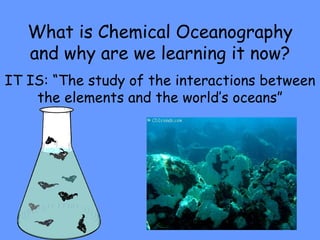
What is Chemical Oceanography and why are we learning it now? IT IS: “The study of the interactions between the elements and the world’s oceans”
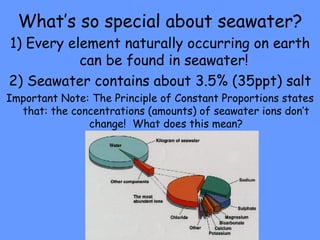
What’s so special about seawater? 1) Every element naturally occurring on earth can be found in seawater!  2) Seawater contains about 3.5% (35ppt) salt Important Note: The Principle of Constant Proportions states that: the concentrations (amounts) of seawater ions don’t change!  What does this mean?
Other Cool Stuff You Should Know About Ocean Water: 3) Water Temperature, Salinity, and Density change with Depth **LOOK OUT!!! Very Important Vocab Below!**
More Important Water Stuff to Consider! Think about what these mean!!! Ask questions!!! 4) Water has a high heat capacity 5) What happens to salinity when ice forms in seawater? How does this affect the density of the seawater? (Great Test Questions!)
Tools Frequently Used For Chemical Oceanography Secchi Disk CTD Rosette Niskin Bottles Hydrometer Refractometer
Secchi Disk Measures turbidity (cloudiness) of the water What can make water turbid? Plankton Sediment Pollution (i.e. sewage)
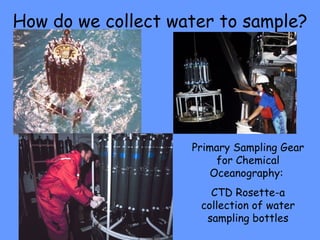
How do we collect water to sample? Primary Sampling Gear for Chemical Oceanography:  CTD Rosette-a collection of water sampling bottles
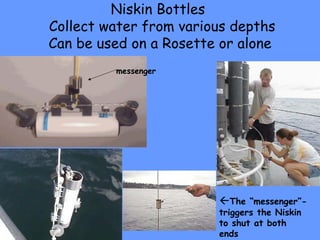
Niskin Bottles    Collect water from various depths Can be used on a Rosette or alone  The “messenger”- triggers the Niskin to shut at both ends messenger
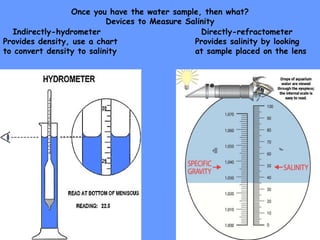
Once you have the water sample, then what? Devices to Measure Salinity Indirectly-hydrometer   Directly-refractometer Provides density, use a chart  Provides salinity by looking to convert density to salinity at sample placed on the lens
What types of problems do chemical oceanographers study? Hypoxia – low DO (dissolved oxygen) **why is this a problem?  Hint:  take a deep breath and think about it! Dead Zones! What does the picture above have to do with the picture to the left?

Marine chemistrynotes1011

  • 1.
  • 2.
    Lets take aquiz to see how much you know! http://ga.water.usgs.gov/edu/sc3.html (1) Water contracts (gets smaller) when it freezes. (2) Water has a high surface tension. (3) Condensation is water coming out of the air. (4) More things can be dissolved in sulfuric acid than in water. (5) Rainwater is the purest form of water. (6) It takes more energy to heat water at room temperature to 212o F than it does to change 212o F water to steam. (7) If you evaporate an 8-inch glass full of water from the Great Salt Lake (with a salinity of about 20% by weight), you will end up with about 1 inch of salt. (8) Sea water is slightly more basic (the pH value is higher) than most natural fresh water. (9) Raindrops are tear-shaped. (10) Water boils quicker at Denver, Co. than at the beach.
  • 3.
    What is ChemicalOceanography and why are we learning it now? IT IS: “The study of the interactions between the elements and the world’s oceans”
  • 4.
    What’s so specialabout seawater? 1) Every element naturally occurring on earth can be found in seawater! 2) Seawater contains about 3.5% (35ppt) salt Important Note: The Principle of Constant Proportions states that: the concentrations (amounts) of seawater ions don’t change! What does this mean?
  • 5.
    Other Cool StuffYou Should Know About Ocean Water: 3) Water Temperature, Salinity, and Density change with Depth **LOOK OUT!!! Very Important Vocab Below!**
  • 6.
    More Important WaterStuff to Consider! Think about what these mean!!! Ask questions!!! 4) Water has a high heat capacity 5) What happens to salinity when ice forms in seawater? How does this affect the density of the seawater? (Great Test Questions!)
  • 7.
    Tools Frequently UsedFor Chemical Oceanography Secchi Disk CTD Rosette Niskin Bottles Hydrometer Refractometer
  • 8.
    Secchi Disk Measuresturbidity (cloudiness) of the water What can make water turbid? Plankton Sediment Pollution (i.e. sewage)
  • 9.
    How do wecollect water to sample? Primary Sampling Gear for Chemical Oceanography: CTD Rosette-a collection of water sampling bottles
  • 10.
    Niskin Bottles Collect water from various depths Can be used on a Rosette or alone  The “messenger”- triggers the Niskin to shut at both ends messenger
  • 11.
    Once you havethe water sample, then what? Devices to Measure Salinity Indirectly-hydrometer Directly-refractometer Provides density, use a chart Provides salinity by looking to convert density to salinity at sample placed on the lens
  • 12.
    What types ofproblems do chemical oceanographers study? Hypoxia – low DO (dissolved oxygen) **why is this a problem? Hint: take a deep breath and think about it! Dead Zones! What does the picture above have to do with the picture to the left?

Editor's Notes